Life With God 3f – I AM The Resurrection

image The I Am statement we immerse ourselves in today comes in response to the sorrow surrounding the death of Lazarus. The Lord has purposely waited until His friend had died and begun to molder in a tomb and He arrives in Bethany during the period of deep mourning. Does Martha accuse Jesus when she meets Him saying if He had been here Lazarus would still be alive? Perhaps not angrily but it could have been a question that had swirled between Martha and Mary’s lips for the preceding four days. We ask it ourselves from time to time; where were you God when this or that was happening to me? You could have prevented it or guided me away or, or …

Notice that the Lord does not rebuke  her for her challenge. Isn’t it good to know that God knows us well enough to not take offense at our outbursts? He knows the limitations of our hearts and our understanding. God knows that we can intellectually assent to the idea spoken through Isaiah, ‘my thoughts are not your thoughts’ but in our hearts we push this aside and reveal our innermost anger and hurts. In love, the Lord listens and is compassionate. Like Martha, we can pull out our intellectual reserve and repeat it when questioned theologically during our grief: ‘yes Lord, everything will be well at some point.’ But what about now we wonder, can you help me now?

Jesus said to here, “I am the resurrection and the life. He who believes in me will live, even though he dies; and whoever lives and believes in me will never dies. Do you believe this? " John 11:18

Do you believe this beyond the intellectual point? Immersing ourselves in this I Am brings us to a different point of confidence in this life. We no longer have to simply look ahead to the new life, we have it now in full and we have nothing to fear. Though we may die, we will not die! Making this a part of who we are leads us to follow Martha and Peter in exclaiming ‘Yes Lord, I believe that you are the Christ, the Son of God’ and then living as though we believe it.

Life With God 3e – I AM The Way and the Truth and the Life

Thomas said to him, “Lord, we don’t know where you are going, so how can we know the way?”

Jesus answered, “I am the way and the truth and the life.”    John 14:5-6

Nearly every Christian will have interacted with this passage on some level by the time this is written. What more can be said about this most definitive statement? The complete theology of the book of John is summarized in 14:6 where it serves also to challenge the modern feel-good canard of ‘many paths to God.’ Less discussed is the context of the farewell discourse and, in particular here, the continued lack of understanding that the disciples displayed. These were the men closest to Him, to whom Jesus had shared the greatest intimacy and still they failed to comprehend the trajectory of the Savior’s life as it hurtled toward the cross.

In many ways, our spiritual formation is challenged in the same fashion. We know Jesus intellectually and have the benefit of knowing the full story and yet, it can sometimes be said that we don’t know Him. As we meditate deeply on the details of Jesus, we are seeing the Truth, the ultimate revelation of God, in a form which we can relate to. Transformation comes in challenging our own flawed character to the Truth that we encounter. Christians are privileged in having the indwelling Spirit to leads us in the Life but we must encounter Him beyond the intellectual level. Perhaps the first step is to admit ‘we don’t know where you’re going’ and then follow Him anyway despite our urge to do the opposite.

Life With God 3d – I AM The Gate

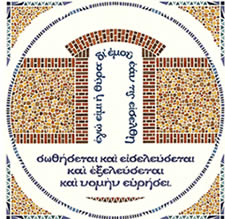
I am the gate for the sheep…I am the gate; whoever enters through me will be saved. He will come in and go out, and find pasture. The thief comes only to steal and kill and destroy; I have come that they may have life, and have it to the full. John 7, 9-10

imageAs we meditate on the Shepherd who will lay down his life for His sheep, these leading verses take on a new emphasis. Describing himself as the gate for the sheep would have painted a much more vivid picture to the first century hearers. A sheepfold might be built without a door or gate, requiring some manner of obstacle placed across the opening to protect the sheep within, both from enemies coming in from the outside and from the tendency of the sheep to wander out from the inside. The shepherd willingly lay across that opening in the dark to protect the sheep within, whether they appreciate it or not.

Are we like the sheep, unappreciative of the sacrifice The Gate? Do we see His presence blocking our path as a hindrance? As we think about how positively we view his willingness as the shepherd to lay down his life for us, we should also view his willingness to ‘pen’ us in when necessary so that we are protected from things that we are unable to see. In the presence of the Good Shepherd, we truly can ‘let not our hearts be troubled.’

Life With God 3c – I AM The Good Shepherd

I am the good shepherd. The good shepherd lays down his life for the sheep. John 10:11

image

We can meditate a good long time on this verse. It strikes our hearts on numerous levels but I’d like to narrow this discussion down to those who have a pastoral calling. If we are following closely in our Master’s footsteps, our call also may be to lay down our lives for the sheep entrusted to us. The wolves can attack at any moment and our calling requires us to be a bulwark. Is your heart being shaped such that you can do this without hesitation?

Can you do it when you sense that not all of the sheep appreciate your willingness to do so? Will your heart be turned to a greater flock if your celebrity grows, taking your protective eye off of those whom God has placed under your care? Can you recover if the wolf somehow infiltrates your flock and scatters them despite your earnest intentions?

It’s one thing to say that you are prepared to do so, yet another to actually do it. We must be certain that our public and private heart are one and the same.

Life With God 3b – I AM The Light of the World

I am the light of the world. Whoever follows me will never walk in darkness, but will have the light of life. (John 8:12)

image

The second I AM statement that deepens our faith is this; Jesus is the illuminator of the darkness. Though we are born into a darkened world in which it is difficult to find our way, we have available to us a source of light that can never be extinguished. We no longer need to stumble.

Once we immerse ourselves in the light, we find it more and more difficult to step back into the darkness. It beckons us and we’re tempted to return to the shadows but the Spirit exerts a greater attraction as our character is molded. Even in those instances when dark overcomes us, the Savior will reach without fear into the shadows to pull His brothers and sisters back.

Life With God 3a – I AM The Bread of Life

image The ‘I Am’ passages in the book of John are good immersion points on which to meditate in seeking spiritual transformation. In these statements Jesus declares himself to us, encouraging and deepening our faith and our enhancing our ability to trust Him on a more mature basis. We become what we immerse ourselves in. The first is found in John 6:35;

“I am the bread of life. He who comes to me will never go hungry, and he who believes in me will never be thirsty.”

When we meditate on this verse in a non-theological sense, we hear the Lord speak and the Spirit move. We question the things that we pursue in life that sate only temporarily. We find nothing in our pursuit of food, sex, material things, feelings or challenges that results in anything but a momentary satisfaction that is soon followed by a desire to pursue more. Spiritual fulfillment replaces or subdues these fleeting desires with a permanent fulfillment. For sure, we will want more in the sense of going deeper but we will never hunger to fill the void in our souls that can only be filled by the Holy Spirit. 

Christians and Pacifism

The church is the spiritual, social, and political body that gives its allegiance to God alone. As citizens of God’s kingdom, we trust in the power of God’s love for our defense. The church knows no geographical boundaries and needs no violence for its protection…As disciples of Christ, we do not prepare for war, or participate in war or military service. The same Spirit that empowered Jesus also empowers us to love enemies, to forgive rather than to seek revenge, to practice right relationships, to rely on the community of faith to settle disputes, and to resist evil without violence. “Confession of Faith in a Mennonite Perspective”

The Anabaptist tradition within the larger Church is perhaps the most well-known body of pacifist believers, though the practice is not confined to these Christians. Pacifism, the refusal to engage in military action or violence in revenge or defense, is a radical practice. In the larger world of non-believers, Just War, and increasing violence, the refusal to visit violence on those labeled ‘enemies’ immediately sets one apart from the society norm and expectation. The radicalism extends to our physiological makeup; when we are about to become the victim of a violent act our body and mind naturally seek to act in self-preservation, even to point of exterminating the threat. The Christian who follows the path of pacifist action must strongly apply their allegiance to Christ alone at the expense of their citizenship in the state and more importantly, they must train their mind and body to submit to the suppression of its natural response to react to violence. Dr. Buschart records,

“Anabaptists were the most violently persecuted Christian movement of the sixteenth century, being pursued by both Roman Catholic and Protestant forces, in conjunction with civil authorities. Consequently, Anabaptists were were confronted by the demand to practice in the most radical ways this practice of nonresistance, and many practiced the principle to the point of suffering a martyr’s death.” Exploring Protestant Traditions

The source of the practice of Christian pacifism is deeply rooted in the Gospel. From the mountainside, Jesus said in contrasting the old and new ways  “You have heard that it was said, ‘Eye for eye, and tooth for tooth.’ But I tell you, Do not resist and evil person. If someone strikes you on the right cheek, turn to him the other also.” (Mt 5:38-39) Later in the garden he  cautioned Peter “Put your sword back in its place, Jesus said to him, for all who draw the sword will die by the sword.” (Mt 26:52). The Old Testament, often derided as being blood-soaked and hyper-violent, is not neglected either. Micah speaks eschatologically, pointing us forward to the era of the Christ  when he says “They will beat their swords into plowshares and their spears into pruning hooks. Naiton will not take up sword against nation, nor will they train for war anymore.” (Micah 4:3)

Over and above the words of Jesus, the pacifist follower will point to the life of the Lord as being completely non-resistant and peace seeking in His lifestyle. With Christ as our center and our revelation, believers are to develop their ethics, morality, and behavior from His example and teaching. These will often run counter to the demands of the state but we are called to be theological thinkers, examining the decisions that we must make in the light of our higher priority membership in the kingdom of Christ. It is to this that our primary allegiance is required teach the pacifists.

The early Church is historically pacifist and there is scant, if any, evidence of early Christians engaging in warfare. There was a gradual acceptance of military service through the centuries with noted objectors – such as the Anabaptist movement – here and there through the records. In our modern era we see the pacifism practiced in Martin Luther King who confronted the violence he encountered with an equally vehement non-resistance. King worked from five principles which fit human bio-social understandings effectively into the notion of Christian pacifism:

  1. Nonviolent resistance is not for cowards as it requires more strength to stand without retaliation.
  2. The non-violent resistance is not intended to humiliate the attacker but to establish love and understanding.
  3. Non-violent resistance is focused on evil, not the people performing the evil act
  4. You must be willing to suffer without retaliation.
  5. The external lack of violence is to be matched with an internal peace.

John Howard Yoder has a prodigious body of work that is rooted in this ideal. He says that we cannot kill other people for whom Christ died. We are to live the first commandment of the Lord, to love Him with heart, mind, and soul and to love our neighbor in the same way. Violence toward them for any reason is seen as contrary to this command.

Despite its inherent attractiveness, pacifism is not without its critics. Some say it is unrealistic in today’s world or that Christ’s words were hyperbole and not meant to be directly applied in this case. Theologians examine the word of Jesus in the light of Paul’s later commands that we be good citizens of the state in Romans 13, going so far as to see this as allowing military service as a part of this obedience. Another argument against the pacifist system is that our own non-violent capitulation may expose us and our neighbors to a greater violence. In this position, our refusal to act does not demonstrate an effective love for neighbor by the absence of our protection. In other words, Justice cannot be restored without the Christian’s action and ethics.

“Again, Jesus said, “Peace be with you! As the Father has sent me, I am sending you.”  John 20:21

Ultimate Fighting Jesus

Once again, the inimitable Dr. Groothuis leads us through an examination of one the movements afoot within Christendom: Jesus for Men. This vision of the Lord is meant to counteract the supposed feminization of the Church which is turning men away. He is attractive to men, not because of holiness but because of His brawn. Read the piece here. 

Advent: Happy, Happy, Joy, Joy

Many folks use happiness and joy synonymously, especially this time of year, but there is a world of difference between the two. Happiness is more often than not circumstantial, that is, it is dependent upon your current situation. There are times when we are happy and times when we are obviously unhappy. Happiness is dependent on things that can be out of our control and so, as I drive this morning, I may be happy when all the lights are green or a bit unhappy when all the folks on their way to the airport slow the flow of traffic down. Happiness is fleeting.

Joy, on the other hand, is an internal condition that is wholly within you. It is not connected to the ups and downs of daily life nor is it dependent on circumstances out of your control. As we say earlier this week, Jesus points to something that lives within us as the source and meaning of our joy…

“As the Father has loved me, so have I loved you. Now remain in my love. If you obey my commands, you will remain in my love, just as I have obeyed my Father’s commands and remain in his love.  I have told you this so that my joy may be in you and that your joy may be complete. (John 15:9-11)

The true joy of the Advent season is knowing the King. Our joy as followers of Christ is rooted in relationship with Jesus and the security that this communion brings. Unlike happiness, this joy is not affected by our external circumstance. We, like Paul, learn to be content in all circumstances knowing that our greatest reward still lies ahead.

Maranatha!