The Price of Pacifism

Is pacifism a luxury belief?

Pacifism is not a philosophy defined by a single belief. It encompasses a range of positions regarding nonviolence in the face of aggression. Pacifism is a costly position. The reality of violence will demand a costly response, ranging from complete surrender on principle to the use of overwhelming force in defense. The cost of holding a pacifist position requires consideration, as these costs cannot be avoided or dismissed. Pacifism for one comes at the expense of another who will use force in defense of the right to hold that ideal. Philosophy like this is very costly.

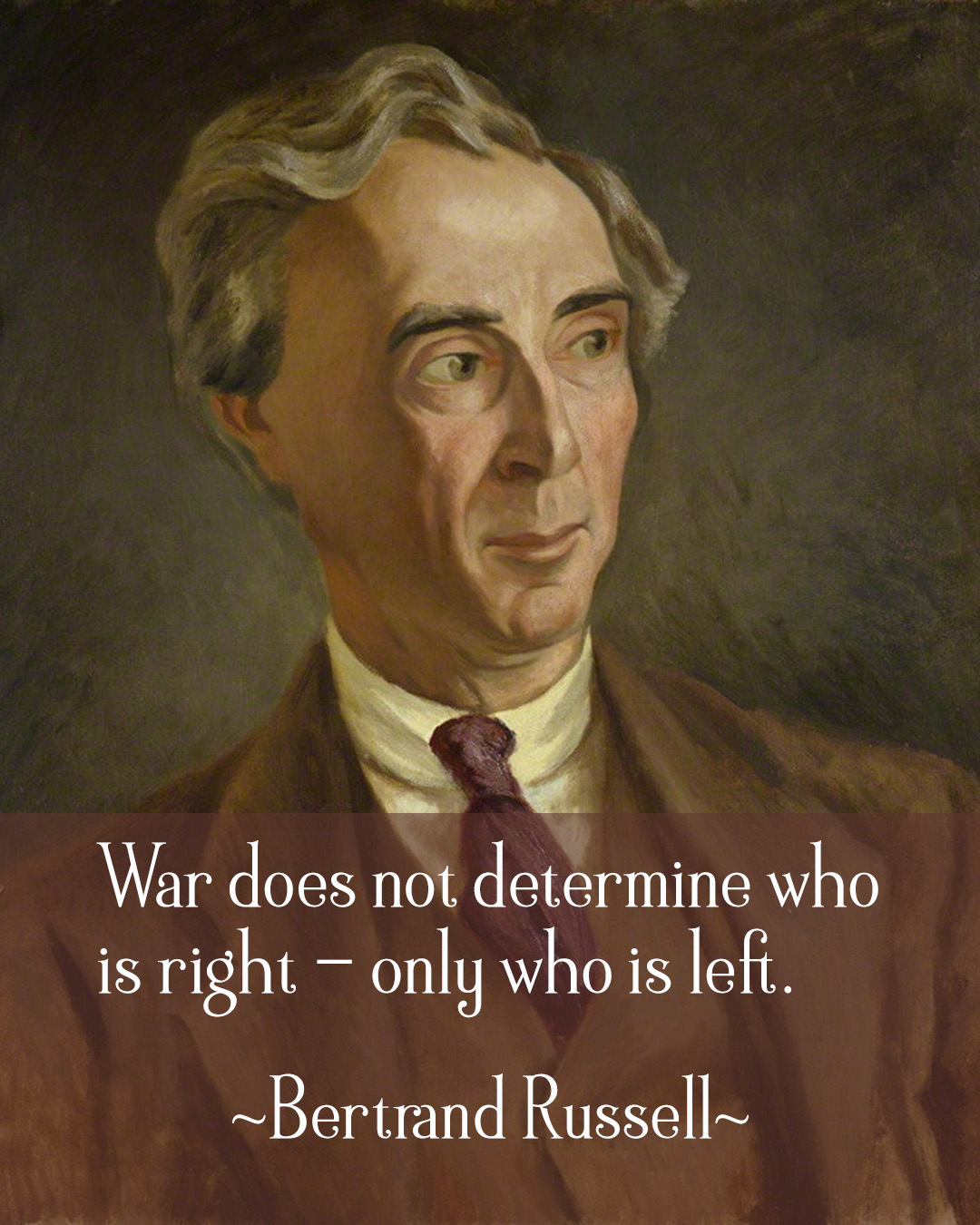
Twentieth-century philosopher Bertrand Russell was a pacifist. He summarized his position by saying that “[T]here is almost always a way, though sometimes a much slower way, of doing things without violence.” Russell invited people to view war with the same revulsion that they view the murder of an individual, and he sought widespread adoption of his idealism from the supposed safety of the academy. His ethic, developed through a mindset of consequentialism [1], set the foundation for his nonviolence ethic. The calculus for arriving at this moral position was binary for him: he believed that war is always bad and produces no good outcome; therefore, we must avoid it at all costs. For Russell, pacifism was not a passive moral position. He lived out his beliefs as he stood in active opposition to World War I, writing for pacifist publications, protesting the government’s conscription of young men, and advocating for many to adopt the mantle of conscientious objectors. The exercise of his principles was costly. Russell lost his university position and was later jailed by the British government for his attacks on their foreign policies. Russell paid an extraordinary price to remain true to his position of nonviolence.

With a historical event like either of the World Wars, we can perform a thought exercise involving the adoption of nonviolence as a system of political belief. Suppose Russell were successful in persuading the Crown and the entirety of the British Empire to adopt pacifism. Would nonviolence have persuaded the German coalition to drop their weapons as they examined the consequential outcomes of the war for themselves? This simple case study points to the multifaceted nature of examining pacifism. In its most straightforward application, pacifism is the belief that war or any kind of violence is not to be used to resolve conflicts. This is a good and admirable, even desirable, position if it can be a principle that avoides fighting. To stand in an extreme position on refusing to meet violence with violence, an individual must be prepared to give their life as the cost of their stand. Pacifism on the national level requires a second consideration. If, like Russell, an individual will pay any societal cost for adopting this position, then it is a noble stand and one’s life can be arranged in such a way as to adhere to it. The cost of adopting pacifism as a political philosophy that governs a nation containing several million individuals becomes much more costly in a world filled with potential aggressors who do not share the same belief. The cost of extinction by their violence is not a price all will be willing to pay, nor should they be expected to.

Over time, Bertrand Russell changed positions on his commitment to nonviolence. The philosophy of pacifism has a history of evolving as it collides with reality. Nonviolence is not a monolith but a graduated spectrum of degrees of absolutism. Russell’s initial position was ‘absolute nonviolence.’ This was characterized by the belief that all violence of any degree was always morally wrong. The absolutist position would maintain that even in situations of self-defense or protection against a greater evil, violence is not to be used. The cost of adopting this position on the nonviolence spectrum is quite high unless every other human and human institution adopts the same position. (This question of absolute non-violence is examined further in the next essay about Christian Pacifism and the command to “turn the other cheek.”) Shortly after the initiation of World War II, Russell’s view of pacifism changed from an absolute position to what he referred to as ‘relative political pacifism.’ It is notable that here again, consequentialist reasoning moderates his position. Russell continues to believe that war is always evil, but faced with the violence of war, engaging the enemy might be the lesser evil in contrast to the aggression. In a calculation of cost/benefit, the price of nonviolence in the face of aggression and the potential loss of national sovereignty from an invasion of his home, Russell judged the evil of aggression to be greater than the evil of fighting back and stepped back from the extreme position.

Approaching a discussion of nonviolence requires the consideration of multiple arguments. A central consideration in the adoption of pacifism is how to address the prevalence of violence in the world. Its existence contributes to the evaluation that the price I, as an individual, will absorb is not the same cost that a country must pay to hold the same national belief. A commitment to absolute nonviolence on a nationwide scale demands the agreement of every citizen, each of them clear as to the existential cost of not taking up arms. Should one citizen demur, it would be a dereliction of the social pact to leave them unprotected from violence.

Personal pacifism is noble, and commitment to absolute nonviolence is commendable, but the cost of holding this position is often repressed. If I have the freedom to commit to nonviolence because the nation I live in has a strong military force to protect me from aggression, the cost to me is low. But that cost, however, transfers to those who take part in the defense. Pacifism is a luxury belief in that I can transfer the cost to others. Consider the same scenario borne out on a local level. Nonviolence can be my default when I live behind the walls of a gated community with a strong police force to enforce my separation. Can my neighbors in every part of the community have the same opportunity to exercise their commitment to nonviolence?

A pacifist may object to the theme of this essay on the grounds that it misunderstands or misstates the moral force of their philosophical position. As Russell discovered in his move from an absolute to a more relative position, the principles are challenging to implement. This is partly because pacifists claim that they are not arguing that nonviolence is safe nor free of cost. Their central principle is philosophical rather than practical: participation in violence is morally abhorrent and corrupts the individual or state, even in situations where it appears unavoidable. The arguments surrounding the cost transfer are also nuanced. The pacifist may be fully prepared to surrender their life or freedom rather than abandon the principle of nonviolence. Labeling pacifism as a luxury belief cannot be one-sided. It must take this individual into account.


Pacifism may rightly be viewed as a luxury belief secured by those willing to rise in defense of one who insists on total nonviolence. Until the world is at peace and every human being makes a similar pact of nonviolence toward others, the need for security will demand at least some citizens be willing to fight. The range of pacifist positions, moving from absolute nonviolence to the recognition that sometimes violence is thrust upon us, is a spectrum of philosophical ideals that are worth examining. Nonviolence is an excellent position, but it is a costly one.

Notes

  1. Consequentialism is a philosophical view that the moral rightness of any action can be determined by the consequences of that action. If the action produces an overall good, then it is a morally right choice. The opposite is then also true: negative results make an action morally wrong. The most apparent challenge in this philosophical exercise is the determination of ‘good.’

Christians and Nonresistance

Many times in the discussion of Christians and their attitudes toward war, nonresistance and pacifism get tumbled together as a single doctrine without distinction. In fact, nonresistance has numerous facets which make it unique from the doctrines of pacifism. Nonresistance appears to take a broader view of one’s responsibility as a citizen of a country and of the kingdom when it states that Christians should strive to avoid conflict as a daily practice but may, in times of war, serve their fellow citizens through military service in a noncombatant role. Matthew 5:39 gives the doctrine its name;

But I tell you, Do not resist an evil person. If someone strikes you on the right cheek, turn to him the other also.

This verse can lead a reader astray into thinking that the Lord has called His followers into a passivity in the face of evil but there is much nuance that confers a more positive and active sense to the command. The Christian’s initial order of business upon regeneration is to begin the process of separating him/herself from the world and its ways, including the common use of force to accomplish the objectives of living. The Christian also begins to develop an awareness that they are citizens now of a different kingdom of a higher order while being sojourners in the world. Behavioral expectations come from the former to be practiced in the latter.

Jesus said, “My kingdom is not of this world. If it were, my servants would fight to prevent my arrest by the Jews. But now my kingdom is from another place.”

While we sojourn here in this world, the Lord does not however command us to disengage from it. On the contrary, we are obligated to use spiritual means to bring blessing and do good for others (Rom 12:17-21). This said, the most crucial component of the new thinking of a regenerate person is to be directed toward the recognition of a new citizenship and the outward display of that privilege. Through the differences that are to be noted in Christian behavior, an evangelistic awareness is created among non-Christians, attracting some back to the Cross. They are at the center of God’s will and demonstrate their full faith in such. Some may have to pay with their lives for the privilege of following the Lord while others may be rescued by supernatural means. In either case, the testimony that remains will bear witness to greatness of God.

The distinction between nonresistance and pacifism comes in the interpretation of a couple of points. The first is the separation of the Church from the state. The commands of the Bible are written to the regenerate believers who, through their belief, obligate themselves to following and applying these commands. The pacifist will say that because violence is prohibited for the Christian, it is therefore prohibited for the government as well. Second, while Christians are citizens of God’s kingdom and look forward to eschatological restoration of that kingdom again on earth, they retain a responsibility to the state in which they live. The citizen must meet their obligations to support the state (Rom 12:1-7) (except as armed combatants) trusting that the end of the age will come at its appropriate time and usher in the new. This important distinction allows the nonresistant Christian to serve their government in non-combative roles for the common good.

The unbelieving world gives no credence to the doctrine of nonresistance because it is so contrary to the thinking and practice of the unregenerate. It appears that many fellow Christians also share this disdain of Christians who seek to follow the path of nonresistance. Those against the doctrine posit three objections against it. First, they point to Israel as a warring state as recorded in the Word of God. It is to be noted that Israel was a state of the world and an unregenerate people following a different set of commandments. Second, there appears to be a contradiction between the commands of Christ and his call to nonresistance. Critics point to passages such as Matthew 10:34 “Do not suppose that I have come to bring peace to earth. I did not come to bring peace, but a sword.” Careful exegesis shows that this passage focuses on spiritual division and not war; the same practice usually clears up the confusion surrounding other passages (Luke 22:35-38, 22:50). Finally, there is difficulty in defining the correct relationship of believers to civil government. This is perhaps the most challenging argument against the practice, sometimes leading to charges of hypocrisy. Romans 13:1-7 can be referenced as defining the proper relationship.

Christians and Pacifism

The church is the spiritual, social, and political body that gives its allegiance to God alone. As citizens of God’s kingdom, we trust in the power of God’s love for our defense. The church knows no geographical boundaries and needs no violence for its protection…As disciples of Christ, we do not prepare for war, or participate in war or military service. The same Spirit that empowered Jesus also empowers us to love enemies, to forgive rather than to seek revenge, to practice right relationships, to rely on the community of faith to settle disputes, and to resist evil without violence. “Confession of Faith in a Mennonite Perspective”

The Anabaptist tradition within the larger Church is perhaps the most well-known body of pacifist believers, though the practice is not confined to these Christians. Pacifism, the refusal to engage in military action or violence in revenge or defense, is a radical practice. In the larger world of non-believers, Just War, and increasing violence, the refusal to visit violence on those labeled ‘enemies’ immediately sets one apart from the society norm and expectation. The radicalism extends to our physiological makeup; when we are about to become the victim of a violent act our body and mind naturally seek to act in self-preservation, even to point of exterminating the threat. The Christian who follows the path of pacifist action must strongly apply their allegiance to Christ alone at the expense of their citizenship in the state and more importantly, they must train their mind and body to submit to the suppression of its natural response to react to violence. Dr. Buschart records,

“Anabaptists were the most violently persecuted Christian movement of the sixteenth century, being pursued by both Roman Catholic and Protestant forces, in conjunction with civil authorities. Consequently, Anabaptists were were confronted by the demand to practice in the most radical ways this practice of nonresistance, and many practiced the principle to the point of suffering a martyr’s death.” Exploring Protestant Traditions

The source of the practice of Christian pacifism is deeply rooted in the Gospel. From the mountainside, Jesus said in contrasting the old and new ways  “You have heard that it was said, ‘Eye for eye, and tooth for tooth.’ But I tell you, Do not resist and evil person. If someone strikes you on the right cheek, turn to him the other also.” (Mt 5:38-39) Later in the garden he  cautioned Peter “Put your sword back in its place, Jesus said to him, for all who draw the sword will die by the sword.” (Mt 26:52). The Old Testament, often derided as being blood-soaked and hyper-violent, is not neglected either. Micah speaks eschatologically, pointing us forward to the era of the Christ  when he says “They will beat their swords into plowshares and their spears into pruning hooks. Naiton will not take up sword against nation, nor will they train for war anymore.” (Micah 4:3)

Over and above the words of Jesus, the pacifist follower will point to the life of the Lord as being completely non-resistant and peace seeking in His lifestyle. With Christ as our center and our revelation, believers are to develop their ethics, morality, and behavior from His example and teaching. These will often run counter to the demands of the state but we are called to be theological thinkers, examining the decisions that we must make in the light of our higher priority membership in the kingdom of Christ. It is to this that our primary allegiance is required teach the pacifists.

The early Church is historically pacifist and there is scant, if any, evidence of early Christians engaging in warfare. There was a gradual acceptance of military service through the centuries with noted objectors – such as the Anabaptist movement – here and there through the records. In our modern era we see the pacifism practiced in Martin Luther King who confronted the violence he encountered with an equally vehement non-resistance. King worked from five principles which fit human bio-social understandings effectively into the notion of Christian pacifism:

  1. Nonviolent resistance is not for cowards as it requires more strength to stand without retaliation.
  2. The non-violent resistance is not intended to humiliate the attacker but to establish love and understanding.
  3. Non-violent resistance is focused on evil, not the people performing the evil act
  4. You must be willing to suffer without retaliation.
  5. The external lack of violence is to be matched with an internal peace.

John Howard Yoder has a prodigious body of work that is rooted in this ideal. He says that we cannot kill other people for whom Christ died. We are to live the first commandment of the Lord, to love Him with heart, mind, and soul and to love our neighbor in the same way. Violence toward them for any reason is seen as contrary to this command.

Despite its inherent attractiveness, pacifism is not without its critics. Some say it is unrealistic in today’s world or that Christ’s words were hyperbole and not meant to be directly applied in this case. Theologians examine the word of Jesus in the light of Paul’s later commands that we be good citizens of the state in Romans 13, going so far as to see this as allowing military service as a part of this obedience. Another argument against the pacifist system is that our own non-violent capitulation may expose us and our neighbors to a greater violence. In this position, our refusal to act does not demonstrate an effective love for neighbor by the absence of our protection. In other words, Justice cannot be restored without the Christian’s action and ethics.

“Again, Jesus said, “Peace be with you! As the Father has sent me, I am sending you.”  John 20:21