
The Psalms Project | A Psalm for the Dark Nights
Psalm 36 | The Psalms Project
So Many Good Books in 2024
And A Couple of Lousy Ones
“When I have a little money, I buy books; and if I have any left, I buy food and clothes.”
― Desiderius Erasmus Roterodamus
The calendar turns to January, a new year begins, and once again, it’s time to review my reading for the past year. There are fewer books overall this year and a fair number of books were “read” by listening to them (shown on the list as (A)). The count was an intentional choice on my part. Seeking better books and spending more time with them took precedence over the filling of shelves. In looking at the selections of paper versus audio books you can see how I approach each medium. The overwhelming majority of my theological reading is done in paper form so that it can be notated and readily accessed once entering the library. The books I “read” in audio form enable me to explore my diverse interests and engage a variety of topics. It’s also my chance to enjoy my guilty pleasures of Jack Reacher and Harry Bosch novels while working in the garden. In many cases, the audio book inspired me to purchase a companion paper copy as I wanted to give it a second read with a pencil and straightedge in hand. Good marketing Amazon!
“Where is human nature so weak as in the bookstore?”
― Henry Ward Beecherr
A practice that has encouraged multiple reads and improved my understanding of complex material is the making of book notes. These notes are generally thoughts derived from the highlighting and marginalia in a book. Their purpose is to record the most important aspects of a piece of literature in a form that can serve me for research and writing purposes without having to search my shelves for an idea contained in my reading. I make these notes in Evernote so they are searchable and easily referenced when needed. It is a time-consuming process, but the benefit is priceless; I am rethinking through the material in the book as I make each note, and this process has been beneficial in building depth to my understanding of the selected topics. If this sounds like a benefit you would like to have for yourself, you need not start at this depth. Start by making chapter notes in the empty spaces in your current read. Summarize each chapter on the last page to see what you’ve learned. Outline the book on the blank pages in the back to see if you’re tracking with the author’s thoughts. Make the book your own.
When I have completed each book, I record the date of completion and my rating in the front cover before placing it into my library. My rating system is simple. Books rated 5 of 5 are the best. These are books that are memorable pieces of writing that deserve to be read, notes taken and thought about. Those rated as 4s are also worthy of reading and notation, but perhaps just once. The middle tier is a 3, and this is simply a good book. Those rated as 2 or below come with a warning. Don’t waste your time. Also, don’t ask to borrow these books as they do not have a home in my library. There were only a couple of 10s this year and one was a reread from years past. A 10 is an invaluable book, a must-read that I would recommend to anyone and everyone interested in the topic. Anything noted as (x…) means that it was reread. I intend (someday) to reread all of my Lee Child and Michael Connelly, having moved many of them from state to state. How many books do you have in this category?
| Title | Author | Rating |
| Being God’s Image | Imes | 10 |
| The Divine Conspiracy (x2) | Willard | 10 |
| The Shaping of Things to Come (x2) | Frost | 5 |
| Embracing Grace | McKnight | 5 |
| Gospel Fluency (x2) | Vandersteldt | 5 |
| Practicing the Way | Comer | 5 |
| Unlimited Grace (x2) | Chapell | 5 |
| Transforming Grace | Bridges | 5 |
| Rejoice and Tremble | Reeves | 5 |
| The Mission of God | Schell | 5 |
| Scripture is Supreme | Chester | 5 |
| Covenant & God’s Purpose for the World | Schreiner | 5 |
| A Resilient Life (A) | MacDonald | 5 |
| The Art of Living | Epictetus | 4 |
| Jesus the King (x2) | Keller | 4 |
| Someday is Today | Dicks | 4 |
| By Grace Alone (x2) | Ferguson | 4 |
| The Grace of God | Stanley | 4 |
| The Practice | Godin | 4 |
| The Promise of Grace | Chappel | 4 |
| Renewal for the 21st Century | Werning | 4 |
| How to Pray | Torrey | 4 |
| All it Takes is a Goal (x2) | Acuff | 4 |
| Knowing the Spirit | Hinn | 4 |
| The Ministry of the Missional Church | Van Gelder | 4 |
| Storm | Cymbala | 4 |
| The Essence of the Church (x2) | Van Gelder | 4 |
| Factfulness | Rosling | 4 |
| Forgotten Ways Handbook | Hirsch | 4 |
| The Kingdom of God | Schreiner | 4 |
| The Forgotten Ways (x2) | Hirsch | 4 |
| ReJesus (x2) | Frost | 4 |
| The Death Christ Died | Lightner | 4 |
| The Secret | Child | 4 |
| The Lord’s Supper | Waters | 4 |
| Sacrilege | Halter | 4 |
| The Creative Act | Rubin | 4 |
| Excellence Wins (A) | Schulze | 4 |
| The Black Echo (A) | Connelly | 4 |
| Mind Shift (A) | McManus | 4 |
| Unreasonable Hospitality (A) | Guidara | 4 |
| Choose Your Story (A) | Hall | 4 |
| Trillions (A) | Wigglesworth | 4 |
| It’s Never Too Late to Begin Again (A) | Cameron | 4 |
| Missional Communities | McNeal | 3 |
| Handmade | Rogowski | 3 |
| The Difficult Doctrines of the Love of God | Carson | 3 |
| Writing for Busy Readers | Rogers | 3 |
| Church Turned Inside Out | Berquist | 3 |
| Expecting the Unexpected | Pearring | 3 |
| Who Needs Theology? | 3 | |
| Twelve and a Half | Vaynerchuk | 3 |
| Strangest Secret | Nightengale | 3 |
| Revival | Gaines | 3 |
| Everything Is | Manson | 3 |
| Primal Fire | Cole | 3 |
| If Only You Would Ask | Rogers | 3 |
| The Mission Always Wins | Bolsinger | 3 |
| Shaped by God’s Heart (x2) | Minatrea | 3 |
| Apostolic Priorities | Richards | 3 |
| Missional Map Making | Roxborough | 3 |
| Words Matter | Ballard | 3 |
| Redeeming the Routines | Banks | 3 |
| And | Halter | 3 |
| The Focus Project | Equalman | 3 |
| Sharpening the Focus of the Church | Getz | 3 |
| Hell Yeah or No | Sivers | 3 |
| Praying the Psalms | Brueggemann | 3 |
| Running Blind (A) | Child | 3 |
| Co-Active Coaching | Kimsey | 3 |
| Nothin’ But A Good Time (A) | Beaujour | 3 |
| The Last Array (A) | McManus | 3 |
| Chasing Daylight (A) | McManus | 3 |
| The Perfect Story (A) | Eber | 3 |
| The Miracle Morning (A) | Elrod | 3 |
| The Creative Curve (A) | Gannet | 3 |
| Love People, Use Things (A) | Millburn | 3 |
| Butcher’s Work (A) | Schechter | 3 |
| Drowning (A) | Newman | 3 |
| Goals and Vision Mastery (A) | Brown | 2 |
| Unlikely Thru-Hiker (A) | Lugo | 2 |
Sharing a Vision of Revitalization
Carry the Fire
The challenges and complexities intrinsic to church renewal demand a single, shared vision for the revitalization to have a hope of being successful. Whatever contributed to the decline will have left lasting marks and lingering infirmities. The culture at large will continue to ignore or outright denigrate the Church and her practices. Countless uncategorized factors will actively impede the renewal process. To maintain momentum and direction against these headwinds, a church determined to find new life must have a single vision of its new life shared among all those who commit themselves to the journey. Everyone must own the collective vision, and leaders must carry that vision and when darkness and doubt close in, raise it as a torch to push back the threatening shadows and light the way forward.

Photo by Kevin Finneran on Unsplash
A clear vision, shared by the church, encourages continued forward movement even when various hurdles present themselves on the way. A shared vision recognizes that obstacles are not limited to external factors alone, there are various internal realities that can hamper the pace of renewal. Years of decline are almost always evidenced by limited or depleted resources. A vision of renewal will need to be narrowed in the early segments of the journey so that these limited resources (monetary, human, etc.) can be marshaled and dedicated to the near-term goal. The renewing church also cannot be everything to everybody. A shared vision enables us to say (without constant turmoil) what we are called to be and also what we are not called (at this time) to be. The renewal vision serves as a touchpoint for everyone as the horizons can be easily pointed out, obstacles recognized and agreed upon and the goal(s) used as an ultimate authority when alternative directions present themselves.
Developing a statement that can support these requirements is not a simple task. A vision for revitalization must consider the Bible’s purpose for the Church, the Holy Spirit’s intent for your church, and the local context in which Christ has planted you. A vision for revitalization is a tool that will be put before the Renewal cohort as often as possible. Unlike countless church vision statements, it will not be printed, framed and placed on the lobby wall and then forgotten. The shared vision is rehearsed, again and again, in the same the Bible repeats mention of God’s goodness, His grace, His love; participants need to be reminded of the reasons they are laboring, committing their time and resources, perhaps even suffering. Another important facet of developing the renewal vision is that it need not be “once for all time”, the authors can be comfortable viewing the vision as temporal. The church can develop a vision for the first leg of the journey (return to “health”, address the issues that led to decline, et al.) and then discard it in favor of a vision of the next horizon. Taking this attitude enables the renewal journey to be envisioned as a series of intermediate goals leading to longer and longer horizons, making each one eminently reachable.
A shared vision is much more powerful written in that light; if the vision is to be owned by each member of the revitalizing church, write it in community. The composition of this group includes the members of the congregation, to be sure, but also the living Word of God, His Holy Spirit and a composite view of the neighbors blessed by the new life of the church. The vision must be biblically grounded which automatically narrows the scope of the vision as to the purpose of the Church and, unless an immediate move out the location is in the cards, the vision must also consider the local conditions, people and realities that the church is meant to serve.
Writing the renewal vision as a collective exercise leads to the likelihood that everyone will take spiritual ownership of the statement, and that they will be spiritually dedicated to the vision and the Giver of the vision. Ideally, as the renewal vision takes the form of spiritual commitment, the body will recognize the necessity of praying together and praying deeply. The renewal group must not be satisfied with perfunctory prayer asking for blessing and guidance at the writing sessions. Renewalists must pray deeply together seeking to be shaped and emboldened and committed to reaching the goal of the vision. They must pray to be changed as needed to accommodate the demands of the changed realities. The group must pray to be fully sacrificial in their own comfort, their own wants, and perhaps with their own treasure. It is essential that the renewal cohort pray together to experience the guidance of the Holy Spirit as one. They need to hear the laments of those who have lived through the decline, the heart-hopes of those who see a glimmer of new life, even the struggles of those who are having a hard time with the changes that accompany the journey. Prayer is not an optional adjunct to the renewal process and it cannot be limited as a requirement for the pastor and elders alone. It is essential that the first commitment of the church, especially when desiring renewal, is to be a praying church. We must always keep before us the quote of Matthew Henry, “When God intends great mercy for His people, the first thing He does is to set them a-praying.”
Prayer is fueled by scripture and the congregation journeying toward revitalization should commit to collectively read and study God’s word, alone and together. The effect of regular immersion in the bible is well documented (“a lamp unto my feet”) for personal growth. Bringing this individual study together in a group setting deepens our understanding of the Bible’s story as we gain insights from one another, seeing truths revealed by the Holy Spirit to another. Renewal reading and study build renewal confidence as we collectively believe that what God has powerfully done in the past, He can easily do again (Hab 3:2). Deeper knowledge of what God reveals in the Bible makes the travelers more sensitive to what they are seeing and experiencing on their current spiritual journey.
The power of a shared vision for the renewal of a church is undeniable. As the leaders step out ahead, taking determined steps to lead the life of the body back to vitality, the vision lights the path, imbues confidence, and serves as the true north for aligning the map and plans. Leaders will need to be consistently rehearsing the vision before the renewal cohort, reminding them of its importance and painting a picture of where they are headed. When a glimmer of light is seen on the horizon, the leader must point out the sometimes-faint light for all to see. The leader must be guide and interpreter on the journey, pointing out landmarks and teaching their importance. He or she should be sensitive to making note of where God is at work in the life of the church and making sure that these events are memorialized. There is little more powerful than pointing out how God is working through or blessing or clearly guiding a church. Placing these divine interactions in the context of the shared vision builds the encouragement for the next step, the next week and the next year.
The Mission of God by Justin Schell
The Mission of God and the Witness of the Church
The missio Dei, or the mission of God, is the context in which every other theological event takes place. Creation, the fall, the Cross, the calling of Israel and the Church and the new heavens and new earth all have their place as moments along the timeline of God’s mission. As important as this topic is, the Church today can be fuzzy on the definition of missions, and especially the mission of God. As Schell says, “When an important word like mission becomes so elastic that its meaning is cloudy, significant questions arise.” In the first pages of this excellent book, he offers this working definition that sets the stage for the rest of the material. Mission, Schell says, is “…God’s revelatory work intended to establish a divine-human communion within creation.”

The missio Dei is not a peripheral theological topic, it is central to understanding God’s actions at every point to reveal Himself to creation in such a way as to gather a people for Himself and so to have a perfect, blessed communion with them for eternity. Schell has done a magnificent job of distilling this enormous topic down to an approachable form that pastors, theologians or laymen alike can come away with a more than sufficient understanding that contributes to their thinking and worship.
Each of the eight chapters is concise but packed with the necessary scriptural references for the reader to construct a biblical understanding of the mission. Schell leans heavily on the Old Testament as understanding the events of creation, the Garden and the Fall, and the calling of Israel form the background to understand the blessing of the incarnation and the cross and the assignment of the Church. This background is often missing from the thinking of many in the Church who form their understanding by starting at the Christmas narrative.
One of the finest features of this book is its size. I have numerous volumes of several hundred to over a thousand pages that require immense dedication to engage. By the time I have finished these books, the point or topic can be lost in the countless details and arguments. This series by Crossway contributes immensely to the craft of theology by concisely presenting the enormous things of God in a form approachable by any reader at nearly any level.
A Healthy Base for Planting Churches

Nurturing Roots to Fruit
If the Church wants to plant more churches in more places, we must launch them from a solid foundation. If your denomination, conference, affiliation or even your local church wants to see the reach of Christ’s church expand the kingdom gospel near and far, our commitment to church planting must balance that with an equally keen resolve to the nurture and maintenance of our existing bodies. We must nurture our legacy congregation at the same time we send out planters of new ones. Without the firm foundation of existing churches, planters without support, material and spiritual.
The Church is organic. We are the body of Christ spread across the globe and yet inseparably interconnected. Health in the body should be measured holistically, believing that all churches matter: fresh growth and existing parts equally. No leaves or fruit survive without the stem and roots. Like our own bodies, pain or weakness in one part is detrimental to the unhindered working of the other parts. It’s distracting at best, debilitating at worst. Sore legs cannot provide the stability and mobility needed by the rest of our body as we try to be of service in the kingdom. It can still happen, but it will require significantly more effort and may not be as effective.
While I support para-church planting efforts, I believe the most natural and effective church planting is done from within the church, done by churches who plant other churches. The men and women sent to plant are then known by the church, loved by the church, and supported by the church. When they are sent, they go with a support system in place and a time-tested culture adaptable to a new gathering of people. In order to realize this culture of planting, the existing churches need the confidence that comes from being healthy themselves.
To realize this mindset requires a cultural awareness on two fronts. The church must maintain as a life goal to reproduce itself. This begins on the more atomic level of being disciples who produce other disciples. Without this attitude, the larger goal of reproducing the church will be impossible in the eyes of the congregation. Keeping reproduction in the front of the other ministry goals, the church has an easier time of recognizing the need for health in all aspects of the life of the church. A public aim of reproduction heightens the awareness of a need for maintaining the church’s health in all areas to be prepared when the time comes to birth a new congregation.
Decline in churches occurs for a variety of reasons, but one of the most common is the loss of a frontier, a horizon toward which the body is always on the move. This is easily diagnosed by looking at the macro level; does the church have a group of saints who have ceased to grow? Are they not producing new disciples on their own? These truths point to the starting point on the path to health and, hopefully, a new vigorous pursuit of kingdom goals. This is a challenging ministry, but with the end goal of reproducing in mind, fresh motivation can kick-start a return to health.
Healthy roots support an abundance of fruit.
The Greatest Love
A Rolling Stone Sings of God’s Love || Warren Rachele
[Originally published in the Times-News during the Time of Covid, 2020]
The most familiar verse in the Bible reads “For God so loved the world, that he gave his only Son, that whoever believes in him should not perish but have eternal life.” Jesus says this to a man who is trying to understand the Messiah. He went on to describe his mission in the next sentence, “For God did not send his Son into the world to condemn the world, but in order that the world might be saved through him.” Life and love are the essence of Easter.
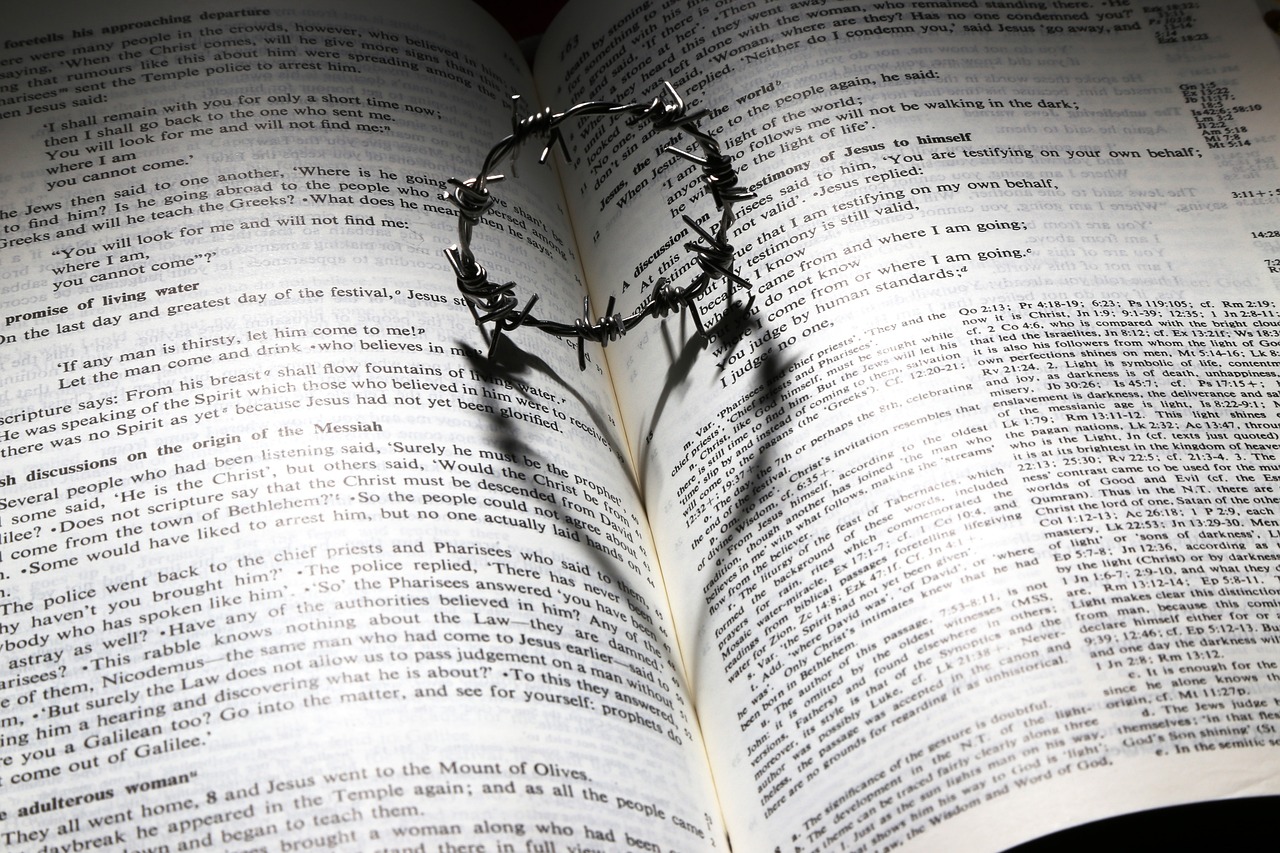
When Jesus said these memorable words, his crucifixion was still some distance in the future and the way God would ‘give’ the son still a mystery. The degree of sacrificial love that motivated the gift, however, was not. The two letters of ‘so’ describe the great extent to which God loved the creation and all in it. The love would not be measured in a blanket forgiveness and not in requiring the rebellious humans to earn it. Instead, the promise of forgiveness and salvation would be fulfilled by one perfect sacrifice, a sacrifice that was pure and unblemished, a sacrifice that human effort could not attain. The price of redemption would be the life of the Son of God, the Messiah Jesus.
The love of Easter is not merely an emotion. Emotional love is subject to change, it can be influenced by circumstance, it can be lost in an instant. The love that God has for his creation is none of those things. It is a facet of his character, a state of being. God’s love for the world is unchanging and unwavering. It cannot be earned nor can any human action result in its termination. The measure of this love is nearly beyond human ability to understand. Despite this, the full measure of God’s love is seen in the most horrific act in history, the crucifixion the Messiah Jesus.
How is this love? The rebellion of humanity in the earliest days of history create a chasm between creator and creation so wide that it cannot be bridged by any human effort. God, loving the world and its inhabitants so deeply, longs to close this divide, to be united in peace once again. He knows that without action on his part, his creatures are lost. In their pitiful state they cannot make restitution or pay a sufficient penalty, and try as they might humanity can never leap, fly, swim or find any way of transporting themselves to the other side. If this dark expanse is to be crossed, it will have to be done by God himself.
The paradox of the good news is that God, in the depths of his love, takes it upon himself to pay this penalty owed by humankind. His holy nature does not permit the option of dismissing the charges, a penalty is due in equal measure to that holiness. No human work can make a dent in that debt and so, out of an immeasurable love, God sends His Son to be the payment for the debt. The sobering truth in that good news? The debt could only be satisfied by sacrifice, the blood of Jesus on the cross paying the cost in full.
This ‘giving of his son’ would become the measure by which love is measured. As the cross grew nearer, Jesus described its heights, the personal challenge for his followers, telling them that “Greater love has no one than this, that someone lay down his life for his friends.” More than a challenge, his followers realized the judicial change that would be brought about, they would be friends and no longer enemies of God. The gulf would be bridged and the lost would be able to make their way home.
If it ended at the cross, this love would be unmatched. God had a higher expression of love to give though. The debt paid on the cross became the new life of Easter morning when the Messiah rose from the tomb. The perfect judge who paid the penalty himself rose as he had assured, condemnation behind and new life in full ahead. Easter became two parts of the same story, horror and celebration, mourning and joy. The rise of the sun on Easter morning brings all the promises of the Savior to light. Forgiveness came through the cross for those who would believe. For his friends, Jesus’ death became life in full. No greater love has ever been shown, nor will it be again. The love of Easter assures us of that.
Watch Your Blind Side
Expecting the Unexpected by JD Pearring
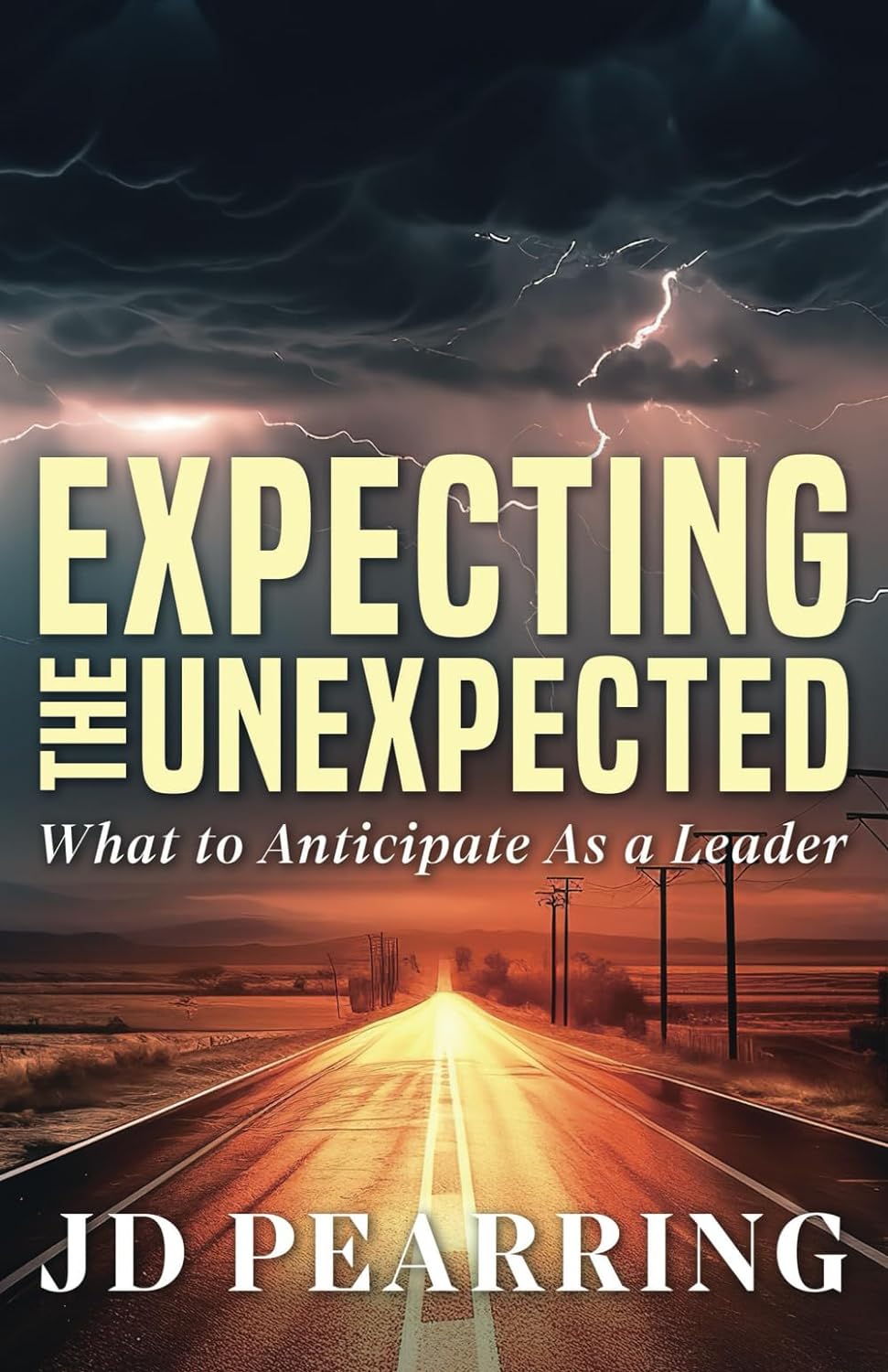
Many leadership books focus on the act of leading, as though by sheer will, one can create success with no unanticipated outside interference. Anyone who has ever been in a position of leadership, however, knows this isn’t true. There are dozens of things that can come out of nowhere and derail your efforts toward reaching your goals. In his excellent new book Expecting the Unexpected, JD Pearring catalogs eighteen of these actions, feelings and events that we do well to be looking out for. He talks about anticipating these things as you go about your leadership duties, but the book is also useful in hindsight as you reflect on ways that each of us could have handled these negative influences better.
JD combines personal anecdotes, stories and scripture to structure each chapter. From these, he offers several ways to deal with the unexpected as it comes. The option to give up, quit, surrender, etc. is mostly missing from his suggested actions. Instead, by applying scripture to each type of event, leaders are encouraged to overcome in the best moments, or endure with faith in the more challenging instances. The Big Challenge conclusions to each chapter range in application from simple [don’t quit] to character challenging [serve in obscurity]. Depending on your situation, some will be more helpful than others.
Take some encouragement. It is out there for you.
JD Pearring
Expecting is a book to keep on a lower shelf for reference in the future. You may not be experiencing discouragement (now), but chances are you will at some point. Pull the book out, turn to chapter(s) on discouragement (and smears and complaining and fools and so on) and let JD’s wisdom get you back on track. This is a good book for new leaders who have yet to experience these troubles, as well as more seasoned leaders who have seen them all. I plan to use this material in coaching relationships with renewal leaders who often find themselves overwhelmed by these negative effects on the health of their church, as well as negatively affecting their leadership. Don’t miss this book.
Joy Comes in the [Easter] Morning
Joy Rises with the Easter Sunrise || Warren Rachele
[Originally published in the Times-News during the Time of Covid, 2020]
Easter is a holiday marked by stark contrasts. The pastel pinks and sunny yellows of the springtime celebration feel out of place against the deep crimson and shadows of Good Friday. The sadness, despair and horror of the passion of Jesus give way to the elated celebration of Resurrection Sunday. Happiness and joy have similar contrast, though they are often spoken of as having the same meaning. The happiness of a beautiful Easter sunrise can be swept away by a snowstorm the following Monday. In contrast, joy that is anchored in the Easter miracle is lifelong and stands up to these storms of life. Americans are fond of quoting the Declaration’s promise regarding the “pursuit of happiness”, recognizing the ongoing desire of the heart but also, the elusive, sometimes fleeting nature of that emotion. What people really want, even if they can’t put it into words, is joy. Joy that is not easily stripped away and this is the joy of Easter, the joy of Grace.

If a poll were taken, the results would probably show that everyone wants to be happy. People throughout history have chased happiness in countless forms. Some find it in things, some find it in experiences and others still find happiness in relationships. But once found, can happiness be kept? Can this emotion be protected from the changes in life or are people looking for the wrong thing? Perhaps, rather than settling for momentary happiness, what their heart needs is the state of being joyful.
In our talking with one another people often use the words happiness and joy to mean the same thing. Though similar, feelings of happiness are generally controlled by what’s going on in life at any moment. If things are going great, happiness follows. If things take a turn and troubles become the norm, happiness can fade quickly into unhappiness. The heart wants something more stable, something that is not bound to the way things appear at any given moment. The heart wants joy.
The heart wants joy because it’s a windbreak against the storms of life; the storm will still pass over, but its effect will be less severe. Joy is anchored to a foundation of long-term contentment. The foundation results from having faith in something unchanged by day to day circumstances. A person who has this faith faces the darkest of dark moments and says, “this too shall pass.” Joy is built on this faith. Joy rests on belief that even if a storm doesn’t pass anytime soon, there is still confidence in the solid rock on which it stands. People who have joy trust in the way things are going to work themselves out.
Easter lays the foundation for people to know joy. Understanding Easter begins with the contrast of Good Friday and Easter Sunday. Jesus was crucified on Good Friday and it appeared that all the evil of the world had been revealed in that moment. The crucifixion gave the appearance that all hope was lost to even his closest followers. The happiness they felt from the promises they had seen in him was swept away. In their sadness they scattered, each looking for a new way to be happy again.
When Jesus rose on that Sunday morning, joy rose with him. His unhappy followers were the first to discover the truth of joyfulness. They learned that what had appeared to be defeat and snatched their happiness was something far greater, something eternal. Jesus was restored to life and he put all the momentary promises into the perspective of history. His followers were given an intimate demonstration of the contrasting natures of happiness and joy. While things might’ve been dark for a moment in their lives, the eternal promises of redemption assured their joy in both the rain and the sunshine.
The promise of joy is as true today as it ever has been. The joy of Easter is woven into the promise of redemption, of all things being made right. Jesus is the centerpiece of things being made right, his death making it possible for the restoration to proceed. The empty grave of Easter morning assures us that restoration is proceeding as planned. Joy, indivisibly welded to that truth, sustains through a day or two of trouble or a thousand nights of darkness. Happiness is fragile and positive thinking might maintain it for a day or a week, but if there is not the peace of deep-held joy, happiness will eventually turn to sadness. The deepest, darkest red of the crucifixion cannot strip the joy of belief that the bright sun of everything being made right is held in place by the eternal promises of Easter morning.
Reverend Warren Rachele is the pastor of Hope Community Church in Paul, Idaho.
Once Again
Rethinking the Divine Conspiracy
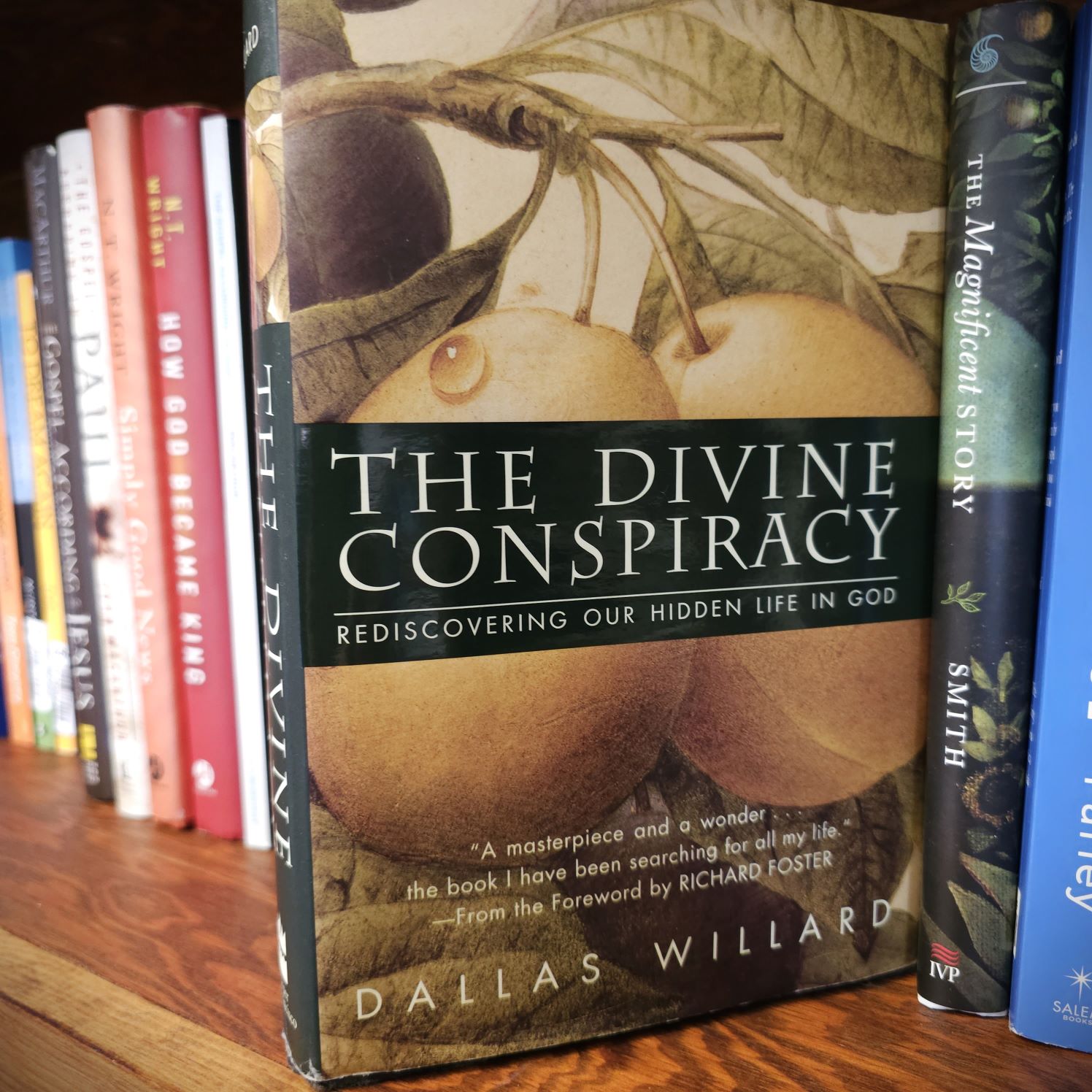
I recently took The Divine Conspiracy off my shelf to look up a reference for a project I was working on. I read the paragraphs I was searching for, then the surrounding pages, and then the full chapter—context, of course—and to my delight, I found a new book in my hands. Captivated by Willard, I reread the book in its entirety, and found that it was not the same volume I had read better than twenty years ago. Had the text changed in the shelf-bound years? Obviously not. Rather, as Heraclitus once opined, I was not the same person. I wonder now, what other wisdom awaits on these shelves?
“No man ever steps in the same river twice, for it’s not the same river and he is not the same man.”
Heraclitus
Reading anything more than once today is a radical idea. The firehose of electronic communication, our ever-growing to-be-read piles of books (nearly 100 as I look over) and our bias toward the new makes the practice of rereading the stuff of fantasy. This may or may not be an accurate observation, but, if it is, we’re poorer for it. As the philosopher said, we are not the same people when we return to a book 20 years later, let alone two weeks later. Our thinking affected by what we read, we have lived life in the intervening period. To return to an author’s work is to have tested their theses, applied their suggestions, lived their propositions or, to the contrary, ignored them altogether. Either way, we’re now able to agree or disagree, take out our pencils and argue in the margins, perhaps even decide to remove the book from our library.
“Master those books you have. Read them thoroughly. Bathe in them until they saturate you. Read and reread them…digest them. Let them go into your very self.”
Charles Spurgeon
Willard’s book was one of many that I have reread a second and third time in the past couple of years. When I first read it, I found it difficult to understand and, fitting my level of spiritual maturity, I couldn’t apply it. The reading process for me was to read it, say that I had read it and watch the dust cover spine fade on my bookshelf. I knew the book was important—because my seminary professors told me it was—but it was not important to me. I had no ability to interact deeply with Willard’s vision of our participation in The Kingdom Among Us.
Two decades later, however, the prose that I had once merely consumed was now something to be savored. I aligned with the author’s views on the kingdom gospel. I had wrestled with the biblical texts he referred to, built up the stamina and muscles needed to hold most of the points of his discussion in mind as I worked to understand his conclusions. I was a more mature disciple now, ready for the meat, having grown on the milk of my earlier years. No longer was I the same person who opened the cover and I am, even now, a different person, having reread the book again before returning to its spot amongst the others occupying the shelf.
For the past few years, I’ve made it an annual tradition to publish my reading list from the previous year. These lists have averaged around 90 books each, with an increasing number of rereads a part of those lists. The value of rereading is tempering my pace thus far in the current year as I slow down to interact more with the authors and their ideas. Marginalia and pencil lines are more common now, as are literature notes and summaries in Evernote. Fewer and better seems to be my new reading style, trading a high book count for a more engaged interaction with books of value.
Many a thoughtful reading has shed new light on other older volumes. Time spent with John Franke and Darrell Guder opened up my older books by Roxborough and Hirsch for me; Scot McKnight brought Jeff Vanderstelt off the shelf for a gospel conversation. Growing spiritual maturity and a developing recall of what I’ve read spur on this relational cycle of growth. The flood of published books urges us to consume and shelve, but is this rapid turnover leaving us undernourished? Might we grow more by an intentionally slower style of rereading and engaging? Let me study the question some more.
 LOVE | ACCEPT | FORGIVE