The Greatest Love

A Rolling Stone Sings of God’s Love || Warren Rachele

[Originally published in the Times-News during the Time of Covid, 2020]

The most familiar verse in the Bible reads “For God so loved the world, that he gave his only Son, that whoever believes in him should not perish but have eternal life.” Jesus says this to a man who is trying to understand the Messiah. He went on to describe his mission in the next sentence, “For God did not send his Son into the world to condemn the world, but in order that the world might be saved through him.” Life and love are the essence of Easter.
When Jesus said these memorable words, his crucifixion was still some distance in the future and the way God would ‘give’ the son still a mystery. The degree of sacrificial love that motivated the gift, however, was not. The two letters of ‘so’ describe the great extent to which God loved the creation and all in it. The love would not be measured in a blanket forgiveness and not in requiring the rebellious humans to earn it. Instead, the promise of forgiveness and salvation would be fulfilled by one perfect sacrifice, a sacrifice that was pure and unblemished, a sacrifice that human effort could not attain. The price of redemption would be the life of the Son of God, the Messiah Jesus.

The love of Easter is not merely an emotion. Emotional love is subject to change, it can be influenced by circumstance, it can be lost in an instant.  The love that God has for his creation is none of those things. It is a facet of his character, a state of being. God’s love for the world is unchanging and unwavering. It cannot be earned nor can any human action result in its termination. The measure of this love is nearly beyond human ability to understand. Despite this, the full measure of God’s love is seen in the most horrific act in history, the crucifixion the Messiah Jesus.

How is this love? The rebellion of humanity in the earliest days of history create a chasm between creator and creation so wide that it cannot be bridged by any human effort. God, loving the world and its inhabitants so deeply, longs to close this divide, to be united in peace once again. He knows that without action on his part, his creatures are lost. In their pitiful state they cannot make restitution or pay a sufficient penalty, and try as they might humanity can never leap, fly, swim or find any way of transporting themselves to the other side. If this dark expanse is to be crossed, it will have to be done by God himself.

The paradox of the good news is that God, in the depths of his love, takes it upon himself to pay this penalty owed by humankind. His holy nature does not permit the option of dismissing the charges, a penalty is due in equal measure to that holiness. No human work can make a dent in that debt and so, out of an immeasurable love, God sends His Son to be the payment for the debt. The sobering truth in that good news? The debt could only be satisfied by sacrifice, the blood of Jesus on the cross paying the cost in full.

This ‘giving of his son’ would become the measure by which love is measured. As the cross grew nearer, Jesus described its heights, the personal challenge for his followers, telling them that “Greater love has no one than this, that someone lay down his life for his friends.” More than a challenge, his followers realized the judicial change that would be brought about, they would be friends and no longer enemies of God. The gulf would be bridged and the lost would be able to make their way home.

If it ended at the cross, this love would be unmatched. God had a higher expression of love to give though. The debt paid on the cross became the new life of Easter morning when the Messiah rose from the tomb. The perfect judge who paid the penalty himself rose as he had assured, condemnation behind and new life in full ahead. Easter became two parts of the same story, horror and celebration, mourning and joy. The rise of the sun on Easter morning brings all the promises of the Savior to light. Forgiveness came through the cross for those who would believe. For his friends, Jesus’ death became life in full. No greater love has ever been shown, nor will it be again. The love of Easter assures us of that.
Once Again

Rethinking the Divine Conspiracy

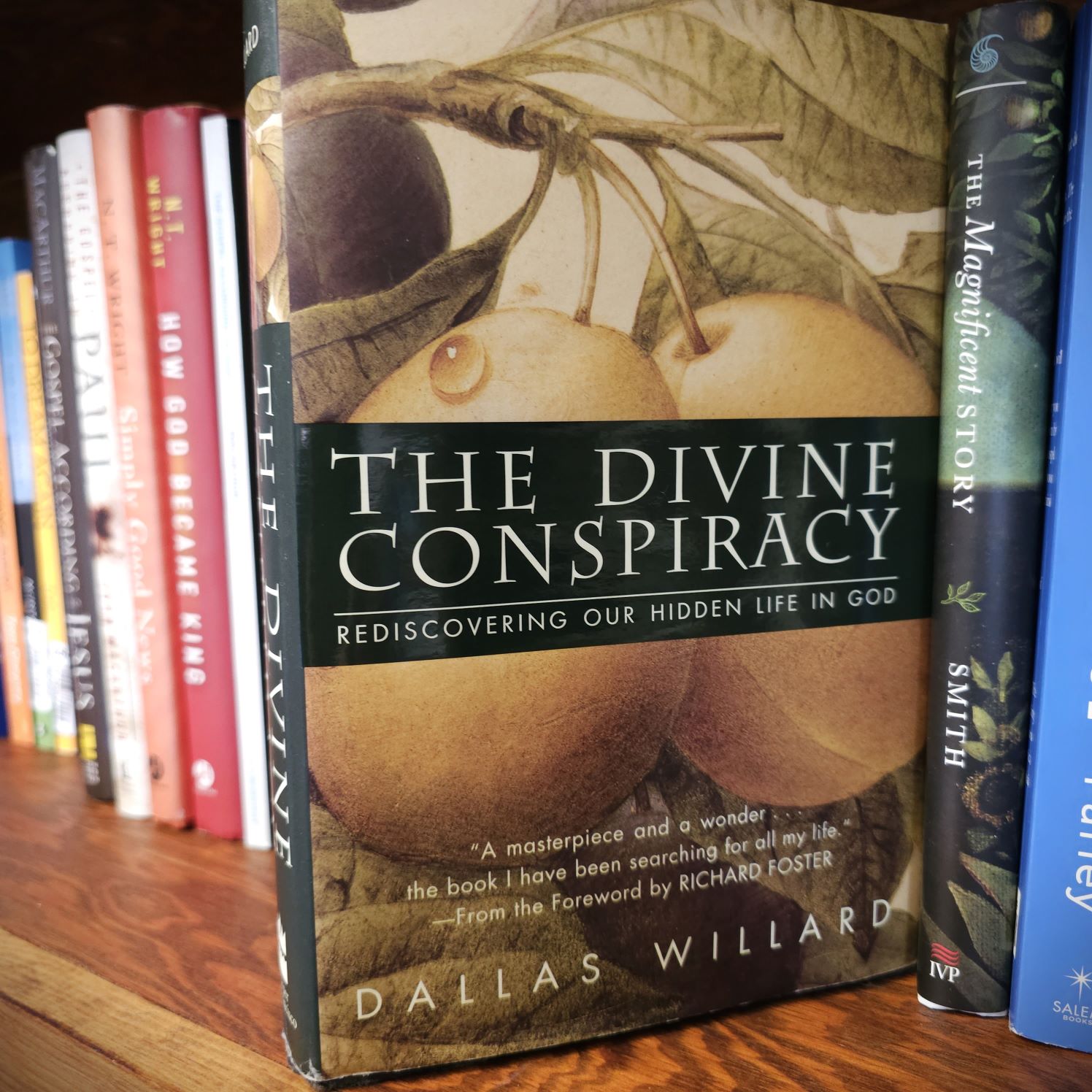
I recently took The Divine Conspiracy off my shelf to look up a reference for a project I was working on. I read the paragraphs I was searching for, then the surrounding pages, and then the full chapter—context, of course—and to my delight, I found a new book in my hands. Captivated by Willard, I reread the book in its entirety, and found that it was not the same volume I had read better than twenty years ago. Had the text changed in the shelf-bound years? Obviously not. Rather, as Heraclitus once opined, I was not the same person. I wonder now, what other wisdom awaits on these shelves?

“No man ever steps in the same river twice, for it’s not the same river and he is not the same man.”

Heraclitus

Reading anything more than once today is a radical idea. The firehose of electronic communication, our ever-growing to-be-read piles of books (nearly 100 as I look over) and our bias toward the new makes the practice of rereading the stuff of fantasy. This may or may not be an accurate observation, but, if it is, we’re poorer for it. As the philosopher said, we are not the same people when we return to a book 20 years later, let alone two weeks later. Our thinking affected by what we read, we have lived life in the intervening period. To return to an author’s work is to have tested their theses, applied their suggestions, lived their propositions or, to the contrary, ignored them altogether. Either way, we’re now able to agree or disagree, take out our pencils and argue in the margins, perhaps even decide to remove the book from our library.

“Master those books you have. Read them thoroughly. Bathe in them until they saturate you. Read and reread them…digest them. Let them go into your very self.”

Charles Spurgeon

Willard’s book was one of many that I have reread a second and third time in the past couple of years. When I first read it, I found it difficult to understand and, fitting my level of spiritual maturity, I couldn’t apply it. The reading process for me was to read it, say that I had read it and watch the dust cover spine fade on my bookshelf. I knew the book was important—because my seminary professors told me it was—but it was not important to me. I had no ability to interact deeply with Willard’s vision of our participation in The Kingdom Among Us.

Two decades later, however, the prose that I had once merely consumed was now something to be savored. I aligned with the author’s views on the kingdom gospel. I had wrestled with the biblical texts he referred to, built up the stamina and muscles needed to hold most of the points of his discussion in mind as I worked to understand his conclusions. I was a more mature disciple now, ready for the meat, having grown on the milk of my earlier years. No longer was I the same person who opened the cover and I am, even now, a different person, having reread the book again before returning to its spot amongst the others occupying the shelf.

For the past few years, I’ve made it an annual tradition to publish my reading list from the previous year. These lists have averaged around 90 books each, with an increasing number of rereads a part of those lists. The value of rereading is tempering my pace thus far in the current year as I slow down to interact more with the authors and their ideas. Marginalia and pencil lines are more common now, as are literature notes and summaries in Evernote. Fewer and better seems to be my new reading style, trading a high book count for a more engaged interaction with books of value.

Many a thoughtful reading has shed new light on other older volumes. Time spent with John Franke and Darrell Guder opened up my older books by Roxborough and Hirsch for me; Scot McKnight brought Jeff Vanderstelt off the shelf for a gospel conversation. Growing spiritual maturity and a developing recall of what I’ve read spur on this relational cycle of growth. The flood of published books urges us to consume and shelve, but is this rapid turnover leaving us undernourished? Might we grow more by an intentionally slower style of rereading and engaging? Let me study the question some more.

Gospel Blessing | The Gospel Saves

“The time has come” With this announcement, Jesus proclaimed that the single most radical shift in all of history had begun. The plan that God had made for the salvation of His beloved creatures and the redemption of His world was entering the final phase, one that would lead the Savior from Galilee to Cavalry. His announcement was earthshaking, “The kingdom of God is near. Repent and believe the good news!”

As Mark states in the first verse of his gospel, the good news is about Jesus Christ, the son of God. But the good news is also Jesus Christ, the son of God. The rightful king had come, bringing the kingdom of God near to His creatures in the incarnate form of Jesus. Repent, Jesus says, and believe this incredible news; turn back to God, turn back to home and be blessed by this act of your loving Father.

The gospel is more than an idea, it is a divine force. Among its countless blessings is the power to salvation (Rom 1:16). St. Paul repeats this idea in the first letter that he wrote to the church at Corinth. In that letter he dealt with several disturbing issues that had come to cause weakness in the church and required correction. Having dealt with those issues, rebuking in some cases and gently correcting and others, Paul reminds them of their common foundation, their unity in the gospel. He reminds them that all believers share one common truth; each was saved by the gospel of Jesus crucified and risen again:

“Now, brothers, I want to remind you of the gospel I preached to you, which you received and on which you have taken your stand. By this gospel you are saved, if you hold firmly to the word I preached to you.” (1 Corinthians 15:1 – 2)

The power of the gospel is inherent in its content. God in Christ died to pay the penalty due sinful man. Penalty paid, life is restored as Jesus demonstrates his mastery over the grave, removing for all believers the sting of death. And none of this is left to conjecture: three days hence Jesus rose from the tomb appearing to those with eyes to see. All good news, all gospel, but also a call to action.

The gospel calls us to pause and consider the great sacrifice made on our behalf, our undeserving behalf. Because Jesus endured this, because God planned this, because you are hearing this good news the invitation to turn back toward God – to repent – is seen in a whole new light. No longer is it just one man calling another to change their behavior. It is an invitation to turn back toward home, to turn back toward the life that you were created for, to turn back to the one who sacrificially loves you. This is the gospel. This is the gospel that saves.

The Gospel is Grace

The Gospel of IS Grace

“From the fullness of his grace we have all received one blessing after another. For the law was given through Moses; grace and truth came through Jesus Christ. No one has ever seen God, but God the One and Only, who is at the Father’s side, has made him known.”     John 1:16 – 18

The Gospel is sometimes referred to as the gospel of grace. There is a tremendous amount of truth in that label, but it can also lead to a diminishing of the fullness of the gospel. Our elementary school grammar lessons taught us that a preposition connects a modifying word, an adjective or adverb, to a noun. The purpose of this construct is to give the reader or listener a more detailed definition of that down. This is why it is so important to be cautious in selecting those words that we attach to gospel. The Good News needs no modification. That God, in his great mercy, intervened in history to reconcile humankind to himself is the greatest news that one could ever receive. That this invitation to reconciliation is addressed to everyone takes your breath away.

“Whoever believes in the Son has eternal life…”     John 3:36

The Gospel is power; power to save, power to regenerate, power to make holy that which is unholy. (Rom 1:16-17). The Gospel is not just words or an idea or a theological concept, the Gospel is divine power. It is the incarnation of God’s grace, it is alive and growing. The apostle Paul writes to the church at Colosse, “all over the world this gospel is bearing fruit and growing, just as it has been doing among you since the day you heard it and understood God’s grace in all its truth.” (Colossians 1:6)

“He causes his sun to rise on the evil and the good, and sends rain on the righteous and the unrighteous.”     Matthew 6:45

The grace of God is made manifest in his benevolent care for his creation, despite the fact that it has rebelled against Him. The result of this common grace should be the universal recognition that God is present and active in the world. It should result in gratitude as God demonstrates his goodness to all but the rebellious mind is devoted to denying these truths by any means possible.

“Let us then approach the throne of grace with confidence, so that we may receive mercy and find grace to help us in our time of need.”     Hebrews 4:16

Our greatest need has been addressed in the Gospel. Salvation comes by grace; salvation comes by the power of the gospel. The Gospel is God’s merciful grace embodied.  The Gospel IS grace.


Gospel By Faith

The good news, the gospel of Jesus Christ, is anchored in faith. This is incredible news for many reasons, not the least of which is that it removes the giving or receiving of this gift of grace from our hands. The apostle Paul speaks about the result of the good news, the power of the gospel and our utter dependence on God for its application; “for it is by grace you have been saved, through faith — and this is not from yourselves, it is the gift of God — not by works, so that no one can boast.” (Ephesians 2:8 – 9) We must hear the good news in faith, respond to the gospel in faith and continue to believe in faith for the gift of salvation to have its effect on our life.

It is good news that the gospel of Jesus Christ is anchored in faith. This means that on our part we take no action that we can claim as our own. This means that nothing on our part is worthy of note. We hear and respond to the gospel of Jesus by faith alone. This means that

  • we do no preparation to make ourselves worthy of the gospel
  • there are no works that we perform their worthy of the good news of Jesus
  • there is no ritual that we must perfect and perform for the gospel to have its effect
  • there will be no wondering on our part whether we have done enough, or done anything properly for the good news to be good news

In the midst of the magnificent “Hall of Fame of Faith”, the author of Hebrews cements this good news:

“(And) without faith it is impossible to please God, because anyone who comes to him must believe that he exists and that he rewards those who earnestly seek him.” (Hebrews 11:6)

What sets this chapter apart is that the heroes of faith listed all exercise that faith before the gospel of Jesus Christ was realized in full. Their faith was rooted in the promise of the care and the mercy and the benevolence of God, all of these fully realized in the gospel: that Jesus Christ, God incarnate came into the world of man, lived and gave his life as the atonement for sin for those highlighted in Hebrews, those in our day and those who will come after us until that glorious day when Jesus returns again.

The good news, the gospel of Jesus Christ, is anchored in faith. We believe the incredible news that God has dealt with our greatest problem – our separation from him by sin – in Jesus. We believe in the full sufficiency of the Lord’s sacrifice to atone from our sin, no matter its degree. We believe that on that earth-shaking Sunday morning the Lord rose and lives again, continuing to this day his ministry of intercession and care for those who have placed their faith in this good news. We believe and keep on believing.

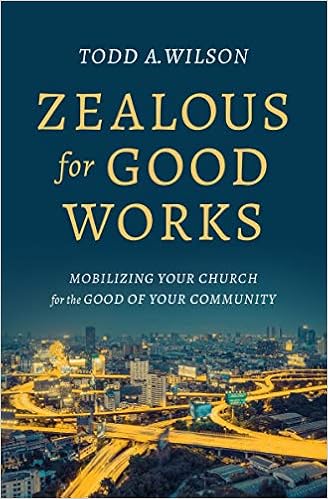
Book Review: Zealous for Good Works by Todd Wilson

Pastor Wilson turns the Church’s attention to the much quoted but less applied New Testament epistle of Titus and its core message. The Spirit inspired the author of that letter to not only leave his worker Titus on the Greek island of Crete to organize the Christians there, but gave the principles by which he was to do so as well. Using as his objective that the Church be the city on a hill that Jesus describes in the Sermon on the Mount, Wilson leads the reader through the points of Paul’s letter and helps us to understand how his marching orders for Titus apply to the Church today.

For such a brief book the value is immense. Wilson expertly exegetes the equally brief letter and helps the reader to see the big idea in each of the passages. ‘Zealous’ is not a gnostic promise (Jabez et al.) of discovering some new hidden secret, but rather, it is an eminently practical look at the principles that Paul gave to Titus that address many of the shortcomings of the Church in our age. Three that are discussed in the book are the poor level of discipleship, the chasm of credibility (that is, the difference between what we say and what we do) and the effect that these have on how we apprehend the missional opportunity ahead of us.

Read ‘Zealous’ with your bible close by. It is likely you have read Titus multiple times (if you are picking up a books such as this) but much of that reading has been focused in the Eldership requirements. Wilson deftly leads the reader to see that Titus contains so much more practical application for the Church beyond those instructions. For example, Wilson stops us in a passage often seen as preamble, Paul’s greeting in 1:1-4 to point out the importance of preaching and the power of the gospel. The gospel is both the content and the power of preaching something that can be missing in today’s environment of therapeutic deism. A city on hill is not built on the pillars of making people feel better where it teeters and shifts with every new personal demand. It is founded on the unchanging glory of the gospel of Jesus Christ.

The only disappointment I had with the book was that it was over so quickly. The more I think about it though, the length of the book is exactly right given the brevity of the profound instruction in its source. I have a new hunger to dig into Titus and preach it in the future. In the meantime, the study guide included at the back of the book is a bonus for church leaders seeking to present their people as salt and light in the world. Buy this, read this and read it again.

I Am Not Ashamed of the Gospel

“I am not ashamed of the gospel, because it is the power of God for the salvation of everyone who believes…” Romans 1:16

Gospel Square 1The gospel that the Apostle spoke of is good news, stupendously good news. God had intervened in history, entering personally into the morass of human rebellion against Him and making a way out, a way to be freed from the entanglements that drew them to destruction. Jesus Christ entered the world in purity, lived a life of perfect holiness and died as the sacrifice for the sins of the world. His death atoned for all sin. When Jesus was then resurrected on that third day, He demonstrated indisputably that He had overcome death and broken the entrapping bonds of sin. The long-awaited promises to Israel were fulfilled and the blessing of God extended to all who would believe that Jesus was their only avenue of freedom from the bondage of the Fall.

That is fabulously good news. “How beautiful are the feet of those who bring good news!” Romans 10:15

The Apostle quoted the prophet Isaiah in this assuring statement. The prophet communicated to God’s people Israel that their exile would end, that they would be released from their captivity in Babylon, that freedom was imminent. Good news to be sure, fantastic even. Except, the power sin remained and, while physically freed, people were still held in its vise-like grip. Better news was still to come.

The better news is Jesus. Jesus, the savior who died for the “sins of the whole world” 1 John 2:2. The amazing news is Jesus who overcame death and its sting (1 Corinthians 15:55-57) and gives all who will believe that victory. Jesus not only makes the way of atonement, He shepherds believers along the path of life (Hebrews 7:25) until they are rejoined with God in perfect communion.

This is good news. This is the gospel.