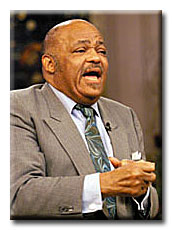
No Fakin’ and Shakin’ Here – Holy Roller by Julie Lyons

clip_image002Sister Johnson had a way of cutting through the mess. I found this out after I started teaching a Sunday-school class, replacing the previous teacher who quit unexpectedly. Standing in front of a roomful of adults, I asked a question: “Why do we sin?”

Sister Johnson, who was in her sixties, piped up as soon as the last word left my mouth.

“Because we want to.”

At that moment, a thousand volumes of Christian theology were rendered redundant.

Holy Roller is two parallel stories; the birth and growth of a black Pentecostal church and its pastor and a white writer who unknowingly stumbles into its midst and discovers that the heart of the faith she has been seeking in her life beats within this unfailingly honest body. Julie Lyons skillfully intertwines her story with that of the The Body of Christ Assembly and Pastor Frederick Eddington. Many churches attach the label ‘spirit-filled’ to their biographies but you often discover little of His presence once you in the walls of their meeting hall. Pastor Eddington and the Assembly on the other hand are true believers in the power of the Spirit and demonstrate the power of His work over and over in the life of the church and community beyond its crumbling walls.

Lyons weaves the story of her early ‘faith of facts’ with the charismata of the Spirit driven Church. The dichotomous church life of her early life is familiar to many evangelicals, a church experience where one is said but another is done. Cynicism of some measure had set in when she proposed a story to her editor about churches on the fringes of South Dallas and their ministry in the midst of a crack cocaine crisis. As she passed by numerous small churches with their lights turned out she finds herself in front of the tiny, ramshackle house that strained to hold the Holy Spirit’s work. A young girl (?) points out Pastor Eddington to Julie and she asks the questions that will quickly transform her life.

“Do you pray for crack addicts?”

“Yes” replied the pastor.

“Are they getting healed?” asked Julie.

“Some are.”

The story that follows in Holy Roller is a multi-threaded page-turner rooted in a faith that takes the promises of power in the Holy Spirit at face value, believing the Bible and its promises of transformed lives and demonstrating for the world to see that these things are indeed true. It is not a Christianity of constant theological argument over arcane points or concern with the finer points of Greek exegesis where the truths are analyzed but not necessarily applied. Lyons tells the story of moving from one world to another as she witnesses the changed lives she spends time with in becoming a part of the Body of Christ Assembly and the challenges that came with the shift.

Transformation is the heart of the story. Frederick Eddington moving from psychologically challenged man to pastor. His wife Diane changed from a party girl to the first lady of the church and Julie and Lyons who were exposed to new racial relationships and faith founded in the living Spirit. As expected, the integration is not always easy and significant challenges are recorded for all of the people we encounter. The common thread linking them together is a profound trust in the power of Christ to make things right, even if it doesn’t happen overnight. The average American evangelical reading this book is going to come to one of two conclusions as the pages are read. Either they will continue to view the Pentecostal church in a low church light and with considerable skepticism or they will view the evangelical church and its lack of Holy Spirit power as needing a restorative dose of reformation itself.

Mrs. Lyons is transparent in documenting her personal struggles alongside the challenges she encounters as a member of the church. She has done a stellar job of telling all of these disparate stories while passing a connecting thread through all of them. I became deeply enmeshed in the lives she reveals to us and spent a good deal of time contemplating the sometimes weak power of the Spirit in my own faith life. At the conclusion of the book, I was immediately set to reread it again and consider how I have personally viewed the work of the Spirit and consider whether I desire more of Him or more arguments over the Arminian/Calvinist divide. I’m pretty sure the Holy Ghost is going to win.


More information on the book can be found here.

An Invitation to Submission

imageThe spiritual discipline of submission releases the Christian from the ongoing need to get their own way. When you consider the things that we all in one way or another struggle with — judging others, pride, demanding that we be first, etc. –  we discover at the core of each of these the demand that we get our own way in things. Submission is difficult to put into practice because it guarantees we will not get our own way. Letting go of that need/desire is one of the biggest, most challenging steps that the Christian takes.

Submission is at the core of a biblical faith in God. Consider these passages:

“I am the Lord your God, who brought you out of Egypt, out of the land of slavery. You shall have no other Gods before me.” (Ex 20:2-3)  (This includes the god of ME)

“If anyone would come after me, he must deny himself and take up his cross and follow me.” (Mk 8:34)

“So the last will be first and the first will be last.” (Mt 20:16)

Submission is all encompassing. We submit to God and His Lordship. We submit to His Word and obey. We submit to one another within the Body, putting others ahead of ourselves. We submit to the world at large, even if they are not a part of the Body. We seek in every instance to reduce ourselves while lifting others. We do this all in the joy of knowing that our salvation and the new life of today and eternity was purchased with the ultimate act of submission.

The practice of submission is often abused and this abuse contributes to the struggles we have in putting it into practice. A prime rule for practicing submission is that we do so until it becomes destructive. That is, we submit to others until the practice becomes a denial of the law of love and our submission threatens to revert to a slavery outside of the boundaries of the Bible. We are then called to speak out and remedy the situation as best we can.


Image Bruce McKinlay

E.V. Hill and the Soul of Los Angeles

imageThe city still cries for another like Pastor Hill to speak truth in the City of Angels. For over forty years he served the Mt. Zion Missionary Baptist church in the Watts neighborhood of Los Angeles and never drew back from proclaiming righteousness. To learn more about the heart of a true man of God, a good primer is the sermon he preached at his beloved Baby’s funeral. Set aside a few minutes and soak it in…you will be changed.

For the visual generation, here is a good starter link on Youtube:

Psalm 43 – Send Forth Your Light and Truth

image Send forth your light and your truth, let them guide me; let them bring me to your holy mountain, to the place where you dwell.

Then will I go to the altar of God, to God, my joy and my delight. I will praise you with the harp, O God, my God. (vv 3-4)

The Psalmist groans in the face of continued persecution, much as he did in psalm 42. [N.B. Psalm 42 and 43 form a single prayer unit and should be read together.] He begs to be restored into an audience with Yahweh who he will praise. The hope that colors this brief prayer applies now as it did then; praise does not require peace. Praising God requires the long view. We must look beyond our immediate circumstances, whether morass or exultation, and know that in the eternal blueprint that God has for the world he works all things for good.

Why are you downcast, O my soul?

Why so disturbed within me?

Put your hope in God, for I will yet praise him, my Savior and my God. (v 5)


Image Walt Jabsco

No Invitation to Abortion Party

At Alternet:

“Have you guys heard the news?” Maggie (name changed) unwrapped the scarf from around her neck and patted her flat belly. “Preggers.” It was around 30 degrees outside, and her cheeks were splashed pink from the Indiana wind.

She had discovered earlier that week, after missing a period and taking the test. “I kind of knew already. My boobs and my lower back have been killing me for a while.” She shrugged.

My girlfriend Ali and I exchanged a surprised look. Our forks, dotted with pasta sauce, dangled identically, flaccidly, in our hands. She was quicker than me to gain her composure, and turned to address her best friend.

“What are you going to do?” Unnecessary question, really — a conversational life vest, used when you’re sputtering for something to say. We knew the answer. Maggie, a 22-year-old college senior with no intention of bringing a child into the world yet, was going to have an abortion. She told us that she had already made up her mind; she had even determined the time, date and location. A better question might have been, “How are you going to pay for it?”

She answered that one before we had a chance to ask. “We’re having a party Friday to raise money,” Maggie said. “You guys are obviously invited.”

An abortion party. For the price of whatever we were willing to donate, she explained, we could partake of baked goods, beer and dancing.

Dark, crushing depression envelopes me as I realize how deeply crass depraved and disconnected from the sanctity of life our culture has become. Two things strike you immediately; Maggie’s vacuous indifference to the life within her and the celebration-of-impending-death mindset that would lead people to hold a rave in its honor. Pray for these people.

Bear Flag Revolt 2009

image Though I’ve lived in Colorado for 23 years, I remain a Californio at heart. To see the depths to which the Golden State has sunk is depressing. The once flourishing land of infinite promise which lured seekers for decades has become a moribund captive to the legislative Meerkat band that is systematically destroying the core of the state and whose rapaciousness is matched only by certain especially virulent strains of the plague. California has become divided into roving hordes of special interests who, by the very definition of the term, care nothing for the ideals and desires of the other. As is their privilege, these groups elect the pirates in Sacramento expecting them to remember that the elect are beholden to them. Divisions become deeper, battle lines are drawn, and the order for no retreat is passed along the line.

The 1846 Bear Flag Revolt was an uprising against despotism and oppression, a condition that the current residents can easily identify with. Perhaps its time for a repeat stand against the tyranny of those elected to represent but who take the election as a mandate to rule. A clean house should be restored in Sacramento and perpetual embarrassments on the national stage like Waxman, Boxer, Pelosi, and Feinstein sent home. All of this can be done by people in the same tranquility that marked the first rebellion, by the use of their vote. As the first president of the California Republic, William Ide, said “Choose ye this day what you will be!” Free men and women restoring the luster of the Golden State or servants to the plutocracy.

image

xxx

Psalm 42 – My Soul Thirsts for God

image

As the deer pants for streams of water, so my soul pants for you, O God.

My soul thirsts for God, for the living God. When can I go and meet with God? (vv 1-2)

Being oppressed by the enemies of God is a theme that abounds within the Psalter. The purpose of the repetition is to give voice to the question that continues to nag us to this day; where is God as trouble closes in around us. Has He abandoned us, do we no longer enjoy His favor? Foolish thoughts, but thoughts we must admit to entertaining.

To fill our minds with the joy of our moments of worship brings comfort and a reminder that God does not forget us. We can be assured that He is always near and worthy of our hope and belief.

These things I remember as I pour out my soul: how I used to go with the multitude, leading the procession to the house of God, with shouts of joy and thanksgiving among the festive throng. (v4)

Meditation on this truth brings the psalmist and us to the same conclusion:

Why are you downcast, O my soul?

Why so disturbed within me?

Put your hope in God , for I will yet praise him, my Savior and my God. (v5)

The oppression and suffering that the psalmist refers to is not of the random type. He recognizes that God’s hand has allowed it, if not brought it upon him. His allusion to the flow from above that washes over him.

Deep calls to deep in the roar of your waterfalls; all your waves and breakers have swept over me. (v7)

The ultimate goodness of God’s totality does not escape him. Ultimately and despite current suffering, praise is the only response to the hand of God.

By day the Lord directs his love, at night his song is with me—a prayer to the God of my life. (v8)


Image bjmccray

Contemplating Creation

The heavens declare the glory of God; the skies proclaim the work of his hands. (Ps 19:1)

image Returning to Evelyn Underhill’s Practical Mysticism she suggests that one interested in beginning the spiritual discipline of meditation start “with that first form of contemplation which the old mystics sometimes call the ‘the discovery of God in his creatures.’” Meditating on creation is a contemplative form that lends itself to practice at any moment during the day when you can view the world around you. By focusing on His creation from its grandest examples such as the Sierra Nevada or the Grand Canyon to its most minute in the tiny flowers of the Verbena. You seek to encounter God through the glory proclaimed in all that he created, in whatever form it takes. Allow yourself to meditate on the symmetry of the flower, at the wonder of its shape and color. From the tiny stamens your meditation can move to reflect on the thousands and thousands of types and colors of flower in the creation and glory at the creative mind that brought them all to life. Your soul will find its humility and allow you to commune even closer with your Father.