
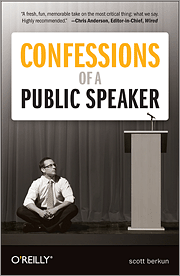
Confessions of a Public Speaker

imageI scrambled for excuses—I’m too busy (lie), I’m tired (lie), my feet hurt from the road test (bad lie)—but before anything good came to mind, he said these invaluable words: “The clutch is your friend.”

How could the clutch be my friend?

How indeed? For Scott Berkun this datum came out of the dark at just the right moment. It distilled a lot of information into a single memorable idea that was needed to be successful at a crucial task (learning to drive his brother’s beloved ‘84 Honda Prelude.) These memorable points, important as they are, are often buried or missing from the lectures, sermons, and talks that we hear (endure?). Should this come as a revelation? As people who communicate for a living it becomes all too easy for preachers, teachers, and speakers to forget the foundation of public speaking: conveying information of value to an audience whose lives will be enriched by receiving it. Everything we think about in terms of speechifying should swirl around this single ideal. To the rescue comes a new reminder in Berkun’s Confessions of a Public Speaker. 

Confessions is not a how-to book as in make three points and start with a humorous story. Instead, the reader gets the benefit of Berkun’s hard earned knowledge of what it’s like to stand up in front 5 or 5000 people and convey something in a meaningful fashion. He talks about the highs and lows with plenty of reality based examples that can aid any speaker willing to invest the time in improving their public speaking skills. There is much about the business of speaking in these pages but the most valuable paragraphs are those in which Berkun is willing to share the failures and their causes. Here is where we learn to improve.

If you are involved in any type of speaking, whether it is in front a church or classroom or simply presenting the TPS reports at a staff meeting, you need to ask yourself how much you have invested in improving yourself in this critical area. We tend to invest our time in learning the information we want to present but simply let the end product, the communication, just happen. The pages of Scott’s invaluable book remind us of the reality; unless we can effectively communicate that information to an audience all of our other efforts are for naught. Make the commitment to improve. Read Confessions and then spend the time necessary to think about the process of speaking. Practice, practice, practice. Then go out and make some noise of your own.

A Word for My Brother & Sister Pastors

image

Prophetical-Priestly Ministry by Darius Salter

It’s fascinating how things fall into your lap when you least expect them. Serendipity is the word often used to describe favorable circumstances like this when you discover something grand has come your way unexpectedly. Christian sagacity trends not towards luck though, but instead, toward an understanding of the work of the Father and Spirit in concert. Salter’s book landing in my hands was just such an event.

Prophetical-Priestly Ministry was published in 2002 to little fanfare. A quick search for reviews of the book comes up short; it is ignored on Amazon and the single entry at ChristianBook.com is a restatement of the title. The silence is understandable. The book is not about how to grow your church, new ways of reaching post-moderns, or new secrets of the life of Jesus. These books fly off the shelves into pastoral libraries. Books that serve as correctives such as this are often ignored. And I believe, ignored at the peril of the pastor and their church.

Salter’s message to pastors is simple: return to your core responsibilities. Speak the prophetic word of God into the lives of your congregation rather than feeding them messages about how to have their ‘best life now.’ Stand as the priest for God’s people rather than their cheerleader or worse, their manager. He says “Prophet-priests specialize in diseases of the soul; sin, despair, depression, loneliness, alienation, anger, hostility, pride, greed, avarice, addiction and fear. The list is almost endless. Of course, these sicknesses eventuate in the systemic evils of ethnocentricity, nationalism, exploitation, oppression, and racism.” The message in this thin volume calls us back to the service of the congregation and gets us away from parading around selling books or conducting seminars on how to fill more seats in the sanctuary.

The author critiques the current ‘worldly’ ministry that he sees all around the American landscape (in 2002 and worsening since). The Church has gotten entrapped in the self-fulfillment culture and, in some cases, has moved away her first love. God is a second thought in the worst of these environments. The ministry has become enablers. We promise spirituality while allowing our people to remain in their materialistic, pluralistic lifestyle. The gospel becomes a casualty of the latest charity initiative or small group study topic.

I didn’t go looking for this book. It appeared in a weekly-specials email and something moved me to purchase it. Initially, it arrived and made its way to the book shelves to be read later. I picked it up after a time and was immediately struck by the message that the Spirit brought to bear through Brother Salter’s words. I was stopped cold when the Spirit brought my feeble ministry efforts up against those of Francis Asbury,

For the elect’s sake, Asbury ceaselessly uttered the Word through Scripture reading, prayer, exhortation, teaching, and family worship. Every overnight stay would involve spiritual examination of the residents and subsequent catechism. There would be no idle words. “My mind was powerfully struck with a sense of the great duty of preaching in all companies, of always speaking boldly and freely for God as if in the pulpit.” This included calling “the family into the room and addressing this pointedly one by one concerning their souls.”

One by one; when was the last time you (or I) sat even our immediate families down and questioned them concerning their spiritual welfare? Have we gone home by home and addressed these concerns with our faith families? Why not? Because we have succumbed to the Western individuality of the culture and we respect the personal nature of a person’s faith more than we do the calling we have received to be a priest and prophet.

Brothers and sisters, now is the time for a new awakening within the Church. Not the watered down awakening of “spirituality” in its myriad forms but for us to stand upon the walls ahead of our flock, intervening for them with God and speaking His word into their lives not matter how difficult. Find this book, read it, absorb it, and let the Spirit work it all out in your ministry.

E.V. Hill and the Soul of Los Angeles

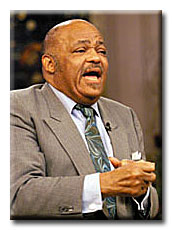
imageThe city still cries for another like Pastor Hill to speak truth in the City of Angels. For over forty years he served the Mt. Zion Missionary Baptist church in the Watts neighborhood of Los Angeles and never drew back from proclaiming righteousness. To learn more about the heart of a true man of God, a good primer is the sermon he preached at his beloved Baby’s funeral. Set aside a few minutes and soak it in…you will be changed.

For the visual generation, here is a good starter link on Youtube:

Lent 2009 – 21 Steps to the Cross

PeterSteps

From that time on Jesus began to explain to his disciples that he must go to Jerusalem and suffer many things at the hands of the elders, chief priests and teachers of the law, and that he must be killed and on the third day be raised to life.

Peter took him aside and began to rebuke him, “Never, Lord!” he said. “This shall never happen to you!”

Jesus turned and said to Peter, “Get behind me, Satan! You are a stumbling block to me; you do not have in mind the things of God, but the things of men.” (Matthew 16:21-23)

As we began to explore yesterday, we wonder why Peter would make such a crucial slip of the tongue. This concern comes from the impression within ourselves that we might not have made the same mistake, knowing what we do about Jesus. The answer that may elude us is this; Peter’s statement was not the result of ignorance or a lack of information. Peter’s rebuke was located in his resentment.

In his mind, Peter has sacrificed everything to follow and serve with Jesus but not to the end that Jesus was unfolding before him. Had he known in the beginning that Jesus was headed toward the cross, he more than likely would have stayed in Bethsaida and kept his fishing business. Peter’s rebuke was centered on himself and the good things that he thought should come from an association with Jesus.

Denial of self and carrying one’s own cross was not on his agenda.

The meditation today is in large part for pastors. How many of us are in the same place as Peter? How many of us are tired of suffering for Christ and want to look for the good things that were promised? We are willing to carry our cross but, just so far before we want a reward. Our name should be Peter.

Digg This

Friction Free Worship

As I’ve thought more about the impediments introduced by the church coffee shop and bookstore, I see a great deal of value in moving in the opposite direction of the “mall church” trend and instead designing a friction-free worship environment. This would be one which leads a worshipper directly from the narthex to the chancel (or in modern language, from the doorway to the altar) with as few obstacles as possible. Consider this passage from Isaiah as we reflect on the intentional design of our celebration event;

A voice of one calling: In the desert prepare the way for the Lord; make straight in the wilderness a highway for our God. (Isa 40:3)

and this one

And it will be said: “Build up, build up, prepare the road! Remove the obstacles out of the way of my people. (Isa 57:14)

image Each of these verses serves the larger context of the passage in describing the movement of the Lord to the holy place in which He meets with His people. Because He is the King, his people’s desire is to smooth the way for their meeting by removing obstacles and straightening the path so that there is as little friction as possible in His movement toward the destination.

I’m getting the feeling that the ‘all-in-one’ church design is beginning to deter from the core reason for the Sunday celebration. We may not all agree but from the perspective of a pastor, my understanding of the Sunday (or Saturday or Tuesday as it applies) gathering is the corporate worship of God. With this objective placed properly in the hierarchy we can then clearly examine the effect that other activities might have on accomplishing this goal. For example, an issue I raised in an earlier post has to do with the distraction caused by the church coffee shop. It has a certain stickiness, an attractiveness that introduces friction on the path to worship. I am tempted to stop and enjoy a cup of coffee on my way to sanctuary, perhaps justifying it as fellowship, rather than moving deliberately toward the altar, physically and mentally.

When we introduce friction in this manner, we are placing obstacles in our people’s preparation and attendance to worship. Their minds can become distracted from the purpose of the gathering and thus, they become not fully present to God. Our task as the called leaders of the Church is reduce rather than increase any friction between God and His people. Must we do away with the coffee shop or the bookstore? No, they serve a purpose in the community of the church and the lives of the congregation. Perhaps we might consider closing them before and during the worship gathering and opening them afterwards to contribute to the fellowship and growth of the family of God. In doing so we accomplish two things. One, we establish the priority of the corporate worship event and practice in the life of the Christian and two, we make straight the path for the worshipper’s heart so that there is a frictionless path from the door to the altar. What do you think?

Digg This

Bricks Without Straw

Ministry that is accompanied by struggle, persecution, and difficulty often leads the pastor to what where God’s plan lies. The Lord calls us to specific ministry objectives big and small and we faithfully follow that call only to discover that the ministry that results is fraught with heartache, disappointment, and struggle, sometimes even failure. I was reminded of this in reading Exodus this morning. Moses and Aaron are called to a ministry of confrontation with Pharaoh and leadership to their people. They carry the Lord’s message to him to release His people and, as a result, Pharaoh increases the pressure on the Hebrews.

The result is predictable, given what we know about human nature:

The Israelite foremen realized they were in trouble when they were told, “You are not to reduce the number of bricks required of you for each day.” When they left Pharaoh, they found Moses and Aaron waiting to meet them, and they said, “May the Lord look upon you and judge you! You have made us a stench to Pharaoh and his officials and have put a sword in their hand to kill us.”  Ex 5:19-21

Leaders in Christ’s church must be willing to remind God’s people that following His plan is a dangerous pursuit and there is always a chance that not all of us are going to come through unscathed. If God calls your church to a specific ministry, no matter how unglamorous, our calling is to lead our people into the fire regardless of the pain, scorn, and fallout that might come our way. To do anything less is to proclaim our lack of trust in the providence of our Father.

You see, we must continue to read on despite the fear of reprisal that a ministry call may generate. When Moses presses Yahweh for understanding, he gets this response:

“Therefore, say to the Israelites: ‘I am the Lord, and I will bring you out from under the yoke of the Egyptians. I will free you from being slaves to them, and I will redeem you with an outstretched arm and with mighty acts of judgment. I will take you as my own people, and I will be your God. Then you will know that I am the Lord your God, who brought you out from under the yoke of the Egyptians. And I will bring you to the land I swore with uplifted hand to give to Abraham, to Isaac and to Jacob. I will give it to you as a possession. I am the Lord.’ ” Ex 6:6-8

We, as followers of the Risen Christ, have the same great promise to undergird everything that the Father calls us to do. Every step of every day may be an incredible struggle as compared to others around us but, in the end, we have the promise of eternal life in the peace of the Lord. We can be faithful to our calling or we can avoid it, God gives us this choice but there is never a promise that either path will be easy.

Tragedy and a Theological Loss For Words

Two tragedies have intertwined themselves in my mind as I worked today. One is a current news story not unlike the heart breaking incident with Addie Kubisiak that broke our hearts last winter. It appears that a women has kept the bodies of infants who she possibly miscarried wrapped in plastic in various parts of her home. Little else is known at this point. The other story was a reminder of the destruction of a young family on a downtown Denver street at the hands of a drunk driver who plowed through a red light running over the entire family as they crossed the street to get hot chocolate last November. This picture can still bring me to tears: Becca Bingham still keeping her children close as she escorts them into the arms of their savior.  

While the professional theologians can spend their time immersed in the Word in an effort to bolster certain theological positions or to identify certain Greek or Hebrew structures, the Pastors of this world must search the Scriptures to help provide answers to a world that asks of our God, why, why why? Why does He allow these things to happen? How does one answer the problem of Evil in a world that has little concept of what total depravity means. What can the pastor offer to the father who must now face life alone and broken?

How do you tell this father (sitting leftmost in the picture in the front pew) to go on despite this tragedy. Theologian Steve Camp insists that we give it to him straight: there is no way to know whether or not his children are in heaven being comforted by the Lord Jesus or condemned to an eternity in Hell. Camp looks sideways and says, c’mon, we all know that you Pastors just say that the children received a special mercy just to comfort the father, knowing all the while that it isn’t true.  Here is his post on this subject: Weekly Dose of the Gospel.

While Camp correctly asserts that even babies are inflicted with a sinful nature from before their birth, the theological positions on infant condemnation are not as clear cut as he likes to proclaim as he posts on a variety of subjects. It does not appear that the Lord viewed those unable to make a conscious decision to accept Him as under condemnation:

Matthew 18:3 – And he said: “I tellyou the truth, unless you change and become like little children, you will never enter the kingdom of heaven.”

Matthew 19:14 – Jesus said, “Let the little children come to me, and do not hinder them, for the kingdom of heaven belongs to such as these.”

These are the condemned? There are indications throughout Scripture that persons are held to a different moral standard of responsibility and we must consider them carefully before exclaiming that the Scriptures are silent. Deuteronomy 1:39 for example:

And the little ones that you said would be taken captive, your children who do not yet know good from bad –they will enter the land. I will give it to them and they will take possession of it.

All is not as cut and dried as some would like to make it. It may be nice to be insulated from tragedy and be able to speculate and make proclamations about the destinies of the men, women, and children who we all come into contact with on a daily basis, but it comes with a responsibility. As for me, I would rather walk among the wounded and help them to trust the same sovereign, merciful God that I trust. Lord Jesus, bring us peace.

The Seduction of Compromise

Compromise is a winsome suitor. She will tempt you with promises of peaceful agreement on all sides if only you are willing to lower your standards to meet the needs of the other side. It is a seductive ploy, tempting you to soften your position with a siren song of calm and a self-image of one who is not stubborn but willing to consider the ideas of others. The trouble that compromise brings though is that it never ends. Once you have compromised what you believe to be right, it will be expected from you again and again until one day you are no longer able to compromise any further, then what? Will you stand on your principles then?

2 Timothy 4:3-4 says “For the time will come when men will not put up with sound doctrine. Instead, to suit their own desires, they will gather around them a great number of teachers to say what their itching ears want to hear. They will turn their ears away from the truth and turn aside to myths.” For the pastoral leadership, compromise is death. The temptation comes to the pastor in the form of concerns about the size of one’s church or the retention of a congregation. Murmurs will begin about how other churches do things, or about how happy a family would be to stay if only the Sunday school did such and such, or worship will be limited to the same 15 songs because a musician that you ‘need’ will not learn any others… and so on and so on. The pastor will say, ‘I’m a servant of the people’ and he or she soon becomes a people pleaser.

The trouble is, people are rarely satisfied and will continue to demand that you compromise. One day, you’ll look up and decide that you are not going to compromise any longer, that you are going to stand on your principles and guide the church according to your original vision…often looking at suddenly empty seats where the family you changed ‘A’ for used to sit. And over there is a chair where so and so who you changed ‘B’ for used to sit and so it goes around the auditorium. You were afraid they wouldn’t stay if you stuck to your guns in the first place and it turns out they wouldn’t stay anyway because you were unwilling to make them more and more comfortable.

The work of God is not about making people comfortable, it is about making them uncomfortable. Uncomfortable with their sinful state, uncomfortable with their lack of concern for justice, uncomfortable with their lackadaisical relationship with the Father, uncomfortable period. God has given you, the shepherd a vision for where the sheep are to be led. There are no shortcuts on this path and the journey is hard. Don’t let one little wandering sheep pull the entire flock off of the path. Do what’s right from the beginning.

Views on Divine Election: Sublapsarian Universalism

The doctrine of limited atonement (the L in TULIP) states that Christ’s work on the Cross was effectual only for the elect, who in God’s sovereign will were chosen out of the mass of humanity for salvation. This is represented by the infralapsarian and supralapsarian order of decrees. The sublapsarian sequence of decrees broadens the scope of what was accomplished by Jesus Christ through His death. The order of divine decrees reads:

  1. Creation of human beings
  2. Permit the Fall
  3. Provide salvation sufficient for all
  4. Election to salvation and reprobation

Universalism

As you notice upon comparing the infralapsarian and supralapsarian decrees, the salvation made possible by Christ was only for the elect. The Universalist searches the whole of Scripture and finds a different idea; that Christ’s work on the cross was sufficient for all people and made effectual upon their exercise of faith. This is the view of an interesting union of Arminians and some Calvinists and it makes the gospel message of John 3:16(-17) come to life:

For God so loved the world that He gave His one and only Son, that whoever believes in Him shall not perish but have eternal life. For God did not send His Son into the world to condemn the world, but to save the world through Him.

Election, for the universalist, is neither limited nor conditional but is rooted in merciful character of God. As portrayed in the well known passage above, election is an expression of God’s love for the world which is unconstrained in scope and unconditional in application. In other words, the universalist will point out that the New Testament declares that God at a minimum wills or desires the salvation of all humans and is not will that any of them should perish. To link these ideas to scripture:

This is good, and pleases God our savior who wants all men to be saved and to come to a knowledge of the truth. (1 Tim 2:3-4)

The Lord is not slow in keeping his promise, as some understand slowness. He is patient with you, not wanting anyone to perish, but everyone to come to repentance. (2 Pet 3:9)

God’s mercy is fixed in his love, and God is love. Universalism will dispute that God’s love is evidenced by the Augustinian God who separates in His mysteries one from another for salvation. This unconditional election is incompatible with the God of love described by 1 John 4:8-16 whose very essence is love and the object of that love is all the world. The Arminian who is able to thwart God’s desire, thus His plan, is also considered to be incorrect because, though God’s love may be resisted, it cannot be denied or challenged. God does not stop loving those who reject them and this brings Him ever greater glory.

Conclusion

Christian universalists believe that, apart from a corporate salvation of the human race as a whole, there is no real grace and no worthwhile salvation for anyone. Limited election replaces mercy with a decree, and an arbitrary one at that, while conditional election grants the human agent who exercises their free will to choose God a kind of moral superiority that outshines God’s grace. To quote Thomas Talbott, “For no power in the universe, not the power of death itself and not even the power of our own recalcitrant wills, can finally ‘separate us from the love of God in Christ Jesus our Lord.'” (Rom 8:30)

Sola Scriptura

Other Views on Election