After The Rain The Sun

After The Rain The Sun, originally uploaded by wrachele.

These are the last words of David:
“The oracle of David son of Jesse,
the oracle of the man exalted by the Most High,
the man anointed by the God of Jacob,
Israel’s singer of songs:
2 “The Spirit of the Lord spoke through me;
his word was on my tongue.
3 The God of Israel spoke,
the Rock of Israel said to me:
‘When one rules over men in righteousness,
when he rules in the fear of God,
4 he is like the light of morning at sunrise
on a cloudless morning,
like the brightness after rain
that brings the grass from the earth.’

2 Sa 23:1-4

Sunday Prayer of the Contrite

From The Path of Celtic Prayer, Miller reminds us that ” The self-sufficient, on the other hand, see God as a mere topic of discussion. Therefore, only the needy really have a God.”

Attributed to a ninth-century Welsh poet:

Grant me tears, O Lord, to blot out my sins;

may I not cease from tears, O God, until I have been purified.

May my heart be  burned by the fire of redemption…

Grant me contrition of heart so that I may not be in disgrace:

O Lord, protect me and grant me tears,

O Creator flowing in streams from my eyes.

For my anger, my jealousy, and my pride, a foolish deed, in pools

from my inmost parts bring forth tears.

My falsehood, my lying and my greed, grievous the three,

to banish them all from me…grant me tears.

In a Predestined Universe II

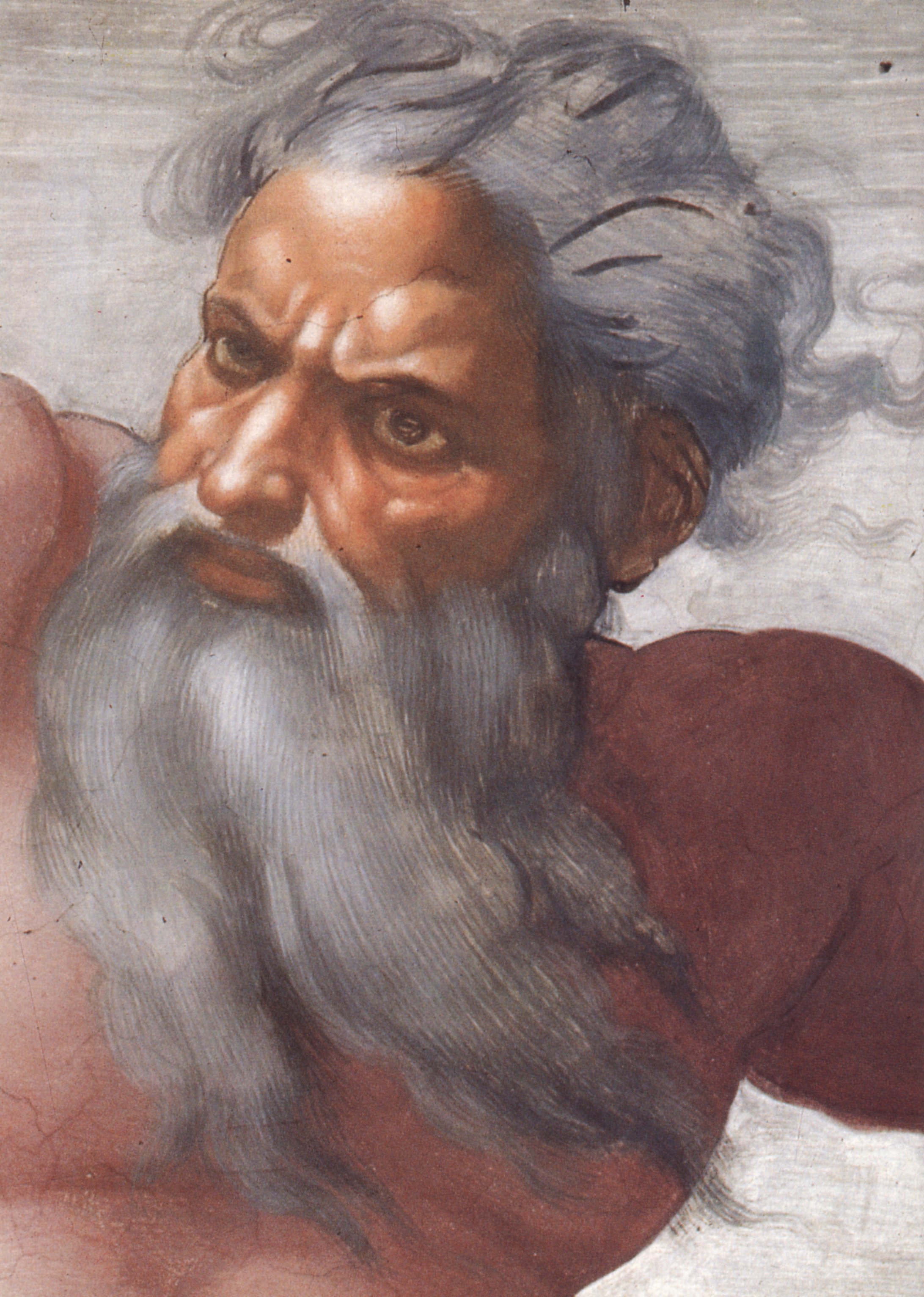
Michaelangelo's paintingIn a foreordained universe, where every act is according to God’s plan, why does he become angry when His actors fulfill their roles?

Again the anger of the Lord burned against Israel, and he incited David against them, saying “Go and take a census of Israel and Judah.” (2 Sam 24:1)

We ask why God would be angry with Israel since they were acting according to His will and then, why would he cause David to sin (via the census) and bring further wrath upon the people?

Poor, poor Uzzah and The New Cart

In an ongoing discussion with a brother in another forum (here) I was reflecting on the importance of Holiness in the Church and how it is affected by our theological constructs. There is a telling incident in 2 Samuel that gives us a lot to dwell upon. King David, recognizing that the Ark represented the earthly throne of God devoted himself and Israel to returning it to Jerusalem. His motives are good but his actions turn out bad, as we will see:

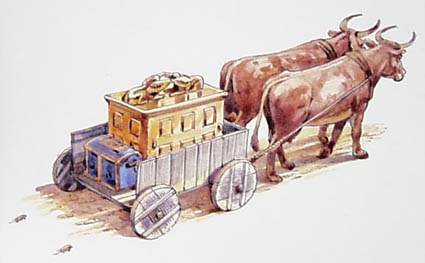
David again brought together out of Israel chosen men, thirty thousand in all. He and all his men set out from Baalah of Judah to bring up from there the ark of God, which is called by the Name, the name of the Lord Almighty, who is enthroned between the cherubim that are on the ark. They set the ark of God on a new cart and brought it from the house of Abinadab, which was on the hill.

ArkCart Oops, a small detail catches our attention. The ark is set upon a new cart for its transport back to Jerusalem. God should be pleased with our motivation and the way we decided to move it. After all, our hearts are in the right place. But, if we refer back to God’s instructions for handling the ark ( Exodus 25:12-15 ) we find that it is to be carried on poles balanced on the shoulders of the Levites. Why would David make such an error? Not because he was ignorant of importance of the ark or the instructions of the Lord but because he was affected by the culture. He saw the Philistines transport the ark by cart with no ill effect and he followed in their footsteps. Perhaps David thought that the ‘rules’ could be overcome by the charismatic worship of the Lord that surrounded the movement:

Uzzah and Ahio, sons of Abinadab, were guiding the new cart with the ark of God on it, and Ahio was walking in front of it. David and the whole house of Israel were celebrating with all their might before the Lord, with songs and with harps, lyres, tambourines, sistrums and cymbals.

We stand warned that worship that we deem worthy of God is not always so.

Neither are all of the actions that we take on behalf of God. It is easy for us as sentient beings to feel that if our motivations tell us we are doing the right thing that it will be perceived by everyone as being the right thing. This may work on an interpersonal level but our Lord is stickler for detail. Watch His reaction when we substitute what we think is right for what He says is right:

When they came to the threshing floor of Nacon, Uzzah reached out and took hold of the ark of God, because the oxen stumbled. The Lord’s anger burned against Uzzah because of his irreverent act; therefore God struck him down and he died there beside the ark of God.

Uzzah had the purest of motives in keeping the holy ark from touching the ground but this purity still conflicted with God’s clear instructions. How often do we substitute our ideas for what is right for the clear instructions of our Lord? For myself, probably far too often. When the consequences of our actions visit us, do we repent or do we get angry with God? David himself gives us a clue as to what usually happens:

Then David was angry because the Lord’s wrath had broken out against Uzzah, and to this day that place is called Perez Uzzah.

Perhaps beginning today, we reexamine the things we do to please God. Are they in line with His expectations or do we expect Him to fall in line with ours?

Leaving the past behind

Last night as our family gathered to study the word we looked at one of my favorite passages of encouragement, Philippians 3. There are many verses that are especially meaningful in this passage but the two that really caught my attention last night were 3:13 – 14:

Brothers, I do not consider myself yet to have taken hold of it. But one thing I do: Forgetting what is behind and straining toward what is ahead, I press on toward the goal to win the prize for which God has called me heavenward in Christ Jesus.

I am confronted by Paul’s model (and I’m sure I’m not alone) in forgetting what is behind, good or bad. Putting the past behind in return for the newly generated hope in what lies ahead should be an easy thing given the overwhelming greatness of our destination. A newly reborn heart that holds nothing but promise can be stubborn though. I don’t have a problem trading what I thought was really great about my life before Christ renewed me for a different but greater life now. My struggle lies in releasing old injuries, real or supposed, and moving forward.

Why is this such a challenge? Do we hang on to a grudge because we still lack sufficient faith to trust that God works all challenges for good? This might be a partial explanation. Some human notion of fairness pervades our lives and if we interpret an action to have wronged us, our hearts cry out for reprisal in some form. Our souls are turned inside out though and we being forgiven creations are to be forgiving creations. Do we hold on to hurts because it gives us an excuse for our own hurtful behavior? This could also be a remnant of our old being, something to be gotten rid of as we mature. The trouble is the difficulty in doing so.

Perhaps today, as the sun begins to brighten the eastern horizon, I can leave the past behind and commit fully to moving on towards the prize for which God redeemed me. I can only pray.

Christians and Nonresistance

Many times in the discussion of Christians and their attitudes toward war, nonresistance and pacifism get tumbled together as a single doctrine without distinction. In fact, nonresistance has numerous facets which make it unique from the doctrines of pacifism. Nonresistance appears to take a broader view of one’s responsibility as a citizen of a country and of the kingdom when it states that Christians should strive to avoid conflict as a daily practice but may, in times of war, serve their fellow citizens through military service in a noncombatant role. Matthew 5:39 gives the doctrine its name;

But I tell you, Do not resist an evil person. If someone strikes you on the right cheek, turn to him the other also.

This verse can lead a reader astray into thinking that the Lord has called His followers into a passivity in the face of evil but there is much nuance that confers a more positive and active sense to the command. The Christian’s initial order of business upon regeneration is to begin the process of separating him/herself from the world and its ways, including the common use of force to accomplish the objectives of living. The Christian also begins to develop an awareness that they are citizens now of a different kingdom of a higher order while being sojourners in the world. Behavioral expectations come from the former to be practiced in the latter.

Jesus said, “My kingdom is not of this world. If it were, my servants would fight to prevent my arrest by the Jews. But now my kingdom is from another place.”

While we sojourn here in this world, the Lord does not however command us to disengage from it. On the contrary, we are obligated to use spiritual means to bring blessing and do good for others (Rom 12:17-21). This said, the most crucial component of the new thinking of a regenerate person is to be directed toward the recognition of a new citizenship and the outward display of that privilege. Through the differences that are to be noted in Christian behavior, an evangelistic awareness is created among non-Christians, attracting some back to the Cross. They are at the center of God’s will and demonstrate their full faith in such. Some may have to pay with their lives for the privilege of following the Lord while others may be rescued by supernatural means. In either case, the testimony that remains will bear witness to greatness of God.

The distinction between nonresistance and pacifism comes in the interpretation of a couple of points. The first is the separation of the Church from the state. The commands of the Bible are written to the regenerate believers who, through their belief, obligate themselves to following and applying these commands. The pacifist will say that because violence is prohibited for the Christian, it is therefore prohibited for the government as well. Second, while Christians are citizens of God’s kingdom and look forward to eschatological restoration of that kingdom again on earth, they retain a responsibility to the state in which they live. The citizen must meet their obligations to support the state (Rom 12:1-7) (except as armed combatants) trusting that the end of the age will come at its appropriate time and usher in the new. This important distinction allows the nonresistant Christian to serve their government in non-combative roles for the common good.

The unbelieving world gives no credence to the doctrine of nonresistance because it is so contrary to the thinking and practice of the unregenerate. It appears that many fellow Christians also share this disdain of Christians who seek to follow the path of nonresistance. Those against the doctrine posit three objections against it. First, they point to Israel as a warring state as recorded in the Word of God. It is to be noted that Israel was a state of the world and an unregenerate people following a different set of commandments. Second, there appears to be a contradiction between the commands of Christ and his call to nonresistance. Critics point to passages such as Matthew 10:34 “Do not suppose that I have come to bring peace to earth. I did not come to bring peace, but a sword.” Careful exegesis shows that this passage focuses on spiritual division and not war; the same practice usually clears up the confusion surrounding other passages (Luke 22:35-38, 22:50). Finally, there is difficulty in defining the correct relationship of believers to civil government. This is perhaps the most challenging argument against the practice, sometimes leading to charges of hypocrisy. Romans 13:1-7 can be referenced as defining the proper relationship.

Cone’s Perspectives on Black Theology

To complete our examination of James Cone’s book Black Theology and Black Power and the affect that these theological suppositions may have had on Jeremiah Wright we will look into some perspectives that he offers in support of the way he recommends that blacks in America (in 1969) interact with the White church, the Black church, and ultimately, with the culture as a whole. What one finds most difficult to understand about the way Pastor Wright continues to apply this theology is that he sees no change has occurred over the ensuing four decades that have passed since the publication and codification of these ideas. White America and relationships between whites and blacks have been perpetually locked in the turbulence of the sixties, there must still be endemic racism (institutional racism per Carmichael), blacks are still attempting to throw off the heel of the oppressor, etc. Your own perspective on these matters will greatly affect then the way that you reacted to hearing the sermonic sound bites that hit the news several weeks ago.

Cone begins this way, ” Just as black revolution means the death of America as it has been, so it requires the death of the Church in its familiar patterns…We need a theology for the oppressed black people of America aimed at the destruction of racism in the society. Black theologians can no longer be tied to the irrelevancies of white American “Christianity.”” This theology lays its roots in black suffering; Cone insists that Black theology must see the reality of black suffering in the form of suffering and humiliation. The task of Black Theology is “to analyze the black man’s condition in the light of God’s revelation in Jesus Christ with the purpose of creating a new understanding of black dignity among black people, and providing the necessary soul in that people, to destroy white racism.” It is, at heart, a way of restoring the humanity destroyed by oppression.

Following the path alighted by reformers before him, Cone presses on to the issue of religious authority answering the question of whether or not there is a ‘black’ theology. He is quick to point out that all theological authority is rooted in Scripture as Luther had before him so ultimately, the validity of his theology must be measure against the Word of God rather than the structures of man. Black theology, fomented in and by oppression, is formed only of doctrines of God, man, Christ, and Scripture that do not contradict demands for freedom now. It would be difficult to contradict this demand in light of God’s consistent demand for justice throughout the Scriptures. The crucible of oppression plays such a key role because it was through this hell that blacks came to know the Savior and through it, know that He identifies with them in their condition.

Black freedom that breaks the bonds of oppression necessarily requires the creation of new values likely to be alien and threatening to white society. This evaluation is stated by Cone to be based on the fact that “white American “Christian” values are based on racism.” This new value system is to be oriented singularly toward bringing alive the spirit of self-determination in the consciousness of black people. The newly enlightened will no longer be dependent on the white oppressor for their notions of truth, reality, or the proper approach to the relief of their oppression. This harkens back to the pre-Civil War black church which, in its independence from the white Church, was creative in its approach to spawning the idea of freedom among its members.

In conclusion, Cone closes with this:

Black Theology believes that we are on the threshold of a new order–the order of a new black community. The Black Power movement is a transition in the black community from nonbeing to being. In the old order, black people were not allowed to be human; we were what white America permitted us to be–no-things. We took on false identities which destroyed our real selves, our beautiful black selves. The new order (partially realized now, but not fully consummated) is an order which affirms black self-identity.

The Black Church and Black Power Part III

I continue with an examination of James Cone’s seminal book Black Theology and Black Power, oft cited as a formative factor in the vitriolic preaching of Jeremiah Wright. [ Part 1 here and Part 2 here] Liberation theology takes many forms, many dependent on the particular geography and culture in which it foments. Particular to Reverend Wright’s brand of theological discourse is the Black experience in America and its effect on the psyche of both black and white Americans.

The Black church found its roots in the same oppression that gave rise to the ideals of Black power, enslavement. Initiated by the white oppressive slave owner as one more way to deny the African heritage of the men and women dehumanized by him, the black church nonetheless found that it must develop from within its own theological perspective. The black church was unwilling to accept the notion that Christianity was concerned only with the freedom of a man’s soul but not his body. Furthermore, Cone reminds us, the black churchman did not readily accept the prevailing myth that God had ordained slavery for them.

The Black church was born carrying these twin concerns in its DNA and an attitude of accepting Christian tenets while rejecting the place that the white church offered. The independent Black church became the first institution free from White power and at liberty to focus on the concerns of freedom and equality for Black humanity. Cone quotes Mays and Nicholson; ” Relatively early the church, and particularly the independent Negro church, furnished the one and only organized field in which the slaves suppressed emotions could be released, and the opportunities for him to develop his own leadership.” As with all institutions organized by fallen humans, the rhetoric heated to the point that outright rebellion against the oppressive forces could be heard from the pulpit. Early responses to this cry included Nat Turner’s revolt which returned a measure of violence against the slave owners.

Early theological reflection in the Black church surprisingly did not lead most black preachers to decide that God was against slavery. The oppression and violence were counter to the character of God to be sure but they struggled to understand (in a Job-like manner) why He allowed such misery to be visited upon people He loved. While some church leaders were able to sustain a patience for God’s passivity towards their misery and the evil practiced by their white brothers, others could not. Many black churchmen came to the theological conclusion that God’s character demanded a more active response linked to His absolute abhorrence of slavery. Taking this expectation contrasted to His supposed silence, some in the Black church began to speculate on the very existence of God, wondering as Daniel Payne of the A.M.E. church did, “Is there no God?”

The post-emancipation Black church displayed gradual changes in its theological underpinnings. While rejoicing in the freedom granted from slavery, black men and women faced new challenges in segregation and a more subtle dehumanization in Jim Crow. Blacks were certainly free from the bondage they had suffered but their freedom continued to be tempered by the fact that the White population at large failed to see them as fully human, denying the image of God within them. The former slaves lost their chains but had new bonds tied to them in the form of continued racist attitudes that led the black theologian to turn his focus from explorations of freedom to return to the White church’s theology of a better life ahead in the next world. No longer in rebellion, the Black church succumbed to the question, ‘what must be change about ourselves in order to be liked by our oppressors, thus making the evil stop?’ Cone points to this era saying “The black minister thus became a most devoted “Uncle Tom,” the transmitter of white wishes, the admonisher of obedience to the caste system.”

He makes this as the point at which a decline in the Black church began as the forces of capitulation to white demands for continued obedience softened the pulpit message. This weakness in the Black preacher is partly justified by Cone as he points out that to continue to challenge the White power was to put his church and his people at risk; an explanation perhaps, but the lack of obedience to Christ that it involved was a sin. The Black church convinced itself that they were doing the right thing in advocating obedience to white oppression in order to experience heaven in a future age. Albeit for different reasons, the apostasy of the Black church mirrored that of the slavery supporting White church.

Cone moves quickly forward to the turning point brought to life with the ascension of Martin Luther King and the return to confrontation between Blacks and Whites in America. He saw in MLK a rapid refocus in the Black church on the social justice Gospel that threatened Whites in their evil and also lead to the leader’s death. The author’s thesis comes full circle at this point in the book as he demands that Black power (the demand that Whites recognize the full humanity of Blacks and treat them with full equality as men (and women))  be at the center of the Black church and it’s theology. The first order of the Black church must be to re-instill in Blacks the gospel message that they are made beautiful and strong in the image of their Creator and that anyone who attempts to destroy this message (i.e. the White church and White culture) runs counter to the will of God. Cone reiterates, “The existence of the Church is grounded exclusively in Christ. An in twentieth-century America, Christ means Black Power!” Responding to the call of the gospel requires, in his mind, a return to the rebellion of the pre-Civil War black church and complete identification with the rejected and downtrodden, as Christ the Lord did.

Black Power & Black Theology Part II

[Part I here]

Black power takes a myriad of forms throughout society in politics, culture, and education. As a theologian, James Cone goes on to explain the nature of Black power in the Church. As we learn to expect, in his mind there is a Black church and a White church. As we saw earlier, the process of the slave liberating himself from the devastating dehumanization and forcing the oppressor to recognize his God given image is the heart of Black power. Mr Cone states bluntly, “I contend that such a spirit is not merely compatible with Christianity; in America in the latter twentieth century it is Christianity.” He extends the liberation vocabulary to the Church as a whole, saying that the Church is composed of those called by God to share in his liberating activity. There are three activities that mark the modern (NT) Church: preaching (kerygma), service (diakonia), and fellowship (koinonia). Each is a weapon against white racism from both the Black and White perspective. From the viewpoint of the formerly oppressed, the preaching of the gospel is a message of freedom. Freedom from racism – Christ has conquered it; Freedom from oppression – Christ has freed you; Freedom from dwelling in one’s current circumstances – the Christ has set you free. It is, Cone says, the message of Black Power.

The White church fails in its Gospel mission in the latter two aspects of being the Church, service and fellowship. It fails to render services of liberation to the previously enslaved or to be the manifestation of the new society. Cone points to the failure of the White church to reach out in reconciliation (contra his earlier proclamation that Black power meant having nothing to do with Whites and their church) or to engage in true, equality-based fellowship. He sees the failure of the White church to radically follow Christ in obedience as unique to them (again, contra to his exclamation that many blacks have failed to grasp their freedom from enslavement.) In fact, to finally warn blacks away from engagement with the White church, the Antichrist is identified as the white Christian body.

The Antichrist..as in one most evil.

Is there hope then for a change in the White church that might lead to reconciliation between the races? Cone responds in the affirmative and with cautious theological support. In order for this chasm to be bridged, the White church must be willing to turn to a radical obedience of Christ and die. Whites must be willing to die to self and old ideas of the superiority and righteousness. They must be willing to die to their own status and follow Christ into radical identification with the poor and the oppressed, so much so that they themselves feel crack of the oppressor’s whip on their own backs. The whites who want reconciliation must be willing to join the others proclaiming Black Power. He must be both the agent of and the object of liberation.

Black theology is actively integrated with life as opposed to the overly scholastic theology of the greater White church. It is an encompassing worldview that instructs the follower in how to interact with a fallen world that appears to actively work against the black man’s liberation. Cone sees (in 1969) that the White church refuses to participate in this reconciling era and in that refusal, little hope for the future of black-white relations.