Is pacifism a luxury belief?
Pacifism is not a philosophy defined by a single belief. It encompasses a range of positions regarding nonviolence in the face of aggression. Pacifism is a costly position. The reality of violence will demand a costly response, ranging from complete surrender on principle to the use of overwhelming force in defense. The cost of holding a pacifist position requires consideration, as these costs cannot be avoided or dismissed. Pacifism for one comes at the expense of another who will use force in defense of the right to hold that ideal. Philosophy like this is very costly.
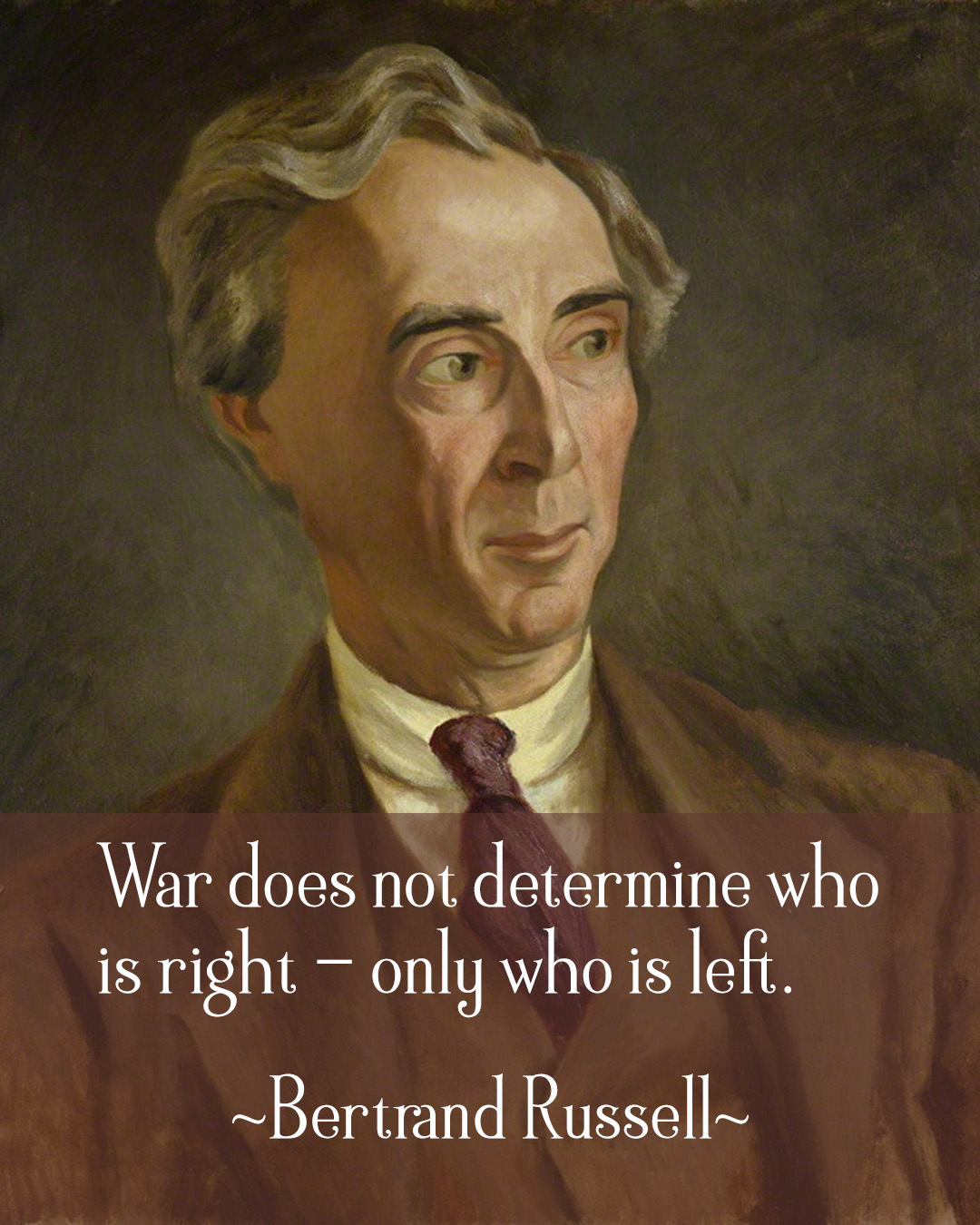
Twentieth-century philosopher Bertrand Russell was a pacifist. He summarized his position by saying that “[T]here is almost always a way, though sometimes a much slower way, of doing things without violence.” Russell invited people to view war with the same revulsion that they view the murder of an individual, and he sought widespread adoption of his idealism from the supposed safety of the academy. His ethic, developed through a mindset of consequentialism [1], set the foundation for his nonviolence ethic. The calculus for arriving at this moral position was binary for him: he believed that war is always bad and produces no good outcome; therefore, we must avoid it at all costs. For Russell, pacifism was not a passive moral position. He lived out his beliefs as he stood in active opposition to World War I, writing for pacifist publications, protesting the government’s conscription of young men, and advocating for many to adopt the mantle of conscientious objectors. The exercise of his principles was costly. Russell lost his university position and was later jailed by the British government for his attacks on their foreign policies. Russell paid an extraordinary price to remain true to his position of nonviolence.
With a historical event like either of the World Wars, we can perform a thought exercise involving the adoption of nonviolence as a system of political belief. Suppose Russell were successful in persuading the Crown and the entirety of the British Empire to adopt pacifism. Would nonviolence have persuaded the German coalition to drop their weapons as they examined the consequential outcomes of the war for themselves? This simple case study points to the multifaceted nature of examining pacifism. In its most straightforward application, pacifism is the belief that war or any kind of violence is not to be used to resolve conflicts. This is a good and admirable, even desirable, position if it can be a principle that avoides fighting. To stand in an extreme position on refusing to meet violence with violence, an individual must be prepared to give their life as the cost of their stand. Pacifism on the national level requires a second consideration. If, like Russell, an individual will pay any societal cost for adopting this position, then it is a noble stand and one’s life can be arranged in such a way as to adhere to it. The cost of adopting pacifism as a political philosophy that governs a nation containing several million individuals becomes much more costly in a world filled with potential aggressors who do not share the same belief. The cost of extinction by their violence is not a price all will be willing to pay, nor should they be expected to.
Over time, Bertrand Russell changed positions on his commitment to nonviolence. The philosophy of pacifism has a history of evolving as it collides with reality. Nonviolence is not a monolith but a graduated spectrum of degrees of absolutism. Russell’s initial position was ‘absolute nonviolence.’ This was characterized by the belief that all violence of any degree was always morally wrong. The absolutist position would maintain that even in situations of self-defense or protection against a greater evil, violence is not to be used. The cost of adopting this position on the nonviolence spectrum is quite high unless every other human and human institution adopts the same position. (This question of absolute non-violence is examined further in the next essay about Christian Pacifism and the command to “turn the other cheek.”) Shortly after the initiation of World War II, Russell’s view of pacifism changed from an absolute position to what he referred to as ‘relative political pacifism.’ It is notable that here again, consequentialist reasoning moderates his position. Russell continues to believe that war is always evil, but faced with the violence of war, engaging the enemy might be the lesser evil in contrast to the aggression. In a calculation of cost/benefit, the price of nonviolence in the face of aggression and the potential loss of national sovereignty from an invasion of his home, Russell judged the evil of aggression to be greater than the evil of fighting back and stepped back from the extreme position.
Approaching a discussion of nonviolence requires the consideration of multiple arguments. A central consideration in the adoption of pacifism is how to address the prevalence of violence in the world. Its existence contributes to the evaluation that the price I, as an individual, will absorb is not the same cost that a country must pay to hold the same national belief. A commitment to absolute nonviolence on a nationwide scale demands the agreement of every citizen, each of them clear as to the existential cost of not taking up arms. Should one citizen demur, it would be a dereliction of the social pact to leave them unprotected from violence.
Personal pacifism is noble, and commitment to absolute nonviolence is commendable, but the cost of holding this position is often repressed. If I have the freedom to commit to nonviolence because the nation I live in has a strong military force to protect me from aggression, the cost to me is low. But that cost, however, transfers to those who take part in the defense. Pacifism is a luxury belief in that I can transfer the cost to others. Consider the same scenario borne out on a local level. Nonviolence can be my default when I live behind the walls of a gated community with a strong police force to enforce my separation. Can my neighbors in every part of the community have the same opportunity to exercise their commitment to nonviolence?
A pacifist may object to the theme of this essay on the grounds that it misunderstands or misstates the moral force of their philosophical position. As Russell discovered in his move from an absolute to a more relative position, the principles are challenging to implement. This is partly because pacifists claim that they are not arguing that nonviolence is safe nor free of cost. Their central principle is philosophical rather than practical: participation in violence is morally abhorrent and corrupts the individual or state, even in situations where it appears unavoidable. The arguments surrounding the cost transfer are also nuanced. The pacifist may be fully prepared to surrender their life or freedom rather than abandon the principle of nonviolence. Labeling pacifism as a luxury belief cannot be one-sided. It must take this individual into account.
Pacifism may rightly be viewed as a luxury belief secured by those willing to rise in defense of one who insists on total nonviolence. Until the world is at peace and every human being makes a similar pact of nonviolence toward others, the need for security will demand at least some citizens be willing to fight. The range of pacifist positions, moving from absolute nonviolence to the recognition that sometimes violence is thrust upon us, is a spectrum of philosophical ideals that are worth examining. Nonviolence is an excellent position, but it is a costly one.
Notes
- Consequentialism is a philosophical view that the moral rightness of any action can be determined by the consequences of that action. If the action produces an overall good, then it is a morally right choice. The opposite is then also true: negative results make an action morally wrong. The most apparent challenge in this philosophical exercise is the determination of ‘good.’