Sharing a Vision of Revitalization

Carry the Fire

The challenges and complexities intrinsic to church renewal demand a single, shared vision for the revitalization to have a hope of being successful. Whatever contributed to the decline will have left lasting marks and lingering infirmities. The culture at large will continue to ignore or outright denigrate the Church and her practices. Countless uncategorized factors will actively impede the renewal process. To maintain momentum and direction against these headwinds, a church determined to find new life must have a single vision of its new life shared among all those who commit themselves to the journey. Everyone must own the collective vision, and leaders must carry that vision and when darkness and doubt close in, raise it as a torch to push back the threatening shadows and light the way forward.

Photo by Kevin Finneran on Unsplash

A clear vision, shared by the church, encourages continued forward movement even when various hurdles present themselves on the way. A shared vision recognizes that obstacles are not limited to external factors alone, there are various internal realities that can hamper the pace of renewal. Years of decline are almost always evidenced by limited or depleted resources. A vision of renewal will need to be narrowed in the early segments of the journey so that these limited resources (monetary, human, etc.) can be marshaled and dedicated to the near-term goal. The renewing church also cannot be everything to everybody. A shared vision enables us to say (without constant turmoil) what we are called to be and also what we are not called (at this time) to be. The renewal vision serves as a touchpoint for everyone as the horizons can be easily pointed out, obstacles recognized and agreed upon and the goal(s) used as an ultimate authority when alternative directions present themselves.

Developing a statement that can support these requirements is not a simple task. A vision for revitalization must consider the Bible’s purpose for the Church, the Holy Spirit’s intent for your church, and the local context in which Christ has planted you. A vision for revitalization is a tool that will be put before the Renewal cohort as often as possible. Unlike countless church vision statements, it will not be printed, framed and placed on the lobby wall and then forgotten. The shared vision is rehearsed, again and again, in the same the Bible repeats mention of God’s goodness, His grace, His love; participants need to be reminded of the reasons they are laboring, committing their time and resources, perhaps even suffering. Another important facet of developing the renewal vision is that it need not be “once for all time”, the authors can be comfortable viewing the vision as temporal. The church can develop a vision for the first leg of the journey (return to “health”, address the issues that led to decline, et al.) and then discard it in favor of a vision of the next horizon. Taking this attitude enables the renewal journey to be envisioned as a series of intermediate goals leading to longer and longer horizons, making each one eminently reachable.

A shared vision is much more powerful written in that light; if the vision is to be owned by each member of the revitalizing church, write it in community. The composition of this group includes the members of the congregation, to be sure, but also the living Word of God, His Holy Spirit and a composite view of the neighbors blessed by the new life of the church. The vision must be biblically grounded which automatically narrows the scope of the vision as to the purpose of the Church and, unless an immediate move out the location is in the cards, the vision must also consider the local conditions, people and realities that the church is meant to serve.

Writing the renewal vision as a collective exercise leads to the likelihood that everyone will take spiritual ownership of the statement, and that they will be spiritually dedicated to the vision and the Giver of the vision. Ideally, as the renewal vision takes the form of spiritual commitment, the body will recognize the necessity of praying together and praying deeply. The renewal group must not be satisfied with perfunctory prayer asking for blessing and guidance at the writing sessions. Renewalists must pray deeply together seeking to be shaped and emboldened and committed to reaching the goal of the vision. They must pray to be changed as needed to accommodate the demands of the changed realities. The group must pray to be fully sacrificial in their own comfort, their own wants, and perhaps with their own treasure. It is essential that the renewal cohort pray together to experience the guidance of the Holy Spirit as one. They need to hear the laments of those who have lived through the decline, the heart-hopes of those who see a glimmer of new life, even the struggles of those who are having a hard time with the changes that accompany the journey. Prayer is not an optional adjunct to the renewal process and it cannot be limited as a requirement for the pastor and elders alone. It is essential that the first commitment of the church, especially when desiring renewal, is to be a praying church. We must always keep before us the quote of Matthew Henry, “When God intends great mercy for His people, the first thing He does is to set them a-praying.”

Prayer is fueled by scripture and the congregation journeying toward revitalization should commit to collectively read and study God’s word, alone and together. The effect of regular immersion in the bible is well documented (“a lamp unto my feet”) for personal growth. Bringing this individual study together in a group setting deepens our understanding of the Bible’s story as we gain insights from one another, seeing truths revealed by the Holy Spirit to another. Renewal reading and study build renewal confidence as we collectively believe that what God has powerfully done in the past, He can easily do again (Hab 3:2). Deeper knowledge of what God reveals in the Bible makes the travelers more sensitive to what they are seeing and experiencing on their current spiritual journey.

The power of a shared vision for the renewal of a church is undeniable. As the leaders step out ahead, taking determined steps to lead the life of the body back to vitality, the vision lights the path, imbues confidence, and serves as the true north for aligning the map and plans. Leaders will need to be consistently rehearsing the vision before the renewal cohort, reminding them of its importance and painting a picture of where they are headed. When a glimmer of light is seen on the horizon, the leader must point out the sometimes-faint light for all to see. The leader must be guide and interpreter on the journey, pointing out landmarks and teaching their importance. He or she should be sensitive to making note of where God is at work in the life of the church and making sure that these events are memorialized. There is little more powerful than pointing out how God is working through or blessing or clearly guiding a church. Placing these divine interactions in the context of the shared vision builds the encouragement for the next step, the next week and the next year.

Joy Comes in the [Easter] Morning

Joy Rises with the Easter Sunrise || Warren Rachele

[Originally published in the Times-News during the Time of Covid, 2020]

Easter is a holiday marked by stark contrasts. The pastel pinks and sunny yellows of the springtime celebration feel out of place against the deep crimson and shadows of Good Friday. The sadness, despair and horror of the passion of Jesus give way to the elated celebration of Resurrection Sunday. Happiness and joy have similar contrast, though they are often spoken of as having the same meaning. The happiness of a beautiful Easter sunrise can be swept away by a snowstorm the following Monday. In contrast, joy that is anchored in the Easter miracle is lifelong and stands up to these storms of life. Americans are fond of quoting the Declaration’s promise regarding the “pursuit of happiness”, recognizing the ongoing desire of the heart but also, the elusive, sometimes fleeting nature of that emotion. What people really want, even if they can’t put it into words, is joy. Joy that is not easily stripped away and this is the joy of Easter, the joy of Grace.

If a poll were taken, the results would probably show that everyone wants to be happy. People throughout history have chased happiness in countless forms. Some find it in things, some find it in experiences and others still find happiness in relationships. But once found, can happiness be kept? Can this emotion be protected from the changes in life or are people looking for the wrong thing? Perhaps, rather than settling for momentary happiness, what their heart needs is the state of being joyful.

In our talking with one another people often use the words happiness and joy to mean the same thing. Though similar, feelings of happiness are generally controlled by what’s going on in life at any moment. If things are going great, happiness follows. If things take a turn and troubles become the norm, happiness can fade quickly into unhappiness. The heart wants something more stable, something that is not bound to the way things appear at any given moment. The heart wants joy.

The heart wants joy because it’s a windbreak against the storms of life; the storm will still pass over, but its effect will be less severe. Joy is anchored to a foundation of long-term contentment. The foundation results from having faith in something unchanged by day to day circumstances. A person who has this faith faces the darkest of dark moments and says, “this too shall pass.” Joy is built on this faith. Joy rests on belief that even if a storm doesn’t pass anytime soon, there is still confidence in the solid rock on which it stands. People who have joy trust in the way things are going to work themselves out.

Easter lays the foundation for people to know joy. Understanding Easter begins with the contrast of Good Friday and Easter Sunday. Jesus was crucified on Good Friday and it appeared that all the evil of the world had been revealed in that moment. The crucifixion gave the appearance that all hope was lost to even his closest followers. The happiness they felt from the promises they had seen in him was swept away. In their sadness they scattered, each looking for a new way to be happy again.

When Jesus rose on that Sunday morning, joy rose with him. His unhappy followers were the first to discover the truth of joyfulness. They learned that what had appeared to be defeat and snatched their happiness was something far greater, something eternal. Jesus was restored to life and he put all the momentary promises into the perspective of history. His followers were given an intimate demonstration of the contrasting natures of happiness and joy. While things might’ve been dark for a moment in their lives, the eternal promises of redemption assured their joy in both the rain and the sunshine.

The promise of joy is as true today as it ever has been. The joy of Easter is woven into the promise of redemption, of all things being made right. Jesus is the centerpiece of things being made right, his death making it possible for the restoration to proceed. The empty grave of Easter morning assures us that restoration is proceeding as planned. Joy, indivisibly welded to that truth, sustains through a day or two of trouble or a thousand nights of darkness. Happiness is fragile and positive thinking might maintain it for a day or a week, but if there is not the peace of deep-held joy, happiness will eventually turn to sadness. The deepest, darkest red of the crucifixion cannot strip the joy of belief that the bright sun of everything being made right is held in place by the eternal promises of Easter morning.

Reverend Warren Rachele is the pastor of Hope Community Church in Paul, Idaho.

A Hope For Easter

[Originally published in the Times-News in the Time of Covid, 2020]

Hope is an optimistic outlook that is tested every single day. Hope sustains people and gives meaning to life. Hope, true hope, is not wishful thinking. Rather, it is a trust based on unchanging truth and this hope will not falter. This is the hope that accompanies the first glimmer of sunrise on Easter morning.

For the groups big and small that had followed Jesus into Jerusalem in the week of his passion, the crucifixion gave the sense that all hope was lost. The Messiah was dead and destined for a borrowed tomb. His followers, no doubt recounting the many thoughts they held about him, didn’t know what to believe. The hope of many of these followers turned out to be little more than wishful thinking when the Messiah Jesus did not fulfill their preconceived notions. Doubt plagued them and hopelessness crushed them.

 When the sun broke the darkness on Easter morning and a tiny group of his followers approached the tomb, hope was reignited. Jesus was not in the tomb, an angelic agent giving the incredible news that the Lord had risen. Hope had risen. Not hope that was based on wishful thinking or far-fetched scenarios but hope that was now anchored to eternal promises and unbreakable. This was the hope of Easter.

The hopelessness that plagues our world today, especially among the vulnerable young, is caused by hope in things that are temporary, things that are change by the next day or the next hour. The betrayal of a friend or the bullying of the crowd, not enough likes for the last picture that was posted or any number of other here-today-and-gone-tomorrow things that people believe will give meaning to their life. Each fails and hope slips further away, turning out to be no hope at all.

The hope that rises on Easter morning is rooted in the eternal, making it the antidote to hopelessness. Jesus rising on that Sunday morning was a promise made and a promise kept reaching all the way back to the earliest days of human history. Rebellion against God had created deep, wide gulf separating him from humankind. God knew that those who bore his image would be forever lost unless he bridged that gap. The perfect holiness on one side of the gulf required his sacrifice to create a bridge to the other side. No sooner had rebellion entered the world than God promised that he would make a way for the two to be together again. Jesus was that eternal promise fulfilled. Redemption and restoration began and hope was the result.

The hope of Easter morning has no expiration date nor is it limited to a certain group of people. It is eternal and available to all people. The foundation of hope formed by the promise made and the promise kept gives a solid footing. The promise that everything would be set right was made in the beginning of history, fulfilled early in the first century and stretches into eternity. It is this unending nature that makes the resulting hope unique. The ephemeral things that people often attach their hope to disappoint because they are just that, anchored in little and threatened by the west wind. When hope is followed by this disappointment time after time, it reveals itself to be untrustworthy. A lift of the eyes and one finds the superior hope of new life, the hope of Easter.

Hope anchored in the promise of redemption and restoration sustains through the temporary ups and downs of life in this world. The daily news of pandemic and the enormous personal costs being counted reveal shallow hopes in countless ways. Money that was counted on suddenly disappears. Plans made are abruptly canceled. If hope is tied to such easily changing things then it’s really no hope at all.

The hope revealed in the sunrise and the empty tomb of Easter morning does not change nor waiver. It is a hope that is untouched by the crisis of today or the sorrow of tomorrow. Hope resting on the foundation of eternity is the source of inner strength that have carried many over the bumps and challenges of life. It is this hope that enabled Beethoven to compose the Ode to Joy even as deafness stole his hearing. Eternal hope carried Abraham Lincoln from total poverty to the presidency. Rosa Parks, steeled in her resolve by the promise of eternal hope, ignited the press for civil rights for all. The hope of the empty grave is the hope that transcends any of the countless challenges people will face in this life. This is hope for all. This is the hope of Easter.

Reverend Warren Rachele is the pastor of Hope Community Church in Paul, Idaho. © 2020 Warren Rachele

Patience in Leadership

PATIENCE

“What would you like for breakfast?” mother would ask.

“Ice Cream,” came the reply. The actual food requested was immaterial as it was a cycle of equally inappropriate breakfast items.

“No, I think we’ll have porridge this morning.” Mother did not introduce so much as an extra breath before pulling out the pot in which the oats and water would soon be simmering. She knew–because her mother had trained her as had her grandmother trainer her mother–that a diet of ice cream, cookies or cake was not the foundation of a successful day or life. She was immune to the disappointed voices and saddened faces when the desired bowl of chocolate chip appeared as the mottled beige of oatmeal, perhaps sweetened with a touch of brown sugar. Mother knew her role and she looked to the day when her children would become adults with their own children, perhaps smirking at the fleeting thought of being that grandmother who gave her grandchildren everything they wanted. Even ice cream for breakfast.

But mother said no and meant it. She knew that her role was to nurture and raise you, and she did it. And aren’t you glad she did?

Leaders of God’s people must be equally steadfast in adhering to the promises of God despite calls to ‘turn back’, ‘stay here’ or ‘make us gods who will go before us’. While Moses trembled in the presence of God who outlined the way in which his people would engage Him and worship Him (Ex 20-31), the recently freed people became restless and demanding (Ex 32). Forgetting what they had witnessed in their escape from bondage, forgetting the grace that had secured them from the angel of the Lord, forgetting the protection that God had promised and demonstrated, forgetting the provision of food and water; forgetting. Forgetting, either by lapse or design, but forgetting nonetheless. Forgetting, and demanding that their wishes be satisfied.

Aaron should not have forgotten however. Aaron who had witnessed the miraculous work of Yahweh firsthand. Aaron who had learned to trust God alongside Moses and who, as the interim leader of the Hebrews, needed to stand firm in that trust despite the length of Moses’ absence. A leader needed to stand and say “No!” No, God has given us a vision for the future as His people and we will not deviate from that vision. No, God’s providence will not be denied. No, God’s grace will not be discounted. No, the freedom from bondage given to us by grace will not be ignored.

The leader of God’s people must be patient and steadfast in leading them forward toward the vision that God gives. Many will want to stop along the way citing ample food and water supplies but the leader must continue the march. The leader must not hesitate, even when the siren songs of comfort and tradition tempt people away from the path. Even when trouble appears to be insurmountable and failure sure, like the Red Sea stretched endlessly before them and Pharaoh’s army speeding from the rear, the leader of God’s people must wait patiently for God to move and he must lead the people to do the same.

Because God will move, just as He has promised. At just the right moment and in exactly the right way.

SIDE BY SIDE: 2 audacious lists

Two Lists Will Revolutionize Your Relationship with God

Praise the Lord, O my soul; and forget not all his benefits–   Psalm 103:2

2106907984_b1050bd895_b

In a busy life it is all too easy to miss God at work. We can become so wrapped up in our daily lives that the sometimes subtle moves of God all around us can fade into our surroundings and we walk right by.Some will not be noticed and missed forever. Others will be sensed at the amygdala level and later, through the prompting of the Holy Spirit, will receive the full attention of the brain. We can call these ‘near misses’.

It’s certainly possible to proceed through life unaware of God at work. We can remain faithful and repentant to the best of our ability. We can just exist, naïve to what we are missing but this is a difficult position to maintain. Once the Christian has tasted the briefest experience of knowing the living, active God at this level, he is driven to experience more. This is by design in the relationship between God and human kind and it serves a purpose in the course of discipleship.To become cognizant of God at work begins to form our confidence. He has promised to be at work and we have seen him at work. Confidence builds faith. Our witness to the work of God trains us to place ever greater trust in His promises. Faith builds boldness. If God has been faithful in promise A He will be faithful in promise B despite appearances to the contrary. Greater trust, greater faith and audacious boldness lead to the fullness of life promised to the people of God.

Two sheets of paper can start the trust building exercise. On page one, list the experiences you have had that evidence God at work around you. This is an easy list to start since the first experience you have to record is your own salvation. Build from there recording moments in which you have seen God at work in your life or the lives of others. Make note of the transformation that occurred. Search the scriptures for promises that align with that experience. Write it all down and set it aside.

The second sheet of paper will contain a record of near misses, those times in which you walked past God at work only to realize it later. Perhaps it was an evangelistic opportunity or a moment in which you could have encouraged another person, brought correction for them, comforted them. We call these near misses because the Spirit reminds us after the fact that we passed by the Father without notice. This activates the Reticular nerves and we become more aware of our surroundings, seeing things that had not been noticed before.

When you have completed both lists place them side by side. Ask yourself, if God has been faithful and actively working in those instances on list A, won’t He also be faithful and active when you become more aware of the moments on list B? Of course! The witness of list A builds your confidence and your increasing confidence contributes to a deepening faith. That faith and your heightened spider-sense will transform you from being an observer to one actively seeking to be involved with the Father’s work. Now, you’re living.

image by Ana C.

Psalm 78 – In Spite of His Wonders, They Did Not Believe

image It was not unusual for Jewish religious leaders to rehearse their covenant history with God in writing, or verbally in worship. The fickle loyalty of the human heart had loved and loathed with equal vigor again and again throughout the whole of their relationship with God. Typical of this ever changing relationship, the psalmist records this:

Thus he brought them to the border of his holy land,

to the hill country his right hand hand had taken.

He drove out nations before them and allotted their lands to them as an inheritance;

he settled the tribes of Israel in their homes.

But they put God to the test and rebelled against the most high;

they did not keep his statutes.

Like their father they were disloyal and faithless, as unreliable as a faulty bow. (Ps 78:54-56)

Christians often wish aloud to be restored to an age of signs and wonders, claiming that their faith would be impenetrable to doubt if they could just see a single miracle. Saving the miracle of changed lives that surround them for a later discussion, we need only read this psalm or the Old Testament to know that this is bunk. The human heart is, above all else, dedicated to self.

The Christian will say aloud that ‘their heart belongs to Jesus’ but in practice, they are fully aware of the parts they hold back for themselves. We put our faith in God who is unseen and the corruption of our heart is such that we continue to harbor doubt about whether or not He might come through for us. We read our bibles and see that time after time, God has been perfectly faithful and yet we wonder if this is the day when He will not. We wander in a desert of our own making.

There is no such thing as a part-time Christian. Christ lives in us but did not displace us. Paul’s words to the Galatian church remind us “I have been crucified with Christ and I no longer live, but Christ lives in me.” (Gal 2:20) The struggle is internal but must ultimately end in our surrender of the parts of our hearts that we insist on keeping to ourselves. The signs and wonders we seek are inside of us and ready to be displayed only at our own humility. Problem with anger that you want to disappear? Bend the knee and turn it over to Christ in you and see it reworked. Unable to control some personality aspect? Give it to Christ in you and see it changed. Allow the Holy Ghost to completely overtake your heart and the signs and wonders will be before you constantly. Belief will grow to the benefit of all.


Grace and peace to you.

image by kmakice

Lent Spent with the Psalms Day Four

image“’For this is what the Sovereign Lord says: I myself will search for my sheep and look after them. As a shepherd looks after his scattered flock when he is with them, so will I look after my sheep. I will rescue them from all the places where they were scattered on a day of clouds and darkness.” (Ezekiel 34:11-12)

It’s easy to misread the skies and come to a faulty conclusion. Here in Colorado, the mountains can point you in the wrong direction as they hide the truth. Just yesterday a clear sky in the morning would have let you leave the house in a light jacket that would have offered little protection as you scraped the snow and ice from your car in the evening. We can fall into the same error in our spiritual lives, looking at the clouding skies and believe that God has let us go beyond his loving grasp.

The faith built of our ever more intimate relationship with our Father tells us something quite different. Look at the final verse of Psalm 11,

For the Lord is righteous, he loves justice;

upright men will see his face. (v7)

Though it might seem as though we have been lost by him and surrounded by trouble and challenge, His people will see His face. He will seek you out, there is no place you can go from which God will not bring you back. As we walk toward Calvary, faith lights the way. As we near the Cross, the light will lead us on.

The Lord is in his holy temple; the Lord is on his heavenly throne.

He observes the sons of men; his eyes examine them. (v4)

Grace and peace to you.

image m angel herrero

Psalm 60 With God We Will Gain the Victory

imageYou have rejected us, O God, and burst forth upon us; you have been angry – now restore us!

You have shaken the land and torn it open; mend its fractures, for it is quaking. (vv 1-2)

Those who read the Psalms devotionally or at random often fail to notice exactly how much of the Psalter is composed of pleas for restoration and paeans to God’s faithfulness in doing so, ‘one more time.’ In verse after verse the psalmist is hemmed in by his enemies and threatened with destruction. He raises his eyes and voice to the heavens and asks God where he is in this time of travail. In every instance, the same answer comes back: “I am here.”

Our lessons in coming to this observation are twofold. The most difficult of the two is to come to the realization that God will turn away from us during different seasons of our lives. The duration may be brief or endure for a long time but the scriptures clearly demonstrate that we risk the the turning of His Face.

You have shown your people desperate times; you have given us wine that makes us stagger. (v3)

Whether the purpose be our redemption through repentance and the subsequent restoration or to enable a larger purpose in His plan, God may cause us to suffer. Do we trust Him in this struggle? Are we willing to be sacrificed for the larger purpose of an eternal plan. To God, our lifetime is but a second; to us it is an eternity of testing. Surely He knows this but can we learn this lesson and shift our perspective into eternity, lifting our eyes from the rocky ground in front of our feet?

The second of the lessons enables us to endure the first. We can trust in God completely. We can dismiss worry and erase our doubts knowing that He is perfectly good and that whatever state we find ourselves in perfectly aligns with His eternal course for history.

But for those who fear you, you have raised a banner to be unfurled against the bow. (v4)

We can unfurl the banner of the gospel, swath ourselves in the good news, and march forward. If our rejection is brought about our own behaviors we can turn from them and seek the restoration that God willingly extends. If our separation is a part of the larger purpose we can be faithful, knowing the ultimate good will come of it. As the Psalmist shouts,

With God we will gain the victory, and he will trample down our enemies. (v12)

Image by ronny andre

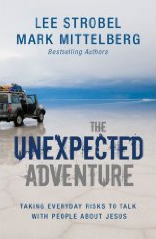
The Unexpected Adventure by Lee Strobel & Mark Mittelberg

imageAs we follow our particular paths through life we’re all going to encounter people like Jack, people laying tile nearby another conversation, and spend moments with our neighbors and friends. We may find ourselves in the company of a young Hindu farmer or even a Billy Moore. In every one of these interactions there is an opportunity for God to call us into the adventure of a lifetime, opening the door for a spiritual conversation that may be the turning point in someone’s life. In The Unexpected Adventure, authors Lee Strobel and Mark Mittelberg draw us into the excitement of recognizing these moments without the pressure that sometimes accompanies a programmed evangelism process.

Adventure is about opportunity. Strobel and Mittelberg speak do not set out a program as we might find in Mark’s earlier effort ‘Becoming a Contagious Christian’ and the training program of the same name. Thousands of churches have participated in these types of programs and trained numerous people in how to have the most important conversation that can be had. You learn your spiritual style and how to find those interactions where this can be utilized to the greatest advantage. In many cases, men and women have been successful in implementing the lessons and have gone on to important evangelistic efforts. Many others have found themselves watching and waiting for their opportunities to put the steps into practice but have been too shy or hesitant to move. What sets Adventure apart is its singular focus on the moments of spiritual opportunity that surround us every day. Strobel and Mittelberg serve up vignettes of personal contacts in which they recognized an opening to tell the gospel story, both directly and obliquely.

Written as a collection of 42 devotion-style entries, each of the chapters serves up a different example of the myriad ways in which God arranges spiritually needy lives to intersect with His evangelistic partners, you and me. From an overheard conversation with someone else, through a misunderstood Buenos Dias, or to a close friend who confides her darkest secrets to you; each is a possible invitation to introduce the hope that you know to someone keenly in need of that hope. The variety of encounters that the authors recall is so broad that you will be able to easily locate yourself in more than one. When you have tuned your spiritual antennae to be alert to these invitations you will find that it becomes the most natural thing in life to share what you know without the pressure of thinking about the ‘E’ word or worrying that it must be done in a specific way.

Strobel and Mittelberg have made a fantastic contribution to the Church and her commandment. This book stands up with Rebecca Pippert’s Out of the Shaker, Paul Little’s Know books and Joe Aldrich’s Lifestyle Evangelism in making sharing your hope a natural outpouring of your transformed life. What sets Adventure apart is page after page of recognizable moments in life that we all have. After reading each chapter, you will fold the pages over your finger and think back to similar times in your own life, perhaps recognizing them for divine appointments and hungry for another chance. With no steps to remember, telling your story of hope or simply answering a question will become a response as easy as breathing. Sign up now for The Unexpected Adventure, you won’t regret it.

Digg This

Lent 2009 – 32 Steps to the Cross

PeterSteps

“For, said Peter, “it is written in the book of Psalms,

“’May his place be deserted; let there be no one to dwell in it,’

and,

“’May another take his place of leadership.’ (Acts 1:20)

Peter is continuing the conversation he has been having with the remaining disciples after they had confronted the betrayal by Judas (33 Steps). In Acts we see a Peter who is maturing as the Spirit has confronted his worst tendencies and worked His transformation. The Apostle now turns his attention to filling the emptiness among the Eleven and fulfilling their mission. His use of scripture is a turning point for Peter; he has put aside his raw emotion in decision making and is applying the Word to the situation at hand.

The lesson for us is plain. Our maturity as Christ followers is measured by those moments in which we put aside our self reliance and rely on the revealed Word and the Spirit’s direction in plotting our direction in life. Make note of the twin requirements: we must know God’s Word and discern the Spirit’s guidance. Growth in these areas only comes from devotion to study and prayer.

Do you need to renew your commitment?

Digg This