Sharing a Vision of Revitalization

Carry the Fire

The challenges and complexities intrinsic to church renewal demand a single, shared vision for the revitalization to have a hope of being successful. Whatever contributed to the decline will have left lasting marks and lingering infirmities. The culture at large will continue to ignore or outright denigrate the Church and her practices. Countless uncategorized factors will actively impede the renewal process. To maintain momentum and direction against these headwinds, a church determined to find new life must have a single vision of its new life shared among all those who commit themselves to the journey. Everyone must own the collective vision, and leaders must carry that vision and when darkness and doubt close in, raise it as a torch to push back the threatening shadows and light the way forward.

Photo by Kevin Finneran on Unsplash

A clear vision, shared by the church, encourages continued forward movement even when various hurdles present themselves on the way. A shared vision recognizes that obstacles are not limited to external factors alone, there are various internal realities that can hamper the pace of renewal. Years of decline are almost always evidenced by limited or depleted resources. A vision of renewal will need to be narrowed in the early segments of the journey so that these limited resources (monetary, human, etc.) can be marshaled and dedicated to the near-term goal. The renewing church also cannot be everything to everybody. A shared vision enables us to say (without constant turmoil) what we are called to be and also what we are not called (at this time) to be. The renewal vision serves as a touchpoint for everyone as the horizons can be easily pointed out, obstacles recognized and agreed upon and the goal(s) used as an ultimate authority when alternative directions present themselves.

Developing a statement that can support these requirements is not a simple task. A vision for revitalization must consider the Bible’s purpose for the Church, the Holy Spirit’s intent for your church, and the local context in which Christ has planted you. A vision for revitalization is a tool that will be put before the Renewal cohort as often as possible. Unlike countless church vision statements, it will not be printed, framed and placed on the lobby wall and then forgotten. The shared vision is rehearsed, again and again, in the same the Bible repeats mention of God’s goodness, His grace, His love; participants need to be reminded of the reasons they are laboring, committing their time and resources, perhaps even suffering. Another important facet of developing the renewal vision is that it need not be “once for all time”, the authors can be comfortable viewing the vision as temporal. The church can develop a vision for the first leg of the journey (return to “health”, address the issues that led to decline, et al.) and then discard it in favor of a vision of the next horizon. Taking this attitude enables the renewal journey to be envisioned as a series of intermediate goals leading to longer and longer horizons, making each one eminently reachable.

A shared vision is much more powerful written in that light; if the vision is to be owned by each member of the revitalizing church, write it in community. The composition of this group includes the members of the congregation, to be sure, but also the living Word of God, His Holy Spirit and a composite view of the neighbors blessed by the new life of the church. The vision must be biblically grounded which automatically narrows the scope of the vision as to the purpose of the Church and, unless an immediate move out the location is in the cards, the vision must also consider the local conditions, people and realities that the church is meant to serve.

Writing the renewal vision as a collective exercise leads to the likelihood that everyone will take spiritual ownership of the statement, and that they will be spiritually dedicated to the vision and the Giver of the vision. Ideally, as the renewal vision takes the form of spiritual commitment, the body will recognize the necessity of praying together and praying deeply. The renewal group must not be satisfied with perfunctory prayer asking for blessing and guidance at the writing sessions. Renewalists must pray deeply together seeking to be shaped and emboldened and committed to reaching the goal of the vision. They must pray to be changed as needed to accommodate the demands of the changed realities. The group must pray to be fully sacrificial in their own comfort, their own wants, and perhaps with their own treasure. It is essential that the renewal cohort pray together to experience the guidance of the Holy Spirit as one. They need to hear the laments of those who have lived through the decline, the heart-hopes of those who see a glimmer of new life, even the struggles of those who are having a hard time with the changes that accompany the journey. Prayer is not an optional adjunct to the renewal process and it cannot be limited as a requirement for the pastor and elders alone. It is essential that the first commitment of the church, especially when desiring renewal, is to be a praying church. We must always keep before us the quote of Matthew Henry, “When God intends great mercy for His people, the first thing He does is to set them a-praying.”

Prayer is fueled by scripture and the congregation journeying toward revitalization should commit to collectively read and study God’s word, alone and together. The effect of regular immersion in the bible is well documented (“a lamp unto my feet”) for personal growth. Bringing this individual study together in a group setting deepens our understanding of the Bible’s story as we gain insights from one another, seeing truths revealed by the Holy Spirit to another. Renewal reading and study build renewal confidence as we collectively believe that what God has powerfully done in the past, He can easily do again (Hab 3:2). Deeper knowledge of what God reveals in the Bible makes the travelers more sensitive to what they are seeing and experiencing on their current spiritual journey.

The power of a shared vision for the renewal of a church is undeniable. As the leaders step out ahead, taking determined steps to lead the life of the body back to vitality, the vision lights the path, imbues confidence, and serves as the true north for aligning the map and plans. Leaders will need to be consistently rehearsing the vision before the renewal cohort, reminding them of its importance and painting a picture of where they are headed. When a glimmer of light is seen on the horizon, the leader must point out the sometimes-faint light for all to see. The leader must be guide and interpreter on the journey, pointing out landmarks and teaching their importance. He or she should be sensitive to making note of where God is at work in the life of the church and making sure that these events are memorialized. There is little more powerful than pointing out how God is working through or blessing or clearly guiding a church. Placing these divine interactions in the context of the shared vision builds the encouragement for the next step, the next week and the next year.

2023 Reading List

“A room without books is like a body without a soul.” – Cicero

My 2023 reading list has finally been tallied and it contains 97 books read in the past year. Though electronic media dominates, there is a special value to the slower pace and tactile experience of reading a book. For pleasure or knowledge, the engagement of mind (and soul) and eyes and fingertips with the paper and the binding and the slipcover creates a bond with yourself and the ideas contained within. This intimacy is also why bad books are especially offensive to us; the personal investment we’ve made in the selection and the purchase and the preparation to read the book spins up our expectations to the point where bad writing is an insult. One of the most valuable permissions that I’ve received in life is to not finish books. Life is brief and forcing yourself to finish something that turns out to be of little value is a waste of your time. Pass the book on and select another from the ever-growing pile of yet-to-be-reads.

I purchase a good many of my books used (yea Thriftbooks!). Apart from saving money, the book you receive has a story to tell. Many have never been read, like they had been languishing in someone else’s yet-to-be-read pile before being abandoned. The dust jacket may have a faded spine, but you still get to enjoy the satisfaction of opening the covers for the first time, feeling that resistance as the cover and spine loosen up for the first time, ready to share the author’s insights with an excited reader. It’s a delight to receive copies  used by note-takers like myself. Do I agree or disagree with the marginalia? I’ve discovered heartfelt prayers and prayer lists in the front and back covers from and for people I’ll never meet but I feel apart of as I read them, wondering how they were answered. Few underline with pencil and ruler as I do. Some freehand with ballpoint pen, or worse, use garishly colored highlighters. Here too is a telling practice. When nearly every sentence is highlighted, which of the author’s thoughts were truly valuable?

“Read the best books first, or you may not have a chance to read them at all.” – Henry David Thoreau

I record each book in my journal as I complete it, writing the date of completion and my rating in the front cover before placing it into my library. My rating system is simple. Books rated 5 of 5 are the best, memorable pieces of writing that deserve to be read, notated if applicable and thought about. Those rated as 4s are also worthy of reading and notation, but perhaps just once. Threes are just good books and there an awful lot of those. Those rated as 2 or below come with a warning. Don’t waste your time. Also, don’t ask to borrow these books as they do not have a home in my library. You will notice a handful of books at the top of the list rated as 10. These are invaluable books and ideas that I would recommend to anyone and everyone interested in their topics. You’ll notice a number of titles in the list followed by a notation like (2x). This means that the book was reread during the year. How many books do you have that fall in that category?

TitleAuthorRating
Fresh Encounter (3x)Blackaby10
The Gospel Precisely (2x)Bates10
Why the Gospel? (2x)Bates10
Missional ChurchGudder10
Be My WitnessesGudder10
No Easy Road (2x)Eastman5
Simply Good News (3X)Wright5
King Jesus GospelMcKnight5
Becoming the Gospel (2x)Gorman5
A Praying Church (2x)Miller5
The Mission of GodWright5
Bearing God’s NameImes5
How to Hear GodGreig5
A Community Called AtonementMcKnight5
Fan the FlameCymbala4
The Travelers GiftAndrews4
48 Laws of Spiritual PowerViola4
Smarty BrevityVande Hei4
Sin, The Savior and SalvationLightner4
The Grace MessageFarley4
The Coffee BeanGordon4
Church Revitalizer as Change AgentCheyney4
The Psychology of MoneyHousel4
Salvation by Allegiance Alone (2x)Bates4
Romans ZECNTThielman4
Beautiful ResistanceTyson4
Revitalize (2x)Davis4
How to Start a RiotStorment4
Courage is CallingHoliday4
Creating a Missional Culture (2x)Woodward4
Missional Theology (2x)Franke4
Missional Renaissance (2x)McNeal4
Subversive MissionGreenfield4
Flickering LampsBlackaby4
Case for KetoTaubes4
Status and CultureMarx4
Built from ScratchMarcus4
6 Habits of GrowthBurchard4
Punk ParadoxGraffin4
How I Built ThisRaz4
The PerfectionistsWinchester4
Measure of a ManGetz4
The Permanent RevolutionHirsch4
The Faith of LeapFrost4
Radical Praying and PreachingRavenhill4
CuesVan Edwards4
The Power of Group PrayerCarney3
Can These Bones Live (2x)Henard3
MercyBaldacci3
Enjoy Your Prayer LifeReeves3
Our Iceberg is MeltingKotter3
Racing the LightCrais3
Longing for Revival (2x)Choung3
Praying for One Another (2x)Getz3
PrayerBunyon3
GoHunter3
Bully PulpitKruger3
Passion in the PulpitVines3
How to ChangeMilkman3
The Magnificent JourneySmith3
Put Your In the ChairPressfield3
Life Together in ChristBarton3
The Eye TestJones3
HabitsSincero3
There’s HopeMcIntosh3
What About Lordship SalvationBing3
Romans BECNTSchreiner3
Investigating Lordship SalvationWeierbach3
Hearing God’s VoiceBlackaby3
Faithful FaithMoore3
Breaking the CurseKinner3
Introducing the Missional Church (2x)Roxburgh3
No Plan BChild3
The Mission of Theology & Theology as MissionKirk3
The Church’s MissionLeeman3
StoryworthyDicks3
Insights on CommunionRenner3
City on FireWinslow3
Come to the TableHicks3
The Present Future (2x)McNeal3
Knowing ChristFargo3
It’s Not How Good You AreArden3
The PARA MethodForte3
Prayer RevolutionSmed3
Gather God’s PeopleCroft3
Sentness (2x)Hammond3
Holy SpiritYoung3
Into the VoidButler3
SoundtracksAcuff3
The Lighthouse EffectPemberton3
Hunting LerouxShannon3
Free BillyWinslow3
Help Thanks WowLamott3
Freaky DeakyLeonard3
The Upper Room DiscourseHenry2
Lifeless to New LifeBrown2
Greatness MindsetHowes2

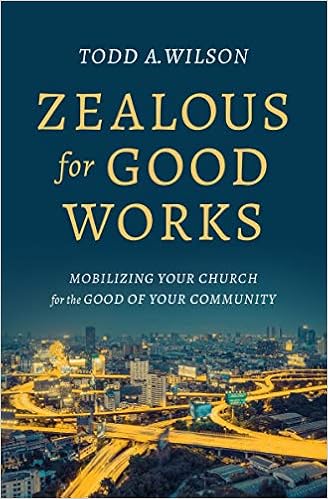
Book Review: Zealous for Good Works by Todd Wilson

Pastor Wilson turns the Church’s attention to the much quoted but less applied New Testament epistle of Titus and its core message. The Spirit inspired the author of that letter to not only leave his worker Titus on the Greek island of Crete to organize the Christians there, but gave the principles by which he was to do so as well. Using as his objective that the Church be the city on a hill that Jesus describes in the Sermon on the Mount, Wilson leads the reader through the points of Paul’s letter and helps us to understand how his marching orders for Titus apply to the Church today.

For such a brief book the value is immense. Wilson expertly exegetes the equally brief letter and helps the reader to see the big idea in each of the passages. ‘Zealous’ is not a gnostic promise (Jabez et al.) of discovering some new hidden secret, but rather, it is an eminently practical look at the principles that Paul gave to Titus that address many of the shortcomings of the Church in our age. Three that are discussed in the book are the poor level of discipleship, the chasm of credibility (that is, the difference between what we say and what we do) and the effect that these have on how we apprehend the missional opportunity ahead of us.

Read ‘Zealous’ with your bible close by. It is likely you have read Titus multiple times (if you are picking up a books such as this) but much of that reading has been focused in the Eldership requirements. Wilson deftly leads the reader to see that Titus contains so much more practical application for the Church beyond those instructions. For example, Wilson stops us in a passage often seen as preamble, Paul’s greeting in 1:1-4 to point out the importance of preaching and the power of the gospel. The gospel is both the content and the power of preaching something that can be missing in today’s environment of therapeutic deism. A city on hill is not built on the pillars of making people feel better where it teeters and shifts with every new personal demand. It is founded on the unchanging glory of the gospel of Jesus Christ.

The only disappointment I had with the book was that it was over so quickly. The more I think about it though, the length of the book is exactly right given the brevity of the profound instruction in its source. I have a new hunger to dig into Titus and preach it in the future. In the meantime, the study guide included at the back of the book is a bonus for church leaders seeking to present their people as salt and light in the world. Buy this, read this and read it again.

Be Careful What You Wish For – Roman Road 6

Furthermore, since they did not think it worthwhile to retain the knowledge of God, He gave them over to a depraved mind, to do what ought not to be done.   Romans 1:28

romansheader

Despite our protestations to the contrary, we human beings want what we want. We invest a lot of energy in trying to be less selfish, or at least appearing to be less self-interested. Sooner or later, however, the reality of who we are comes to the surface. Our greatest desire is for our greatest desire.

On its surface, this doesn’t appear to be a negative trait. And if we are pure in heart and consider the greater good when evaluating our own interests then the probability of a positive outcome is measurably higher. But let’s not fool ourselves; we are not pure in heart and our idea of the greater good takes self into account before other.

This is what Paul has in mind as we begin to walk down the Roman Road. He makes a simple case for our greatest desires to be guided by the will of God rather then our natural self-satisfaction. Without diving into a deep theological morass he makes the case that what can be known about the natural order is self-evident to all people. To put this another way, we can evaluate what is proper according to the natural order and therefore judge when our desires are not in alignment with that order.

It’s here that the awful reality of accountability before God strikes our hearts. If we cannot claim to be ignorant of the way in which God intends for things to be then we will only be left with two choices, align with God’s will or our self-will. The consequence of this decision is clear as well.

When we choose and elevate and exercise our desires contrary to the plain evidence of God’s order and will, the possibility that we will find ourselves in a dangerous position increase exponentially. That dangerous position — that horrific position — is that God may turn us over to our desires. Paul makes this awful proclamation three times in the span of four verses and it catches us off guard. The omnipotent God who could force us to toe the line instead appears to throw up his hands and say “have at it!” Enjoy your desire and the consequence of that choice.

“Not fair”, we exclaim. We want the product of our selfish desire without the consequence but this is contrary to the evidence all around us that Paul has pointed to. You can’t have one without the other. It has never happened and it never will since it contradicts the created order.

The direction of our will sets the foundation for the gospel that Paul unfolds as we walk further down the road together. God does not force us to accept his will in place of our own. He makes the superiority of his ways evident to all. He makes the extent of his love for all transparent. He gives evidence to his desire in Jesus. Then God says choose. This call to choose is put in human language by Moses (Deuteronomy 30:19); “choose life.” Not choosing life can result in nothing but death.

Grace and peace to you.

IN ALL THINGS GOD WORKS FOR THE GOOD OF THOSE WHO LOVE HIM : CHARLESTON EDITION

So where was God at work for those who love Him when the shooter in Charleston entered His house and began making martyrs with a pistol?

3946694948_b2c5461444_o

In the title you likely recognized a very familiar passage from Romans often ripped from its context and applied to different life situations indiscriminately. When that happens the meaning of the verse in the larger passage becomes muddled, and even lost. The idea of God working all things for good can adopt a diminished connotation, taking on the secular definition of good — a positive, pleasing outcome.

So where was God at work for those who love Him when the shooter in Charleston entered His house and began making martyrs with a pistol?

The answer requires that you travel back months and years in the faithful journey of the pastor and the disciples of the church who were mindful of preparing their hearts and souls for an event that they never imagined would be visited upon their church. They took seriously what the Lord taught in the Beatitudes and shaped their souls with his command to love your neighbor as yourself. They knew the necessity of recognizing the heart as the wellspring of life and were diligent in prayer and study to strengthen in shape that heart.

The good that God had worked in his people in the AME Church in Charleston was seen almost immediately in the aftermath of the shooting. A feverish news media descended on the crime scene looking high and low for someone who would shout words of racial division or a demand for the scalp of the shooter. Disappointed, all they received from the remaining members of the church were Christ-like words of forgiveness and love for the young man who had made such life shattering decision.

This is a challenge to understand until we grasp what Paul is saying in this verse in its context. The good that God works for is those things that increasingly conform us to the likeness of our Savior. It may be positive things and it may be life-changing events. Both stretch and test our souls in different ways giving the Holy Spirit ample opportunity to shape and mold us into the people that our Father intends us to be.

People whose first impulse is to love and forgive when hateful revenge seems to be the most appealing course.

image by Ken Wilcox

You, Theologian

image I’ll move right to the conclusion. You and I, if we are followers of Christ, are called to be theologians. We, as Christians, have a tendency to assign this title only to a small sampling of our community, perhaps to pastors or scholars but this is wrong. To be a theologian has little to do with academic achievement or vocational calling. Rather, it has everything to do with processing all of our thoughts and actions through the filter of what we understand it to mean to be a Christian. To put this another way, our decision to speed a little on the way to work should be processed not only through the filter of civil law but through the notion of what it means to be a Christian who is disrespecting civil law and representing Christ as you do so. The witness you and I present to the world in the course of our daily lives reflects our understanding of the faith. We are not given the luxury to compartmentalize and separate life from life in Christ.

Theology is not some arcane art, to be grasped by a select few who have made the epic journey across the wild and unforgiving seas, fighting dragons as we go. Theology is the knowledge and understanding that you and I have of God. Theology is dual-faceted and it encompasses our doctrine and the resulting practice that comes from applying that doctrine. Doctrine can be generally defined as our beliefs about the nature of God and His actions, who we are as His created beings, and what He has done to restore our damaged relationship with Him. To the extent that we find our understanding in line with those of historic Christianity is the degree of our orthodoxy. The behaviors that result from this understanding are the external display to those around us of what our doctrine is. Orthopraxy defines our allegiance to our doctrine through the act of daily living. Say and do are not separated in theological reflection.

The tools of theological reflection are within the grasp of all Christians. We find our content in the sixty-six books of the Bible, the revealed word of God to and for His people. We bring to this content an assent to our personal biases and suppositions and are honest in admitting how they might tint our reflection. Finally, we bring our faith to bear on the whole of the endeavor. We believe in God who has revealed Himself to us in numerous and varied ways yet remains elusive. We have yet to be privileged to see Him face to face and so we trust. Here, we come full circle. Some have described theology as faith that is seeking understanding and this is is an excellent baseline definition. To understand what you believe and why you believe it and then apply this structure to your life, this is the task that you are called to Theologian. Godspeed.


image by size8jeans

The Blue Parakeet 6

BPkeetDo not merely listen to the word, and so deceive yourselves. Do what it says. (James 1:22)

The Lord’s brother reminds us that although having a correct view of the Bible regarding its inspiration, inerrancy, and authority are essential, because the Bible is God’s personal word to each of us we must also be doers of that word. Our training in reading the Bible has a goal of developing our listening skills. We want to be more than information gatherers. We want to approach the words in love, with attentiveness and intention so that our thoughts and behaviors become naturally driven by the voice that we hear emanating from those words. In this week’s chapter of  The Blue Parakeet, Scot McKnight devotes a short chapter to the importance of listening intentionally.

God speaks to us through His bible for a reason. He speaks so that we might know Him and enter fully into relationship with Him. In the context of that relationship we tend to listen differently. If we were to happen upon a cache of love letters between two strangers, we might sit and read them marveling at the turn of a phrase or the depth of emotion expressed but they would not necessarily speak to us as an outsider. On the other hand, finding the letters that we received from our husbands or wives early on in our relationship we hear a different voice. It is no longer our own voice reciting the words but the soft, gentle voice of our wives telling the story of the letter. It speaks directly to us because we know and love the person who put the words to paper.

The Bible is intended to be read the same way, in the context of a love relationship. God speaks through the story directly to you and I in order to move us. It may be for the purposes of mission or it may be to put up a guardrail in our lives by hearing Him tell the story of others who failed to do His word. Either way, the voice we hear is personal and loving, not the technically disconnected voice of the Greek interpretation of Paul. We aren’t moved by Paul or John or Micah, we are moved by the story that God tells through them.

This concept is amongst the easiest to understand when we ask ourselves what our significant others want from us more than anything else…to be heard. Listening is loving (thank you Alan Jacobs.)

Blue Parakeet 3

BPkeet

Scot McKnight establishes a key idea in The Blue Parakeet mid way through chapter four. He posits that the Bible that God gives us to read is presented as the unfolding story of His ways with His people. When we approach the text as something else, we lose the power of reading the book as a story. In doing so, we lessen its impact on our lives and may even ‘discover’ interpretations that differ from the original intention of the authors or The Author.

Context is everything in reading the Bible as we’ve seen countless times. Context can be viewed as the concentric rings of a pebble in a pond; there is an immediate ring or context, and then one a little further out, and so on. Each of the verses exists in a context of a passage and that exists in a book and so on until we can see that each of the smallest contextual markers contributes to the whole of God’s story. Rather than standing on their own trying to carry the full weight of biblical revelation, the stories contribute to The Story. McKnight gives us a valuable example in asking us to consider our perspective on paying interest on a loan. Many of us have home mortgages or car loans on which we have agreed to pay a certain percentage of interest. We do this as Christians despite the clear biblical prohibition against it in Leviticus 25:35-38. Why? How do we justify dismissing this (and many other) passage when we claim the whole Bible as the Word of God? We do so saying “that was then, this is now” pointing out culturally how our time in God’s story is different from that of the Israelites. We stand correctly in this assertion because we read the Bible as a story with many different eras and cultures represented for the purposes of God’s expression of His relationship with His creation.

The question that we must address is what determines “what was for then?”  If we read for promises and blessings or morsels of law we lose sight of the story and we are tempted to say that ‘this was for then’ and ‘it is also for now’ to everything, despite the obvious cultural differences. Tempering this is the easily remembered device: God spoke to Moses in Moses ways in Moses days, to Amos in Amos’ days in Amos’ ways and to us in our days in our ways. If we are able to read the Bible as story and we understand the thread that runs throughout, we see that same thread running through our own lives in our own modern ways. Each author reworked the bigger story for his audience and we should read what God has left for us in our own context.

I struggle a bit with this chapter. Is it for everyone to decide what ‘was for then’ on their own? Is it only in the context of reading as a community that we can discover that? I’m interested to hear your views on this and on the book as a whole.