Advent Benediction : The Blessing of Love

imageBlessed is the name of the Lord,

Father, Son, and Holy Spirit.

He alone is your blessing,

He alone is worthy of receiving your blessing,

He alone blesses you.


Blessed is the one who watches and waits,

for the Son, sent of the Father, followed by the Holy Spirit.

He alone is our light.

He alone is our salvation.

Be blessed as you wait the night of His arrival.


Blessed is the one who loves,

the Father, Son, and Holy Spirit.

May God bless you with love,

to give Love as He has,

to be Love as He is,

to know Love as He does.


Blessed is the one who blesses.

Blessed is the one who waits.

Blessed is the one who loves.

May you be counted as blessed.

Amen.


Image steffe

Day Twelve in the School of Prayer : Have Faith!

WithChristInPrayer

“Have faith in God,” Jesus answered. “I tell you the truth, if anyone says to this mountain, ‘Go, throw yourself into the sea, and does not doubt in his heart but believes that what he says will happen, it will be done for him.’  (Mark 11:22-23)

The last lesson of the Master taught us to believe as though we had already received the answer to our prayers, infusing our petitions with a fresh urgency and strength. Belief or trust in the response is predicated on something. It is not our natural attitude toward anything as adults and with ‘things unseen’, it becomes an even greater challenge. Jesus points our belief to its foundation in this lesson. Faith in God is the basis for our belief.

The Lord points us to the God who created all, permeates all, and who knows all in and out of our hearts. On the basis of what we know to be true about God and His consistency in upholding and delivering all He has ever promised we can place our faith. As our tenure as a friend of God lengthens He becomes more visible to us. We know His works in our lives and in the historical lives of others. We make connections between what His Word has told us and what we experience. Faith becomes more real and gradually solidified. Our faith is the core of our belief.

In this faith we pray. We approach the throne with our petitions and a mature trust. We yield and mountains move.

Day 11 in the School of Prayer: Believe It!

WithChristInPrayer

“I tell you the truth, if anyone says to this mountain, ‘Go, throw yourself into the sea,’ and does not doubt in his heart but believes that what he says will happen, it will be done for him. Therefore I tell you, whatever you ask for in prayer, believe that you have received it, and it will be yours.” Mark 11:23-24

“Whatever you ask.” Does our faith extend this far in our prayers? Has the Holy Spirit so fully enveloped our thought and permeated our soul such that we have absolute confidence that whatever we pray we will receive? Our pulpit speech reveals otherwise. Many Christians have heard the litany of justifications and cautions that seek to soften this proclamation of our Lord. The qualifications of this promise include its expediency and whether or not it is according to God’s will.

As we diminish the expansiveness of ‘whatever’ into smaller and smaller categories the depth of our faith and trust in Christ’s promises follows. We pray small things and hope rather than praying for the world and trusting. We claim to believe the Bible, every word, and yet we look at the promises of the Lord and somehow can’t bring ourselves to fully believe them.

Our prayers must emanate from a belief that we have already received what we ask. This is a demonstration of complete confidence in the promise of God. Though a delay may occur in reality before the event of receipt, your assurance that what God promises He does completes the prayer. In this mindset we find how little we have availed ourselves of this privilege, how small our faith has become, how much disbelief has crept into our hearts.

Trust, pray, believe!

Psalm 60 With God We Will Gain the Victory

imageYou have rejected us, O God, and burst forth upon us; you have been angry – now restore us!

You have shaken the land and torn it open; mend its fractures, for it is quaking. (vv 1-2)

Those who read the Psalms devotionally or at random often fail to notice exactly how much of the Psalter is composed of pleas for restoration and paeans to God’s faithfulness in doing so, ‘one more time.’ In verse after verse the psalmist is hemmed in by his enemies and threatened with destruction. He raises his eyes and voice to the heavens and asks God where he is in this time of travail. In every instance, the same answer comes back: “I am here.”

Our lessons in coming to this observation are twofold. The most difficult of the two is to come to the realization that God will turn away from us during different seasons of our lives. The duration may be brief or endure for a long time but the scriptures clearly demonstrate that we risk the the turning of His Face.

You have shown your people desperate times; you have given us wine that makes us stagger. (v3)

Whether the purpose be our redemption through repentance and the subsequent restoration or to enable a larger purpose in His plan, God may cause us to suffer. Do we trust Him in this struggle? Are we willing to be sacrificed for the larger purpose of an eternal plan. To God, our lifetime is but a second; to us it is an eternity of testing. Surely He knows this but can we learn this lesson and shift our perspective into eternity, lifting our eyes from the rocky ground in front of our feet?

The second of the lessons enables us to endure the first. We can trust in God completely. We can dismiss worry and erase our doubts knowing that He is perfectly good and that whatever state we find ourselves in perfectly aligns with His eternal course for history.

But for those who fear you, you have raised a banner to be unfurled against the bow. (v4)

We can unfurl the banner of the gospel, swath ourselves in the good news, and march forward. If our rejection is brought about our own behaviors we can turn from them and seek the restoration that God willingly extends. If our separation is a part of the larger purpose we can be faithful, knowing the ultimate good will come of it. As the Psalmist shouts,

With God we will gain the victory, and he will trample down our enemies. (v12)

Image by ronny andre

A Word for My Brother & Sister Pastors

image

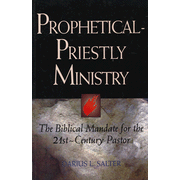
Prophetical-Priestly Ministry by Darius Salter

It’s fascinating how things fall into your lap when you least expect them. Serendipity is the word often used to describe favorable circumstances like this when you discover something grand has come your way unexpectedly. Christian sagacity trends not towards luck though, but instead, toward an understanding of the work of the Father and Spirit in concert. Salter’s book landing in my hands was just such an event.

Prophetical-Priestly Ministry was published in 2002 to little fanfare. A quick search for reviews of the book comes up short; it is ignored on Amazon and the single entry at ChristianBook.com is a restatement of the title. The silence is understandable. The book is not about how to grow your church, new ways of reaching post-moderns, or new secrets of the life of Jesus. These books fly off the shelves into pastoral libraries. Books that serve as correctives such as this are often ignored. And I believe, ignored at the peril of the pastor and their church.

Salter’s message to pastors is simple: return to your core responsibilities. Speak the prophetic word of God into the lives of your congregation rather than feeding them messages about how to have their ‘best life now.’ Stand as the priest for God’s people rather than their cheerleader or worse, their manager. He says “Prophet-priests specialize in diseases of the soul; sin, despair, depression, loneliness, alienation, anger, hostility, pride, greed, avarice, addiction and fear. The list is almost endless. Of course, these sicknesses eventuate in the systemic evils of ethnocentricity, nationalism, exploitation, oppression, and racism.” The message in this thin volume calls us back to the service of the congregation and gets us away from parading around selling books or conducting seminars on how to fill more seats in the sanctuary.

The author critiques the current ‘worldly’ ministry that he sees all around the American landscape (in 2002 and worsening since). The Church has gotten entrapped in the self-fulfillment culture and, in some cases, has moved away her first love. God is a second thought in the worst of these environments. The ministry has become enablers. We promise spirituality while allowing our people to remain in their materialistic, pluralistic lifestyle. The gospel becomes a casualty of the latest charity initiative or small group study topic.

I didn’t go looking for this book. It appeared in a weekly-specials email and something moved me to purchase it. Initially, it arrived and made its way to the book shelves to be read later. I picked it up after a time and was immediately struck by the message that the Spirit brought to bear through Brother Salter’s words. I was stopped cold when the Spirit brought my feeble ministry efforts up against those of Francis Asbury,

For the elect’s sake, Asbury ceaselessly uttered the Word through Scripture reading, prayer, exhortation, teaching, and family worship. Every overnight stay would involve spiritual examination of the residents and subsequent catechism. There would be no idle words. “My mind was powerfully struck with a sense of the great duty of preaching in all companies, of always speaking boldly and freely for God as if in the pulpit.” This included calling “the family into the room and addressing this pointedly one by one concerning their souls.”

One by one; when was the last time you (or I) sat even our immediate families down and questioned them concerning their spiritual welfare? Have we gone home by home and addressed these concerns with our faith families? Why not? Because we have succumbed to the Western individuality of the culture and we respect the personal nature of a person’s faith more than we do the calling we have received to be a priest and prophet.

Brothers and sisters, now is the time for a new awakening within the Church. Not the watered down awakening of “spirituality” in its myriad forms but for us to stand upon the walls ahead of our flock, intervening for them with God and speaking His word into their lives not matter how difficult. Find this book, read it, absorb it, and let the Spirit work it all out in your ministry.


Day 10 in the School of Prayer : Say It!

WithChristInPrayerJesus stopped and said, “Call Him.”

So they called to the blind man, “Cheer up! On your feet! He’s calling you.” Throwing his cloak aside, he jumped to his feet and came to Jesus.

“What do you want me to do for you?” Jesus asked him.

The blind man said, “Rabbi, I want to see.”

“Go,” said Jesus, “your faith has healed you.” (Mark 10:49-52)

Among the lessons in our primer, this may be the easiest thus far; the Lord does not want to us to voice vague calls for His mercy or undefined pleas for His blessing. He wants us to be direct and to state clearly our need. In doing so, we are moved to clarify our need, to dwell upon it and evaluate it, to consider it in the context of the Kingdom. Jesus asks, what do you want me to do for you? Are you prepared with an answer? No vague and pointless prayer will satisfy this question. It is prayer that is bold, direct, and from the deepest wells of our hearts that the Lord seeks. Put aside all other.

Murray directs us further though, back into the King James text for the emphasis of the Master’s words: “What wilt thou that I should do unto thee?” What wilt thou—not, what wish thou? A wish is a formless, meaningless, hope-for. Something can be wished for without being willed. The will however will stop at nothing until it is achieved. It has a purpose and as the Holy Spirit directs, it has a kingdom purpose. God will have no peace until He answers this prayer. The wish vanishes like a child’s balloon over the horizon. What is willed will be.

Lord, teach us to pray.

Psalm 59 God Will Go Before Me

image Deliver me from my enemies, O God; protect me from those who rise up against me.

Deliver me from evildoers and save me from bloodthirsty men. (vv 1-2)

These have become familiar refrains from David as he implores God to release him from the constant harassment of his enemies. Time after time we hear him turn to God in need of protection, shelter, and safety, describing his enemies in the harshest terms. In this psalm we share David’s apprehension as his home is watched by Saul’s men who are intent on killing him. To place this in historical context, refer to 1 Samuel 19. Does David succumb to the temptation to rid himself of Saul? No, he righteously refuses to touch God’s anointed, a lesson that the modern lesson can learn as member are tempted to attack and destroy a pastor.

God will go before me and will let me gloat over those who slander me.

But do not kill them, O Lord our shield, or my people will forget.

In you might make them wander about, and bring them down. (v 11)

Rather than see them destroyed, David wishes that they might simple lose their way. Possibly he hopes that they will realize how far astray they have gone in hunting down God’s chosen king. He follows with a plea that their pride might be realized and they might turn back. We can be thankful that our intercessor please for one more minute for us to repent despite our manifold sins, even though they are injurious to Him. Ultimately, the redemption of a horrific sinner such as myself brings more glory to the King than my immediate destruction, though it would be well deserved.

Then it will be known to the ends of the earth that God rules over Jacob. (v 13b)

Image saibotregeel

Day Nine in the School of Prayer: Seek Help

WithChristInPrayer

When He saw the crowds, He had compassion on them, because they were harassed and helpless, like sheep without a shepherd. Then He said to His disciples, “The harvest is plentiful but the workers are few. Ask the Lord of the harvest, therefore, to send out workers into his harvest field.”  (Matthew 9:36-38)

The Lord taught us the necessity of persistence in prayer for the goals of the kingdom, trusting in the Father’s love for our own providence. He now extends that focus, leading us into prayer for the workers necessary to imbue the kingdom with change. It is easy for us to look around and see the overwhelming need of the souls that press in on us from every side. It is not so easy to understand that we are to pray for the workers needed to reap this bountiful harvest in the name of the Father.

Is this need for prayer due to a deficit in God’s planning? Certainly not. The Creator knows all that is needed and has, in fact, supplied the workers. Who? You. We see Jesus in the passage moved with compassion at the plight of the lost, the sheep without a shepherd. As a disciple of the Son, the prayer that should result from this lesson is not that God would send additional workers but that those who have claimed love for Him would have their hearts turned in compassion to the plight of the sheep. No one should be found standing idle in the vineyard.

Psalm 58 May They Not See the Sun

imageBreak the teeth in their mouths, O God; tear out, O Lord, the fangs of the lions!

let them vanish like water that flows away; when they draw the bow, let their arrows be blunted.

Like a slug melting away as it moves along, like a stillborn child, may they not see the sun. (vv 6-8)

The Bible is no stranger to violence whether it be retribution against sin-stained men by God or the broken interactions between men. Many are critical of Christianity and use the violence as proof that their is either no God, or that God cannot be as holy as He is made out to be since He is associated with various violent acts. The psalms do not escape this history and in certain passages, the imprecation of the prayer against his enemies places us in an odd position. The Christian is challenged to justify words such as these in the light of the Beatitudes  or the admonition to put away thoughts of an eye for an eye (Mt 5:38-42).

We must be cautious in our approach to these psalms and not confuse the violent fantasies of the author with the righteous actions of God. In order to show the depravation against which he rails, David attempts to portray a similar level of violence in judgment to that which is being measured out by the unrighteous rulers. Though they may have personally injured David, he is not seeking to justify a personal vendetta. Rather, he is seeking only to restore righteousness to the land and the hyper-violence he portrays is to serve as a warning to the wicked of their coming judgment which he entrusts to God alone.

The righteous will be glad when they are avenged, whey they bathe their feet in the blood of the wicked.

Then men will say, “Surely the righteous still are rewarded; surely there is a God who judges the earth. (vv 10-11)

This psalm is about trust, trust that God will see to it that righteousness prevails. The imagery that David utilizes affects our sensitivities differently than it may have to original listeners. He seeks in all of the warning and cries for justice not to destroy the unrighteous but instead, to render them impotent. To break out the teeth of the ravenous beast is to release its prey from certain destruction. To watch watch water evaporate harmlessly is to prove the ultimate fate of evil while their blunted attacks bounce harmlessly to the ground. Perhaps, as David voices, it would be better for the wicked had they never been born.

Day Eight in the School of Prayer : Be Persistent

WithChristInPrayer

Then he said to them, “Suppose one of you has a friend, and he goes to him at midnight and says, ‘Friend, lend me three loaves of bread, because a friend of mine on a journey has come to me, and I have nothing to set before him.’

Then the one inside answers, ‘Don’t bother me. The door is already locked, and my children are with me in bed. I can’t get up and give you anything.’ I tell you, though he will not get up and give him the bread because he is his friend, yet because of the man’s boldness he will get up and give him as much as he needs. (Luke 11:5-8)

We have often read this parable or heard it preached with an emphasis on the persistence of the asker. The friend who responds to our knock would turn us away because the conditions are not right, yet if we are bold (persistent depending upon your translation) he will arise and provide the requested loaves. There is another emphasis in the Lord’s words that is not often heard and that is speaking to a friend on behalf of another.

Christ teaches us of the importance of intercession in this brief interchange. Our temptation is most often to pray for ourselves and our own needs or comforts. God is certainly not offended when we voice our needs but He is examining our trust of His provision if this activity becomes our sole focus. Jesus speaks here of shifting our focus from ourselves to the needs of others in prayer. We do not seek the three loaves for ourselves because we were too lazy to bake them. We seek the three loaves from a friend at midnight when he is in bed because we want to provide for a visitor who has unexpectedly appeared at our door and is in need of sustenance. We can be assured of answer to our intercessory prayer.

Perhaps the easiest word to read over is ‘friend.’ Jesus does not say we go our neighbor or a stranger to request to loaves, we go to a friend. Are you approaching God as a friend? Jesus proposed the simplest test for us to evaluate our friendship; “You are my friends if you do what I command.” (John 15:14) The prayer as a friend of God is the one in which confidence can be vested.