Christians and Pacifism

The church is the spiritual, social, and political body that gives its allegiance to God alone. As citizens of God’s kingdom, we trust in the power of God’s love for our defense. The church knows no geographical boundaries and needs no violence for its protection…As disciples of Christ, we do not prepare for war, or participate in war or military service. The same Spirit that empowered Jesus also empowers us to love enemies, to forgive rather than to seek revenge, to practice right relationships, to rely on the community of faith to settle disputes, and to resist evil without violence. “Confession of Faith in a Mennonite Perspective”

The Anabaptist tradition within the larger Church is perhaps the most well-known body of pacifist believers, though the practice is not confined to these Christians. Pacifism, the refusal to engage in military action or violence in revenge or defense, is a radical practice. In the larger world of non-believers, Just War, and increasing violence, the refusal to visit violence on those labeled ‘enemies’ immediately sets one apart from the society norm and expectation. The radicalism extends to our physiological makeup; when we are about to become the victim of a violent act our body and mind naturally seek to act in self-preservation, even to point of exterminating the threat. The Christian who follows the path of pacifist action must strongly apply their allegiance to Christ alone at the expense of their citizenship in the state and more importantly, they must train their mind and body to submit to the suppression of its natural response to react to violence. Dr. Buschart records,

“Anabaptists were the most violently persecuted Christian movement of the sixteenth century, being pursued by both Roman Catholic and Protestant forces, in conjunction with civil authorities. Consequently, Anabaptists were were confronted by the demand to practice in the most radical ways this practice of nonresistance, and many practiced the principle to the point of suffering a martyr’s death.” Exploring Protestant Traditions

The source of the practice of Christian pacifism is deeply rooted in the Gospel. From the mountainside, Jesus said in contrasting the old and new ways  “You have heard that it was said, ‘Eye for eye, and tooth for tooth.’ But I tell you, Do not resist and evil person. If someone strikes you on the right cheek, turn to him the other also.” (Mt 5:38-39) Later in the garden he  cautioned Peter “Put your sword back in its place, Jesus said to him, for all who draw the sword will die by the sword.” (Mt 26:52). The Old Testament, often derided as being blood-soaked and hyper-violent, is not neglected either. Micah speaks eschatologically, pointing us forward to the era of the Christ  when he says “They will beat their swords into plowshares and their spears into pruning hooks. Naiton will not take up sword against nation, nor will they train for war anymore.” (Micah 4:3)

Over and above the words of Jesus, the pacifist follower will point to the life of the Lord as being completely non-resistant and peace seeking in His lifestyle. With Christ as our center and our revelation, believers are to develop their ethics, morality, and behavior from His example and teaching. These will often run counter to the demands of the state but we are called to be theological thinkers, examining the decisions that we must make in the light of our higher priority membership in the kingdom of Christ. It is to this that our primary allegiance is required teach the pacifists.

The early Church is historically pacifist and there is scant, if any, evidence of early Christians engaging in warfare. There was a gradual acceptance of military service through the centuries with noted objectors – such as the Anabaptist movement – here and there through the records. In our modern era we see the pacifism practiced in Martin Luther King who confronted the violence he encountered with an equally vehement non-resistance. King worked from five principles which fit human bio-social understandings effectively into the notion of Christian pacifism:

  1. Nonviolent resistance is not for cowards as it requires more strength to stand without retaliation.
  2. The non-violent resistance is not intended to humiliate the attacker but to establish love and understanding.
  3. Non-violent resistance is focused on evil, not the people performing the evil act
  4. You must be willing to suffer without retaliation.
  5. The external lack of violence is to be matched with an internal peace.

John Howard Yoder has a prodigious body of work that is rooted in this ideal. He says that we cannot kill other people for whom Christ died. We are to live the first commandment of the Lord, to love Him with heart, mind, and soul and to love our neighbor in the same way. Violence toward them for any reason is seen as contrary to this command.

Despite its inherent attractiveness, pacifism is not without its critics. Some say it is unrealistic in today’s world or that Christ’s words were hyperbole and not meant to be directly applied in this case. Theologians examine the word of Jesus in the light of Paul’s later commands that we be good citizens of the state in Romans 13, going so far as to see this as allowing military service as a part of this obedience. Another argument against the pacifist system is that our own non-violent capitulation may expose us and our neighbors to a greater violence. In this position, our refusal to act does not demonstrate an effective love for neighbor by the absence of our protection. In other words, Justice cannot be restored without the Christian’s action and ethics.

“Again, Jesus said, “Peace be with you! As the Father has sent me, I am sending you.”  John 20:21

Christians and the Just War

Other than pacifism, the Just War is the idea most associated with the Christian in discussions of war. The word just has a wide range of meanings but, in this context, the word is often interpreted to mean right as describing the righteousness of the war. This, of course, leads to endless debate about the propriety of Christian engagement in war that is declared either right or wrong. The fallacy inherent in this type of discussion is that it centers on the righteousness of a campaign when the idea of just war has nothing to do with this. We will explore in the rest of this post what the just war theory is, and it is just that, a theory or principle upon which decision making can be rested.

The Just War Theory is an ethical framework intended to be normative for all peoples regardless of religion, culture, or racial-ethnic identification that one might assume. As is obvious from any cursory reading of history, just war is not a description of how people have acted nor of how they will act in future conflict. It is rather, a tool by which moral decisions can be made about a war. As the Christian applies it to their thinking and actions, the expectation is that their enemy will also apply the same framework to their planning and action. This expectation is rooted in the biblical notion that all people are held accountable to God (Romans 1-3) for the adherence to moral standards.

The standards established within the Just War framework pre-date Christian thinking and application of the idea lending credence to their universal application. As far back as the 6th century B.C. we find the founder of Taoism, the philosopher Lao Tzu propounding on balancing the knowledge that conflict and war are inevitable realities of the human condition and the realization that total destruction of the enemy and their territory is counter-productive in the long run. Sun Tzu, probably the most read ancient thinker on war, held to similar conclusions, seeing war as a regrettable necessity but one of vital importance to the state and therefore deserving of much thought. 

Since the earliest days of Christendom, believers struggled with understanding the scope of their responsibilities to society in light of their membership in the Kingdom of God. Many served as soldiers while trying to remain faithful to their Lord and comprehending the ethics of their situation. Philosophical thinking on peace was highly developed among the Greeks and the Romans within which Christianity was developing. The Greek notion of peace built upon the Hebrew concept of shalom, a general well being, and added a greater component of prosperity. The Roman ideal described in the word pax was more oriented toward the absence of war. It was from the Greeks however that the framework which would later be defined as Just War would come. Viewing peace as the object of any battle, Greek ethicists and generals began to look at war and ways in which it could be avoided if possible and be less terrible if it could not. They were willing to subject disagreements with enemies to mediation prior to battle and avoid the total destruction of the enemy and their holdings if war should come about. Violence was limited, governed by this reasoning and the justice of a confrontation measured by the vague concept of natural law.

The Christian ethic of war appears to have first been formulated by St. Ambrose (340-396 A.D.) and passed on to his converted Augustine (354-430 A.D.). An important change that his ethic introduced to the Christian sphere was to relegate pacifism to the clerical and private arenas. Duty to one’s state remains an obligation of Christians who enjoy the benefit of the protection offered thereof. Augustine took Ambrose’s rough sketch and shaped it into the foundation that we discuss today.  The Sermon on the Mount had burned itself into Augustine’s heart and deeply affected his view on violence, tempered as it was by the reality of conflict. Peace with justice for all involved is the most succinct statement of his overall ethic that we can make in a short space.

Justice and War

The Just War framework extends far beyond a simple summary statement. It is a highly complex and nuanced  ethic with numerous conditions and presuppositions. In order to maintain this piece at a readable length, I am going to present these in very short form, perhaps to return to them individually as this study continues. Four suppositions frame the moral statements:

1. Not all evil can be avoided. Evil is a pervasive condition brought about by the fallen human condition and a reality with which we must contend.

2. The Just War Theory is an ideal that is normative for all peoples. It is obviously not a historical fact nor a prediction of how humans are likely to behave in the future but rather, it is a standard by which actions and plans can be judged.

3. Perhaps the greatest misunderstanding and misapplication of the Just War Theory by those who are unfamiliar with the details is that it is an attempt to justify war; it is not. Correctly interpreted, it attempts to bring war under the control of justice so that, if consistently practiced by all of the parties to a dispute, it can eliminate war altogether.

4. Finally, the Just War framework insists that private individuals have no license to utilize force and engage in war on their own. War is the prerogative of states alone in their duty to preserve the order of their society.

That stated, we can examine the rules by which justice is applied to the consideration of war:

1. Just Cause. All aggression is condemned and only defensive actions are legitimate.

2. Just intention. The only intention for war is the securing of a just peace for all involved. Revenge, conquest, economic gain, or ideological supremacy are never justified.

3. Last Resort. Only when all negotiations and compromise have been exhausted can war be entered upon.

4. Formal Declaration. War must be declared by the highest authority of a state.

5. Limited Objectives. If the purpose of a war is peace then the complete destruction of a nation’s economic or political institution or an unconditional surrender are disallowed objectives.

6. Proportional Means. The force and weapons brought to bear in a war must be limited only to what is needed to repel aggression and deter future attacks. This rules out Total or unlimited war.

7. Noncombatant Immunity. Only those agents of the government authorized to fight may engage in the war. Civilians and those not actively participating in the fight are to be protected from the violence.


Due to the ongoing reality of conflict in the fallen world in which Christians lives, the Just War theory and its application has often been deemed to be unrealistic. Because it assumes that all parties to a conflict will apply it equally, it has found little use for those who would be themselves aggressors with economic or ideological objectives stated as the basis for war. The equal application of justice to both sides of the conflict rarely exists for example when the objective of a war is the subjugation of one’s enemy or the imposition of a government which restricts the loser’s liberty. The Just War theory provides an excellent framework through which Christian’s can discuss the morality of their involvement in conflict but ultimately we discover that the notion of justice has many definitions upon people do not agree.

War and the Christian

In the pantheon of evils that are a part of the human experience, war and the destruction and carnage that follow in its wake rank in the uppermost tier of wickedness. War has been a constant of human history and, despite the promise of the transforming power of Jesus Christ, we are warned (Matthew 24:6) that it will be with us until the eschaton. Given these twin dynamics of the horrific and the constant, the Christian worldview is forced to confront the issue and settle a position from which we determine our thoughts and actions in relation to the act of war. The Christian is under competing pressures that obtain from the Lordship of Christ and our membership in society. Shall we declare ourselves to be conscientious objectors when the country that supports the foundation of our religious liberty is under attack? Can we determine for certain that a war is just, and thus appropriate to engage in for the follower of Christ? These questions just begin to enunciate the concerns that a spirit led Christian must wrestle with in approaching the desires for peace and the reality of war.

There is a great body of work created by  Christian thinkers to which we can turn to begin to develop our own thinking and what will follow in the coming weeks is a series of posts surveying the variety of positions. In general we will encounter four schools of thought: engaging in the Just War, offensively approaching a Preventative war, the Nonresistance role as a noncombatant, and ultimately Christian pacifism. A quick read of the last sentence tells us right away that Christianity has engaged the full range of philosophy toward war, from full participation to absolute prohibition. If asked, can you define your position such that it will not wither in the face of challenge?

The Bible of course is the ultimate resource from which we develop our beliefs and even a cursory knowledge of the text shows us that war has been a reality for God’s people since they became such. Early in the OT we encounter mentions of war and as God’s people coalesce around their movement into the Promised Land they are told that they are going to have to fight the current residents to take possession of the land and later, take up a defensive mindset in order to retain it. All this of course, at the behest of Yahweh who generals and guides the battle Himself. Is God therefore in support of war, despite the destruction and loss of life that follow? What of the words of Christ that even non-Christians can quote to ‘turn the other cheek’ toward the face of evil? Is God of two minds? Certainly not, but the complexity of thinking about war and how the Christian should think about the topic should be obvious by now. As difficult as it is however, the demands of the Gospel and our allegiance first and foremost to our Lord and His will should cause us to soberly and carefully determine the most correct position to take.

“War is a poor chisel to carve out tomorrow.” ~ Martin Luther King

Thank God for My Punishment

Obama provides us with further insight into how he views the unborn and their convenient disposal, referring to an unplanned pregnancy as a punishment. In referencing his own daughters and the possibility that despite his teaching on morals and standards, he stated that they should not be punished with a child. We can further extrapolate from his favorable stand on unfettered access to abortion that this punishment could only be mitigated by the extinguishing of the human life and the disposal of the unborn fetus.

My apologies Mr. Obama but a child, whether born or unborn, is not a punishment. You may view it as a consequence of engaging in sexual activity, but in no way should a child ever be referred to as a punishment. Perhaps those values and morals that you teach your daughters should be that Pro-Choice can mean something more than the free ability to dispose of a life; it can also be the choice not to engage in an activity that has specific and predictable biological consequences. I’ll be interested to see in the coming days how you finesse this staff. Perhaps the next time you are in church, you can ask about Psalm 139.

I’m eternally grateful for my punishment.

MyPunishment

Ultimate Fighting Jesus

Once again, the inimitable Dr. Groothuis leads us through an examination of one the movements afoot within Christendom: Jesus for Men. This vision of the Lord is meant to counteract the supposed feminization of the Church which is turning men away. He is attractive to men, not because of holiness but because of His brawn. Read the piece here. 

He Is Risen Indeed at Red Rocks

For the first time in many years, my family and I had the opportunity to attend the sunrise service at Red Rocks. If you have never seen the beauty of this God created amphitheater, you can find a good Wiki here and, maybe more famously, it is the backdrop for U2’s ‘Sunday Bloody Sunday’ video. Yesterday, it was the house of God as several thousand people braved temperatures around 18 and snow and ice to be a part of this wonderful worship service.

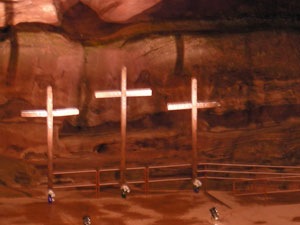
RREaster1

The three empty crosses await the coming of the dawn and the promise of new life.

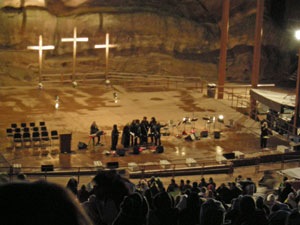
RREaster2

These sisters awaken the spirits in the darkness, preparing hearts for the presence of the Lord.

RREaster3

We look out over the Great Plains to the East, flat for as far as the eye can see, straining to catch the first glimpse of the new dawn.

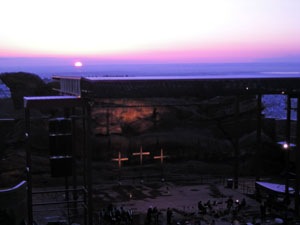
RREaster4

As the sun rises just over the horizon, the promise of the new life is renewed. He is risen! He is risen indeed!

Passion Week: Vigil

We wait through the day and the darkness for the Lord and His promised return. He told us but we didn’t understand that he would rise and leave the tomb, overcoming the final fear of humankind, death. With this miracle He alone would change all of history; we would mark the time which he created by His presence among us. Those at or near the Cross that Friday afternoon were filled with despair as their Lord gave up His spirit, crying out to the God of the Exodus and the Immaculate Conception “Why? Why have your forsaken me?” Was their last hope given up in that breath also? They could only spend the days in their personal darkness.

3 Or don’t you know that all of us who were baptized into Christ Jesus were baptized into his death? 4 We were therefore buried with him through baptism into death in order that, just as Christ was raised from the dead through the glory of the Father, we too may live a new life.

5 If we have been united with him like this in his death, we will certainly also be united with him in his resurrection. 6 For we know that our old self was crucified with him so that the body of sin might be done away with, that we should no longer be slaves to sin— 7 because anyone who has died has been freed from sin.

8 Now if we died with Christ, we believe that we will also live with him. 9 For we know that since Christ was raised from the dead, he cannot die again; death no longer has mastery over him. 10 The death he died, he died to sin once for all; but the life he lives, he lives to God.

11 In the same way, count yourselves dead to sin but alive to God in Christ Jesus. (Rom 6:3-11)

The clarity brought by standing distant from the event still does not preclude us from our own moments of vigil. Where is God in our lives? Has he forsaken us? Is the separation temporary, brought about by our own rebellion or is it meant to strengthen us in our trust? These questions race through our minds but can be quieted by the promise of the new day’s sunrise: He was risen and He will rise again in our hearts. We must simply trust through this day.

Passion Week: The Great High Priest

The author of Hebrews exhorts us with this passage of promise:

14 Therefore, since we have a great high priest who has gone through the heavens, Jesus the Son of God, let us hold firmly to the faith we profess. 15 For we do not have a high priest who is unable to sympathize with our weaknesses, but we have one who has been tempted in every way, just as we are—yet was without sin. 16 Let us then approach the throne of grace with confidence, so that we may receive mercy and find grace to help us in our time of need. (Heb 4:14-16)

On this day of Holy Week we consider the sacrifice of our Lord. He gives His life so that we might gain ours. In giving His life to rise again, Jesus shows that His dominion extends beyond our greatest fear – death – while not dismissing our lesser fears of failure in sin. He stands on our behalf knowing the human struggle against temptation and offering His strength in place of our own to overcome the weakness of our will. In every time of need, His grace is available to us if we will only reach out and take hold of it. As we reflect this Good Friday, we can consider how this confidence that he builds in us can lead us to make a similar sacrifice in our own lives. Be blessed.

Passion Week: The Year of the Lord’s Favor

Bookending the ministry of the Christ are the events of Holy Week and the announcement of His ministry:

16 He went to Nazareth, where he had been brought up, and on the Sabbath day he went into the synagogue, as was his custom. And he stood up to read. 17 The scroll of the prophet Isaiah was handed to him. Unrolling it, he found the place where it is written:

18 “The Spirit of the Lord is on me,

because he has anointed me

to preach good news to the poor.

He has sent me to proclaim freedom for the prisoners

and recovery of sight for the blind,

to release the oppressed,

19 to proclaim the year of the Lord’s favor.”

20 Then he rolled up the scroll, gave it back to the attendant and sat down. The eyes of everyone in the synagogue were fastened on him, 21 and he began by saying to them, “Today this scripture is fulfilled in your hearing.” Lk 4:16-21

Preaching the good news and healing the broken, the essence of the Lord’s holy ministry and, by extension, our own. When we look to the heavens for a fresh vision for the fulfillment of our calling our eyes and hearts are drawn back to the utter simplicity of our mission: love others as the beloved of the Almighty King. You and I can proclaim the good news of freedom in Jesus Christ in myriad ways. We can heal the broken and shine a light so bright that sight for blindest can be attained. Our lives with each breath and act can proclaim again and again that we live in the year of the Lord’s favor. We can do all of these things if we put aside our fears, trusting in the miracle of the Risen Christ. Do you believe?

Passion Week: A Face Set Like Flint

The Suffering Servant speaks:

The Sovereign Lord has given me an instructed tongue,

to know the word that sustains the weary.

He wakens me morning by morning,

wakens my ear to listen like one being taught.

5 The Sovereign Lord has opened my ears,

and I have not been rebellious;

I have not drawn back.

6 I offered my back to those who beat me,

my cheeks to those who pulled out my beard;

I did not hide my face

from mocking and spitting.

7 Because the Sovereign Lord helps me,

I will not be disgraced.

Therefore have I set my face like flint,

and I know I will not be put to shame.

8 He who vindicates me is near.

Who then will bring charges against me?

Let us face each other!

Who is my accuser?

Let him confront me!

9 It is the Sovereign Lord who helps me.

Who is he that will condemn me?

Isaiah 50:4-9a

The Servant moves a day closer to the Cross with the rising of the sun this morning and yet, knowing the travail that He faces, fixes his unturning face toward Golgotha. He sets the example for our own journey in God’s will. We can let the world see the shine in our face though it may be spat upon. We can turn an unscarred cheek toward our attackers. We can do all of this without concern because we are secure in God’s grace. We are adopted as co-heirs along with our Servant brother. If the Lord is for us, who can be against us?