Day 11 in the School of Prayer: Believe It!

WithChristInPrayer

“I tell you the truth, if anyone says to this mountain, ‘Go, throw yourself into the sea,’ and does not doubt in his heart but believes that what he says will happen, it will be done for him. Therefore I tell you, whatever you ask for in prayer, believe that you have received it, and it will be yours.” Mark 11:23-24

“Whatever you ask.” Does our faith extend this far in our prayers? Has the Holy Spirit so fully enveloped our thought and permeated our soul such that we have absolute confidence that whatever we pray we will receive? Our pulpit speech reveals otherwise. Many Christians have heard the litany of justifications and cautions that seek to soften this proclamation of our Lord. The qualifications of this promise include its expediency and whether or not it is according to God’s will.

As we diminish the expansiveness of ‘whatever’ into smaller and smaller categories the depth of our faith and trust in Christ’s promises follows. We pray small things and hope rather than praying for the world and trusting. We claim to believe the Bible, every word, and yet we look at the promises of the Lord and somehow can’t bring ourselves to fully believe them.

Our prayers must emanate from a belief that we have already received what we ask. This is a demonstration of complete confidence in the promise of God. Though a delay may occur in reality before the event of receipt, your assurance that what God promises He does completes the prayer. In this mindset we find how little we have availed ourselves of this privilege, how small our faith has become, how much disbelief has crept into our hearts.

Trust, pray, believe!

I Am Thankful

image

When she heard about Jesus, she came up behind him in the crowd and touched his cloak, because she thought, “If I just touch his clothes, I will be healed.” (Mark 5:27-28)

Today across America, families will gather together and prompt one another to announce what they are grateful for. Many will include in their schedules their family members and perhaps some friends among the other milestones they voice. I too am grateful beyond words for my loving wife and best friend (one in the same) and my fabulous son, now grown into a good man. There is one thing that supersedes them but does not diminish them in any way. One thing we all share as a family and that is the privilege of being even in the vicinity of Christ.

There are many times when I am unable to be face to face with my Lord but to know that His power is so great that just a glancing brush against the hem of His garment can heal brings peace. To know that if the best I can muster is to graze my fingers over the trailing cloth and healing will be available is knowledge to be thankful for. And treasured. And shared. My hope is that all of you are able to know this same thankfulness and, if you don’t, you feel free to ask me about it. It’s not to be missed.

Image by cabezalana

Get Committed

Bishop Thomas Tobin on Sunday said he made the request because of the Democratic lawmaker’s support for abortion rights. The news prompted debate among Catholics around the country and within the bishop’s flock in the nation’s most Catholic state about whether it was right for Tobin to publicly shame Kennedy for breaking with the church on what its leaders consider a paramount moral issue.

Angel Madera, 20, a Marine visiting his home in Providence for Thanksgiving, said before attending Sunday evening Mass that Tobin was wrong to assail Kennedy’s faith.

"If they believe they’re a true Catholic, who’s to say that they’re not?" he said. From Foxnews.com

Well, Angel, God determines who is a Christian and who is not. Since God has proclaimed His human creations to be very good and He participated in the creation of that life from its first moment in the womb I imagine He gets to make the final determination.

The problem here is not the postmodern-no-fixed-point-of-truth philosophy but that we in the Church often fail to take a stand on matters of holiness. Whether Catholic or Protestant, there should be a unanimity of thought and practice regarding abortion; it simply cannot be condoned by any true Christian. Those within the Church who feel that they can sidestep this issue while keeping the others has placed one foot on ice in your Sunday shoes. Valuing life begins at the second that it becomes so.

In Evangelical pastoral circles, the Bishop’s firm stand should cause us to consider how tolerant we have become of other sin within our churches. We should ask ourselves how much the prevailing culture has wormed its way into our churches and made tolerance our driving principle rather than holiness. Confronting sin has gotten a bad rap as we fear being caricatured as foaming at the mouth Fundamentalists. We’re afraid to call sin sin and teach and preach holiness. We’re afraid to take a stand.

Whether you believe Catholic theology or not, you should respect the Bishop’s stand when it comes to profaning the elements of God and what they stand for. There is always a gnawing fear in the back of the pastor’s mind that the congregation will turn on him if he brings holiness to the altar and asks those who truly believe to kneel and allows others to step away. The greater fear should be judgment morning when he is asked why he didn’t care for the flock entrusted to him.

Psalm 60 With God We Will Gain the Victory

imageYou have rejected us, O God, and burst forth upon us; you have been angry – now restore us!

You have shaken the land and torn it open; mend its fractures, for it is quaking. (vv 1-2)

Those who read the Psalms devotionally or at random often fail to notice exactly how much of the Psalter is composed of pleas for restoration and paeans to God’s faithfulness in doing so, ‘one more time.’ In verse after verse the psalmist is hemmed in by his enemies and threatened with destruction. He raises his eyes and voice to the heavens and asks God where he is in this time of travail. In every instance, the same answer comes back: “I am here.”

Our lessons in coming to this observation are twofold. The most difficult of the two is to come to the realization that God will turn away from us during different seasons of our lives. The duration may be brief or endure for a long time but the scriptures clearly demonstrate that we risk the the turning of His Face.

You have shown your people desperate times; you have given us wine that makes us stagger. (v3)

Whether the purpose be our redemption through repentance and the subsequent restoration or to enable a larger purpose in His plan, God may cause us to suffer. Do we trust Him in this struggle? Are we willing to be sacrificed for the larger purpose of an eternal plan. To God, our lifetime is but a second; to us it is an eternity of testing. Surely He knows this but can we learn this lesson and shift our perspective into eternity, lifting our eyes from the rocky ground in front of our feet?

The second of the lessons enables us to endure the first. We can trust in God completely. We can dismiss worry and erase our doubts knowing that He is perfectly good and that whatever state we find ourselves in perfectly aligns with His eternal course for history.

But for those who fear you, you have raised a banner to be unfurled against the bow. (v4)

We can unfurl the banner of the gospel, swath ourselves in the good news, and march forward. If our rejection is brought about our own behaviors we can turn from them and seek the restoration that God willingly extends. If our separation is a part of the larger purpose we can be faithful, knowing the ultimate good will come of it. As the Psalmist shouts,

With God we will gain the victory, and he will trample down our enemies. (v12)

Image by ronny andre

A Word for My Brother & Sister Pastors

image

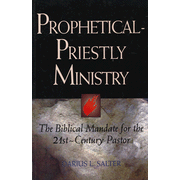
Prophetical-Priestly Ministry by Darius Salter

It’s fascinating how things fall into your lap when you least expect them. Serendipity is the word often used to describe favorable circumstances like this when you discover something grand has come your way unexpectedly. Christian sagacity trends not towards luck though, but instead, toward an understanding of the work of the Father and Spirit in concert. Salter’s book landing in my hands was just such an event.

Prophetical-Priestly Ministry was published in 2002 to little fanfare. A quick search for reviews of the book comes up short; it is ignored on Amazon and the single entry at ChristianBook.com is a restatement of the title. The silence is understandable. The book is not about how to grow your church, new ways of reaching post-moderns, or new secrets of the life of Jesus. These books fly off the shelves into pastoral libraries. Books that serve as correctives such as this are often ignored. And I believe, ignored at the peril of the pastor and their church.

Salter’s message to pastors is simple: return to your core responsibilities. Speak the prophetic word of God into the lives of your congregation rather than feeding them messages about how to have their ‘best life now.’ Stand as the priest for God’s people rather than their cheerleader or worse, their manager. He says “Prophet-priests specialize in diseases of the soul; sin, despair, depression, loneliness, alienation, anger, hostility, pride, greed, avarice, addiction and fear. The list is almost endless. Of course, these sicknesses eventuate in the systemic evils of ethnocentricity, nationalism, exploitation, oppression, and racism.” The message in this thin volume calls us back to the service of the congregation and gets us away from parading around selling books or conducting seminars on how to fill more seats in the sanctuary.

The author critiques the current ‘worldly’ ministry that he sees all around the American landscape (in 2002 and worsening since). The Church has gotten entrapped in the self-fulfillment culture and, in some cases, has moved away her first love. God is a second thought in the worst of these environments. The ministry has become enablers. We promise spirituality while allowing our people to remain in their materialistic, pluralistic lifestyle. The gospel becomes a casualty of the latest charity initiative or small group study topic.

I didn’t go looking for this book. It appeared in a weekly-specials email and something moved me to purchase it. Initially, it arrived and made its way to the book shelves to be read later. I picked it up after a time and was immediately struck by the message that the Spirit brought to bear through Brother Salter’s words. I was stopped cold when the Spirit brought my feeble ministry efforts up against those of Francis Asbury,

For the elect’s sake, Asbury ceaselessly uttered the Word through Scripture reading, prayer, exhortation, teaching, and family worship. Every overnight stay would involve spiritual examination of the residents and subsequent catechism. There would be no idle words. “My mind was powerfully struck with a sense of the great duty of preaching in all companies, of always speaking boldly and freely for God as if in the pulpit.” This included calling “the family into the room and addressing this pointedly one by one concerning their souls.”

One by one; when was the last time you (or I) sat even our immediate families down and questioned them concerning their spiritual welfare? Have we gone home by home and addressed these concerns with our faith families? Why not? Because we have succumbed to the Western individuality of the culture and we respect the personal nature of a person’s faith more than we do the calling we have received to be a priest and prophet.

Brothers and sisters, now is the time for a new awakening within the Church. Not the watered down awakening of “spirituality” in its myriad forms but for us to stand upon the walls ahead of our flock, intervening for them with God and speaking His word into their lives not matter how difficult. Find this book, read it, absorb it, and let the Spirit work it all out in your ministry.

Day 10 in the School of Prayer : Say It!

WithChristInPrayerJesus stopped and said, “Call Him.”

So they called to the blind man, “Cheer up! On your feet! He’s calling you.” Throwing his cloak aside, he jumped to his feet and came to Jesus.

“What do you want me to do for you?” Jesus asked him.

The blind man said, “Rabbi, I want to see.”

“Go,” said Jesus, “your faith has healed you.” (Mark 10:49-52)

Among the lessons in our primer, this may be the easiest thus far; the Lord does not want to us to voice vague calls for His mercy or undefined pleas for His blessing. He wants us to be direct and to state clearly our need. In doing so, we are moved to clarify our need, to dwell upon it and evaluate it, to consider it in the context of the Kingdom. Jesus asks, what do you want me to do for you? Are you prepared with an answer? No vague and pointless prayer will satisfy this question. It is prayer that is bold, direct, and from the deepest wells of our hearts that the Lord seeks. Put aside all other.

Murray directs us further though, back into the King James text for the emphasis of the Master’s words: “What wilt thou that I should do unto thee?” What wilt thou—not, what wish thou? A wish is a formless, meaningless, hope-for. Something can be wished for without being willed. The will however will stop at nothing until it is achieved. It has a purpose and as the Holy Spirit directs, it has a kingdom purpose. God will have no peace until He answers this prayer. The wish vanishes like a child’s balloon over the horizon. What is willed will be.

Lord, teach us to pray.

Psalm 59 God Will Go Before Me

image Deliver me from my enemies, O God; protect me from those who rise up against me.

Deliver me from evildoers and save me from bloodthirsty men. (vv 1-2)

These have become familiar refrains from David as he implores God to release him from the constant harassment of his enemies. Time after time we hear him turn to God in need of protection, shelter, and safety, describing his enemies in the harshest terms. In this psalm we share David’s apprehension as his home is watched by Saul’s men who are intent on killing him. To place this in historical context, refer to 1 Samuel 19. Does David succumb to the temptation to rid himself of Saul? No, he righteously refuses to touch God’s anointed, a lesson that the modern lesson can learn as member are tempted to attack and destroy a pastor.

God will go before me and will let me gloat over those who slander me.

But do not kill them, O Lord our shield, or my people will forget.

In you might make them wander about, and bring them down. (v 11)

Rather than see them destroyed, David wishes that they might simple lose their way. Possibly he hopes that they will realize how far astray they have gone in hunting down God’s chosen king. He follows with a plea that their pride might be realized and they might turn back. We can be thankful that our intercessor please for one more minute for us to repent despite our manifold sins, even though they are injurious to Him. Ultimately, the redemption of a horrific sinner such as myself brings more glory to the King than my immediate destruction, though it would be well deserved.

Then it will be known to the ends of the earth that God rules over Jacob. (v 13b)

Image saibotregeel

The Singletrack Diaries – Ridin’ the Storm Out

DSCN1756

Two days short of my XX birthday and Fall has quickly disappeared in the Rockies after the last big snow storm. The colors of the trees are gone, given way to grays and silvers of the denuded trees. The shed leaves cover the ground and the trail, matted together by the moisture. Traveling the path at a high speed requires a good memory since the rocks are now hidden beneath the leaves, their points camouflaged by the now earth toned foliage. Slower and steadier through the twists and turns.

It’s tights and long sleeves season now. That always makes me self conscious as I ride the streets toward the trail head. Full finger gloves cut the wind but the cold is starting to work its way in until I can build up some heat. A mile or two in and temperature inside is able to counteract the increasing cold. I thought I would beat the incoming storm out but it seems instead that headed out just as the front edge was pushing over the mountains and down into the front range. Calm gave way quickly to the leading winds of the pressure change.

I’ll admit it. I hate riding in the wind. In the upright position of a mountain bike your torso becomes a sail and sometimes, no matter how hard you pedal, you don’t seem to make any forward progress. Worse yet, yesterday witnessed that weather anomaly that remains a mystery; the multi-direction wind. Normally, unless you ride out in a perfect circle, you will face one general direction going out and the opposite coming back in. Yesterday, the wind managed to track me and blow against me both ways every time I came out of the trees into the open. If the Wind ever establishes a facebook page, I will not be a fan.

Despite it all, it’s hard to beat a ride, isn’t it?

Practicing the Discipline? of Celebration

image

Christians are supposed to be serious and dour all the time, right? Isn’t this what the Bible teaches us?

As Jesus went on from there, he saw a man named Matthew sitting at the tax collector’s booth. “Follow me,” he told him, and Matthew got up and followed him.

While Jesus was having dinner at Matthew’s house, many tax collectors and “sinners” came and ate with him and his disciples. (Mt 9:9-10)

Was Jesus hectoring and lecturing the guests at Matthew’s table or was He allowing His joy to infiltrate the gathering, making it a celebration?

When Jesus went to the wedding in Cana with Mary, did He take the jugs of cold water and dump them on the proceedings or did he genuinely celebrate the joyous event? The answer to both of these questions is yes, of course Jesus celebrated to the fullest. The Holiest man ever to tread the planet was no stranger to joy, happiness, and celebration despite the burdens that He carried. With this kind of joy in the head of the Church, shouldn’t the body be following?

Pleasure is not our enemy unless it becomes an end unto itself. We dishonor God by fearing and avoiding it when He has so clearly commanded it and demonstrated it in human form. Celebration is the completion of worship and can be an act of piety in its expression. Celebration is second nature when we have appropriately rooted our attitude by proper thinking:

Finally, brothers, whatever is true, whatever is honorable, whatever is just, whatever is pure, whatever is lovely, whatever is commendable, if there is any excellence, if there is anything worthy of praise, think about these things. (Phil 4:8)

If your mind is centered on these things and grounded in the faith of the ultimate goodness of the Lord you won’t be able to resist celebrating. It will become your nature rather than a forced act. Joy will become your trademark.

Day Nine in the School of Prayer: Seek Help

WithChristInPrayer

When He saw the crowds, He had compassion on them, because they were harassed and helpless, like sheep without a shepherd. Then He said to His disciples, “The harvest is plentiful but the workers are few. Ask the Lord of the harvest, therefore, to send out workers into his harvest field.”  (Matthew 9:36-38)

The Lord taught us the necessity of persistence in prayer for the goals of the kingdom, trusting in the Father’s love for our own providence. He now extends that focus, leading us into prayer for the workers necessary to imbue the kingdom with change. It is easy for us to look around and see the overwhelming need of the souls that press in on us from every side. It is not so easy to understand that we are to pray for the workers needed to reap this bountiful harvest in the name of the Father.

Is this need for prayer due to a deficit in God’s planning? Certainly not. The Creator knows all that is needed and has, in fact, supplied the workers. Who? You. We see Jesus in the passage moved with compassion at the plight of the lost, the sheep without a shepherd. As a disciple of the Son, the prayer that should result from this lesson is not that God would send additional workers but that those who have claimed love for Him would have their hearts turned in compassion to the plight of the sheep. No one should be found standing idle in the vineyard.