Psalm 70 Let God Be Exalted

imageHasten, O God, to save me; O Lord, come quickly to help me. (Psalm 70:1)

How often have we heard or said these words? Come now Lord, save me now! Our urgency must, through our pleas, become the Father’s urgency. We bring God’s time into our infinitesimal lifespan rather than seeking to understand our life in the span of eternity. Shall we not trust Him to save us tomorrow rather than today?

Our impatience is linked to our view of God’s glory. We believe that were He to save us now it would be to His greater glory rather than waiting until tomorrow. Our view down the corridors of the future ends at the tip of our nose and sometimes, our trust ends there as well.

Yet I am poor and needy; come quickly to me, O God.

You are my help and my deliverer; O Lord, do not delay. (v5)

Grace and peace to you.

image by adesigna

Disciplined Steps to Worship

image One who apprehends worship as a spiritual discipline is going to stand forever separated from the mass of believers who treat worship as a singular event that occurs once per week. She is going to be intentional about the assimilation, preparation for, and spirit of worship. When worship is an event, minimal preparation is necessary; you need only appear at the appointed time and ‘worship’ when the music begins. It becomes a check list item.

For those who correctly see worship as contributing to their spiritual formation, there are number of exercises and attitudes that can be integrated into your practices in order to build up the strength necessary to properly worship the God of the universe. Is anything less rigorous true worship?

A disciplined worshipper will practice the presence of God as a regular part of their lives. Paul wrote of developing the proper spirit needed to worship: Be joyful always; pray continually; give thanks in all circumstances, for this is God’s will for you in Christ Jesus. Do not put out the Spirit’s fire; (1 Thess 5:16-19) A mindset fixed in this way will heighten the expectancy of a meeting with God in worship, an encounter that change you.

A disciplined worshipper will seek out different worship experiences. She will worship alone and worship in community. He will find private moments to worship in solitude and will express the magnificence of God in public.

A disciplined worshipper will be intentional about preparing for the community worship experience. He will be physically prepared (rested, nourished, hydrated) and spiritually prepared (prayed through the services, confessed his sin privately).

A disciplined worshipper cultivates an attitude of Holy Dependency so that in the midst of the act of worship, she is completely dependent on God for anything at all. Any hint of manipulation is found to be abhorrent. So neither he who plants nor he who waters is anything, but only god, who makes things grow. (1 Cor 3:7)

A disciplined worshipper is not distracted by events around him. Instead, he allows God to speak to him through the crying baby, the stifling heat, or the dancer in the aisle. Bless them, pray for them, see if there is a message embedded in what has grabbed your attention. Be in community.

A disciplined worshippers offers sacrificial praise and devotion even when he doesn’t feel like it.

A disciplined worshipper recognizes that true worship ends in obedience. To stand before God is to change.

Grace and peace to you.

image by miki

Day 29 in the School of Prayer : What You Will

image I write these things to you who believe in the name of the Son of God so that you may know that you have eternal life. This is the confidence we have in approaching God: that if we ask anything according to His will, he hears us. And if we know that he hears us—whatever we ask—we know that we have what we asked of Him. (1 John 5:13-15)

But, you say, how can we know the will of God?

It is at this juncture that many who take to their knees find themselves at a loss. They desire to ask of the Father but are disheartened because they cannot find within themselves to say that they know the will of God. This confusion derives from the difference between the hidden and revealed will of God. Yes, the Father has a plan and outcomes that are hidden to us but prayer is not driven by this. God does not play guess a number games with His beloved.

If you know the revealed will of God as it is unfolded in the Scriptures, you know the parameters of prayer. He has revealed what is good and has expressed His will that we stay within the good. This revelation however is not apprehended simply by turning the pages of the Bible. In order to understand the full expression of good, the path of revelation must be lighted by the Holy Spirit. Words on a page become embedded truth under His guidance.

We are commanded to pray and to petition within His will. Unanswered prayer should not sway us from our task, it should drive us back to revelation to gain a firmer grasp on the purposes of God. Return to your knees with greater vigor and a deeper devotion and know that an answer will come.

Grace and peace to you.

image by Dia

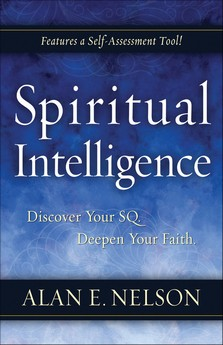
Deepening Your Spiritual Intelligence Quotient

image

Spiritual immaturity is one of those problems within the modern Christian church that is known, discussed, and programmed with little fruit to show for all of the myriad efforts. Cultural forces have allowed the intentional pursuit of discipleship to fall from favor in the Church, only to be replaced by a more casual approach, maturity by osmosis. Spiritual muscles have gone soft with a commensurate lack of influence in the world.

Alan Nelson’s contribution to the library of spiritual development is his newest book, Spiritual Intelligence. Borrowing loosely from Goleman’s Emotional Intelligence, SI is measured by the ability to translate the Christ-likeness that we hear about in sermons, talk about in small groups, and even occasionally encounter when opening our bibles into transformative application in our day to day lives. Just as many social problems are attributable to a low EI, lack of spiritual maturity reflects deficit SI.

Nelson doesn’t offer a quick three-step solution to this problem. True spiritual maturity with meaningful depth is not gained by watching a DVD series with your cell group followed by some obligatory conversation and snacks. It requires an intentional workout, one that takes time, effort, and dedication with none of the social status that comes with being seen at 24 Hour Fitness. The path to growth that he advocates mirrors the rigorous investment that Jesus made in His original disciples. The ‘travel team’ is the modern equivalent of Jesus’ band of brothers ( now brothers and sisters ), and intentional assembly that are in covenant agreement with one another to travel the challenging terrain of discipleship together. They will love you and hold you accountable as you will them for consistent gains in spiritual fruit, humility, and the demonstration of a lifestyle that is consistent with the faith your profess.

One of the fine attributes of this book that will also turn off many readers is that Nelson states that there is no single path or experience that will culminate in maturity. He rightly recognizes that, like the original disciples, we are all vastly different people who will each follow a slightly different road to growth. The book offers a wide variety of mapping strategies, suggestions for the inclusion of a Pathfinder, and strategies for avoiding the inevitable plateaus and days of back tracking. Unlike a 40 day schedule that excites the church for a month and a week, SI emphasizes that the methods of Jesus apply to the whole of our lives, from “pampers to depends.”

When you turn the first few pages you will be tempted to put it aside as I did. You have encountered everything you will read in SI in little bits here and there and the temptation will be to dismiss this as derivative of everything that came before it. Pick it up though and read it again. There is a rigorous demand that supports the ideas, a program of growth that will drain all that you can offer just as the Disciples were drained by their three year internship with Jesus. He took his band on a road trip of epic proportions experiencing joy, disappointment, frustration and love along the way. When it was time for them to display their SI, the individual disciples made an imprint on the world that is still being felt today. Isn’t that what you want to do with your life?

I’m grateful to Baker Books who supplied this copy for review.

Psalm 69 : May Your Salvation Protect Me

imageOn the cross at Calvary the perfect innocent was crucified. Though charges were leveled and accusations screamed about Him, there was no guilt in the verdict of the ultimate Judge. The Savior knew and trusted in the ultimate outcome of The Plan.

Though our voices ring with affirmation of our trust in God and His Plan, the immediacy of the struggles we face excite the doubting voice in our hearts. Why God? Why do you allow your saints to be falsely accused while the mockers go free? No answer has ever been given except, “trust me.”

Save me O God, for the waters have come up to my neck.

I sink in the miry depths, where there is no foothold.

I have come into the deep waters; the floods engulf me.

I am worn out calling for help; my throat is parched. My eyes fail looking for God. (Psalm 69:1-3)

Along with Psalm 22, this scripture is found most often in the New Testament. The authors (as well as modern Christians) found the parallels with the innocent suffering of Christ to be the perfect descriptive words. John speaks of Jesus’ rejection by His own people (Jn 15:25) and his motive in driving out the traders from the Temple (Jn 3:17). The other gospel authors heard the words of innocence being put to death ( Mt 27:34; Mk 15:23; Lk 23:36; Jn 19:19-30) and Paul related the meaning of His suffering (Rom 15:3) to this psalm.

for zeal for your house consumes me, and the insults of those who insult you fall on me. (Ps 69:9)

For even Christ did not please himself but, as it is written: “The insults of those who insult you have fallen on me.” (Rom 15:3)

Trusting that our struggle is for the greater good is one of the greatest challenges that we face. Our innate sense of what is fair doesn’t have a category into which we can organize our pain in the face of the guilty walking free of injury. We must simply trust.

I will praise God’s name in song and glorify him with thanksgiving.

This will please the Lord more than an ox, more than a bull with its horns and hoofs. (vv 30-31)

Grace and peace to you.

image by prilfish

Tozer on Time on the Telephone

Blackberry Logos Android iPhoneYet another inducement to add my Logos software to my telephone flashes onto the screen and I’m tempted. Wonder of wonders! To be able to access my bibles and commentaries while standing in line at Safeway or conjugate Greek verbs while sitting at a red light! Exclamation point!

I am no Luddite and I respect the ability to enjoy a bit of scripture while riding BART or on a break at work but there is a danger implicit in this ever lengthening path of compression. The portability of the device encourages us to ‘squeeze in’ our time in the scriptures. Rather than being deliberate about setting aside an appointed hour and reinforcing this appointment by arranging our well worn bible in our prayer closet, we are drawn into an increasingly fragmented life that is now defined by the brevity of tweets and chirps, giving God 140 characters of our life at a time.

A.W. Tozer, prescient as he was, wrote about this danger back in 1950. In The Divine Conquest (now, God’s Pursuit of Man), he wrote:

In my creature impatience I am often caused to wish that there were some way to bring modern Christians into a deeper spiritual life painlessly by short,easy lessons; but such wishes are vain. No shortcut exists. God has not bowed to our nervous haste nor embraced the methods of our machine age. It is well that we accept the hard truth now: The man who would know God must give time to Him. He must count no time wasted which is spent in the cultivation of His acquaintance. He must give himself to meditation and prayer hours on end.

Perhaps the laptop and a pocket bible should be our limit.


Grace and peace to you.

Day 28 in the School of Prayer : I Want but I Will

image

“Abba, Father,” he said, “everything is possible for you. Take this cup from me. Yet not what I will, but what you will.”
Mark 14:36

As in any course of study, the lessons come to finer and more distinct points as the class turns to its final days. The Lord has taught the discipline of prayer to us in this fashion, starting with a very broad brush but now switching to a fine point tool dipped in blood red to emphasize the finest points of petition. In this Gethsemane moment, the (we) disciples are schooled through an especially intimate communication between Son and Father as Jesus implores ‘ not my will but yours!’

Our initial prayer will always be self-serving. We know little of God’s will as beginning pray-ers and the scope of our world is limited to our own selfish wants. As our prayer bond grows through maturity and diligent practice, the Lord leads us to understand that all ultimately leads to His will. Our prayers are still honest expressions of our desire but we learn to fashion them in the context of the Father’s will. We say, Lord please for this or that but follow with, if it is your will. We find our place.

Grace and peace to you.

image Daniel Y. Go

Atonement – Under Attack.

imageThis slim collection of essays is rooted in the proposition that the doctrine of atonement is under attack. While I agree that there are a number of views about the nature of atonement and what it accomplished, I dispute the idea that the doctrine itself is under attack. Given the publisher (P & R Publishing) and the group who assembled the project, the Alliance of Confessing Evangelicals, I believe the perceived challenge is to the application of the the Penal Substitution theory. It is not clear as to why this distinction isn’t made clear other than the possible notion that any other theory is so far outside of the range of discussion that it can simply be dismissed.

The essays, assembled by editor Gabriel Fluhrer, come from presentations given at the Philadelphia Conference on Reformed Theology. Bringing the best Reformed minds to bear on a topic of importance to Christ’s Church, this collection of discussions on atonement from the Conference is almost universally excellent. Heavyweight pastors and theologians J.I. Packer, James Boice, R.C. Sproul, John Gerstner, Sinclair Ferguson, John R. DeWitt, and Alistair Begg each repeat the truth and application of the atonement brought about on the cross at Calvary from a variety of perspectives.

Packer and Boice are at their usual best offering clarity in defining atonement drawing the important distinction between propitiation and expiation. Boice’s essay on the language of the marketplace and his exposition of the grace in Hosea bridges God’s wrath and His redemptive love and bear repeated reading. Gerstner’s emphasis on centering atonement only within the narrow stem of the TULIP is out of place among the winsomeness of the other authors. Perhaps I misread his intentions but it appears that atonement, in his view, can only be seen in its limited form, something the other authors avoided emphasizing.

Atonement is a fine addition to the literature on this doctrine but it remains to be seen where it fits in the library. It is an excellent introduction to the admittedly narrow definition of the doctrine of Atonement but it doesn’t offer anything new in the way of ideas.

Psalm 68 – Proclaim the power of God

imageIf you were to compose a psalm proclaiming all that God has brought you through as you follow Him to glory it would likely end up reading much like Psalm 68. The glory of the Father is magnified in the processional and was rehearsed in a liturgy used in the Temple. The worshippers who trail behind the Ark and the Cherubim cry out:

Sing to God, sing praise to his name, extol him who rides on the clouds —

his name is the Lord —

and rejoice before him. (v4)

We lift our voices in praise because of who He is and what He is but it is an expression of mercy over evil that helps us to associate our hearts with the congregation..

God sets the lonely in families, he leads forth the prisoners with singing;

but the rebellious live in a sun-scorched land.

When you went out before your people, O God, when you marched through the wasteland, 

the earth shook, the heavens poured down rain,

before God, the One of Sinai, before God, the God of Israel. (vv 6-8)

This is the God we worship, the one who leads us safely through the wasteland. Despite the temptations on all sides, it is God who leads us home without fear. We fall behind Him as He takes the rightful place at the head of the procession and follow it to the altar.


Grace and peace to you.

image by gregw66

Day 27 in the School of Prayer : Circles

WithChristInPrayer


“Father, I want those you have give me to be with me where I am, and to see my glory, the glory you have given me because you loved me before the creation of the world.” John 17:24

The structure of the Lord’s high priestly prayer is familiar to most who have encountered it in the fourth Gospel. In chapter 17, Jesus prays first for Himself, then His disciples, and finally for the church at large that will follow in the ages. His glorification is for the glory of the Father, he prays that the work of the disciples in the years that follow will be for the glory of God, and, in the outermost circle, Jesus prays that the Church of His gathered believers will be a monument to the greatest glory of the Father.

The concentric circles all come to meet on the same objective. Our lesson today is to also not become scattered. The glory of the Father is the ultimate objective of all of our intercession. As He has taught us to pray without ceasing, Jesus gives us a target. We are tempted to be broad and all inclusive in our petitions, trying to cover the entire spectrum of human need. The Lord teaches us instead to call down the blessings of heaven upon each of the circles of our lives. Trust in this blessing to address these needs. Focus on the glory of God.