The Church Cafe and Shallow Worship

imageThe incongruity of the scene doesn’t affect you as you sweep past on the way to the sanctuary so that you might find a seat a least a few moments before the praise team takes their places. The rich, bittersweet smell of the daily roast caught you as you entered the lobby of the church and you wind through the clusters and knots of people surrounding the cafe. The brisk pace that you set for the family belies the fact that the Nine O’clock hour is moments away, but you can’t help but notice the number of people sitting at the little tables sipping coffee and the number of people still waiting in line to purchase a steaming cup of their own. Taking your seat with a minute or two to spare you glance around at the sanctuary which is barely one quarter full. Your eyes close and your head bows and you focus on the process of quieting your heart and bringing yourself fully present to the community worship of God.

As people trickle into the room for the next twenty or thirty minutes, you can’t help but wonder how many of them were sitting outside enjoying their latte as the praise leader skillfully attempted to lead the congregation into the immediate presence of God. Sure, many of the latecomers have no sense of urgency in being present while prayers are lifted up and voices raised in praise; to some it is simply a prelude to the sermon and it serves no purpose other than ritual. Do those same notions fill the hearts of the coffee drinkers? Have we gone too far in attempting to create an inviting environment, so much so that we have abandoned our primary mission as the Church – the worship of God?

I believe we have. I believe that in some instances the Church has leaned so far into the venues of the world in an attempt to be relevant or attractive that we have done so to the detriment of the Church itself. We would do well to contemplate again and again our purpose in convening on Sunday mornings. Is it to meet our needs for fellowship and only incidentally about worship? Or, do we gather at an appointed hour and place specifically to give corporate expression of our love and worship to God? With our answer in hand, we should then strive to ‘cleanse the temple’ of everything that distracts from that purpose, stripping away things that do not direct the people of God in the appropriate direction.

What do you think? Do you think that the cafe/bookstore/etc. contributes to preparing the hearts of the people of God for worship? Or, should these venues be closed and the hospitality ministry be directed to remove any friction between the front door and the chapel wherein people can quiet themselves, put the world aside, and prayerfully seek to know the presence of the Father?

Digg This

Psalm 23 ~ Goodness and Love Will Follow Me

image The Lord is my shepherd, I shall not be in want.

He makes me lie down in green pastures, he leads me beside quiet waters, he restores my soul.

He guides me in paths of righteousness for his name’s sake.

Even though I walk through the valley of the shadow of death, I will fear no evil, for you are with me, your rod and your staff, they comfort me.

You prepare a table before me in the presence of my enemies. You anoint my head with oil; my cup overflows.

Surely goodness and love will follow me all the days of my life, and I will dwell in the house of the Lord forever.

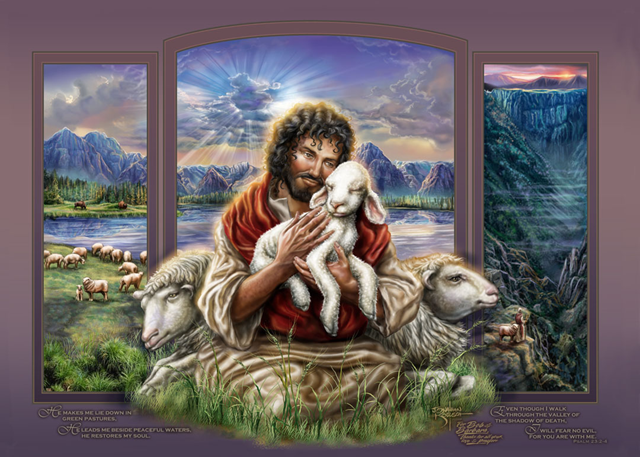
The 23rd psalm is one of the most beloved and well known entries in the Psalter. Though many individual verses have become a part of our praise music vocabulary, many people know this psalm by heart in its entirety. There is an appealing promise in these verses that is painted with vibrant and pleasing verbiage that brings an image of the Good Shepherd (John 10:11) cradling and protecting his lambs. He alone will look out for our every need (though not necessarily our every desire.)

imageIn an age of image we have stored in our minds a catalog of green pastures and quiet waters so these words immediately paint with swathes of verdant, lush tropical greens or the deep  emerald of a grassy countryside. Quiet waters soothe with their deep blues turning to black as the depth increases and pops and gurgles silence us as we strain to catch the song of the water as it moves by. We miss out on the depth of this verse unless we meditate on unforgiving landscape in which the psalmist sees the work of the shepherd.

image The desert of the Middle East is far from the viridescence that our mind shows us as the words are processed in our minds. A dry, khaki, hardened land required extraordinary efforts from the shepherd. Food for the sheep might require movement, the search for water a knowledge of the terrain and the ability to bargain with those who guarded its source. The ewe and ram on their own may stand little chance of survival; dependence on the shepherd is not optional.

imageSuddenly, the imagery changes to one who walks in the shadow of death. The deep and arid Wadi Qelt might be bright at midday but every other hour of the day fills it with ponderous shadows that might hide evil around each bend or rock. Walking alone in this valley, the walls rising high above, the only escape route would be forward or backward and yet the psalmist voices no fear as the Lord walks alongside him.

image Verses 4 and 5 form the core for us in our modern day as they did for Yahweh’s people. Our valley of shadows might be more urban but it holds the same dangers and fears. We will not fear these things though as our Shepherd walks beside us and comforts us. In verse five are presented with the image of the table and the cup, overflowing with good and yet, look carefully at the placement of this table. It is in the midst of our enemies. It is not removed from, guarded from, above, below, or in any way away from our enemies. We will sit with the Shepherd in the presence of our enemies.

You see the Psalmist does not envision an escape from the travails of this world to an eventual dwelling with the Lord in his temple. It is not a psalm of escape. Instead, it is an expression of supreme confidence in the Lord and the knowledge of His intimate presence even as we face trouble and danger in this world. All is for the greater glory of God. Though our pain might be temporary, in the economy of the Good Shepherd it is necessary in the greater picture of His-story. We are blessed in playing our role.

The promise of the 23rd psalm is simple: by following the Good Shepherd we will walk in goodness and love throughout all of our days. It does not mean we will escape the trials and troubles of this world but following the Shepherd will always lead us to better days. No wonder it remains a favorite.

Digg This

The Blue Parakeet ~ Women in Ministry 3

BPkeet In my previous post, we looked at what ministerial efforts women were involved in within the story of the Old Testament and today we turn our focus to the New Testament. Can you think of the names of any of the women involved in ministries in the gospels or epistles? How about Mary? Even the mention of Mary among protestants is likely to cause some measure of agitation but have we fully considered her ministry?

Mary was an enormously influential woman, called by God to be the mother of the Messiah. Not only does she bring Jesus into the world but she demonstrates in her Magnificat (Lk 1:46-56) a depth of spiritual maturity that certainly contributes to the development of her sons Jesus and James. Her parental role is largely hidden in the gospels but the men who developed under her tutelage reflect a deeply committed mother who placed God first in their lives.

Junia is another woman who stands out. We encounter her very briefly in Romans 16:7 where she is mentioned by Paul as one who is outstanding among the apostles. Though we are noting her gender it is more important to recognize her in the same way that the Apostle does. She is noted for the outstanding nature of her intelligence, giftedness, and her calling. Often, in our modern church, we are willing to allow the WKSPs to overwhelm what we can discern as a clear calling from God. Where does this doctrine come from?

In Acts we encounter a pair of of bible teachers named Priscilla and Aquila, husband and wife, as Paul meets them sojourning in Corinth after being driven from Rome (Acts 18:2). They are mentioned numerous times but  are noted as theology and scripture teachers of Apollos (18:26.) What is of note (aside from her calling to and mastery of the role of teacher) is her positional prominence in nearly every mention of the couple’s names. While it was not unheard of to mention a woman’s name first in the context of a couple, it was done in cases where there was a special recognition of the woman as is the case here.

Finally, let us not overlook Phoebe the Deacon we encounter in Romans 16:1. She is not belittled by the modern title deaconess as something less than practicing a fully recognized ministry within the church. She is active in ministry such that Paul recognizes the need to mention her in conjunction with her important contributions to the church. She is not mentioned as having been silent.

The New Testament (from which the WKSP passages derive) shows us women that were influential, that were the source for stories about Jesus, they were church planters, teachers, benefactors and interpreters of Paul’s letters. We have to ask then, why the WKSPs? How does the insistence on the silence of women fit into the theme of Oneness restored by Christ? We’ll broach this in the next post.

Psalm 22 ~ Why Have You Forsaken Me? Part 1

It is a challenge for modern Christians to read this psalm without hearing Jesus voice the words of the opening verse. Our thoughts turn to our Lord, sacrificed on the cross and crying out in the final moments of his agony. We are filled with questions; did God forsake Him? Will He forsake us? Is God really far from our laments and our deliverance?

My God, my God, why have you forsaken me?

Why are you so far from saving me, so far from the words of my groaning?

O my God, I cry out by day, but you do not answer, by night, and am not silent. (vv 1-2)

Many of us have lamented in this fashion as our prayers appeared to hit the ceiling and fall without response. The appearance of God’s distance has left us feeling alone and vulnerable, especially to those who deny Him.

But I am a worm and not a man, scorned by men and despised by the people.

All who see me mock me, they hurl insults shaking their heads:

“He trust in the Lord; let the Lord rescue him. Let him deliver him since he delights in him. (vv 6-8)

Do we allow these insults to pierce our souls or do we continue to trust in God? His will for each of us is beyond our thoughts and understanding and many times, especially in those moments when He seems far away, our faith must persevere. This is why we search the scriptures wherein we encounter others enduring in the same way we are. We see negative examples of those who do not wait on God (wandering in the desert, waiting for a child) and those who know that their only hope in is in the mercy of God (Job.) We can trust in His ways to be perfect despite current circumstances and continue to turn to him in love and faith.

Yet you brought me out of the womb; you made me trust in you even at my mothers breast.

From birth I was cast upon you; from my mother’s womb you have been my God.

Do not be far from me, for trouble is near and there is no one to help. (vv 9-11)

The Blue Parakeet ~ Women in Ministry 1

BPkeet

To conclude his analysis of how we read and apply the Bible to our lives, Scot McKnight closes The Blue Parakeet with a case study involving the contentious issue of women in ministry. The discussions and arguments surrounding the issue and the manner in which the church puts its beliefs into practice are an excellent subject for analyzing our process of discernment. How has our particular church or denomination come to its position on whether or not a woman can be called to the position of Senior Pastor or even another role in which she would have leadership over men? Is Paul the final word on women’s roles or is there a bigger picture when the issue is considered in light of the whole of Scripture? We must finally ask ourselves whether or not this is an application of that was then, this is now?

Throughout history, women are culturally labeled as inferior to men. Because the scriptures provide a view of a wide swath of history and because men are the authors of these books, one can get the impression that the dominant patriarchal view on the pages is a reflection of the societal opinions through time. These ideas combined become the lens through which the church reads the bible and then fossilizes the idea of the subordinate woman in church tradition. McKnight guides the discussion that follows in the remaining chapters with this key question, “Do we seek to retrieve that cultural world and those cultural expressions, or do we live the same gospel in a different way in a different day?”

In our times there are three broad views that direct how we engage this issue and, more often than not, we will find our thinking in one of these categories. It is not enough however, to identify your thoughts in a theological context. Because of their importance, a believer who intends to apply the Bible to all of the various aspects of life must do the spade work of understanding how we come to the beliefs that we hold. On the issue of female leadership it is especially important because our decisions can have a negative effect on a fellow sojourner.

The three views that we often encounter are:

Hard Patriarchy

The biblical context and it teaching are God’s original and permanent design a woman’s responsibility is to glorify God, love Him and her husband and children and others. She must submit to her husband and never seek a role that places her in leadership over him. God ordained men to be leaders. Period.

Soft Patriarchy

We are called to find a living analogy in our Western, 21st century context to the teachings of the Bible. This examination is to include gender roles. This system allows a bit more freedom in pursuing leadership outside of the home but she shall never be placed in a church leadership role over men, including the calling of Senior Pastor.

Mutuality View

This view taps into the oneness-otherness-oneness restoration theme that arrives with the Lord Jesus. The Bible story is cultural and the teachings reflect the culture. Because Jesus restores our oneness, we must rely on the Holy Spirit to guide our understanding of what God has called a woman to do and this possibility must include consideration of her calling to the Senior Pastor role.

Where do you stand?

Fourth Sunday in Advent – Micah and Mary

image In logical ordering of the world God created, the darkness must precede the light. We must endure the night to know the sunrise and warmth of a new day. This ordering extends to the extension of God’s mercy; our repentance leads to the light of the Lord’s mercy. Reading the words of the prophet Micah paints a vivid picture of this contrast. The Lord rebukes his children and follows it with the promises of mercy to be received by those who turn away from their sin. The greatest promise is a featured part of the Advent tradition,

But you, Bethlehem Ephrathah, though you are small among the clans of Judah, out of you will come for me one who will be ruler over Israel, whose origins are from of old, from ancient times. (v 5:2)

Mary too knew the sweet longing of anticipation. Carrying the precious gift she bore closer and closer to His birth, Mary was overwhelmed at the change that was about to take place in the world. She was perhaps at a point similar to those moments just before the crown of the sun breaks the horizon, when the purples mix with the deep blue and black of the night sky and the sliver of light pushes the sphere of darkness to the west; though many weeks would still pass the day of the birth of the Lord was nearer than farther! Her heart sang,

My soul glorifies the Lord and my spirit rejoices in God my Savior, for he has been mindful of the humble state of his servant. From now on all generations will call me blessed, for the Mighty One has done great things for me—holy is His name. (Lk vv 1:46b-49)

The day is near for us as well, rejoice for Immanuel!

Advent Benediction ~ The Song of Mary

image Rejoice in the presence of the Lord, may His face shine upon you.

May you walk in anticipation of the promise kept,

and may you fall to your knees in humility and repentance.


May you join with your sister Mary and your soul glorify the Lord, your savior.

I pray that you will be known as people of mercy as the Lord works through you

and that you will give to others the same love that He has given to you.


May you remember to be merciful, humble, and faithful,

even when you face uncertainty as Mary did.

May you trust in Him as His ways are perfect.

Amen

First Sunday in Advent with Micah

image

The season of anticipation is upon us beginning today. The liturgical year begins anew with the first week in Advent. The break with the old year and everything that may have accumulated during the period is marked with a return to looking forward with a positive sense. Christians look from within the kingdom to the new heavens and new earth to be ushered in by the Lord. For now, we prayerfully look to the record of His coming and to those who pointed the way.

Isaiah often takes center stage in the readings but this year I’d like to turn to his contemporary, Micah. The prophet compresses the cycles of travail and hope and points the way to the coming King.

In the last days the mountain of the Lord’s temple will be established as chief among the mountains;

it will be raised above the hills, and peoples will stream to it.

2 Many nations will come and say, “Come, let us go up to the mountain of the Lord, to the house of the God of Jacob.

He will teach us his ways, so that we may walk in his paths.”

The law will go out from Zion, the word of the Lord from Jerusalem. (Mic 4:1-2)

Living in the kingdom after the Messiah has come gives our anticipation a similar focal point. The Spirit guides our prayers in the now but not yet kingdom of God which we inhabit and serve. We too look forward to a peace that can only be realized as the worship of God floods the world and replaces our brokenness with wholeness.

An Advent Benediction

May the Lord bless you with an aching heart.

An aching heart that beats with His as He longs to gather all of His children,

as He surveys the discord amongst His family, and the condition of His Church.


May the Lord bless you with burning eyes.

Eyes that travel to and fro and view the troubles of the world as opportunities,

eyes that see the people that are often unseen, and eyes that can look forward more than they look backward.


May the Lord bless you with a deep, abiding sorrow.

An anguish at the numbers of lost, of the found who have fallen aside, and for the found who continue to deceive themselves.

A sorrow at allowing doubt and mistrust into our souls and within our community.


May the Lord richly bless you with a childlike humility to know that the Spirit within you knows no boundaries.

May He simplify your thinking, replacing doubt with trust, and move you to change the world.

To sooth the aching heart, salve the reddened eyes, and turn sorrow to Joy.


Amen

The Blue Parakeet 6

BPkeetDo not merely listen to the word, and so deceive yourselves. Do what it says. (James 1:22)

The Lord’s brother reminds us that although having a correct view of the Bible regarding its inspiration, inerrancy, and authority are essential, because the Bible is God’s personal word to each of us we must also be doers of that word. Our training in reading the Bible has a goal of developing our listening skills. We want to be more than information gatherers. We want to approach the words in love, with attentiveness and intention so that our thoughts and behaviors become naturally driven by the voice that we hear emanating from those words. In this week’s chapter of  The Blue Parakeet, Scot McKnight devotes a short chapter to the importance of listening intentionally.

God speaks to us through His bible for a reason. He speaks so that we might know Him and enter fully into relationship with Him. In the context of that relationship we tend to listen differently. If we were to happen upon a cache of love letters between two strangers, we might sit and read them marveling at the turn of a phrase or the depth of emotion expressed but they would not necessarily speak to us as an outsider. On the other hand, finding the letters that we received from our husbands or wives early on in our relationship we hear a different voice. It is no longer our own voice reciting the words but the soft, gentle voice of our wives telling the story of the letter. It speaks directly to us because we know and love the person who put the words to paper.

The Bible is intended to be read the same way, in the context of a love relationship. God speaks through the story directly to you and I in order to move us. It may be for the purposes of mission or it may be to put up a guardrail in our lives by hearing Him tell the story of others who failed to do His word. Either way, the voice we hear is personal and loving, not the technically disconnected voice of the Greek interpretation of Paul. We aren’t moved by Paul or John or Micah, we are moved by the story that God tells through them.

This concept is amongst the easiest to understand when we ask ourselves what our significant others want from us more than anything else…to be heard. Listening is loving (thank you Alan Jacobs.)