Blue Parakeet 1

This is the first post in a series that will engage the ideas in Scot McKnight’s new book The Blue Parakeet.BPkeet As I said in my earlier review, this is an excellent piece of work destined to make a lasting contribution to the Church and is particularly useful to the seminarian immersed in the technical aspects of Bible study. Scot’s perspective is refreshingly non-academic or pedantic in the least. He writes as a fellow journeyman confronting with us what it means to read the 1st century Bible in a 21st century context. Is Christianity fossilized in that time which we must forcefully apply to modern life or is the Bible a guide to understanding how the Spirit moves today?

In the first two chapters of the book, Scot outlines the observations that led him to construct his tools for discernment. The Christian bromide ‘if the Bible says it, we do it’ is the foundation on which he begins to build his method. This, if we stop to consider it for even a moment, is nonsense. We pick and choose among the biblical mandates those that we will apply today and those we will ignore. The Sabbath, foot washing, surrender of possessions, charismatic gifts; all are dispensed with in various ways and with a variety of justifications as not applicable to today’s church. At the same time, we hold other mandates to be fixed in time and to be obeyed regardless of the times, women in ministry leadership a prime example. Scot asks how we develop the discernment to tell which is which.

McKnight outlines the three general ways in which we approach the Bible and the attitudes and actions that result from each. We may read to retrieve, meaning that we return to the times of the Bible to retrieve the ideas and practices for today. The challenge with this common approach is that we cannot live a first century life in the twenty-first century. The truth is, we shouldn’t want to do this as it ignores the work that the Spirit is moving to accomplish in our modern age. If we read carefully we find that God spoke in Moses’ days in Moses’ ways, to Paul in his days in his ways, and we should expect this pattern to continue; God will speak to us in our days in our ways. Our reading of the Bible should help us to see how God wants to move in our current time.

Reading the Bible through tradition is an important component in developing this discernment. One of the most important changes that the Reformation wrought was to put the scriptures into the hands of the believer. Everyone should read the Bible for themselves but they shouldn’t necessarily interpret it for themselves. Christians have a rich history and long held beliefs that can serve as the guard rails to our interpretation. We should respect long held beliefs, trusting that the Spirit guided those who came before us in forming those beliefs. Moving on this track helps us to roughly figure the edges of our belief while allowing the Spirit sufficient freedom to breath new insight into our faith for today.

Finally, we read with tradition, recognizing that God is forever on the move toward His conclusion. We were never meant to be stationary as history flowed around us like a stone in a creek. We were meant to be a part of it, serving out our individual purpose in the story. We should be able to read the Bible without getting stuck there. God did not freeze time in the periods of the Bible anymore than most cultures have stood still. He provided the scriptures so that we would have a guide to understanding how He wants to move today addressing the issues that we face.

McKnight challenges us to think about the way we approach the scriptures. We can try to cage it, taming the Spirit. In doing so we lose its edge, dulling the double edged sword that transforms us and the world around us. Bringing modern eyes to the Bible is not a crime, any more than it was for Paul to understand the whole of his scriptures in light of the modern revelation that he confronted. We’re not Paul but we do have to understand the way that God speaks to us in our days. I hope you’ll follow along as we read through the rest of the The Blue Parakeet, attempting to put the tools to work to hear the Spirit move today. I look forward to hearing what you think.
Kairos

image

We as Americans are at a tipping point in our history. Our nation is roughly divided into two ideological camps; one leans toward the notions of individual responsibility with minimal interference from the a central governing authority and the other finds its identity in a large, caretaker governing authority and abdication of individual responsibility to that authority. Christians find themselves on both sides of this division with a decision to make as to whom the next leader will be. Unlike many other elections in the past with little other than the cacophony of partisan slogans and frenzied lowing to differentiate the ideologies, this event is different. It is kairos.

Some in the Christian community will insist that a call to action is misguided and unnecessary; God will place the man or woman that He ordains into this position of authority without human involvement. While miraculous intervention is always a possibility, this ‘sit back and observe’ attitude shows a profound misunderstanding of how God interacts with His world. Even a cursory review of the biblical record demonstrates that God works through His human agents, imbuing them with appropriately formed hearts and the ability to act on what is right. In a country in which we practice representative self-rule, our responsibility is to exercise our franchise based upon the ethics and morality of Christ.

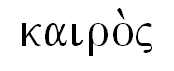
This moment in the history of the United States is kairos. For those unfamiliar with the Greek term, it is a decisive point in a place, situation, or time where the divinely ordained purpose must be grasped boldly by moral agents. It is an opportune time in which human decision is crucial to the fulfillment of divine purpose. Those whose wills are attuned to divine purpose will recognize kairos, those who only hear their internal drummer will not.

Will you act decisively for life in this moment? The next president will be filling positions in the Supreme Court in the coming terms. Will those appointments be men and women who ‘find’ legislation in the Constitution or those who interpret it according to the intention of its authors? Your vote will decide the direction.

Will you act decisively for individual liberty in this moment? The corollary of liberty is individual responsibility guided by your Spirit-driven ethics and morals. The next president will lead the country from either the perspective that you are able to exercise this liberty and be responsible for yourself or that you are unable to be responsible for yourself and that a large government presence and intervention are necessary for your good. Your vote will determine that direction.

Will you act decisively to reverse deepening corruption of the culture? It becomes more difficult each day to see the imago dei in our fellow citizens. The humanity that we each posses is challenged with debasement by a pornified, violent, crass culture that is supported by an underlying attitude of moral equivalency. Cultural insistence that you or I are not to apply our moral or ethical standards to someone else, thus judging their ethics is at the root of the continued and quickening downward cultural spiral. The next president will either lead by an example of honor and principled service to others or from a position in which no morals or ethics are to be judged superior to any other system and that each should seek out whatever they feel is right. Your vote will determine that direction.

If you decide that this is not a kairos moment that needs your action that certainly is your privilege. I urge Christian readers though to review Christ’s insistence that we not retreat into fortresses but that we carry His message of the restoration of humanity and justice in both orthodoxy in the Church and orthopraxy in the world. The Kingdom exists as a here and now concept as well as a yet to come idea. In the here and now, your purpose is to be an influence in the culture, to spread your Christlikeness like yeast throughout your sphere of influence. As a citizen, your responsibility is to apply your values and ethics to selecting the fellow citizen who will lead  us into a strange and new future.

Obama’s Racist America

Barack Obama is obsessed with race.

He has rarely allowed a major speaking opportunity go by without bringing up and refreshing the meme that all of those who oppose him are racists. Over and over he reminds America and the world that he’s different from the other candidates, that people are going to fear him, and even, that he does not look like the faces on our currency. Putting his megalomania aside for a second (what, precisely has he done for us to consider his face for inclusion on the next new dollar bill?), what reason does Mr. Obama give for these propositions that he voices?

Because he’s black.

Barack Obama, supposedly the post-racial candidate, is obsessed with his race. He is using it to both bludgeon the battlefield into shape and to silence his critics. By cravenly attributing the choice for an alternate candidate to his skin color alone, Obama labels non-support as racial opposition. This silences criticism of his lack of experience, his socialist tendencies, or even his constant assertion of victimhood because the critic fears being named a racist. In tandem with his appropriation of the history of such giants as Martin Luther King, this kind of fantastic rhetoric cheapens the entire history of race relations in this country.

The trouble for Obama comes when those who will not vote for him are being slapped with the racist label while they look at the company of true racists that he surrounds himself with and wonder why he cannot also identify them.  Reverend Wright, for example, espouses a theology that treats all whites (based on their skin color) as an amorphous mass of evil. Dear Mr. Obama, when pigment content is the identifier of those who are targeted for vitriol, that is racism.

I believe, when Mr. Obama clambers down from his elitist tower to tramp amongst the hoi polloi, he is going to discover an America that has long moved past the sharp racial divisions that he wants to draw across her people. When he gave his “famous” speech about race several weeks ago, he stated that we needed to start a conversation about race. Perhaps the news has not penetrated the walls that he surrounds himself with but America long ago commenced this conversation with great results. Certainly he will encounter pockets of bigotry and outright racism which, being the logician that he has demonstrated, will be proof positive for him that ALL people are racist. Sadly, this is human nature and we will not be able to eradicate it until the new heavens and new earth are formed. Until then, to continue to utilize race and racism as an antagonist rant against those who don’t support his candidacy is not only unbecoming a presidential candidate but it will run the risk of reversing some of the racial progress that has occurred in this country.

Nothing to Lose by Lee Child

Hope and Despair Lee? Hope and Despair?

The West is riddled with little towns and the remnants of other one-time settlements and they often have interesting names. Many of them point to historical or geographical facets of the community that someone, sometime thought were important. Cripple Creek for example, was said to be named by a rancher whose calf was crippled by an ill-timed jump over a creek as a result of an accidentally discharged six shooter. Bombay Beach was going to lure vacationers from the French Riviera to the edge of the Salton Sea until the salt-in-the-sea combined with torrential rainfall in the 70s overtook man’s ambitions. Given the long, long list of colorful place names that Lee Child could have used to place his latest Jack Reacher thriller in, he settles on the imaginary neighbors Hope and Despair. [CLICHE ALERT…CLICHE ALERT…CLICHE ALERT]

image Reacher and his toothbrush are traversing the country from Maine to San Diego when his hitchhiked ride drops him on the road to a company town named Despair. He makes note of an important marker found where city or county lines meet, the change in the roadway. The road from Hope is smooth, well built, and recently blacktopped. At the expansion joint where Hope relinquishes the thoroughfare, the road becomes pitted, worn out and obviously constructed at minimal expense. Upon walking into town, Jack notices immediately that this was not a town with a huge tourist draw. Sitting in the only cafe he can find, Reacher is pointedly ignored by the waitress until the welcoming committee notices him. As they surround him, not to give him the key to the city but to tell him to leave, their fate is sealed. Those of us who know Jack Reacher know that the fastest way to broken bones and contusions is to tell him to do something without an adequate explanation.

The rest of this fast paced thriller follows Jack as he seeks to discover the reasons why people are so adamant about keeping non-locals out. Utilizing a temporary romance in next door Hope, Reacher learns more than he wants to know about the recycling plant that is the center of life in Despair. In the course of his nosing around we are exposed to Reacher’s/Child’s feelings toward the Iraq war as the snooping intertwines depleted uranium, army deserters, veterans brain injuries, the end-times, and preacher/town hoss. These positions might counter your own but, if you can put that aside, this is a typically good Lee Child effort. Reacher is himself throughout, able to take on and defeat multiple assailants, strangely attractive to women, and tack sharp in his detective skills. Once you are drawn into the story, you won’t stop until you cross the 400 page mark.

I’m hoping that the cliches were simply the result of Child wanting to make his anti-war stand through his hero Jack Reacher and that the next book will return to the generally smart character and fantastic pacing. If you haven’t met Jack yet, I would recommend starting with either Bad Luck and Trouble or The Hard Way to get a better feel for his personae before you draw any conclusions from this effort alone.

Cue Anti-Flag – Depleted Uranium is a War Crime

The Cactus Eaters by Dan White

In the late sixties I first read My Side of the Mountain and was forever hooked. Between that book and The Willie Mays Story (thanks Scholastic book service) my love for voracious reading was kindled. “Mountain” is every boy’s ideal adventure; running away, living in a tree with a pet peregrine falcon, how could it get any better? That remained the standard for a wild escapade until I checked out a library book about a young man who hiked the Pacific Crest Trail alone, the title of which escapes me. Here was an adventure, a solo journey into my beloved mountain forests, hiking with a gigantic, external-frame Kelty backpack and enormous leather boots. I longed for years to emulate this hike, thinking about it on shorter jaunts and knowing that I would never be able to set aside the time to actually accomplish it. I would have to enjoy it vicariously.

image With my radar tuned this way, a browse through the local bookstore landed on Dan White’s recently published book The Cactus Eaters. White’s memoir brought Mountain immediately to mind as he chucks his newspaper job and goads his much more driven girlfriend into a grand lark, hiking the 2650 miles of the Pacific Crest Trail from Mexico to Canada. Never mind that they had not been more than weekend hikers nor had they shared any confined space in the past, this pair set out into the heat of the Southern California desert. Dan and Allison were going to face the Sierra Nevada, the Cascades and all of the challenges with 70 pounds of camping gear strapped to their backs. We’re not given Allison’s reasons for joining the expedition except boredome and wanderlust, but Dan is revelatory in hoping to reshape his image of himself and escape the tentacles of adult life.

The travails start early in the Mojave as the pair discovers that this journey might be harder than they anticipated. Scarce water is jettisoned on a whim as the barrenness of the environment plays with the hiker’s minds, exposing their raw personalities. Dan’s insecurities threaten to derail the journey at numerous junctions, his snarky observations of other hikers and the trail angels who come to his aid giving the narrative a darker edge. A part of Dan’s journey of self realization appears to be the criticism of others, evident in his gleeful attachment to the pejorative unbecoming description of hikers following Ray Jardine’s methods. As he describes his girlfriends transformation into a hardened, shapely, sun-bleached blond, he also seems to be so insecure that the reader is led to wonder why Allison doesn’t leave him at one of the supply stops…walking away humming a death metal hiking ode.

Unlike Bryson’s Appalachian trail memoir, The Cactus Eaters ends on a very sour note. Abandoning his girlfriend, Dan paints a picture of his spiral into near insanity after completing the trail in a second trip. His self absorption in the final pages threatens to ruin the entirety of the preceding pages as the ordinary guy of the first steps of the trek becomes little more than a simpering boy, sitting in his room in his boxers purportedly longing to be like the men he met on the trail who had cast off the bonds of polite society, yet lacking the courage to do so.

Cactus Eaters is a fine trail narrative, good for a summer read as we each consider our own little adventures. Except for White’s meltdown and his admittedly boorish treatment of his girlfriend, he is a writer we can look forward to reading in the future.

American Exceptionalism

It is considered politically incorrect, arrogant, and socially heretical to proclaim, but on this day when we celebrate the humble beginnings of the United States of America, I will exclaim that in the history of the world, the USA is an exceptional nation. To say this is to risk excoriation by those who believe otherwise, but I will not retreat from this position. The vast majority of us are children and grandchildren and great-great grandchildren of those who emigrated to these shores voluntarily with the hopes and dreams of a better life than that which would have been possible in their homeland and collectively we have built one of greatest forces for good that the world has seen, all of it rooted in the liberty enjoyed by each of her citizens.

I don’t take a pollyannaish view of the United States as being without flaw. We enslaved human beings, freed them and did immeasurable damage to their human dignity by discriminating against them. We have enabled virtually unfettered destruction of human life through the abortion trade which has had the unintended consequence of forever affecting the mores of generations. We have failed to count the unmentioned human costs of some of our geopolitical decisions and we often overlook those who survive in the shadows of our own cities.

America is not without her warts and scars but we are at the core founded on a noble principle, that all men and women are created equal and endowed by their Creator with unalienable rights including life, liberty, and the pursuit of their purpose. In living out this belief we have shed blood, brother against brother over this issue of slavery. We have shed American blood in countless foreign locations in securing not only our own continued liberty, but the freedom for others only related to us by our genus. When we have claimed victory in those conflicts we have taken no ground, no spoils of conquest except to ask for small plots of land to bury our sons and daughters where they fell.

America is exceptional in the quality of life that she offers her citizens, giving them the freedom to pursue their dreams whether they be productive, creative, scholastic, or philosophical. This liberty has led the world in innovation and the creation of value in a tide that has raised countless other boats throughout the world. Yes, the tide goes in and out, but the unstoppable spirit of liberty finds a way to stay afloat during the low tide, all the while planning for the next wave.

Finally, in a reflection that is not performed often enough we must recognize those of our citizens who see nothing but the warts and the evil of the US. Each of them should take five minutes to consider the liberty they enjoy in being able to freely voice their dissent without fear or imprisonment or worse. They should consider the resources and wealth of the nation that gives them the freedom to devote their energies to their complaints with little sacrifice of their own. And, finally they should consider the enormous risk taken by those who two hundred and thirty years ago affixed their names to a document proclaiming their intent to form a society never seen before in the world.

Poor, poor Uzzah and The New Cart

In an ongoing discussion with a brother in another forum (here) I was reflecting on the importance of Holiness in the Church and how it is affected by our theological constructs. There is a telling incident in 2 Samuel that gives us a lot to dwell upon. King David, recognizing that the Ark represented the earthly throne of God devoted himself and Israel to returning it to Jerusalem. His motives are good but his actions turn out bad, as we will see:

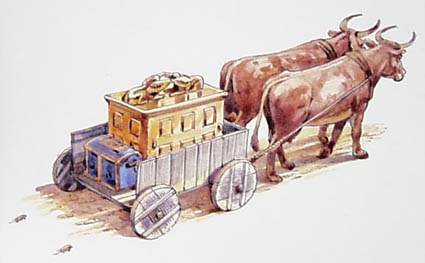
David again brought together out of Israel chosen men, thirty thousand in all. He and all his men set out from Baalah of Judah to bring up from there the ark of God, which is called by the Name, the name of the Lord Almighty, who is enthroned between the cherubim that are on the ark. They set the ark of God on a new cart and brought it from the house of Abinadab, which was on the hill.

ArkCart Oops, a small detail catches our attention. The ark is set upon a new cart for its transport back to Jerusalem. God should be pleased with our motivation and the way we decided to move it. After all, our hearts are in the right place. But, if we refer back to God’s instructions for handling the ark ( Exodus 25:12-15 ) we find that it is to be carried on poles balanced on the shoulders of the Levites. Why would David make such an error? Not because he was ignorant of importance of the ark or the instructions of the Lord but because he was affected by the culture. He saw the Philistines transport the ark by cart with no ill effect and he followed in their footsteps. Perhaps David thought that the ‘rules’ could be overcome by the charismatic worship of the Lord that surrounded the movement:

Uzzah and Ahio, sons of Abinadab, were guiding the new cart with the ark of God on it, and Ahio was walking in front of it. David and the whole house of Israel were celebrating with all their might before the Lord, with songs and with harps, lyres, tambourines, sistrums and cymbals.

We stand warned that worship that we deem worthy of God is not always so.

Neither are all of the actions that we take on behalf of God. It is easy for us as sentient beings to feel that if our motivations tell us we are doing the right thing that it will be perceived by everyone as being the right thing. This may work on an interpersonal level but our Lord is stickler for detail. Watch His reaction when we substitute what we think is right for what He says is right:

When they came to the threshing floor of Nacon, Uzzah reached out and took hold of the ark of God, because the oxen stumbled. The Lord’s anger burned against Uzzah because of his irreverent act; therefore God struck him down and he died there beside the ark of God.

Uzzah had the purest of motives in keeping the holy ark from touching the ground but this purity still conflicted with God’s clear instructions. How often do we substitute our ideas for what is right for the clear instructions of our Lord? For myself, probably far too often. When the consequences of our actions visit us, do we repent or do we get angry with God? David himself gives us a clue as to what usually happens:

Then David was angry because the Lord’s wrath had broken out against Uzzah, and to this day that place is called Perez Uzzah.

Perhaps beginning today, we reexamine the things we do to please God. Are they in line with His expectations or do we expect Him to fall in line with ours?

The Wheels on the bus go bump, bump, bump!

As the candidate for misjudger-in-chief demonstrates his lack of character and incredibly poor judgement, he tosses yet another associate, Mr. Jim Johnson, under the already crowded Obama express bus. Mr. Obama will want to exercise caution however, when that day comes in the future when he must attempt to disengage himself from Ayers and Dorn, given their explosive history. This kind of judgement and character represents the best the United States of America has to offer?