Atheism is a Form of Cognitive Dysfunction

A Shot of Faith {To the Head} by Mitch Stokes PhD.

image

Atheism is a Form of Cognitive Dysfunction

Dr. Stokes includes the section heading above in the closing chapters of this excellent book, not in a provocative sense or to garner cheap attention, but to emphasize the strength of the logical and philosophical arguments in favor of God and Christianity. While the modern Atheists have descended to conclusion that anyone who proclaims a belief in God is suffering from a mental illness at best, and a severe cognitive deficit at worst. Why, they say, one might as well believe in the The Flying Spaghetti Monster just as easily as a deity who created and maintains the world in which we live.

A Shot of Faith is not a casual read. Dr. Stokes writes at a high academic level from three perspectives: rationality, design, and absolute standards. Each theme addresses modern Atheism’s common positions that attempt to disprove God’s existence. The lead argument that he dissects is the position that Christian belief is irrational based upon the lack of evidence. Stokes does a magnificent job of not only outlining the Atheist position, but also in addressing it using the same logic and philosophical tools that they use to arrive at their conclusion. The results are devastating to the foundation of the Atheistic belief system, knocking out the foundations that undergird its fragile construction. 

Stokes’ book may be intended for a wide audience but the concentration and consideration required to work through his epistemic process and to make the information your own. For the reader willing to put in the time and reflection necessary, the knowledge contained in these pages is sufficient to face down any emotional Atheist who chooses to resort to the common memes in challenging their faith in Christ. The thread that weaves through all of the pages is perhaps the most important; we need not be afraid of challenging the bellicose voices that attempt to diminish faith to myth or fairy tale.

I am grateful to Thomas Nelson who provided this book for review.

Terra Incognita

GoosePeople cannot discover new lands until they have the courage to lose sight of shore.

Many Christians will proclaim a willingness to follow the Holy Spirit wherever He leads them until the moment arrives when they actually have to take the first steps, then we hesitate. Through the years we have become expert at all manner of excuse creation, justification and reasoning away in order to limit the Spirit’s influence on our lives. Breaking out of these cages is the subject of Pastor Mark Batterson’s book Wild Goose Chase.

Most churches and the Christians therein are constrained in their faith by shackles of their own making. The Holy Spirit calls each of into ministries that are wildly beyond our comfort zone. Rather than following the Wild Goose where it leads, we put a band on His leg and tether Him so that the apogee of His flight is well within our boundaries of comfort.

Batterson encourages the reader chapter after chapter to live the adventure. We miss out on the blessing of our calling because we fear that the Spirit will take us off into uncharted territory. Addressing this risk-avoidance in the early chapters, the pastor’s word become more challenging as he approaches the final pages. Here we encounter the calamity and upheaval that we were trying so hard to diligently avoid, but, as Batterson points out, many times our calling comes in the form of troubles. The spiritually diligent Christian will learn to read these signs and interpret the next flight pattern of the Goose.

Pastor Batterson’s books are always encouraging, and Wild Goose Chase is an excellent companion to his earlier volume, In a Pit with a Lion on a Snowy Day. Safety-minded Christians will avoid this book at all costs. Those Christians interested in the wild, free faith that we are called to will devour these pages and not stop until they follow the Goose into the wonderful, dangerous faith that the Lord intends for His Church.

I am grateful to Multnomah Books who provided this copy for review.

Burial Cloth and Neatness

The Jesus We Missed by Patrick Henry Reardon

imageThe folding of the kerchief may have been completely unconscious. I do not find this hard to believe. The universal Christ, the eternal Word in whom all things subsist, was still the same Jesus to whom an act of elementary neatness came naturally.

It was in reading these words in the closing paragraphs of The Jesus We Missed that the import of the book finally took hold. The humanity of Christ, while a matter of theological discussion through the centuries, is rarely given the biographical treatment that we read on these pages. Is it important? I believe yes, because the full picture of the God-man Jesus is incomplete unless the full measure of his humanity is realized and taken into account alongside of His words and actions.

Jesus was not God simply inhabiting a human form. He was God who willingly made himself nothing by taking the very nature of a servant, being made in human likeness (Phil 2:7). He was not an infant who simply pretended not to comprehend the voices around him, Jesus was the helpless babe in the feed trough. He was the terrible two-year-old, the rebellious teenager, the young man full of strength and possessing the craftsmen’s hands.

And He was God, knowing an intimate relationship with the heavenly Father that we are called to emulate in the days preceding His return.

Reardon’s excellent book is not a casual read. It demands consideration on every page of the human nature of the Savior. In doing so, the reader is awakened to the senses of sight, smell and hearing in the fully-man Jesus. Events that often take on an other-worldly character when we forget His humanity are viewed in a different light as you consider scriptural hints that you may have skimmed in the past. The human portrait that Reardon paints is an encouragement to the reader in addition to its edification. Jesus relied on prayer to know the Father and His will and God used that open conduit to guide the Son’s steps. Has He promised anything less to us?

The Jesus We Missed will challenge you. It is written for the non-theological reader but that doesn’t make it a breezy read. You will be stopped on page after page as you find facets of the Lord that you had not considered in your travels through the Bible. Don’t hesitate to put the book down and pick up the Scriptures. The expanded perspective is well worth the time.

I am grateful to Thomas Nelson who provided this copy for review.

Holding Treasure in Open Hands

The Treasure Principle by Randy Alcorn

image

Quite simply, you cannot argue with this book. It is simultaneously convicting and edifying as the Treasure Principle does not come from the mind of Brother Alcorn, it comes directly from the Scriptures. Ultimately, the reader cannot arrive at any conclusion other than everything we treasure belongs to God and we are but managers of this treasure during our fleeting days in this world. Once that attitude has come set in the believers mind, behavioral change is soon to follow.

Unlike other books on this topic, Alcorn uses just a handful of application illustrations of a personal nature. This is not a ‘name it and claim it’ guide nor is it a strategy for managing your wealth for greater return. It is, on the other hand, an exemplary survey of the what the Bible has to say about the handling and giving of God’s wealth that he entrusts to his people. Randy organizes a series of principles under the guiding light you can’t take it with you – but you can send it on ahead.

You will read this book in a couple of hours but you will spend many days and weeks thinking about the principles. Inarguable, you are confronted with the uncomfortable truths that the Spirit will use to prick your conscience as He realigns your priorities. Only the most callous will walk away from the book unmoved. Others will carefully and prayerfully review the true object of their heart and begin to make the necessary adjustments.

I am grateful to Multnomah Books who provided this copy for review.

How Long Will You Love Your Simple Ways?

The Richest Man Who Ever Lived by Steven K. Scott

image How much better to get wisdom than gold,
         to choose understanding rather than silver! Proverbs 16:16

Scott’s book comes to the reader presenting an attractive idea; follow and apply each of the hundreds of proverbs to your life and you will be the beneficiary of untold success and wealth. As the author intertwines his stories of financial success and vignettes of nearly every rich person on earth with the proverbs, he intimates that by simply following these wise rules you too can become unimaginably wealthy. What appears to be missing from the consideration of the proverbs is their source.

That night God appeared to Solomon and said to him, “Ask for whatever you want me to give you.” Solomon answered God, …”Give me wisdom and knowledge, that I may lead this people.” (2 Chron 1:7,10) Though Solomon is credited with writing this book of wisdom, its source is undeniably divine. Missing from this book until the very end is any mention of the need to trust in God as the foundation to any endeavor. For the multitude of believers through the centuries who have lived without wealth and success, who even gave their lives for their belief in God, this is an inexcusable omission.

Steven Scott’s enthusiasm is understandable. It would appear that he has been richly blessed with material success. In each story of triumph or failure, he attributes the outcome to the application or ignorance of a particular proverbial concept. In reading the chapters, one begins to get the sense that Solomon’s sayings are conformed to fit Scott’s concepts of business or used to explain those times of need. He utilizes a very loose interpretive scheme, utilizing multiple translations of the Bible to get just the wording that he needs to make his point. (Review his use of the oft-mistranslated and misinterpreted Proverbs 29:18.)

Solomon’s secret to wealth, happiness and success was simple: trust in God and lean not on his own understanding. Perhaps brother Scott could benefit from a review of Proverbs 11:2.

I am grateful to Waterbrook Press who provided this copy for review.

Teach Me Some Melodious Sonnet

Then Sings My Soul Book 3 by Robert J. Morgan

imageUnlike other books of this genre that provide insight into the background of our favorite hymns, Then Sings My Soul inspires. Christians raised on the worship music of today will discover the passion and depth of songs that they had never considered including in a set as they encounter the stories outside of John Newton or Horatio Spafford’s lives. Reading the accounts of tragedy and triumph that have led those who came before to pen the words that have endured as tools of worship for centuries in the ever-transitive life of the Church.

Morgan expands the individual accounts in this volume with material that expands the perspective of the reader in a number of directions. Brief sketches of musical movements throughout different eras broaden our understanding of why, for example, the German hymns follow the developmental course that they did and that the English hymnal is more than a collection of drinking songs. At the other end of this volume, Morgan includes a series of extended stories that will open the reader’s eyes, in many cases bringing new color and texture to some long-treasured life stories shared over and over in worship.

Of special interest is a brief plea to worship leaders to reconsider the concept of blended worship. Having spoken these same words to the Church many times, to read Robert’s eloquent support of intertwining ancient-historic-modern music was heartening. All inspired music has a story to tell, and the worship leader facing an intergenerational congregation honors God and His people by blending all of the eras to lead each to learn from another.

I am grateful to Thomas Nelson who provided this copy for review.

In Him All Things Hold Together

Jesus + Nothing = Everything by Tullian Tchividjian

imageThomas Paine described the crisis of revolution as the “times that try men’s souls”, a season of life in which one would have to be undeniably sure of the foundation on which his feet rested. Without that assurance there would be no resistance against which to create forward motion. Though not as momentous as the birth of a nation, author Tullian Tchividjian was confronted with a leadership challenge in the melding of two ministries that brought an unexpected resistance. The crisis forced him back to the irreducible minimum that formed his foundation, faith in Christ alone.

Driven to reflection, Tullian renewed his understanding of the rock on which he stood as character attacks and questions of ministerial competency swirled around, making him doubt the efficacy of what had brought him to that point. A performance ethic in particular threatened to derail his belief in the completed work of Christ as the touchstone against which he pushed for momentum. His exposition of key passages in Paul’s Letter to the Colossians restored his understanding of the sufficiency of Christ and the atonement and it is these reflections that form the core of the book.

Tchividjian’s writing and structure are dense, limiting the appeal of the tome to those willing to reflect alongside him. It will be read in small sections that turn your attention back to the Scriptures to see things that may have been masked to your eyes on previous reading. It is this density that gives the book its timeless appeal. Unlike the myriad volumes that will be published giving advice that quickly goes out of date, Pastor Tullian has written a book that can be pulled from the shelf over and over in the years to come as a guide to returning to the key, Christ alone.

Snipping the Tail of Rupert’s Drops

image

As readers have come to expect from Dr. Sweet, an upending of long-held paradigms is to be found in the pages of I Am a Follower. Less about mimicking the the ego eimi statements of the Savior and more about challenging modern perceptions of the Mission, Sweet’s book orients around the idea that leadership was not in Jesus’ mind when He set about discipling His followers and the generations that follow through the Bible. Sweet may be right, but a mature and finely-honed sense of discernment are needed to apply this notion, something that those new to the author’s works may not be prepared for.

Many Evangelical’s are immediately critical of Leonard Sweet and his body of work labeling it emergent and him as being on the fringes of orthodoxy. This misses his role as a provocateur working to prod the Christian masses to a deeper meditation of what Christ and His Church are to be about. In Follower, Sweet challenges the infatuation we have leadership in all of its permutations. He critiques the corpus of leadership material, training and practice, saying that it has led Christians away from the true command of Jesus to “follow me.” Creating an environment in which leaders are celebrated threatens to diminish Jesus when those leaders are not intentional about pointing others back to Him. The cure, he says, is for leaders to return to the original position as disciples at the feet of the Rabbi. As their wonder and humility are restored, a new attitude will be reflected in their discipleship of others.

I agree with Dr. Sweet in his premise that good leaders must be first and foremost good followers of Christ. I don’t believe that he intends to say that there should be no focus on leadership in the Church though it is difficult to see in his blanket indictment. Clearly, the Spirit calls some to be leaders. The illustrations that Sweet elects to provide of leaders who ‘get it’ show his bias. Standing up Shane Clairborne as a model of humility is difficult to accept as everything about the carefully cultivated image of Clairborne screams ‘look at me.’ Effective leaders such as John Piper, Bill Hybels and Jim Shaddix can both impress us with the leadership gifts and the calloused knees of true disciples.

Reading Sweet is never easy and Follower is no different. He will cause you to stop and think, considering his use of scripture and illustration. Dr. Sweet’s work is not for the casual Christian who lacks the ability to process the often challenging ideas that he types. The reader must be able to not only say that he or she doesn’t believe what is written, they must also be able to state why.

I am grateful to Thomas Nelson who provided this book for review.

That’s Not Like Me!

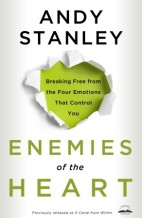
imageEnemies of the Heart by Andy Stanley

How many times have we heard,

I can’t believe I just said that or I don’t know where that came from?

Dr. Luke records the words of Jesus that put these exclamations to rest: “A good man brings good things out of the good things stored up in his heart, and an evil man brings evil things out of the evil stored up in his heart. For the mouth speaks what the heart is full of.” (Luke 6:45) As Pastor Stanley points out, regardless of our attempts to control, hide or otherwise diminish its impact, the heart is the source and control of our speech, action and thoughts. Troubles in the heart will soon become troubles in life.

Four enemies of the heart capture Stanley’s attention in this excellent book: guilt, anger, greed and jealousy. Four poisons that we allow to take root in the soul and then act surprised when their green tentacles reach out at the most inopportune time and damage the relationships that we value so much. Though Oprah would suggest a different path, Stanley correctly identifies these monsters as having spiritual components. Ever the excellent pastor, Andy devotes the largest portion of the book to armor and weaponry needed to combat them.

Pastor Stanley has penned a long string of must-have books for any Christian’s library and this volume belongs on the top shelf. Better yet, buy two copies so you can keep one and pass the other one around to everyone you know. (You should be aware that the book was previously published as It Came From Within, and you may already posses the material.) A useful discussion guide is included with the book enabling you to develop a dialog around the material, whether in a one-on-one relationship or in a group setting.

I am grateful to Multnomah who provided this copy for review.

The Big Story

Why Men Hate Going to Church by David Murrow

image

David Murrow’s updated book asks the same question as the first edition with even more vigor, why are our churches predominantly female? The answers that he proposes are, in many cases, self-evident to any churchman that cares to look. Walk through the church building, look at the dominant programs, review the bible studies and prayer meetings and you see all of the things that turn men off to becoming a part of the church. That is, if we truly want to see these things.

As much as we would like men to hear Jesus’ words two thousand years later and follow him without reservation, the reality is far different. By and large, church programs trend toward the cerebral and relational, two things that men find contrary to their nature. This doesn’t mean that men cannot identify with study, prayer, relationship building; they can but they naturally are attracted to them in less touch-feely ways that our sisters in the faith.

Why Men Hate Going to Church is far more than analysis, Murrow’s short chapters also contain answers. Not in the sense of enumerated steps to be followed to invite the men streaming back into the church but in answers broad enough that an intuitive pastor can apply them to their particular church setting. Most helpful in these is his chapter about Getting the Big Story Right. This was one of the things that Promise Keepers did without fail during their heyday. They placed men in the battle, showing them their place and their mission under Christ their leader. It inspired them in ways that the most well thought out sermon often cannot because it is designed to inspire or challenge men and women simultaneously.

Challenge them, limit hand holding and praying out loud when there is a chance that they will not look good. Small steps but big dividends.

I’m grateful to Thomas Nelson who provided this book for review.