The god of You

gods at war

by Kyle Idleman

Turning the final pages of ‘gods at war’ prompts the question in your mind, why do I come last? As in, why has Idleman waited until the final few pages to expose the root cause of my ongoing skirmishes with all of the other gods of this world? The answer that he provides brings all of the other enemies into perspective; the god of self is the field officer directing the rest of the pantheon. We are our own worst enemy.

Pastor Idleman turns over no new soil in this book. A quick scan of the table of contents will reveal the walls that you have scaled over and over in your life. Some you have overcome and others, well they continue to sneak up on you when you least expect it. The cohesiveness of these gods is stunning. They are bound together like few other things in this world, and making them more difficult to address is the glue that binds; they all start out as something good that we in our self-centeredness turn bad. It is here that Idleman shines. He absolutely refuses to allow us to point at anything other than our love for self as the reason for this good-bad confusion.

Though it doesn’t stand with ‘Not a Fan’, ‘gods at war’ is a good read and would serve well in a study group. Men will be especially receptive to Idleman’s style and approach as he often portrays himself as having to battle the same false dieties.

Dwelling Forever in the house of god

The Great House of God
Max Lucado

“…I want to come home”, who hasn’t voiced that desire at least once in their life? One of Maslow’s fundamental human needs and a terminal thought, the longing for the security, warmth and familiarity of some place called home is sensed in times good and difficult. For not-yet-God’s-people, the destination called home may be an ill-defined concept but for God’s people, the great promise of being safe and secure in the house of God is a promise that brings calm to discord, raises ones vision from the mire of life and powers the endurance of the soul. Pastor Max Lucado writes longingly of the promise of this abode in his exposition of the Lord ’s Prayer, “The Great House of God”.

Lucado brings his pastoral gifts to the five great verses from Matthew’s gospel, bringing each thought of the praise and petition into full bloom as a chapter of its own. Though brief, the chapters give the reader enough to savor for a week of prayer time. His subtle shifting of emphasis in the opening verse for example-our FATHER and OUR father-can leave you to meditate upon the importance of these words corporately and by themselves. Room by room Pastor Lucado continues the tour until you cannot wait to enter the gates of heaven and settle into the place promised just for you, ‘safe and secure from all alarm’.

If you are not a fan of Lucado’s work, give this book an opportunity. It is not a deep theological tome but that is not his genre. Filled with his trademark folksy charm, it is meant to lift your eyes and heart to the promise of the prayer rather than dwelling on the technical aspects of the verses. I found myself enjoying the chapters and the subsequent reflection so much that it too much longer to read this book than the 160 pages would lead me to expect. Perhaps it is just this that makes the book so good, the slow release of the spiritual nourishment, the savoring of joy and the increased longing for the promise of the great house of God.

The Life Men Want

Man Alive by Patrick Morley

It’s the kind of question that men either ask themselves when they’re alone or refuse to confront altogether. “… would you be willing to go up while everyone else is going down?” The deeper question is whether a man will live a life of meaning, do something important, leave a mark on this world. For men who ache to have this life, Patrick Morley offers this encouraging guide, ‘Man Alive’.

Men will appreciate the short bursts of challenge on these pages that are followed by quiet moments that encourage reflection. The peaks and valleys of the text confront the groups of men who congregate at either end of that spectrum. Those who spend their entire lives nestled in the security of reflection without ever tasting the adventure that awaits them outside the door and those whose adrenaline needle is pegged all the time. These men avoid searching the depths of their character, fearful of what they might find there.

Men were created to know God, to fill the yearning for His presence by living a life of action and reflection in equal measures. Morley outlines the primal needs that lie at the soul-core of every man and inspires them to break out of their culturally bound shells to be what their Father intended for them to be. More than just a series of adventures, ‘Man Alive’ holds up a mirror that reflects the soul deficits of nearly every man and challenges him to look that image right in the eye and be more.

The Secret … Again

The Blessed Church

The Blessed Church by Robert Morris

The simple secret to growing the Church you love; the subtitle sings that sweet siren song that lures so many pastors and church leaders to delve into the pages of books like this. In the era of often relentless pressure to grow the attendance of their church, leaders are always looking for an edge, one method or program that will bring more souls into the seats. Morris’ contribution to the literature is enticing, but the secret is absent.

That there is nothing new here is not Morris’ fault. The biblical path to a sound Christian church is well-trod ground. There are no secrets to be gleaned, only an obedient heart to be followed. Sound, God-given vision, check. Godly, devoted leaders at all levels of the church, check. A healthy pastor, check. Each of the elements that Morris highlights is rooted in Scripture and is supported by engaging writing. But new secrets? No.

Pastor Morris is relentlessly upbeat about the Church and the pastorate, and given the blessed success of Gateway Church, he has every reason to be. Reading the book is uplifting and encouraging and can provide some touch points for the pastor to hold their own ministry against. The one thing that should not happen (though it often does as a result of books/programs like this) is that a minister or leader should attempt to clone God’s work at Gateway. God creates every work for his specific purposes in specific locales to specific populations. Looking at the success or failure of other churches simply draws your eyes away the One leading you.

I am grateful to Waterbrook Press who provided this book for review.

Hard Rock Mining

Father Hunger by Douglas Wilson

Coming to the final pages of Father Hunger, I find myself exhausted. Having taken pick and shovel into the pages of Wilson’s book, I find myself looking at my still empty hands. Here there I encountered color in the paragraphs but assembling a coherent whole out of a sentence here or a paragraph here was simply beyond my abilities. Mining this book for its treasures takes dedication, time and a notepad.

And it shouldn’t be this way.

Taking on an issue that is critical to the reversal of cultural trends, Douglas Wilson could have done much better. When I finished the book I would have liked to easily identify the next action step that I should take to address the problems discussed. Instead, I’m left scratching my head wondering what I just read and just what prescription will turn the issue around. Jesus seems to be the answer but the application is absent.

The author’s style may lie at the heart of the readability issue. He veers unexpectedly from and academic voice to colloquialism to one-off humorous aside in the span of a few sentence. I didn’t know whether to snicker or go to the notes to verify a fact. This is not to say that there are not strong chapters, there are, but their effectiveness is blunted by those that go nowhere. Perhaps an editor that enforces a single voice could have saved the book.

If the reader takes each chapter on its own merit and reads the scriptures referenced in context they will gain more from Wilson’s work. The question is, will the casual reader be willing to commit to the extra work in order to find the nuggets?

I am grateful to Thomas Nelson who supplied this volume for review.

Ruled by Reality

Relentless by John Bevere

Relentless - John Bevere

While it can be said that author John Bevere is relentlessly upbeat and nearly breathless in building a case for his premise, ultimately the book falls short of his objective. He says in the first chapter, “how we ‘finish’ is more important than how we ‘begin’” and the proceeds to propose a life in which we are to be in control of all of life’s events such that we arrive at the end of a life “well lived.” The trouble is that throughout the book, the sovereignty of God is abrogated to the will of man.

Bevere is relentless is promoting the idea that if we just have more faith, we won’t sin, we won’t suffer and we won’t do without the riches of this world. Yet we do sin, we do suffer, we do live in poverty, despite our faith. Are we not relentless enough? Or, do we live in the shadow of the Fall, in a corrupted world and corrupted bodies and continue to endure the consequences of the fateful decision in the Garden? Despite our relentless prayer, unending faith and our close abiding in the Lord, loved ones still dies, we continue to get life-changing diagnosis, people still walk into movie theaters and commit unspeakable atrocities.

If the author’s promises were rooted in the sound handling of the Scriptures, my troubles with the book would be muted. When he relates experiences of miraculous healing by claiming a particular verse and having sufficient faith, I think that he does the kingdom a disservice. Claiming Isaiah 53:4-5 as having to do with physical healing reflects an improper handling of the scriptures. This passage has to do with redemption through Christ; to claim it guarantees physical repair is inappropriate and leads believers down a false path driven by their own desires, not those of the Lord.

Casual readers of Relentless will be encouraged. Their faith will be challenged and, when the desired healing, riches, etc. don’t appear, the book will tell them that the faith they have is not strong enough. In the same way, Bevere states that a sinless perfection is possible in this life is one is just relentless in their faith. Worse off is the one who continues to have sin in their life. To them Bevere suggests that their very salvation is in question. At that point, I would have to say that I can’t recommend this book.

I’m grateful to WaterBrook Press who provided this volume for review.

If You Would Just…

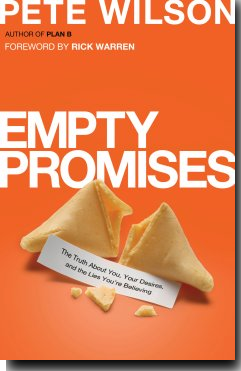
Empty Promises by Pete Wilson

imageIf you would just [give,show, serve, pray…] more, then and only then, will you be safe.

Christians habitually segregate the sacred and profane, thus explaining the blind spot that prevents us from seeing how even religion can become one of the idols that weave their way into our lives. They masquerade as good things: ambition, love, food, etc., only to draw and demand all of our attention in an effort to be the source of our satisfaction. Too late we discover that the promise is empty.

Pastor Pete Wilson comes up beside us and holds the mirror that brings these blind spots to our attention. Empty Promises addresses the pantheon of mute idols that commonly appear in the lives of Christ followers and derail our journey. Each chapter effectively points out our snare in the context of the scriptures, letting us see what it has done in the lives of others. Though we are separated by centuries and context, the solution remains the same. Find satisfaction in God; don’t be led astray by the empty promises of sensual or religious experiences.

Empty Promises is well written and engaging and will find a welcoming audience. The challenge that Wilson encounters in our modern day is that this has all been said before. Voracious readers will have already trod this territory many times over, finding the referenced scriptures already underlined in their bibles. This shouldn’t stop you from picking up the book but it may be one that you pass on to a younger reader so they can engage it for the first time.

I’m grateful to Thomas Nelson who provided this volume for review.

Ethos, Pathos, Logos

Saying It Well by Charles Swindoll

Near the very end of Saying It Well, Chuck Swindoll shares a piece of wise advice that summarizes the preceding pages…deliver it broken. In a moment of personal crisis for the Swindoll family, pastor Chuck considers how to put on his game face and step into the pulpit to deliver his message. Mrs. Swindoll leans in suggests that he not be anything but who he is at that moment and trust that God will use it to hone the edges of His Word to a razor point.

Pray that we should all deliver the Word from our brokenness.

Swindoll’s latest book is for those of us who speak to the public, whether in church or in a secular setting. Rather than a primer on how to craft a three-point message or rousing speech, Saying It Well emphasizes that who we are as people lies behind the most powerful messages. Without the use of the terms, Aristotle’s three conditions for persuasion (Ethos, Pathos, and Logos) are infused on every page.

The structure of the book mystifies the reader at first as it it largely biographical. What might this have to do with public speaking, one wonders, and then it dawns on you. Who you are so colors the delivery of a message that we are drawn to consider our own biography. The credibility (ethos) of your words is measured by the life that you lead. Your words will ring hollow if the listeners know you to be a man lacking integrity in your personal life while you talk about the importance of honest dealings. If you have no bond (pathos) with the people you are addressing, many will wonder why they should listen to you. You will be left with only the logic (logos) of your arguments to make your point. Many speakers bank on this aspect of their message but are disappointed to find little change in the listener afterword.

Swindoll does include a good deal of practical material in the book but none of it hits like a text book. In his homey way, Pastor Chuck suggests that this is his method for building a message, but that the reader should adapt rather than copy the process to their own workflow. We may be tempted to copy given the enormous success of Swindoll’s ministry but then remember that this success comes from who he is and not just the words themselves. Excellent advice for all of us to apply.

Grace and peace to you…

I am grateful to Hachette Book Group and Faith Words who provided this book for review.

Like John Harper

The Truth About the Lordship of Christ by John MacArthur

It is my presumption that I was not the intended audience for this volume in the Truth About trilogy of books. Each page presents a nugget of truth with a single text that is meant to support the idea. For a new Christian, it would serve as an excellent  primer. Perhaps for the more mature Christian, the book would be useful as a reminder of once-grasped ideas. For me, it was a disappointment.

Closing the last page left me wondering if Dr. MacArthur had reviewed the galleys before sending it to print. The book offers nothing new as it is constructed from material already published in a number of his other books. I believe it is this packaging that makes the book such a difficult read. There is a lack of coherence between the thoughts. What the reader is presented with is a proof-text (in whichever translation best coheres to MacArthur’s doctrine) and a handful of paragraphs in support.

The small thought units by themselves are excellent, as I would expect from Dr. MacArthur. He is unabashed in his Hyper-Calvinism and it is on full display in the introductory pages of the book. Though it may be unintentional, the inconsistencies of this theological system are on full display as it does not lend itself to a sound-bite format.

The Truth About the Lordship of Christ should be put into the hands of young Christians, if only to generate questions for conversation. The small, tightly focused sections offer just enough information for someone new to following Christ to begin the process. As the Spirit develops greater interest, Dr. MacArthur’s full-length works are waiting in the wings.

I am grateful to Thomas Nelson who provided this book for review.

Hand to the Plow

Sifted by Wayne Cordeiro

imageSimon, Simon, Satan has asked to sift you as wheat. Luke 22:31

Everyone in ministry hopes to avoid it, some even convince themselves that it might be possible that it will never be visited upon them, but sooner or later a period of testing will set in upon their lives. Some won’t survive and others will be permanently hamstrung. Some however, will emerge stronger than ever and into a season of greater ministry success. In Sifted, Pastor Wayne Cordeiro and his co-authors Chan and Osborne seek to build faith and spiritual muscle to prepare for the trials to come so that a greater number of pastors emerge from the other side of their troubles.

Though sin claims innumerable ministries each year, many more are weakened by trials that people are unprepared to handle. Trials claim their victims through weakened spirit, ineffective ministry and drained enthusiasm. Each of these can be avoided with the proper attitude according to the author. Cordeiro encourages the reader to prepare for trials and look for opportunities to grow spiritually while in the crucible. There may be repentance necessary, an attitude that requires change or work habits needing modification.

The chapters in the home work section are probably the hardest hitting. In the name of laboring for the Lord, so many in ministry sacrifice their marriage, children and health. The truth is that laboring to the point of exhaustion or a marital failure leaves the pastor with greater stress and problems than if the time away had been taken in the first place. The book does not mince words or tiptoe around the truth, which jumps off of each page. Tests and other evaluations help us to see ourselves in the paragraphs that we try to avoid.

This excellent book is not just for those in the midst of trials. Everyone will see them come at some point and it pays big dividends to be fully prepared for their arrival. Pastor Cordeiro opens his life as a warning. Read it and begin the process of preparation.