Psalm 59 God Will Go Before Me

image Deliver me from my enemies, O God; protect me from those who rise up against me.

Deliver me from evildoers and save me from bloodthirsty men. (vv 1-2)

These have become familiar refrains from David as he implores God to release him from the constant harassment of his enemies. Time after time we hear him turn to God in need of protection, shelter, and safety, describing his enemies in the harshest terms. In this psalm we share David’s apprehension as his home is watched by Saul’s men who are intent on killing him. To place this in historical context, refer to 1 Samuel 19. Does David succumb to the temptation to rid himself of Saul? No, he righteously refuses to touch God’s anointed, a lesson that the modern lesson can learn as member are tempted to attack and destroy a pastor.

God will go before me and will let me gloat over those who slander me.

But do not kill them, O Lord our shield, or my people will forget.

In you might make them wander about, and bring them down. (v 11)

Rather than see them destroyed, David wishes that they might simple lose their way. Possibly he hopes that they will realize how far astray they have gone in hunting down God’s chosen king. He follows with a plea that their pride might be realized and they might turn back. We can be thankful that our intercessor please for one more minute for us to repent despite our manifold sins, even though they are injurious to Him. Ultimately, the redemption of a horrific sinner such as myself brings more glory to the King than my immediate destruction, though it would be well deserved.

Then it will be known to the ends of the earth that God rules over Jacob. (v 13b)

Image saibotregeel

Day Nine in the School of Prayer: Seek Help

WithChristInPrayer

When He saw the crowds, He had compassion on them, because they were harassed and helpless, like sheep without a shepherd. Then He said to His disciples, “The harvest is plentiful but the workers are few. Ask the Lord of the harvest, therefore, to send out workers into his harvest field.”  (Matthew 9:36-38)

The Lord taught us the necessity of persistence in prayer for the goals of the kingdom, trusting in the Father’s love for our own providence. He now extends that focus, leading us into prayer for the workers necessary to imbue the kingdom with change. It is easy for us to look around and see the overwhelming need of the souls that press in on us from every side. It is not so easy to understand that we are to pray for the workers needed to reap this bountiful harvest in the name of the Father.

Is this need for prayer due to a deficit in God’s planning? Certainly not. The Creator knows all that is needed and has, in fact, supplied the workers. Who? You. We see Jesus in the passage moved with compassion at the plight of the lost, the sheep without a shepherd. As a disciple of the Son, the prayer that should result from this lesson is not that God would send additional workers but that those who have claimed love for Him would have their hearts turned in compassion to the plight of the sheep. No one should be found standing idle in the vineyard.

Psalm 58 May They Not See the Sun

imageBreak the teeth in their mouths, O God; tear out, O Lord, the fangs of the lions!

let them vanish like water that flows away; when they draw the bow, let their arrows be blunted.

Like a slug melting away as it moves along, like a stillborn child, may they not see the sun. (vv 6-8)

The Bible is no stranger to violence whether it be retribution against sin-stained men by God or the broken interactions between men. Many are critical of Christianity and use the violence as proof that their is either no God, or that God cannot be as holy as He is made out to be since He is associated with various violent acts. The psalms do not escape this history and in certain passages, the imprecation of the prayer against his enemies places us in an odd position. The Christian is challenged to justify words such as these in the light of the Beatitudes  or the admonition to put away thoughts of an eye for an eye (Mt 5:38-42).

We must be cautious in our approach to these psalms and not confuse the violent fantasies of the author with the righteous actions of God. In order to show the depravation against which he rails, David attempts to portray a similar level of violence in judgment to that which is being measured out by the unrighteous rulers. Though they may have personally injured David, he is not seeking to justify a personal vendetta. Rather, he is seeking only to restore righteousness to the land and the hyper-violence he portrays is to serve as a warning to the wicked of their coming judgment which he entrusts to God alone.

The righteous will be glad when they are avenged, whey they bathe their feet in the blood of the wicked.

Then men will say, “Surely the righteous still are rewarded; surely there is a God who judges the earth. (vv 10-11)

This psalm is about trust, trust that God will see to it that righteousness prevails. The imagery that David utilizes affects our sensitivities differently than it may have to original listeners. He seeks in all of the warning and cries for justice not to destroy the unrighteous but instead, to render them impotent. To break out the teeth of the ravenous beast is to release its prey from certain destruction. To watch watch water evaporate harmlessly is to prove the ultimate fate of evil while their blunted attacks bounce harmlessly to the ground. Perhaps, as David voices, it would be better for the wicked had they never been born.

Psalm 55 As for Me, I Trust in You

image

Confuse the wicked, O Lord, confound their speech, for I see violence and strife in the city.

Day and night they prowl about on its walls; malice and abuse are within it.

Destructive forces are at work in the city; threats and lies never leave its streets. (vv 9-11)

David again pleads to the Lord for deliverance from an enemy that seeks to destroy him. So persistent is this foe that even the king would entertain desires to flee from the situation rather than facing it head on. This strikes the reader on the oblique; here is King David, a man deeply vested in the will of God and secure in His protection and yet he toys with the idea of running away.

I said, “Oh, that I had the wings of a dove! I would fly away and be at rest –I would flee far away and stay in the desert; I would hurry to my place of shelter, far from the tempest and the storm.” (vv 6-8)

What attacker could generate such a willingness to retreat in the mighty king? It is the intimacy of his attacker that sets this foe apart. David envisions a city in chaos, a place in which no peace can be found. A similar sentiment was voice by the prophets Jeremiah (Jer 9:2-9) and Micah (Mic 7:1-6) of being surrounded by sin (cf. Micah – the people are able to sin with both hands) without relief. Worse yet, the enemy in view is one who is close to David, a friend once perhaps. This closeness makes the attack personal and therefore the cuts are deeper.

If an enemy were insulting me, I could endure it; if a foe were raising himself against me, I could hide from him.

But it is you, a man like myself, my companion, my close friend, with whom I once  enjoyed sweet fellowship as we walked with the throng at the house of God. (vv 12-14)

We know these struggles well. Our environment is threatening at every turn. Our friends turn against us when we least expect it. We ponder why; why has God placed us in these situations? Perhaps it is to strengthen our trust. We are allowed to momentarily fantasize about running away from the problems, to avoid them altogether but, only for a moment. Those who trust in Him, trust in Him all the time and in all things, good and bad. Ultimately, our travails play a role in our Father’s ultimate glory. For this, we are grateful participants.

Cast your cares on the Lord and he will sustain you; he will never let the righteous fall. (v 22)

image anjan58

Psalm 44 Awake O Lord! Why Do You Sleep?

image

Awake, O Lord! Why do you sleep?

Rouse yourself! Do no reject us forever.

Why do you hide your face and forget our misery and oppression?

We are brought down to the dust; our bodies cling to the ground.

Rise up and help us; redeem us because of your unfailing love. (vv 23-26)

How do you face defeat and destruction when you sense that God himself has brought the calamity upon you? Despite your prayer and commitment to the covenant you come to the conclusion that the Lord has purposely directed defeat on your life. Do you abandon the covenant as it appears that God has or do you continue in your commitment, taking the long view of current struggle being a part of the eternal plan?

The psalmist models the latter for modern readers. The psalm relates the tragedy of an unnamed defeat on Israel, one that the writer is certain that God has brought about on His people. Often, the immediate response would be to curse God. He has made a covenant with the people and yet has injured them. Can God be trusted? A rehearsal of all that Yahweh has done forms the foundation for this reflection on current travail.

We have heard with our ears, O God; our fathers have told us what you did in their days, in days long ago.

With you hand you drove out the nations and planted our fathers; you crushed the peoples and made our fathers flourish.

It was not by their sword that they won the land, nor did their arm bring them victory; it was your right hand, your arm, and the light of your face, for you loved them. (vv 1-3)

If God has been consistently good there is no reason to consider His recent act as anything but a necessary moment in the eternal plan of the world. Doubt creeps in, despite this thought. Is it possible that we the people of the covenant have not held up our end? The psalmist also considers this option.

All this happened to us, though we had not forgotten you or been false to your covenant.

Our hearts had not turned back; our feet had not strayed from your path. (vv 17-18)

Ultimately, trust in God’s wisdom and the ultimate good of His eternal course of events brings us consolation. What alternative do we have?

Image celesteh

Psalm 30 – Rejoicing Comes in the Morning

30 Thirty Sunburst The middle verses of Psalm 30 remind us of why we return to these scriptures for strength and comfort time and time again.

Sing the Lord you saints of his; praise his holy name.

For his anger lasts only a moment, but his favor lasts a lifetime; weeping may remain for a night, but rejoicing comes in the morning. (vv 4-5)

All of the saints of the Lord are called to raise our voices in praise even though their may be fleeting moments in which we believe that our travails overwhelm our ability to worship. David reminds us that life with the Lord will have these peaks and valleys but that the grace of God remains consistent. We need only turn our hearts toward him to rejoice again in His goodness.

The core thought in this psalm is the distinction between death and silence, and life and praise. Despite current circumstances, the question that it drives us to ask is, are we still drawing breath? If so, we can praise God beginning with this simple fact. Once the praise begins, the Spirit will remind us of all of the other things for which we can praise God as well.

To you, O Lord, I called; to the Lord I cried for mercy.

What gain is there in my destruction, in my going down into the pit?

Will the dust praise you? Will it proclaim your faithfulness?

Hear, O Lord, and be merciful to me, O Lord, be my help. (vv 8-10)

… for if I live I praise you…

You turned my wailing into dancing; you removed my sackcloth and clothed me with joy, that my heart may sing to you and not be silent.

O Lord my God, I will give you thanks forever.(vv 11-12)

It is easy to see only darkness when we feel as though the valley has become too deep to ever climb out of but God has a purpose in it. Small graces will visit us, perhaps even those that we might be unaware of but they are cause for praise. We lift our voices despite the darkness for morning will come, just as God promises.

Digg This

Psalm 26 ~ Test Me, O Lord

26Test me, O Lord, and try me, examine my heart and my mind;

for your love is ever before me, and I walk continually in your truth. (vv 2-3)

The Psalmist’s cry to the Lord should cause us to pause in prayer and ask if this is the transparency that we truly want to have before our God. In the lives of many Christians, we offer up our outer beings, the public personae that we rehearse for those around us. That is the cleaned up, polished, and groomed person that we believe will convince others that we are straight and true in our walk. Somewhere in the back of our mind we know it is isn’t true and even more importantly, we know that the Lord isn’t fooled. He needs no invitation to clamber about in our hearts and minds and the know the real us: the one who doesn’t consistently love his neighbor, the one who succumbs to her temptations and on and on.

The proclamations of faith and innocence do not begin or end with those verses that we have seen. In the opening verse, the psalmist proclaims that leads a blameless life and is a man of unwavering faith. The NIV translation of ‘blameless’ is a bit beyond the meaning of absolute purity, something that Yahweh possesses but is found in no man. It is better read as in my integrity I walk which gives it a domain inside of the fallen human experience. Is this braggadocio? Reading further we find instead it is a plea not to be judged as those who are unfairly judging him. The psalmist correctly places his ultimate trust in God.

Do not take away my soul along with sinners, my life with bloodthirsty men, in whose hands are wicked schemes, whose right hands are full of bribes.

But I lead a blameless life; redeem me and be merciful to me.

My fee stand on level ground; in the great assembly I will praise the Lord. (vv 9-12)

Digg This

Women in Ministry: Necessary Preparations

studygirl Coming to a settled position on gender roles and more specifically, women in ministry, is not the simple task that some make it out to be. Whether one falls to either the Complementarian or Egalitarian sides of the issue, there are profound implications for life within the Church and serious effects to be considered in relationships within the Body. Your decision on this issue does not have the same impact theologically as one on an essential doctrine does but it can have far reaching consequences for the life of a church, community, and household.

Deciding this issue responsibly requires that you explore, consider, and understand a vast array of knowledge. Your decision requires more than simple assent to a verse or group of verses within the Bible accepting a singular source as the final word on the subject. “You shall not murder.” is abundantly clear taken alone and there are few, if any, people within the Body of Christ who will argue against the clear meaning and application of this verse. The verses on which many have come to their conclusions regarding gender roles within the church (and sometimes life in whole) in Paul’s letters to the churches at Corinth and Ephesus are not as clear and require much more information be collected before one can arrive at a mature decision.

Properly deciphering the meaning of the key passages on this issue requires that you expend a good deal of energy in study of the Bible as a whole. The first thing that a person must do is place any verse or passage within the larger corpus of the entire Bible, Old Testament and New as well as the history of Christendom. You must devote yourself to developing sound interpretive principles that do not rely on someone else doing all of the work for you. Understanding these contested passages and doctrines requires, for example, that you develop a base of knowledge of the cultures that surround Israel and the early Church and the effect that each had on development of the writing produced there.

Many of the questions that arise during this study come from the grammar and meaning of words in the original language. To decide this issue on the basis of a single English language translation will not suffice. While it is not necessary that you become a linguistics expert, you should avail yourself of resources that can explain the word meanings and connotations that one finds in the Greek (and Hebrew depending on how deeply you want to invest in the topic) text. An interlinear text that matches your English translation is a good place to start.

There are many study skills that are not listed here that can help you come to a mature decision on the issue of gender roles beyond what I’ve mentioned here. The one attitude that can help the most in understanding your position is to recognize that this is not a simple topic with clear cut guidelines (despite what some will tell you.) It is complex and even those within the two camps can find disagreement on the details. As one of my seminary professors said, the more you learn the more complex the subject becomes.

***

The list that follows is not comprehensive by any stretch of the definition but it provides some helpful resources that you may want to add to your library as you become more interested in studying this issue. These are among my tools; if you know of a better alternative I would be interested in knowing about it.

Language Studies
image

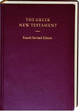
The Greek New Testament is the starting point for language studies. The The Greek New Testament With Greek-english Dictionary is the standard.


image

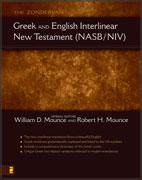
An interlinear places multiple versions of the Bible side by side. I like the Zondervan Greek and English Interlinear New Testament (NASB/NIV) as it puts the Greek alongside my preferred NIV translation as well as the more literal NASB text.


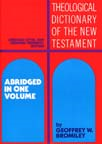
image A dictionary is an absolute necessity when studying languages. As we are aware, each dictionary can provide different insights into a word or word group and the Greek dictionaries are no exception. These tools are very expensive and you may hesitate to invest in more than one for your library. Between the three that are in view on my shelves right now, I recommend the “little” Kittel, the single volume edition of The Theological Dictionary of the New Testament. A sound alternative is the Greek-English Lexicon of the New Testament and Other Early Christian Literature. Another helpful tool is the Greek-English Lexicon of the New Testament: Based on Semantic Domains, otherwise known as the Louw and Nida set.


Introduction and Background

image There are countless volumes that provide cultural information about Israel and the later cultures that the Church would grow within but to be of help, I would suggest starting with Craig Keener’s volumes on the background to particular verses within the Bible. The IVP Bible Background Commentary: New Testament is a good first step that can lead your thinking to ask new questions about the cultural effects that are found in the words we read in the Bible.


image

Introductions to the Old and New testament provide valuable information about each book in the Bible, its context and knowledge about the author that is valuable in understanding the text within. Carson and Moo’s Introduction to the New Testament is a standard.


image

A valuable historical guide to the New Testament is Witherington’s New Testament History. You may not always agree with his conclusions but you cannot argue his scholarship.


Dictionaries

image

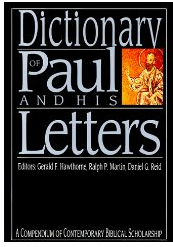
Since Paul is often pointed to as the source or instigator of this issue, the Dictionary of Paul and His Letters is an important tool to have on hand when working through his corpus. Equally important in this series is the Dictionary of Jesus and the Gospels so that the Pauline context does not become the only reference on issues.


image

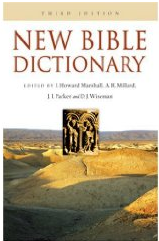
An essential book for any kind of Bible study is a dictionary and my standard go-to is the New Bible Dictionary. I also use the New Dictionary of Biblical Theology. Do not settle for the dictionaries that purport to be for lay people and that are marketed inexpensively. They will often leave you looking for more and wishing you had invested in a more thorough tool in the first place.


It will also be helpful for you to be able to consult a variety of commentaries as you look at various books of the Bible. There are too many in my library to suggest them individually. What I would suggest you do if you must limit the number of resources is to identify one popular evangelical tool ( The NIV Application Commentary series comes immediately to mind), one more technical tool at a level you can utilize (the Interpretation or New International Greek Testament Commentary) and one less technical such as the Holman or  Life Application series. I have concentrated on New Testament resources in this guide but there are equally important and useful Old Testament resources that are needed to understand the entire scope of the gender role issue; it did not start or end with Paul.

Did you notice that none of these resources was specific to the issue at hand? Read and study broadly!

Digg This

Psalm 24 ~ Who is this King of Glory?

image Who is this King of Glory?

The Lord strong and mighty, the Lord mighty in battle.

Lift up your heads, O you gates; lift them up, you ancient doors, that the King of Glory may come in.

Who is He, this King of glory?

The Lord Almighty – he is the King of Glory. (vv 7-10)


Modern readers will find this short psalm following the stunning promises of the 23rd psalm and as the page turns, it is easy to get swept up in the shouts of acclamation for the Lord. We shall not diminish the praise of this psalm as we place it in its proper context as a processional liturgy. Historically, this psalm is associated with the entry of God into Zion, either at the time David returns the Ark to Jerusalem or at a later commemoration of the event. Our free church environment has largely cast aside liturgy but it serves an important purpose in leading and aligning the hearts and actions of God’s people.

As the King of Glory enters the Temple, we want to follow his train up the steps but the liturgy stops us. Who may ascend this hill of the Lord it asks. We pause to reflect on our own condition.

Who may ascend the hill of the Lord?

Who may stand in his holy place?

He who has clean hands and pure heart, who does not lift up his soul to idol or swear by what is false. (vv 3 – 4)

The liturgical pace halts our thoughts to consider our condition before the altar. We seek the blessing and vindication promised in verse 5 but we must never take it for granted. Let our prayer today be two examine our heart and hands for the bits of the world that might have crept in or on and need to be cleansed before approaching the throne.

Digg This

Psalm 23 ~ Goodness and Love Will Follow Me

image The Lord is my shepherd, I shall not be in want.

He makes me lie down in green pastures, he leads me beside quiet waters, he restores my soul.

He guides me in paths of righteousness for his name’s sake.

Even though I walk through the valley of the shadow of death, I will fear no evil, for you are with me, your rod and your staff, they comfort me.

You prepare a table before me in the presence of my enemies. You anoint my head with oil; my cup overflows.

Surely goodness and love will follow me all the days of my life, and I will dwell in the house of the Lord forever.

The 23rd psalm is one of the most beloved and well known entries in the Psalter. Though many individual verses have become a part of our praise music vocabulary, many people know this psalm by heart in its entirety. There is an appealing promise in these verses that is painted with vibrant and pleasing verbiage that brings an image of the Good Shepherd (John 10:11) cradling and protecting his lambs. He alone will look out for our every need (though not necessarily our every desire.)

imageIn an age of image we have stored in our minds a catalog of green pastures and quiet waters so these words immediately paint with swathes of verdant, lush tropical greens or the deep  emerald of a grassy countryside. Quiet waters soothe with their deep blues turning to black as the depth increases and pops and gurgles silence us as we strain to catch the song of the water as it moves by. We miss out on the depth of this verse unless we meditate on unforgiving landscape in which the psalmist sees the work of the shepherd.

image The desert of the Middle East is far from the viridescence that our mind shows us as the words are processed in our minds. A dry, khaki, hardened land required extraordinary efforts from the shepherd. Food for the sheep might require movement, the search for water a knowledge of the terrain and the ability to bargain with those who guarded its source. The ewe and ram on their own may stand little chance of survival; dependence on the shepherd is not optional.

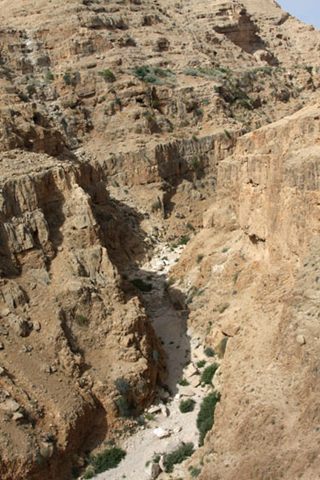
imageSuddenly, the imagery changes to one who walks in the shadow of death. The deep and arid Wadi Qelt might be bright at midday but every other hour of the day fills it with ponderous shadows that might hide evil around each bend or rock. Walking alone in this valley, the walls rising high above, the only escape route would be forward or backward and yet the psalmist voices no fear as the Lord walks alongside him.

image Verses 4 and 5 form the core for us in our modern day as they did for Yahweh’s people. Our valley of shadows might be more urban but it holds the same dangers and fears. We will not fear these things though as our Shepherd walks beside us and comforts us. In verse five are presented with the image of the table and the cup, overflowing with good and yet, look carefully at the placement of this table. It is in the midst of our enemies. It is not removed from, guarded from, above, below, or in any way away from our enemies. We will sit with the Shepherd in the presence of our enemies.

You see the Psalmist does not envision an escape from the travails of this world to an eventual dwelling with the Lord in his temple. It is not a psalm of escape. Instead, it is an expression of supreme confidence in the Lord and the knowledge of His intimate presence even as we face trouble and danger in this world. All is for the greater glory of God. Though our pain might be temporary, in the economy of the Good Shepherd it is necessary in the greater picture of His-story. We are blessed in playing our role.

The promise of the 23rd psalm is simple: by following the Good Shepherd we will walk in goodness and love throughout all of our days. It does not mean we will escape the trials and troubles of this world but following the Shepherd will always lead us to better days. No wonder it remains a favorite.

Digg This