Psalm 7 – Acquit Me O Lord

The psalmist expresses his innocence against all charges in this prayer by casting his fate completely into the hands of the Lord. We are not told what the charges are, but they must rise above the level of even human judgment. David cries out his appeal;

O Lord my God, I take refuge in you; save and deliver me from all who pursue me, or they will tear me like a lion and rip me to pieces with no one to rescue me.

O Lord my God, if I have done this and there is guilt on my hands – if I have done evil to him who is at peace with me or without cause have robbed my foe – then let my enemy pursue and overtake me; let him trample my life to the ground and make me sleep in the dust. (vv 1-5)

Only the pure of heart can make this bargain for we who approach the throne must know that God searches our hearts and knows what a human judge could not decipher without proof. This becomes even more critical if we follow the psalmist in crying out for satisfaction in judgment against our accuser.

O righteous God, who searches minds and hearts, bring to an end the violence of the wicked and make the righteous secure. (v 9)

Before this becomes our prayer, we too must walk the path of light. If any portion of us remains in the shadows we will be tempted to hypocrisy in accusing others of similar guilt. The Spirit searches us day and night and, if we listen, will exert a pull to us out of the dark and convict us when we choose to stay. We are thankful for the imputed righteousness that we have received as believers but our task is to be transformed so that we reflect to a higher and higher degree the source of the righteousness.

I will give thanks to the Lord because of his righteousness and will sing praise to the name of the Lord Most High. (v 17)

Life With God 3e – I AM The Way and the Truth and the Life

Thomas said to him, “Lord, we don’t know where you are going, so how can we know the way?”

Jesus answered, “I am the way and the truth and the life.”    John 14:5-6

Nearly every Christian will have interacted with this passage on some level by the time this is written. What more can be said about this most definitive statement? The complete theology of the book of John is summarized in 14:6 where it serves also to challenge the modern feel-good canard of ‘many paths to God.’ Less discussed is the context of the farewell discourse and, in particular here, the continued lack of understanding that the disciples displayed. These were the men closest to Him, to whom Jesus had shared the greatest intimacy and still they failed to comprehend the trajectory of the Savior’s life as it hurtled toward the cross.

In many ways, our spiritual formation is challenged in the same fashion. We know Jesus intellectually and have the benefit of knowing the full story and yet, it can sometimes be said that we don’t know Him. As we meditate deeply on the details of Jesus, we are seeing the Truth, the ultimate revelation of God, in a form which we can relate to. Transformation comes in challenging our own flawed character to the Truth that we encounter. Christians are privileged in having the indwelling Spirit to leads us in the Life but we must encounter Him beyond the intellectual level. Perhaps the first step is to admit ‘we don’t know where you’re going’ and then follow Him anyway despite our urge to do the opposite.

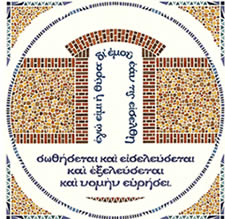
Life With God 3d – I AM The Gate

I am the gate for the sheep…I am the gate; whoever enters through me will be saved. He will come in and go out, and find pasture. The thief comes only to steal and kill and destroy; I have come that they may have life, and have it to the full. John 7, 9-10

imageAs we meditate on the Shepherd who will lay down his life for His sheep, these leading verses take on a new emphasis. Describing himself as the gate for the sheep would have painted a much more vivid picture to the first century hearers. A sheepfold might be built without a door or gate, requiring some manner of obstacle placed across the opening to protect the sheep within, both from enemies coming in from the outside and from the tendency of the sheep to wander out from the inside. The shepherd willingly lay across that opening in the dark to protect the sheep within, whether they appreciate it or not.

Are we like the sheep, unappreciative of the sacrifice The Gate? Do we see His presence blocking our path as a hindrance? As we think about how positively we view his willingness as the shepherd to lay down his life for us, we should also view his willingness to ‘pen’ us in when necessary so that we are protected from things that we are unable to see. In the presence of the Good Shepherd, we truly can ‘let not our hearts be troubled.’

Psalm 6 – Personal Travail

Be merciful to me, Lord, for I am faint; O Lord, heal me, for my bones are in agony.

My soul is in anguish. How long, O Lord, how long? (vv 2-3)

Waiting on God for relief, for an answer, for direction, for anything is difficult because we measure time in the finite scope of minutes and hours and days. With each turn of the calendar or tick of the clock we see our patience tested as our agony continues. The psalmist give us the most personal psalm we have encountered yet in the collection. He is expressing the pain of his condition personally rather than as the voice of all people. His words express the personal relationship with his Lord in which he views himself. He knows that Yahweh will hear his personal plea amidst the voices of all of the people. This confidence encourages him to pray,

Turn, O Lord, and deliver me; save me because of your unfailing love.

The psalmist expresses his assurance that his condition will be addressed based on God’s love, his unfailing, unbreakable, unceasing love. Modern theology diminishes this aspect of God’s character but without the omnibenevolence, the other parts of His character can become lifeless. Knowing and expressing confidence in His unfailing love can lead us also to a new experience, becoming a psalmist ourselves. The love of God and His love for us is not fossilized in the pages of the psalms. You too can create psalms of your own, whether it be from deep personal agony as in this example or from the heights of praise that we see elsewhere. God is interested in hearing your prayer no matter what the source.

Blue Parakeet 1

This is the first post in a series that will engage the ideas in Scot McKnight’s new book The Blue Parakeet.BPkeet As I said in my earlier review, this is an excellent piece of work destined to make a lasting contribution to the Church and is particularly useful to the seminarian immersed in the technical aspects of Bible study. Scot’s perspective is refreshingly non-academic or pedantic in the least. He writes as a fellow journeyman confronting with us what it means to read the 1st century Bible in a 21st century context. Is Christianity fossilized in that time which we must forcefully apply to modern life or is the Bible a guide to understanding how the Spirit moves today?

In the first two chapters of the book, Scot outlines the observations that led him to construct his tools for discernment. The Christian bromide ‘if the Bible says it, we do it’ is the foundation on which he begins to build his method. This, if we stop to consider it for even a moment, is nonsense. We pick and choose among the biblical mandates those that we will apply today and those we will ignore. The Sabbath, foot washing, surrender of possessions, charismatic gifts; all are dispensed with in various ways and with a variety of justifications as not applicable to today’s church. At the same time, we hold other mandates to be fixed in time and to be obeyed regardless of the times, women in ministry leadership a prime example. Scot asks how we develop the discernment to tell which is which.

McKnight outlines the three general ways in which we approach the Bible and the attitudes and actions that result from each. We may read to retrieve, meaning that we return to the times of the Bible to retrieve the ideas and practices for today. The challenge with this common approach is that we cannot live a first century life in the twenty-first century. The truth is, we shouldn’t want to do this as it ignores the work that the Spirit is moving to accomplish in our modern age. If we read carefully we find that God spoke in Moses’ days in Moses’ ways, to Paul in his days in his ways, and we should expect this pattern to continue; God will speak to us in our days in our ways. Our reading of the Bible should help us to see how God wants to move in our current time.

Reading the Bible through tradition is an important component in developing this discernment. One of the most important changes that the Reformation wrought was to put the scriptures into the hands of the believer. Everyone should read the Bible for themselves but they shouldn’t necessarily interpret it for themselves. Christians have a rich history and long held beliefs that can serve as the guard rails to our interpretation. We should respect long held beliefs, trusting that the Spirit guided those who came before us in forming those beliefs. Moving on this track helps us to roughly figure the edges of our belief while allowing the Spirit sufficient freedom to breath new insight into our faith for today.

Finally, we read with tradition, recognizing that God is forever on the move toward His conclusion. We were never meant to be stationary as history flowed around us like a stone in a creek. We were meant to be a part of it, serving out our individual purpose in the story. We should be able to read the Bible without getting stuck there. God did not freeze time in the periods of the Bible anymore than most cultures have stood still. He provided the scriptures so that we would have a guide to understanding how He wants to move today addressing the issues that we face.

McKnight challenges us to think about the way we approach the scriptures. We can try to cage it, taming the Spirit. In doing so we lose its edge, dulling the double edged sword that transforms us and the world around us. Bringing modern eyes to the Bible is not a crime, any more than it was for Paul to understand the whole of his scriptures in light of the modern revelation that he confronted. We’re not Paul but we do have to understand the way that God speaks to us in our days. I hope you’ll follow along as we read through the rest of the The Blue Parakeet, attempting to put the tools to work to hear the Spirit move today. I look forward to hearing what you think.

Life With God 3c – I AM The Good Shepherd

I am the good shepherd. The good shepherd lays down his life for the sheep. John 10:11

image

We can meditate a good long time on this verse. It strikes our hearts on numerous levels but I’d like to narrow this discussion down to those who have a pastoral calling. If we are following closely in our Master’s footsteps, our call also may be to lay down our lives for the sheep entrusted to us. The wolves can attack at any moment and our calling requires us to be a bulwark. Is your heart being shaped such that you can do this without hesitation?

Can you do it when you sense that not all of the sheep appreciate your willingness to do so? Will your heart be turned to a greater flock if your celebrity grows, taking your protective eye off of those whom God has placed under your care? Can you recover if the wolf somehow infiltrates your flock and scatters them despite your earnest intentions?

It’s one thing to say that you are prepared to do so, yet another to actually do it. We must be certain that our public and private heart are one and the same.

Life With God 3b – I AM The Light of the World

I am the light of the world. Whoever follows me will never walk in darkness, but will have the light of life. (John 8:12)

image

The second I AM statement that deepens our faith is this; Jesus is the illuminator of the darkness. Though we are born into a darkened world in which it is difficult to find our way, we have available to us a source of light that can never be extinguished. We no longer need to stumble.

Once we immerse ourselves in the light, we find it more and more difficult to step back into the darkness. It beckons us and we’re tempted to return to the shadows but the Spirit exerts a greater attraction as our character is molded. Even in those instances when dark overcomes us, the Savior will reach without fear into the shadows to pull His brothers and sisters back.

Life With God 3a – I AM The Bread of Life

image The ‘I Am’ passages in the book of John are good immersion points on which to meditate in seeking spiritual transformation. In these statements Jesus declares himself to us, encouraging and deepening our faith and our enhancing our ability to trust Him on a more mature basis. We become what we immerse ourselves in. The first is found in John 6:35;

“I am the bread of life. He who comes to me will never go hungry, and he who believes in me will never be thirsty.”

When we meditate on this verse in a non-theological sense, we hear the Lord speak and the Spirit move. We question the things that we pursue in life that sate only temporarily. We find nothing in our pursuit of food, sex, material things, feelings or challenges that results in anything but a momentary satisfaction that is soon followed by a desire to pursue more. Spiritual fulfillment replaces or subdues these fleeting desires with a permanent fulfillment. For sure, we will want more in the sense of going deeper but we will never hunger to fill the void in our souls that can only be filled by the Holy Spirit. 

Life With God 3

Give ear and come to me; hear me, that your soul may live. Isaiah 55:3

Richard Foster emphasizes the messy reality of the the “I am with you” Immanuel principle in chapter three of Life With God. Reading the Bible with this in mind, one of the transformative themes that we can derive is that the book does more than just tell us about the immediate presence of God. Instead it unfolds for us how embedded the Presence is in every aspect of human existence. Whether we are running toward or away from God, we cannot escape the truth of His pursuit. He calls out, “I am with you” and asks, “Will you be with me?”

Our struggle with Immanuel is often spelled out in the tension between two ideas. We comprehend our value to God in His pursuit of relationships with us and yet, when skies cloud over, we identify equally with the Psalmist’s lament “why, O Lord, do you stand far off? Why do you hide yourself in times of trouble? The space between these two poles is life guided by the choices that we make. In those choices is the ultimate act of spiritual formation, allowing God to perfect His will and His ways in our lives. In the pages of our Bible, we can see how the Living Word transforms countless other human beings and it speaks to us; surrender your will and come into relationship with me! In exercising our freedom to choose to trust in Christ, we open ourselves to transformation in the depths of life with God.

For spiritual formation, we want to read the Bible with two aims. First, we want to engage the story of God’s people who were immersed in God’s immediate presence, whether they were aware of it or not. We read of God pursuing relationship with His creations and of the blessings and consequences of choosing for or against this relationship. In fact we learn from those that have gone before us that turning back to God is not a mechanical transaction, not a rule to follow, it is a relationship.

The second aim that we want to approach the Bible with is hear God as he speaks to us through the Word. The stories that we read are replete with examples of failure and restoration. Human beings are not the most reliable partners in relationship and when we come to this realization it opens up a new horizon in how we view God. Because we are by nature fickle, the transformation that occurs in each of our spiritual lives is a unilateral commitment from our Father. He pursues and transforms. Our task to immerse ourselves in those things that can positively affect our character. It is at this level that the living Word works.

Foster refines this approach to a single statement for modern Christians in saying that the way into this life, the Immanuel life, is trusting in Jesus. The Lord’s words make it simple, “Don’t be afraid; just believe.” (Mark 5:36) Our call is to live the Kingdom life now and not just approach the faith as fire insurance. Our way into the fullness of this life is through character transformation, something that occurs when choose for life in relationships with the Lifegiver and when we immerse ourselves in the Word that changes us into what we were intended to be.

I would love to hear of your experiences of transformation. Have you found any particular scripture verses or story that were particularly meaningful in this process? Let’s share and grow together.

Psalm 5 – Lordship and Mercy

To reach out to God in praise is natural to most Christians. On some level, each of us is grateful for the sacrifice and salvation afforded us by the Creator of all and we find joy in proclaiming this gratitude in words of positive affirmation. We understand that praising God for His greatness, telling Him how wonderful He is is much different than the same interaction on a human level. God’s arrogance is not fed by our praise; our proper relationship to Him is. A common feature that we encounter in the psalms are words of praise, directly addressing God by crying out the magnitude of His awesome nature. Another feature that is more jarring to modern ears are the words that emphasize the fundamental nature of God, His absolute holiness.

You are not a God who takes pleasure in evil; with you the wicked cannot dwell.

The arrogant cannot stand in your presence; you hate all who do wrong. You destroy those who tell lies; bloodthirsty and deceitful men the Lord abhors. (vv 4 – 6)

How often do your prayers, personal or corporate, remind God of His holiness? The psalmist throws a wide net in these two verses that unsettles. “All who do wrong” are hated, lies bring abhorrence. To meditate on these statements brings nearly all of us to the realization that we can easily find ourselves falling into these wide, wide categories. Does the God we praise also hate us? The answer is found in next verses.

But I, by your great mercy, will come into your house; in reverence will I bow down toward your holy temple. (v7)

Only by the mercy of the One we praise can we approach the holy throne. The psalms contrast the people of mercy, God’s people, and those who choose against Him, His enemies. The contrast is less an ‘us and them’ statement as it is a recognition that we are sustained purely by the mercy that God offers. The line between the loved and unloved is very thin indeed. Praise Him.

But let all who take refuge in you be glad; let them ever sing for joy. Spread your protection over them, that those who love your name may rejoice in you.

For surely, O Lord, you bless the righteous; you surround them with your favor as with a shield. (vv 11-12)