Theological Craftsmanship

imageWhen we last were together, we had worked through the distinction between our embedded and deliberative theological understandings. Though there’s nothing wrong with the embedded theological understandings that we carry around, a problem arises when life crises challenge these beliefs. We have second thoughts and sometimes, doubt about what we know. A new crisis of faith is added to our current troubles, burdening the believer rather than giving them the answers they seek. 

Crafting Theology

Before crisis arrives, all Christians should be involved in developing a foundation for their theological understandings. This does not mean that we start from scratch and create a new, personal set of theological tenets that the world has never seen. Theology is our calling to process all that we can gather about God and to craft a strong base of knowledge supporting our embedded beliefs. At the crucial moment when we are seeking to understand how God could allow a child to be taken from their parents a solid and unshakeable foundation is necessary. Those pillars are only built from a deliberate effort.

Theology is said to be crafted as it utilizes raw materials to fashion an end product. In the case of theology, the end product is a new or more substantial theological understanding and our raw materials are the scriptures and the thinking that has preceded our own efforts. These materials are subjected to a three step process of interpreting, correlating, and assessing an idea that stretches and works our theological muscles and, in the end, through this effort supplies us with a new, better, and stronger way of understanding our God and our relation to Him.

Interpretation

We interpret the meanings of things all day every day. Words, images, sounds are all interpreted by each of us and we all bring a unique perspective to the process. As our interpretations become relatively stable, they begin to form our views. Collected together, the views form a viewpoint that allows us to interpret things on a larger scale. For the Christian, interpretation is performed from the perspective of faith. God and our belief in and understanding of who He is influences our perspective on everything. For example, abortion viewed through a perspective that includes God as Creator is much different than a purely clinical view. Recognizing our perspective and its depth, or lack of depth, is the first step in crafting a theological viewpoint.

Correlation

Correlation is the act of discovering the relation between two things if it exists. If it does not, the word can take an active sense as well as we bring two things into relation. A Christian in the process of theological reflection will often be called into the give and take of correlation as he seeks to bring the perspective of God’s people into correlation with other perspectives. These might come from outside of the faith community or they might be an opposing point of view from within the larger Church that differs from your own.

This process is not without conflict. Ask yourself first if you are able to see things as others do. Are you able to fully understand their perspective? Responsible theology requires that you do so. This is a source of much strife within the Church as proponents of one theological view refuse to make the effort to understand how the views of another believer have come to be or why they are supported.

Assessment

When one of your Christian views or viewpoints becomes relatively stable in your mind as representative of truth, there is one final step that occurs in order to set it. An assessment of the position you have crafted pushes it through a series of filters so that you can judge it to be good or bad. The four most common questions asked are:

  • Is it valid?
  • Is it understandable?
  • Does it have moral integrity?
  • Is it appropriate from a Christian standpoint?

Each of these is not equally applicable. A Christian may not be in the position to state whether or not an idea is valid but the plethora of documented positions can certainly aid us in evaluating whether or not we are in the ballpark. Moral integrity, on the other hand, is easier to assign. If your proposed view dooms all babies to death, contrary to centuries of Christian belief, the morality of a god who makes this proclamation would certainly be in question. A view impeded by this filter would likely be a candidate for reformation or to be discarded.

Being a Craftsman

Reflecting on your faith and what you believe requires the same love and attention to detail that a craftsman applies to a piece of furniture that she creates. It requires the ability to examine a view from all perspectives and to have a framework to evaluate different aspects of the position. Experience and maturity round out process, resulting in a pronounced ability for the Christian to understand life and humanity in a way that honors and upholds God and their faith.


image giorgo

We’ve Had an Epiphany!

image


The changing of liturgical colors from White to Green signals a change in the seasons in the Church, just as it will in a few months as the snow melts and spring makes its first appearance. Epiphany is a season of new hope and new growth enabled only by the light emanating from the Savior. We can mark the first day of the season by allowing this light to invade our being, revealing that which needs to come to the surface and filling the spaces with illumination that can only come from a personal epiphany. The divine manifestation is more than a historical event for us to mark, it is a complete shift in the relationship between heaven and earth.

Psalm 97 1-9
The LORD reigns, let the earth be glad;
let the distant shores rejoice.
Clouds and thick darkness surround him;
righteousness and justice are the foundation of his throne. 
Fire goes before him
and consumes his foes on every side. 
His lightning lights up the world;
the earth sees and trembles. 
The mountains melt like wax before the LORD,
before the Lord of all the earth. 
The heavens proclaim his righteousness,
and all the peoples see his glory. 
All who worship images are put to shame,
those who boast in idols—
worship him, all you gods! 
Zion hears and rejoices
and the villages of Judah are glad
because of your judgments, O LORD. 
For you, O LORD, are the Most High over all the earth;
you are exalted far above all gods. 


The celebration of Epiphany commemorates two events in the life of the Lord, the recognition by the Magi that the Lord had come and their subsequent worship (Mt 2:9-12) and Jesus’ baptism in the Jordan and the voice of the Father commending Him as His son. In both Christ manifest as humanity is revealed to a world desperately in need of salvation. As this season leads up to Lent and Easter, we shall focus our worship on the incarnation of God as man. Our Savior put aside his crown for our benefit though He would have been justified in allowing us to continue on in our own desires.

The perfect expression of love was manifest.

Vision Casting in Hindsight

DSCF4827EBW_MThe end of one year and the initial days of a new one often find churchgoers hearing a new vision for the church over the coming year. Some pastors will place the imprimatur of God on their statements, saying “God has directed us in this direction” while others will be less humble in their choice of pronouns, suggesting ‘I’ or ‘We’ view this direction as the way forward for the body. All well and good, whichever attribution is selected. Charisma or at least enthusiasm in the voice can deliver the message effectively.

As long as no one looks back.

If the pastor is delivering an annual vision for the upcoming year shouldn’t it be preceded by a review of the results of the previous vision. How did it turn out? Have we arrived at the destination you pointed us toward? What went wrong? If I am hiking through the forest on a trail that was previously mapped out for me and someone comes up to tell me he sees a new way to reach our destination, shouldn’t I ask how he arrived at my location? God is consistent. He has set things in motion and the story has remained the same as far back as we have kept track. Looking back to see where we’ve been should be the first action before a step is taken.

Vision casting is risky. Vision casting in the Church is riskier. To say that the Lord has given a new vision for this year or this pastor or this incarnation of His church should always be more than an impression. To say that He has forgotten the old vision in favor of the new should always cause us to stop and ask if we were faithful to the last one.

Get Committed

Bishop Thomas Tobin on Sunday said he made the request because of the Democratic lawmaker’s support for abortion rights. The news prompted debate among Catholics around the country and within the bishop’s flock in the nation’s most Catholic state about whether it was right for Tobin to publicly shame Kennedy for breaking with the church on what its leaders consider a paramount moral issue.

Angel Madera, 20, a Marine visiting his home in Providence for Thanksgiving, said before attending Sunday evening Mass that Tobin was wrong to assail Kennedy’s faith.

"If they believe they’re a true Catholic, who’s to say that they’re not?" he said. From Foxnews.com

Well, Angel, God determines who is a Christian and who is not. Since God has proclaimed His human creations to be very good and He participated in the creation of that life from its first moment in the womb I imagine He gets to make the final determination.

The problem here is not the postmodern-no-fixed-point-of-truth philosophy but that we in the Church often fail to take a stand on matters of holiness. Whether Catholic or Protestant, there should be a unanimity of thought and practice regarding abortion; it simply cannot be condoned by any true Christian. Those within the Church who feel that they can sidestep this issue while keeping the others has placed one foot on ice in your Sunday shoes. Valuing life begins at the second that it becomes so.

In Evangelical pastoral circles, the Bishop’s firm stand should cause us to consider how tolerant we have become of other sin within our churches. We should ask ourselves how much the prevailing culture has wormed its way into our churches and made tolerance our driving principle rather than holiness. Confronting sin has gotten a bad rap as we fear being caricatured as foaming at the mouth Fundamentalists. We’re afraid to call sin sin and teach and preach holiness. We’re afraid to take a stand.

Whether you believe Catholic theology or not, you should respect the Bishop’s stand when it comes to profaning the elements of God and what they stand for. There is always a gnawing fear in the back of the pastor’s mind that the congregation will turn on him if he brings holiness to the altar and asks those who truly believe to kneel and allows others to step away. The greater fear should be judgment morning when he is asked why he didn’t care for the flock entrusted to him.

A Word for My Brother & Sister Pastors

image

Prophetical-Priestly Ministry by Darius Salter

It’s fascinating how things fall into your lap when you least expect them. Serendipity is the word often used to describe favorable circumstances like this when you discover something grand has come your way unexpectedly. Christian sagacity trends not towards luck though, but instead, toward an understanding of the work of the Father and Spirit in concert. Salter’s book landing in my hands was just such an event.

Prophetical-Priestly Ministry was published in 2002 to little fanfare. A quick search for reviews of the book comes up short; it is ignored on Amazon and the single entry at ChristianBook.com is a restatement of the title. The silence is understandable. The book is not about how to grow your church, new ways of reaching post-moderns, or new secrets of the life of Jesus. These books fly off the shelves into pastoral libraries. Books that serve as correctives such as this are often ignored. And I believe, ignored at the peril of the pastor and their church.

Salter’s message to pastors is simple: return to your core responsibilities. Speak the prophetic word of God into the lives of your congregation rather than feeding them messages about how to have their ‘best life now.’ Stand as the priest for God’s people rather than their cheerleader or worse, their manager. He says “Prophet-priests specialize in diseases of the soul; sin, despair, depression, loneliness, alienation, anger, hostility, pride, greed, avarice, addiction and fear. The list is almost endless. Of course, these sicknesses eventuate in the systemic evils of ethnocentricity, nationalism, exploitation, oppression, and racism.” The message in this thin volume calls us back to the service of the congregation and gets us away from parading around selling books or conducting seminars on how to fill more seats in the sanctuary.

The author critiques the current ‘worldly’ ministry that he sees all around the American landscape (in 2002 and worsening since). The Church has gotten entrapped in the self-fulfillment culture and, in some cases, has moved away her first love. God is a second thought in the worst of these environments. The ministry has become enablers. We promise spirituality while allowing our people to remain in their materialistic, pluralistic lifestyle. The gospel becomes a casualty of the latest charity initiative or small group study topic.

I didn’t go looking for this book. It appeared in a weekly-specials email and something moved me to purchase it. Initially, it arrived and made its way to the book shelves to be read later. I picked it up after a time and was immediately struck by the message that the Spirit brought to bear through Brother Salter’s words. I was stopped cold when the Spirit brought my feeble ministry efforts up against those of Francis Asbury,

For the elect’s sake, Asbury ceaselessly uttered the Word through Scripture reading, prayer, exhortation, teaching, and family worship. Every overnight stay would involve spiritual examination of the residents and subsequent catechism. There would be no idle words. “My mind was powerfully struck with a sense of the great duty of preaching in all companies, of always speaking boldly and freely for God as if in the pulpit.” This included calling “the family into the room and addressing this pointedly one by one concerning their souls.”

One by one; when was the last time you (or I) sat even our immediate families down and questioned them concerning their spiritual welfare? Have we gone home by home and addressed these concerns with our faith families? Why not? Because we have succumbed to the Western individuality of the culture and we respect the personal nature of a person’s faith more than we do the calling we have received to be a priest and prophet.

Brothers and sisters, now is the time for a new awakening within the Church. Not the watered down awakening of “spirituality” in its myriad forms but for us to stand upon the walls ahead of our flock, intervening for them with God and speaking His word into their lives not matter how difficult. Find this book, read it, absorb it, and let the Spirit work it all out in your ministry.

THE Church in the City

Today, Church in the City in Denver dedicates the restored synagogue that will become its new home, a block away from the old Safeway store that has been its home for many years. Here is an article in the Denver Post about the move. This is my favorite church in the our area. It is the most ethnically diverse congregation we have. Lead by Pastor Michael, the church is also the home to Raleigh Washington, a prime mover in racial reconciliation and the Promise Keepers movements.

Glory to God on this great day for the church. The Temple is Ready! My prayers for blessings on the event and I hope you will add yours too.

The Church in the City

Digg This

Creativity According to Twyla

Creativity Twyla Tharp“I walk into a large white room. It’s a dance studio in midtown Manhattan. I’m wearing a sweatshirt, faded jeans, and Nike cross-trainers. The room is lined with eight-foot-high mirrors. There’s a boom box in the corner. The floor is clean, virtually spotless if you don’t count the thousands of skid marks and footprints left there by dancers rehearsing. Other than the mirror, the boom box, the skid marks, and me, the room is empty.”

Everyone who creates must begin here; the environment and your tools. For the woodworker there is the wood and your edge tools. The writer begins with a blank screen and the keyboard, the photographer with a lens and unexposed film, and the teacher with knowledge and a course schedule.  The process of creating something from nothing is difficult, challenging work that often finds you bumping up against a variety of blocks. Preparation to create is the key to climbing over these obstacles to mine the creative gold that lies on the other side.

The renowned choreographer Twyla Tharp shares the core elements that she relies upon to create new dances over and over throughout the decades of her storied career. Key to the process of creating is to prepare yourself to create. You will not run a marathon without having trained yourself to go that distance. A table will not be created from that expensive walnut without your having learned find it in the wood. Why do we expect creativity to simply flow without having trained ourselves to be prepared to harvest the flow?

Tharp’s theme throughout is to emphasize the habits that the truly creative people develop. She relates her own rituals as well as those of other creatives to point you toward finding your own set of habits that will prepare and arrange you in the place where your mind and soul are prepared to create. Be at your keyboard, with your camera, in your workshop and your brain will automatically know that it is time to create.

But I’m not creative, you say. Twyla would say nonsense! You simply have not prepared yourself to create. You have not identified your specific creative spark, you have not developed a process (The Box), you have put yourself in a place to scratch, you have not identified the core of the work (The Spine), and you have not put the time into the basics (Skill) that must be second nature so that creativity can put them to use in new forms.

Tharp’s book is not a manual but rather, an inspiration. She is not telling you to follow her method step by step. Instead Twyla practically demands that you find your personal method, strengthen it and make it tough, and then put yourself in a position of letting it work for you. Savor the book; get a pencil and make it your own.

Now, get out and create something.

Notes:

Pastors and other ministry leaders might look at a book like this and wonder what it might have to offer them. In reality, is there any more demanding job than preparing to speak God’s word each week? God is a Creative Entity and he has placed this in you. Train yourself to be creative, know your skills (scripture and theology), and let that creativity color the work you produce each week.

Merlin turned me on to this book and many of us can benefit from the new direction he has taken 43 Folders. The language and humor can be a little coarse so be aware but check out what he has to say and who he links to if you want to continue to grow in your creativity.

Digg This

The Church Coffee Shop Redux

coffeecup In a previous post, I voiced dislike for the friction created by the church coffee shop that tended to snag folks on the way into worship. It caused not to be fully present to worship, distracted as they were by coffee, chat, and momentary community. Meanwhile, little thought was given to the disruption of these brothers and sisters filtering in during times of praise and prayer, sidling into rows and breaking any focus that earlier arriving worshippers were enjoying.

Perhaps there is a via media that can work. Much like a ball park in the seventh inning, a local church that emphasizes worship closes the cafe ten minutes prior to every service as a way of encouraging worshippers to move inside of the sanctuary and to prepare themselves for a move of the Spirit. Caffeinated no less!

Priorities…

Digg This

Volume != Passion

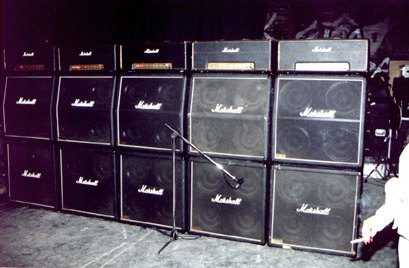
image In the February 2009 issue of Christianity Today, John Stackhouse has a penetrating piece on the trend toward louder worship bands in the church. (You can read the text on his blog by going here.) The core premise of his essay is that we have lost the intent of the musicians in the church. They are to accompany the praise of the congregation, supporting our voices with rhythm, melody, and key as we lift our hearts in song to our Father who we came to worship. The trend has gone in the other direction however. The praise band have become performers in many cases who feel that they must then project their music onto us as though we were attending a concert.

Though no worship band has yet to reach Motorhead-at-the-Warfield sound pressures, the volume in some cases has become annoyingly loud. Besides the physical discomfort of poorly mixed loudness, the volume has an effect that many worship leaders have failed to note. When you cannot hear your voice or those near you, the tendency is to not sing or to sing quietly. Look around you this week if your church uses a high volume praise band and make note of the number of people not singing but instead, simply watching the ‘performers.’ An important part of singing in worship is not often discussed; you are often singing for the benefit of others around you. When a person is unable to raise their own voice in praise due to their pain, suffering, depression, etc. many times it is the sound of your voice that lifts them up and gives them hope. When drowned out by the sound of crash cymbals, an opportunity for love can be lost.

Has your praise group become performers? Has the worship service become so choreographed and scheduled to the second that there is no room for the Spirit to work? When I think back to churches I have visited in which there was a lone pianist who played the melody and God was serenaded by the majority of people in the room and contrast it with some of the production oriented services I have been too, I come to conclusion that the pendulum has swung too far to one side and perhaps it is time for the arc to begin to come back in the other direction. Worship leaders, can you hear us?

Digg This