
The horrors and grief of war generate a ringing in the ears that affects how we hear the words ‘Just War’. Any notion of justice in talk of war rings of an oxymoron; the two terms don’t belong together. War is evil, peace is just. Former president Jimmy Carter voiced the paradox of war: “war may sometimes be a necessary evil. But no matter how necessary, it is always evil, never a good. We will not learn how to live together in peace by killing each other’s children.”
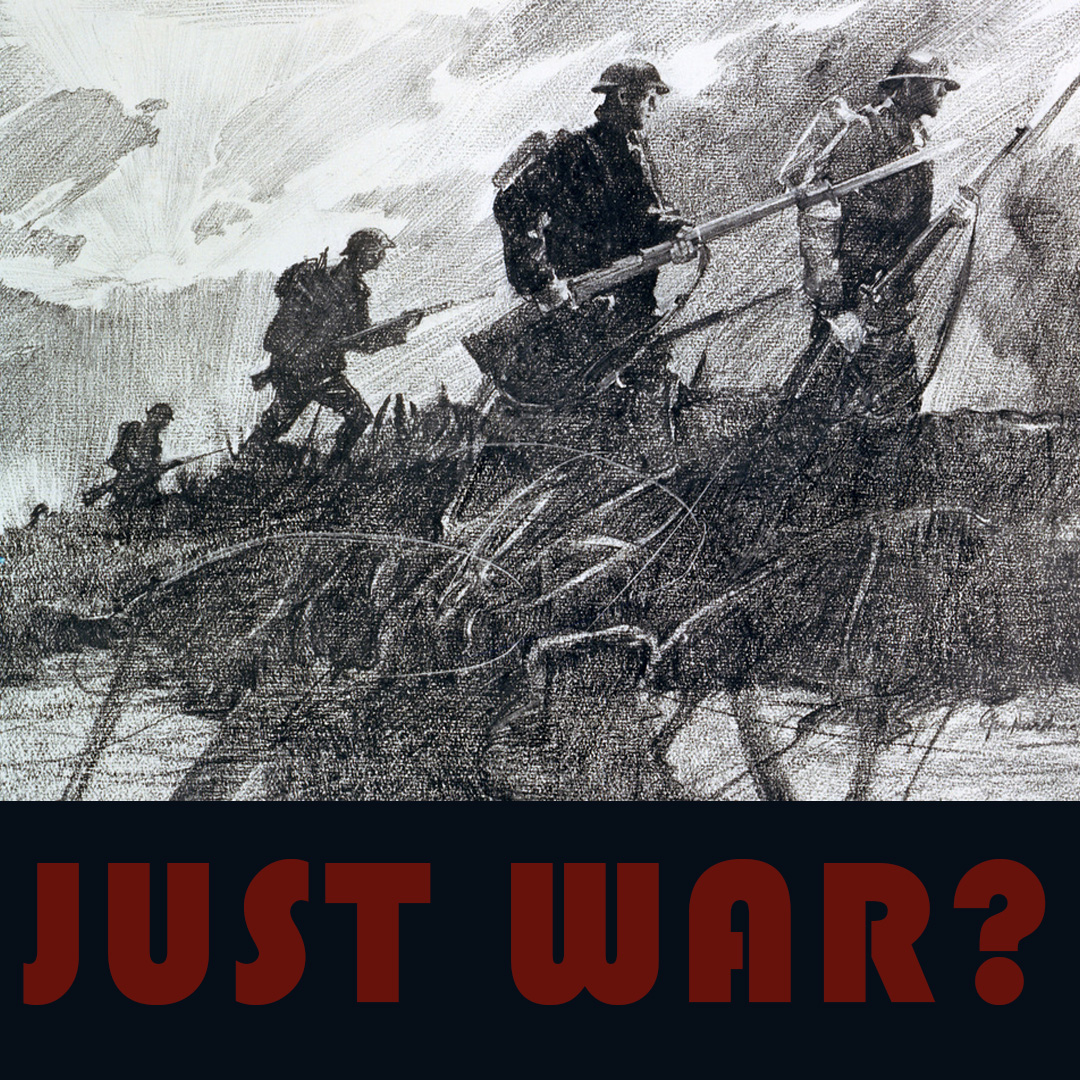
For the Christian, the horrors of war and the command to love the enemy may seem to force us into a position of seeking peace and the avoidance of violence at any cost and in every situation. Yet to do so, to make this the default tenet, does not remove the terror of that violence and war from our life experience. Jesus spoke with candor, saying armed conflict would signal the coming of the End of the Age (Matthew 24), indicating it will not be avoided on this side of the fullness of the Kingdom. His followers must settle for themselves how each will respond.
Throughout the history of the Church, theologians, ethicists and laymen alike have wrestled with studying and fixing a scriptural position toward war. Apathy is not an option, so the general choices narrow to pacifism or engagement in the battle. Neither is a simple choice for a Christian weighing devotion to Christ, and responsibility to loved ones and neighbors. The Church’s answers to this difficult choice over the years have run the gamut from the pacifist witness of the Quakers to war waged in God’s name by the Crusaders. Between these opposing ends was the Dominican friar Thomas Aquinas, who left the Church a developed framework for evaluating the ethics of war, the Just War Theory. This essay surveys that framework and argues that, held with humility and tested against Scripture, it gives the Christian a faithful way to ask: Can war ever be truly just?
Aquinas is the theologian most associated with the Just War Theory, but the thinking within Christianity preceded him by many centuries. The Church was born into persecution and oppression from the pagan cultures it inhabited. Jesus foresaw this and warned, “You will be hated by everyone because of me…” [Matthew 10:22], so it came as little surprise when Christians endured persecution at the hands of the governing authorities. In the Church’s first three hundred years, Christian involvement in the military or government was limited, because it was incongruous to participate in the thing that caused your persecution. The roots of pacifism are sown in the midst of this violence and fed by the Lord’s command to love one’s enemies.
The fourth century brought changes that led to new thinking. The Emperor Constantine converted to Christianity in 312 AD and Augustine of Hippo was born in the year 354; each contributed to the Church’s philosophy on war in a unique way. Constantine’s conversion ends state persecution of the followers of Jesus, and Christianity is subsequently adopted as the official religion. This legal protection shifts the community’s pacifistic thinking to seeing the taking of arms as necessary for the peace of the state in which they dwell. Military service became a viable option as protecting the state from Northern invaders was necessary. The church Council of Arles stated this necessity in saying that to forbid war as a state option was to condemn the citizens to extinction. Athanasius wrote: “Although one is not supposed to kill, the killing of the enemy in time of war is both a lawful and praiseworthy thing.” [The Letter of Saint Athanasius to Amun] This shift in state participation germinates the formulation of Christian thinking about war and justice.
Augustine becomes one of the most important theologians during the last stages of the Roman empire. He considers numerous topics in a Christian context, including life, law, politics and peace, and records them in his greatest work, The City of God. In this book, Augustine contrasts the perfect (but still yet to come) shalom of the Kingdom of God with the role of the Christian in a fallen world. Violence is a reality that the Christian must face and, in seeking the best peace available, there may be times when the man of faith must turn to violence himself. He goes so far as to equate this with the Lord’s command to love one’s neighbor by seeking their welfare in the restoration of peace. In The City of God, he writes: “true religion looks upon as peaceful those wars that are waged not for motives of aggrandizement, or cruelty, but with the object of securing peace, of punishing evil-doers, and of uplifting the good.”
This theological thinking and the experience of the Dark Ages are inherited by Saint Thomas Aquinas. He is not the originator of what becomes known as Just War Theory, but it is he who organizes the thoughts into a series of conditions that can be applied in the justification for Christian participation or acceptance of a war. The superstructure of Just War is comprised of three elements:
- War must be engaged by a legitimate (state) authority.
- War must have a just cause.
- War must have the right intention.
These three points are the foundation to which later thinkers added further conditions, and they give the Christian a theological basis, anchored in Christian tenets, for deciding how to proceed.
When Can the Christian Go to War?
Just War thinking addresses the question of when, or if, it is morally permissible for the Christian-or the state-to go to war (Jus ad Bellum – the right of war). Considering this from a Christian perspective demands that philosophy be guided by the authority of Scripture: loving one’s enemies and seeking the welfare of our neighbor leading automatically to pacifism is not the consistent interpretation of the Bible and Christian meditation. The Psalmist’s recognized force as sometimes necessary in bringing shalom…
3 Defend the weak and the fatherless;
Psalm 82:3-4
uphold the cause of the poor and the oppressed.
4 Rescue the weak and the needy;
deliver them from the hand of the wicked. [Psalm 82:3-4]
… and St. Paul wrote to church in Rome “For the one in authority is God’s servant for your good…[it does] not bear the sword for no reason” [Romans 13:4] about the requirement to safeguard the peace.
The state, recognized as the only divinely formed authority with responsibility for the shalom of its citizens, must not go to war without just cause. War is never to be fought for adventure, conquest or dominance. A war of aggression must only be initiated to resist outward attack or, from a defensive perspective, in protection of the innocent, or the correction of a serious injustice. The breadth of the final condition raises the most challenging question: who defines what is unjust and, who possesses the might and righteousness to be the aggressor? A reference to Proverbs 24:11—”Rescue those who are being taken away to death; hold back those who are stumbling to the slaughter”—gives broad latitude in answering those questions. Because the Christian is calling on scripture to justify violence, he or she must exercise deep humility, applying that word only with commensurate deep reflection and a wide review of all of the Word of God.
Praying the first words of the Lord’s prayer—Our Father in heaven, hallowed be your name. Your kingdom come, your will be done—in discovering the only acceptable intent for war is helpful in reflecting on the purpose of war. For violence to be just it must be in pursuit of peace, it must reflect God’s will in the preservation or restoration of shalom. Again, the scope of justification is wide and requires deep, submissive reflection before giving the command to fight. Shalom is not one-sided and the pursuit of peace must be for both the attacker and attacked alike. When Jesus says “Love your enemies” (Matthew 5:44), it cannot be when their necks are under your boot in defeat. Love must honor the enemy as a fellow image bearer and a peace that results from war must be experienced by both sides of the conflict to be called just.
Peace in the Divide
Can war ever be truly just and can Christian engagement in the violence ever be defended? The framework of Just War suggests that both can be justified under narrowly defined conditions. War must only be the decision of those with legitimate authority and for a defined just cause. The intention of the decision must be equally narrow, the restoration of shalom for victor and vanquished alike. Wars of conquest and acquisition, wars of ethnic or tribal hatred, or wars over political systems (all our current, ongoing experience) do not meet the conditions for initiating aggression; using state power to end these kinds of wars with the aim of peace for all parties as an outcome might be found to be righteous within the Just War framework.
Whether we choose to be a people of peace by turning the other cheek to violence or to exercise might to make right, we must not divide fellowship over each other’s decision. With this survey of Just War and my previous essays on pacifism, you have the framework on which to decide where you stand with regard to your faith and war. Until the fullness of the Kingdom is our experience, Christians and not-yet-Christians will experience “wars and rumors of wars.” [Mark 13:7] Both ways of thinking about war have sound scriptural foundations, and both demand deep reflection and a searching of the heart before fixing on one position over the other. By either approach, brother or sister, the Lord’s redemptive course over history toward an eternal shalom must be the light by which we exercise our conviction.

