
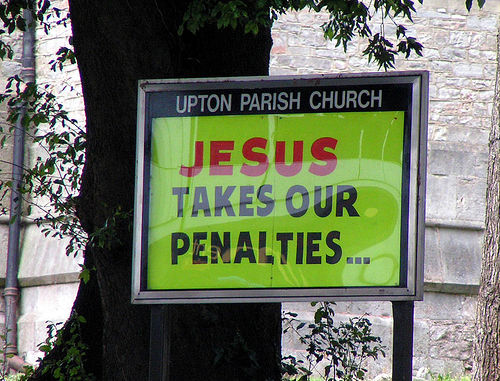
The dominant view of the Atonement among modern Evangelicals is the Penal Substitution view. Simply defined, this view says that God the Father, because of His immeasurable love for humanity, sent His Son to die to satisfy the demands of his justice. In doing so, Jesus Christ took the place of sinful humanity and once and for all was the atonement for all our sins. There are several key elements that support this theory but at its core is the notion that sin results in the just penalty of death (Rom 6:23) and that, in love, Christ died in our place (Rom 5:8). His death took the penalty for our sin (Rom 3:25-26) satisfying the demands of the Father’s justice.
Historical Development of the View
Early church fathers such as Clement of Rome, Ignatius, and Athtanasius included the idea of vicarious sacrifice in their understanding of the atonement but it was Augustine who synthesized the various themes into a comprehensive view of the Atonement. The penal substitution view became fully developed with the Protestant Reformers starting with Luther and then Calvin who formalized the ideas of Augustine into a cohesive whole.
We can use Calvin’s structure to understand the different aspects of vicarious sacrifice as he organized the idea through the use of three key theological concepts. Propitiation portrays Christ’s work in its Godward aspect. Through His sacrifice as our substitute Christ satisfied the demands of a just God: “The meaning, therefore, is, that God, to whom we were hateful through sin, was appeased by the death of his Son, and made propitious to us.” (Ref Rom 5:11 Calvin, Institutes II, xvii, 3). The idea of redemption encapsulates the humanward focus of Christ’s work on the Cross. (“Death held us under its yoke, but he in our place delivered himself into its power, that he might exempt us from it. This the Apostle means when he says, “that he tasted death for every man,”” (Heb. 2:9) ibid, II, xvi, 7). Lastly, to speak of reconciliation is to bring into view both the Godward and humanward aspects of Christ’s work. His death and resurrection serves to reconcile those who were previously separated by enmity and unholiness. (“These words (1 John 4:10) clearly demonstrate that God, in order to remove any obstacle to his love towards us, appointed the method of reconciliation in Christ.”, ibid II, xvii, 2).
Calvin also made a significant contribution to the understanding of atonement through his exegesis of Christ’s mediatorial work in the three offices of prophet, king, and priest. (cf. Institutes II 15:1-6) As prophet, Jesus proclaimed the grace of God and He assists the Church in her proclamation of the gospel message. Jesus the King rules over, guides, and protects the Church and as Priest, He expiated her sins by His sacrifice and even now intercedes on her behalf. We must remember that Calvin’s use of Church represents the New Testament view of the Church as the whole body of redeemed believers and not the organization itself. To those outside of the Church, he represents these three offices in name only.
The Necessity of Sacrifice
The violence of this view of atonement has been a challenge to theologians through the centuries and many, especially in modern times, have tried to posit alternative theories that move away from the theory. Why sacrifice was needed by God is necessary to understand in order to grasp penal substitution and this section will outline the conditions that form the answer. First, one must accept the sinfulness of humanity and how seriously God considers that sin. All humanity is sinful and in rebellion toward God (Rom 3:23). How seriously does God view our repeated failures, regardless of severity? Adam and Eve were expelled from the Garden for one sin because His standard is perfection. James 2:11 reminds us that we are evaluated in the same light; a single sin brands us as a lawbreaker (cf Gal 3:10). Humanity requires atonement because of our sin and the fact that it makes us the enemies of God.
Cannot God simply forget about sin? To answer this question requires that we view sin correctly, as an affront to the very character of God. Our sin is not impersonal. The requirements of holiness are not externally imposed. Rather, the norms of the law express God’s character, the beauty and holiness of His person. Because sin violates God’s law (1 John 3:4) it is so heinous because it is personal rebellion against the person of God. To restate this idea, your sin is a personal attack against the person of God, not just an infraction against an arbitrary set of rules that He composed. The personal nature of sin defiles the holiness of God and it requires retribution. His judgment of sin represents His personal anger at sin (Jer 2:13) and human rejection of His lordship.
Sin, by its personal nature, must be atoned for by sacrifice. Therefore, if humanity is to be redeemed there must be a penal substitute if we are to avoid the punishment our sin invites. Into this world, God sent Jesus Christ to be the sacrifice that would take on our sins (Isa 53, cf. Lev 16:21-22 to view the substitution in practice.) Only the appropriate sacrifice is acceptable to the Holy demands of justice and Christ alone fulfills that requirement (Rom 3:25-26) and removes the curse of sin (Gal 3:10-14). Through His sacrifice believers are redeemed (Mk 10:45).
Conclusion
Penal substitution does not represent all that needs to be said about atonement but it is often seen as the foundation of all other theories of atonement because it focuses its attention Godward. It seeks to explain how human beings are reconciled to God and the reasons for the initial discord. God is holy and righteous and must judge the rebellion of those who sin against His Lordship. His love desires to redeem them but his justice requires payment of the appropriate penalty. Christ is the only appropriate substitute unless we are to stand for judgment on our own merits.




 LOVE | ACCEPT | FORGIVE