
And A Couple of Lousy Ones
“When I have a little money, I buy books; and if I have any left, I buy food and clothes.”
― Desiderius Erasmus Roterodamus
The calendar turns to January, a new year begins, and once again, it’s time to review my reading for the past year. There are fewer books overall this year and a fair number of books were “read” by listening to them (shown on the list as (A)). The count was an intentional choice on my part. Seeking better books and spending more time with them took precedence over the filling of shelves. In looking at the selections of paper versus audio books you can see how I approach each medium. The overwhelming majority of my theological reading is done in paper form so that it can be notated and readily accessed once entering the library. The books I “read” in audio form enable me to explore my diverse interests and engage a variety of topics. It’s also my chance to enjoy my guilty pleasures of Jack Reacher and Harry Bosch novels while working in the garden. In many cases, the audio book inspired me to purchase a companion paper copy as I wanted to give it a second read with a pencil and straightedge in hand. Good marketing Amazon!
“Where is human nature so weak as in the bookstore?”
― Henry Ward Beecherr
A practice that has encouraged multiple reads and improved my understanding of complex material is the making of book notes. These notes are generally thoughts derived from the highlighting and marginalia in a book. Their purpose is to record the most important aspects of a piece of literature in a form that can serve me for research and writing purposes without having to search my shelves for an idea contained in my reading. I make these notes in Evernote so they are searchable and easily referenced when needed. It is a time-consuming process, but the benefit is priceless; I am rethinking through the material in the book as I make each note, and this process has been beneficial in building depth to my understanding of the selected topics. If this sounds like a benefit you would like to have for yourself, you need not start at this depth. Start by making chapter notes in the empty spaces in your current read. Summarize each chapter on the last page to see what you’ve learned. Outline the book on the blank pages in the back to see if you’re tracking with the author’s thoughts. Make the book your own.
When I have completed each book, I record the date of completion and my rating in the front cover before placing it into my library. My rating system is simple. Books rated 5 of 5 are the best. These are books that are memorable pieces of writing that deserve to be read, notes taken and thought about. Those rated as 4s are also worthy of reading and notation, but perhaps just once. The middle tier is a 3, and this is simply a good book. Those rated as 2 or below come with a warning. Don’t waste your time. Also, don’t ask to borrow these books as they do not have a home in my library. There were only a couple of 10s this year and one was a reread from years past. A 10 is an invaluable book, a must-read that I would recommend to anyone and everyone interested in the topic. Anything noted as (x…) means that it was reread. I intend (someday) to reread all of my Lee Child and Michael Connelly, having moved many of them from state to state. How many books do you have in this category?
| Title | Author | Rating |
| Being God’s Image | Imes | 10 |
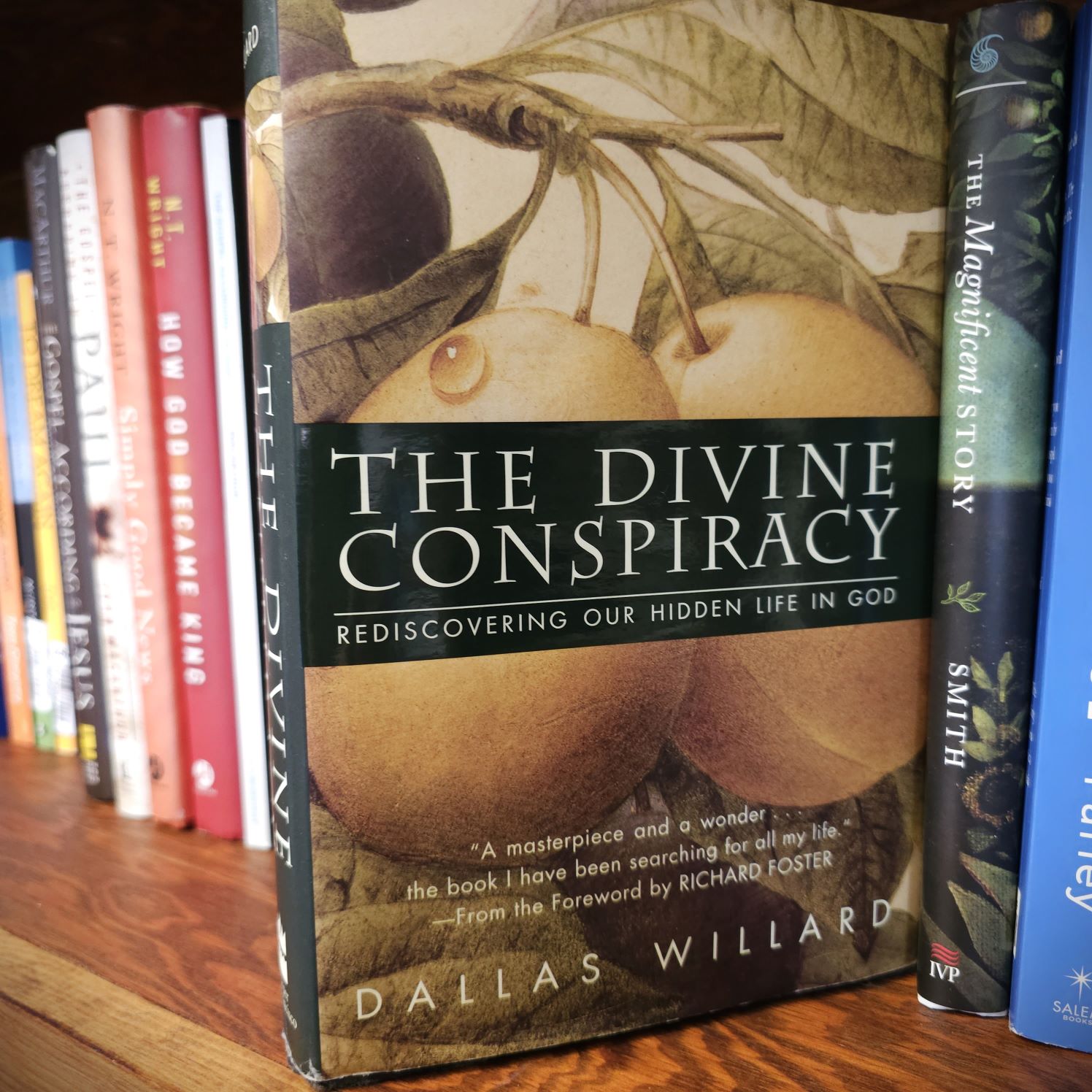
| The Divine Conspiracy (x2) | Willard | 10 |
| The Shaping of Things to Come (x2) | Frost | 5 |
| Embracing Grace | McKnight | 5 |
| Gospel Fluency (x2) | Vandersteldt | 5 |
| Practicing the Way | Comer | 5 |
| Unlimited Grace (x2) | Chapell | 5 |
| Transforming Grace | Bridges | 5 |
| Rejoice and Tremble | Reeves | 5 |
| The Mission of God | Schell | 5 |
| Scripture is Supreme | Chester | 5 |
| Covenant & God’s Purpose for the World | Schreiner | 5 |
| A Resilient Life (A) | MacDonald | 5 |
| The Art of Living | Epictetus | 4 |
| Jesus the King (x2) | Keller | 4 |
| Someday is Today | Dicks | 4 |
| By Grace Alone (x2) | Ferguson | 4 |
| The Grace of God | Stanley | 4 |
| The Practice | Godin | 4 |
| The Promise of Grace | Chappel | 4 |
| Renewal for the 21st Century | Werning | 4 |
| How to Pray | Torrey | 4 |
| All it Takes is a Goal (x2) | Acuff | 4 |
| Knowing the Spirit | Hinn | 4 |
| The Ministry of the Missional Church | Van Gelder | 4 |
| Storm | Cymbala | 4 |
| The Essence of the Church (x2) | Van Gelder | 4 |
| Factfulness | Rosling | 4 |
| Forgotten Ways Handbook | Hirsch | 4 |
| The Kingdom of God | Schreiner | 4 |
| The Forgotten Ways (x2) | Hirsch | 4 |
| ReJesus (x2) | Frost | 4 |
| The Death Christ Died | Lightner | 4 |
| The Secret | Child | 4 |
| The Lord’s Supper | Waters | 4 |
| Sacrilege | Halter | 4 |
| The Creative Act | Rubin | 4 |
| Excellence Wins (A) | Schulze | 4 |
| The Black Echo (A) | Connelly | 4 |
| Mind Shift (A) | McManus | 4 |
| Unreasonable Hospitality (A) | Guidara | 4 |
| Choose Your Story (A) | Hall | 4 |
| Trillions (A) | Wigglesworth | 4 |
| It’s Never Too Late to Begin Again (A) | Cameron | 4 |
| Missional Communities | McNeal | 3 |
| Handmade | Rogowski | 3 |
| The Difficult Doctrines of the Love of God | Carson | 3 |
| Writing for Busy Readers | Rogers | 3 |
| Church Turned Inside Out | Berquist | 3 |
| Expecting the Unexpected | Pearring | 3 |
| Who Needs Theology? | 3 | |
| Twelve and a Half | Vaynerchuk | 3 |
| Strangest Secret | Nightengale | 3 |
| Revival | Gaines | 3 |
| Everything Is | Manson | 3 |
| Primal Fire | Cole | 3 |
| If Only You Would Ask | Rogers | 3 |
| The Mission Always Wins | Bolsinger | 3 |
| Shaped by God’s Heart (x2) | Minatrea | 3 |
| Apostolic Priorities | Richards | 3 |
| Missional Map Making | Roxborough | 3 |
| Words Matter | Ballard | 3 |
| Redeeming the Routines | Banks | 3 |
| And | Halter | 3 |
| The Focus Project | Equalman | 3 |
| Sharpening the Focus of the Church | Getz | 3 |
| Hell Yeah or No | Sivers | 3 |
| Praying the Psalms | Brueggemann | 3 |
| Running Blind (A) | Child | 3 |
| Co-Active Coaching | Kimsey | 3 |
| Nothin’ But A Good Time (A) | Beaujour | 3 |
| The Last Array (A) | McManus | 3 |
| Chasing Daylight (A) | McManus | 3 |
| The Perfect Story (A) | Eber | 3 |
| The Miracle Morning (A) | Elrod | 3 |
| The Creative Curve (A) | Gannet | 3 |
| Love People, Use Things (A) | Millburn | 3 |
| Butcher’s Work (A) | Schechter | 3 |
| Drowning (A) | Newman | 3 |
| Goals and Vision Mastery (A) | Brown | 2 |
| Unlikely Thru-Hiker (A) | Lugo | 2 |
 LOVE | ACCEPT | FORGIVE