Lent 2009 – 7 Final Steps to the Cross

PeterStepsThe next day the great crowd that had come for the Feast heard that Jesus was on his way to Jerusalem. They took palm branches and went out to meet him, shouting, “Hosanna!”

“Blessed is he who comes in the name of the Lord!”

“Blessed is the King of Israel!”

Jesus found a young donkey and sat upon it, as it is written, “Do not be afraid, O Daughter of Zion; see, you king is coming seated on a donkey’s colt.” (John 12:12 – 15)

We cannot turn away now,  the Cross looms large with all that it means. For some Christians, the celebration of the Triumphal Entry colors the solemnity of the week that follows. They want to shout Hosanna and remember the humble Lord descending in strength in Jerusalem only to avoid the humiliation of His Passion.

Walk with the Lord, all the way to Cross. Don’t turn away, don’t deny him. Carry your sins for yourself up the rugged wood of the cross and hang it there as you view the sacrifice made on your behalf.

Know the pain to know the joy.

Digg This

Lent 2009 – 22 Steps to the Cross

PeterSteps

From that time on Jesus began to explain to his disciples that he must go to Jerusalem and suffer many things at the hands of the elders, chief priests and teachers of the law, and that he must be killed and on the third day be raised to life.

Peter took him aside and began to rebuke him, “Never, Lord!” he said. “This shall never happen to you!”

Jesus turned and said to Peter, “Get behind me, Satan! You are a stumbling block to me; you do not have in mind the things of God, but the things of men.” (Matthew 16:21-23)

How fragile and tentative our faith!

No sooner has Jesus proclaimed Peter blessed than the capricious fisherman forgets his understanding and acts out of his own heart. Picture this, Peter grabs the Lord by the arm and takes a distance from the rest of the disciples to rebuke Him! Mere seconds after recognizing Jesus as the Messiah, Peter decides that he knows better than Creator of the Universe what needs to be done to put things right.

For Peter’s sake, Jesus does not simply smile and gently remind him that He, Jesus, must die for the restoration of right in the world. No, He gets angry and rises up in that weather worn face and puts him back with all of the others who seek to forestall His calling. Peter has committed the unthinkable in challenging the teacher and Jesus does not hesitate to grade his efforts…in love. Like every good teacher, Jesus clearly seeks to clearly point out the error in Peter’s thinking not to curse him, but to save him.

Who do you say He is? Who would Jesus say you are?

Digg This

Lent 2009 – 37 Steps To The Cross

PeterSteps

These are the twelve he appointed: Simon (to whom he gave the name Peter); (Mark 3:16)

When we come upon this verse in Mark’s gospel, Jesus and His disciples have withdrawn ‘into the hills’ so that He can clarify the calling and set aside twelve for special office. Their commission will be unique: to be with him and to preach and cast out demons. Like that of the Lord himself, the ministry of the Apostles will be to announce the Kingdom of God. They are intimately sharing in His mission. In our modern reading, we are called to a similar ministry without needing the title given to his inner circle.

We are not told why Jesus elects to give Peter, James, and John their new surnames. Thus far, Peter has not distinguished himself as deserving of special calling but we, like Simeon himself, must simply trust the Lord’s foreknowledge and mission. Our modern world, filled with qualification tests and the prominence of credentials, can lead us to the mistaken belief that we are required to prepare ourselves for calling. In fact, as we learn from Jesus’ methods, he calls us to our ministry and will supply all of the necessary preparation through the Holy Spirit. Do we trust Him enough to simply follow closely along with Him and await His direction?

Digg This

Life After Church by Brian Sanders

imageOne of the things many positive traits that Christians should be known for is doing everything with excellence as we strive to make the Imago Dei within us known. As Brian Sanders writes in Life After Church, this should include our leaving church if the Spirit moves us to do so. To some, this suggestion is sacrilege on the order of the pastor declaring that he is leaving his wife because God wants him to ‘be happy.’ Leaving A church is not the same as leaving church, Sanders is quick to remind throughout his work and it is not a confrontation of God. Rather, it is a way of reconciling the internal movement of the spirit within a particular Christian’s life that does not align with the direction of the body in which she worships and has community.

One of the most important things that the author asks us to consider is how we define church. Can a redeemed believer ever leave The Church? Theologically, no. Our membership in the body is sealed at our surrender. To be able to fully deny Jesus and profess unbelief is not the call of this book. Sanders asks the Christian who is considering a move from their current church to no church or to another congregation to consider the form that the soon to be ex-church takes. Three components are needed to declare a body to be ‘church’: worship, community, and mission. He gives three examples (which I quote directly) against which to compare our church:

  • A group of men who meet in a bar after work to talk about living deeper, more surrendered lives in which they take time to pray for their families and invite their nonbelieving friends to share a meal and the gospel would be church.
  • A Sunday morning service where a great organ resounds the glory of God and the music and preaching move thousands of unrelated people, who return the next week to have the same experience, never engaging the mission or each other—this is not church.
  • A group of mothers invites other mothers to a park after school and builds relationships with them and their kids, hoping to share Jesus with them. They also meet to pray for each other, listen to struggles, cry together and recommmit to the goal of living for Jesus and reaching every mother at that school. That is church.
  • The church softball team plays in a church league, worships together on Sunday and even enjoys good fellowship before and after the games with Christians from their own team and from other churches. This is not church.

The Spirit rebels against a ‘church’ where God is not honored, people aren’t in community with each other, or they aren’t reaching anyone. This is what causes the unrest in the Christian’s soul causing him to consider the jump into the unknown. The absence of one or more elements cannot be made up for by the overemphasis on the others. Again, I quote Sanders on falling into this error;

  • Just Worship: hypocrisy. If our spiritual life is confined to a privatized worship that’s sincere but doesn’t lead us into mission or into deep relationships with others, we face the threat of hypocrisy. We offer ourselves to God but don’t put into practice what his presence and his Word would require.
  • Just Community: idolatry. If we pursue deep relationships but fail to live those relationships in the light of the mission of God or to submit those relationships to the headship of Jesus, we risk idolatry. Deep relationships unmediated by a concern for the kingdom and mission of God will take over our hearts, taking a place that should belong only to God. These unbalanced relationships will quickly become unhealthy and detrimental to our spiritual life.
  • Just Mission: pride. If our spiritual life is confined to independently pursuing mission but not open, accountable friendships or dependence on God, we risk becoming our own God. Taking the mission on ourselves without realizing our need for God or the people of God will certainly lead to error and egomania.

Without all three, the place we find ourselves is not church. 

This book didn’t generate the buzz that others have over the past year since it was published and I must admit, this sat on my shelf for some time before I picked it up to read. While it is messy in the way that our lives as Christians are, Brian has filled the book with so many nuggets of wisdom and insight that you want to read with a pencil or marker in hand to underline or highlight those thoughts that you will want to go back to again and again. The final pages about leaving well reveal his true heart for The Church; we are not to leave to damage but to rebuild or strengthen. Selfishly leaving for the satisfaction of injuring others is not an acceptable action for the people of Jesus. We leave in love and concern for those left behind.

Digg This

The Blue Parakeet 7

BPkeet

A collection of laws from Leviticus, chapter 19 includes the following:

19:2 Be Holy because I, the Lord your God, am holy.

19:3 You must observe my Sabbaths.

19:9-10 When you reap the harvest of you land, do not reap to the very edges of your field or gather the gleanings of your harvest. . . . Leave them for the poor and the alien.

19:16 Do not spread slander.

19:19 Keep my decrees.

19:26 Do not eat any meat with blood still in it.

19:27 Do not cut the hair at the sides of your head or clip off the edges of your beard.

19:28 Don’t put tattoo marks on your bodies.

19:32 Show respect for the elderly.

19:37 Keep all my decrees and all my laws and follow them.

So, how’re you doing on keeping this list along with the hundreds of other laws spread throughout the Bible? Most Christians will claim that if the Bible says it, they make their best attempt at following the law.

Except for those they don’t.

The question that we must answer to ourselves is why. How have we come to decide that some of the biblical laws are no longer applicable in our modern day and age? More importantly, how have we come to decide which ones to put aside? There are some who will read the bible within the framework of God’s holiness and His requirements being unchanging and therefore, His laws remain unchanging. This prism does not take into account that despite the unchanging nature of His holiness, God’s will for his people does.

Christians have developed a discernment rooted in Jesus and the New Testament and this way of discerning what applies to our lives and what is to be left to history. This stands us up to accusations of picking and choosing what applies and to some extent, this is true. In fact, the Church as a whole has historically taken this approach to the commandments of the Bible. Our goal then is to identify the patterns of discernment that lead us to the choices we make. Anyone want to start the conversation?


Psalm 18 Pt 2 ~ The Lord is My Rock

The Lord has dealt with me according to my righteousness; according to the cleanness of my hands he has rewarded me.

For I have kept the ways of the Lord; I have not done evil by turning from my God. (vv 20 – 21)

Reading the psalmists words in the second segment of Psalm 18 often leads us in a couple of different directions. First, we ask if David is boasting, proclaiming a righteousness that we find incredible. Is his blessing truly the direct result of his works or behaviors? If we were to pull these verses out of context it could certainly be understood that way but we don’t read that way. We read these statements in contrast to the wickedness of David’s enemies. He has devoted himself to the worship and the service of the Lord and is simply saying that any peace and prosperity that he enjoys is the result of this faithful service.

The second thing that jumps out at modern followers of Christ is the idea of possessing any righteousness of our own. You see, we enjoy a righteousness far in excess of what was available to David, we have the perfect imputed righteousness of our Savior.  We are no longer under the law, laboring for a perfection that cannot be attained by mortal man and always at risk of our personal Bathsheba. Our righteousness is fixed in the final work of the Lord on the cross. We too can claim the joy and benefit of the righteousness we have received.

You, O Lord, keep my lamp burning; my God turns my darkness into light.

With your help I can advance against a troop; with my God I can scale a wall. (vv 28-29)

First Sunday in Advent with Micah

image

The season of anticipation is upon us beginning today. The liturgical year begins anew with the first week in Advent. The break with the old year and everything that may have accumulated during the period is marked with a return to looking forward with a positive sense. Christians look from within the kingdom to the new heavens and new earth to be ushered in by the Lord. For now, we prayerfully look to the record of His coming and to those who pointed the way.

Isaiah often takes center stage in the readings but this year I’d like to turn to his contemporary, Micah. The prophet compresses the cycles of travail and hope and points the way to the coming King.

In the last days the mountain of the Lord’s temple will be established as chief among the mountains;

it will be raised above the hills, and peoples will stream to it.

2 Many nations will come and say, “Come, let us go up to the mountain of the Lord, to the house of the God of Jacob.

He will teach us his ways, so that we may walk in his paths.”

The law will go out from Zion, the word of the Lord from Jerusalem. (Mic 4:1-2)

Living in the kingdom after the Messiah has come gives our anticipation a similar focal point. The Spirit guides our prayers in the now but not yet kingdom of God which we inhabit and serve. We too look forward to a peace that can only be realized as the worship of God floods the world and replaces our brokenness with wholeness.

Blue Parakeet 3

BPkeet

Scot McKnight establishes a key idea in The Blue Parakeet mid way through chapter four. He posits that the Bible that God gives us to read is presented as the unfolding story of His ways with His people. When we approach the text as something else, we lose the power of reading the book as a story. In doing so, we lessen its impact on our lives and may even ‘discover’ interpretations that differ from the original intention of the authors or The Author.

Context is everything in reading the Bible as we’ve seen countless times. Context can be viewed as the concentric rings of a pebble in a pond; there is an immediate ring or context, and then one a little further out, and so on. Each of the verses exists in a context of a passage and that exists in a book and so on until we can see that each of the smallest contextual markers contributes to the whole of God’s story. Rather than standing on their own trying to carry the full weight of biblical revelation, the stories contribute to The Story. McKnight gives us a valuable example in asking us to consider our perspective on paying interest on a loan. Many of us have home mortgages or car loans on which we have agreed to pay a certain percentage of interest. We do this as Christians despite the clear biblical prohibition against it in Leviticus 25:35-38. Why? How do we justify dismissing this (and many other) passage when we claim the whole Bible as the Word of God? We do so saying “that was then, this is now” pointing out culturally how our time in God’s story is different from that of the Israelites. We stand correctly in this assertion because we read the Bible as a story with many different eras and cultures represented for the purposes of God’s expression of His relationship with His creation.

The question that we must address is what determines “what was for then?”  If we read for promises and blessings or morsels of law we lose sight of the story and we are tempted to say that ‘this was for then’ and ‘it is also for now’ to everything, despite the obvious cultural differences. Tempering this is the easily remembered device: God spoke to Moses in Moses ways in Moses days, to Amos in Amos’ days in Amos’ ways and to us in our days in our ways. If we are able to read the Bible as story and we understand the thread that runs throughout, we see that same thread running through our own lives in our own modern ways. Each author reworked the bigger story for his audience and we should read what God has left for us in our own context.

I struggle a bit with this chapter. Is it for everyone to decide what ‘was for then’ on their own? Is it only in the context of reading as a community that we can discover that? I’m interested to hear your views on this and on the book as a whole. 

Blue Parakeet 2

Scot McKnight’s excellent book The Blue Parakeet next addresses the question of what the Bible is. His point is that the way in which we approach the Bible deeply affects the truth that we draw from it. This section on The Bible as Story begins with a reminder from scripture as to the way that God speaks to His people in different ages:

In the past God spoke to our forefathers through the prophets at many times and in various ways, but in these last days he has spoken to us by his Son, whom he appointed heir of all things, and through whom he made the universe. (Heb 1:1-2)

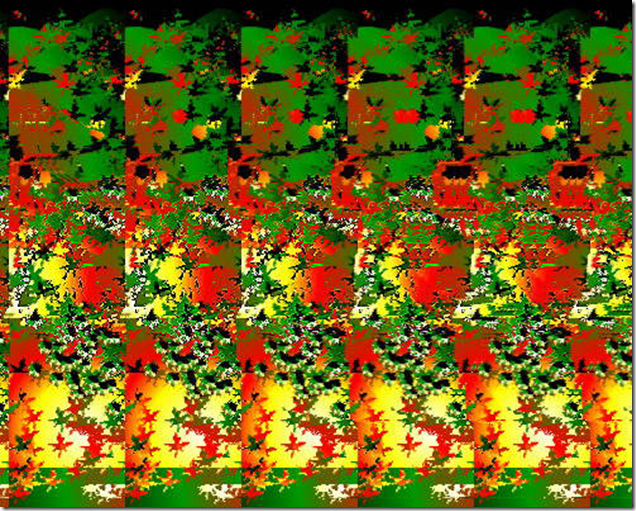
Chapter 3 opens with a deliciously applicable illustration. The image below is an autostereogram. When you first look at the picture you see the obvious repetitive abstract pattern. Kind of fall-like, maybe some maple leaves at the bottom.
 

image


Now, press your nose against your monitor and slowly let your eyes adjust to the picture. As you slowly move away from the image, the picture in the picture begins to emerge. Do you see it? The bird, the donut? It’s easier for some than others but if you scan the web you can find dozens of these kinds of images.

What does this have to do with the Bible? In order for God’s word to take its full three-dimensional presence in our lives, we need to adjust our reading methods so that the picture in the picture reveals itself to us. Just the like the bird in the image seems to become a part of our plane of existence, so God wants to have his words move into our immediate experience.

Reading the Bible as story is what will allows the Spirit to move in this way in our lives. The challenge to us is that we must put away our shortcuts as they tend to obscure the story in favor of deriving other kinds of information. Do any of these hit home with you?

Morsels of Law

We read the Bible strictly as a huge collection of laws. God is portrayed as the impatient and irritable giver of laws and we are judged by how many of these laws we follow and how closely. Our relationship is then defined by how good as citizens we are.

Morsels of Blessing and Promise

If this is our shortcut we read the Bible as a collection of blessings and promise. The tendency here is to pull promising verses out of their context while ignoring the others. The sense of the Christian life that develops from this practice is that it is all good with no troubles clouding the horizon.

Mirrors and Inkblots

We’ve all seen the inkblot cards used in psychological tests. Splat! What do you see? Spronk! Now what do you see? The point is that you will see what you want to see. When you encounter Jesus in the Bible your mind sees someone a lot like you. He thinks and acts the way that you would. It’s amazing…until I talk to you and find out Jesus is more like you! How can this be.

Puzzling Together the Pieces to Map God’s Mind

The Bible is a puzzle that we are challenged to put together. The trouble we run into is that, unlike the boxed puzzle, we don’t have the picture on the lid to help us assemble the thousands of pieces. Without that picture, we have to rely on our imagination and anything that doesn’t fit goes back into the box.

Maestros

Reading to find the maestro answers the question, What Would Jesus Do? If he is the master, all we have to do is to imitate this model of perfection and all will be well.

These are all snapshots that give us an incomplete view of the Bible and the story that God wants to envelope us in. Do you agree with these shortcut descriptions. Is there another that was missed?

Life With God 3g – I AM The True Vine

image

In the last allegory that we will examine in this series, we find ourselves once again meditating on one of the fundamental truths of our lives; the primary and most important relationship that we must maintain as disciples is with Jesus Christ.

I am the the true vine, and my Father is the gardener. He cuts off every branch in me that bears no fruit, while every branch that does bear fruit he prunes so that it will be even more fruitful.

The image of the vine is sufficiently vivid as to fire our imagination. We receive the life giving nourishment only as we remain connected to that vine. To be separated is to die. It is the vine that has roots deep into the earth, drawing everything it needs from the creation. Some of the branches will make the most effective use of their junction with the vine and bear glorious fruit. Other will only see the connection in the most cursory terms, not drawing on it and simply surviving.

Dead wood is ruthlessly culled by the gardener. It harbors rot and danger to the healthy plant. Pruning of the live branches is nothing to be feared. Without this practice, energy can go into developing the branch’s wood rather than into bearing fruit. Cutting back the branch reorients its growth into the important task of bearing fruit, painful at first but beneficial in the end. Sometimes the branch that appears to have received the harshest cutback can produce the greatest fruit.