Sharing a Vision of Revitalization

Carry the Fire

The challenges and complexities intrinsic to church renewal demand a single, shared vision for the revitalization to have a hope of being successful. Whatever contributed to the decline will have left lasting marks and lingering infirmities. The culture at large will continue to ignore or outright denigrate the Church and her practices. Countless uncategorized factors will actively impede the renewal process. To maintain momentum and direction against these headwinds, a church determined to find new life must have a single vision of its new life shared among all those who commit themselves to the journey. Everyone must own the collective vision, and leaders must carry that vision and when darkness and doubt close in, raise it as a torch to push back the threatening shadows and light the way forward.

Photo by Kevin Finneran on Unsplash

A clear vision, shared by the church, encourages continued forward movement even when various hurdles present themselves on the way. A shared vision recognizes that obstacles are not limited to external factors alone, there are various internal realities that can hamper the pace of renewal. Years of decline are almost always evidenced by limited or depleted resources. A vision of renewal will need to be narrowed in the early segments of the journey so that these limited resources (monetary, human, etc.) can be marshaled and dedicated to the near-term goal. The renewing church also cannot be everything to everybody. A shared vision enables us to say (without constant turmoil) what we are called to be and also what we are not called (at this time) to be. The renewal vision serves as a touchpoint for everyone as the horizons can be easily pointed out, obstacles recognized and agreed upon and the goal(s) used as an ultimate authority when alternative directions present themselves.

Developing a statement that can support these requirements is not a simple task. A vision for revitalization must consider the Bible’s purpose for the Church, the Holy Spirit’s intent for your church, and the local context in which Christ has planted you. A vision for revitalization is a tool that will be put before the Renewal cohort as often as possible. Unlike countless church vision statements, it will not be printed, framed and placed on the lobby wall and then forgotten. The shared vision is rehearsed, again and again, in the same the Bible repeats mention of God’s goodness, His grace, His love; participants need to be reminded of the reasons they are laboring, committing their time and resources, perhaps even suffering. Another important facet of developing the renewal vision is that it need not be “once for all time”, the authors can be comfortable viewing the vision as temporal. The church can develop a vision for the first leg of the journey (return to “health”, address the issues that led to decline, et al.) and then discard it in favor of a vision of the next horizon. Taking this attitude enables the renewal journey to be envisioned as a series of intermediate goals leading to longer and longer horizons, making each one eminently reachable.

A shared vision is much more powerful written in that light; if the vision is to be owned by each member of the revitalizing church, write it in community. The composition of this group includes the members of the congregation, to be sure, but also the living Word of God, His Holy Spirit and a composite view of the neighbors blessed by the new life of the church. The vision must be biblically grounded which automatically narrows the scope of the vision as to the purpose of the Church and, unless an immediate move out the location is in the cards, the vision must also consider the local conditions, people and realities that the church is meant to serve.

Writing the renewal vision as a collective exercise leads to the likelihood that everyone will take spiritual ownership of the statement, and that they will be spiritually dedicated to the vision and the Giver of the vision. Ideally, as the renewal vision takes the form of spiritual commitment, the body will recognize the necessity of praying together and praying deeply. The renewal group must not be satisfied with perfunctory prayer asking for blessing and guidance at the writing sessions. Renewalists must pray deeply together seeking to be shaped and emboldened and committed to reaching the goal of the vision. They must pray to be changed as needed to accommodate the demands of the changed realities. The group must pray to be fully sacrificial in their own comfort, their own wants, and perhaps with their own treasure. It is essential that the renewal cohort pray together to experience the guidance of the Holy Spirit as one. They need to hear the laments of those who have lived through the decline, the heart-hopes of those who see a glimmer of new life, even the struggles of those who are having a hard time with the changes that accompany the journey. Prayer is not an optional adjunct to the renewal process and it cannot be limited as a requirement for the pastor and elders alone. It is essential that the first commitment of the church, especially when desiring renewal, is to be a praying church. We must always keep before us the quote of Matthew Henry, “When God intends great mercy for His people, the first thing He does is to set them a-praying.”

Prayer is fueled by scripture and the congregation journeying toward revitalization should commit to collectively read and study God’s word, alone and together. The effect of regular immersion in the bible is well documented (“a lamp unto my feet”) for personal growth. Bringing this individual study together in a group setting deepens our understanding of the Bible’s story as we gain insights from one another, seeing truths revealed by the Holy Spirit to another. Renewal reading and study build renewal confidence as we collectively believe that what God has powerfully done in the past, He can easily do again (Hab 3:2). Deeper knowledge of what God reveals in the Bible makes the travelers more sensitive to what they are seeing and experiencing on their current spiritual journey.

The power of a shared vision for the renewal of a church is undeniable. As the leaders step out ahead, taking determined steps to lead the life of the body back to vitality, the vision lights the path, imbues confidence, and serves as the true north for aligning the map and plans. Leaders will need to be consistently rehearsing the vision before the renewal cohort, reminding them of its importance and painting a picture of where they are headed. When a glimmer of light is seen on the horizon, the leader must point out the sometimes-faint light for all to see. The leader must be guide and interpreter on the journey, pointing out landmarks and teaching their importance. He or she should be sensitive to making note of where God is at work in the life of the church and making sure that these events are memorialized. There is little more powerful than pointing out how God is working through or blessing or clearly guiding a church. Placing these divine interactions in the context of the shared vision builds the encouragement for the next step, the next week and the next year.


A Healthy Base for Planting Churches

Nurturing Roots to Fruit

If the Church wants to plant more churches in more places, we must launch them from a solid foundation. If your denomination, conference, affiliation or even your local church wants to see the reach of Christ’s church expand the kingdom gospel near and far, our commitment to church planting must balance that with an equally keen resolve to the nurture and maintenance of our existing bodies. We must nurture our legacy congregation at the same time we send out planters of new ones. Without the firm foundation of existing churches, planters without support, material and spiritual.

The Church is organic. We are the body of Christ spread across the globe and yet inseparably interconnected. Health in the body should be measured holistically, believing that all churches matter: fresh growth and existing parts equally. No leaves or fruit survive without the stem and roots. Like our own bodies, pain or weakness in one part is detrimental to the unhindered working of the other parts. It’s distracting at best, debilitating at worst. Sore legs cannot provide the stability and mobility needed by the rest of our body as we try to be of service in the kingdom. It can still happen, but it will require significantly more effort and may not be as effective.

While I support para-church planting efforts, I believe the most natural and effective church planting is done from within the church, done by churches who plant other churches. The men and women sent to plant are then known by the church, loved by the church, and supported by the church. When they are sent, they go with a support system in place and a time-tested culture adaptable to a new gathering of people. In order to realize this culture of planting, the existing churches need the confidence that comes from being healthy themselves.

To realize this mindset requires a cultural awareness on two fronts. The church must maintain as a life goal to reproduce itself. This begins on the more atomic level of being disciples who produce other disciples. Without this attitude, the larger goal of reproducing the church will be impossible in the eyes of the congregation.  Keeping reproduction in the front of the other ministry goals, the church has an easier time of recognizing the need for health in all aspects of the life of the church. A public aim of reproduction heightens the awareness of a need for maintaining the church’s health in all areas to be prepared when the time comes to birth a new congregation.

Decline in churches occurs for a variety of reasons, but one of the most common is the loss of a frontier, a horizon toward which the body is always on the move. This is easily diagnosed by looking at the macro level; does the church have a group of saints who have ceased to grow? Are they not producing new disciples on their own? These truths point to the starting point on the path to health and, hopefully, a new vigorous pursuit of kingdom goals. This is a challenging ministry, but with the end goal of reproducing in mind, fresh motivation can kick-start a return to health.

Healthy roots support an abundance of fruit.

The Greatest Love

A Rolling Stone Sings of God’s Love || Warren Rachele

[Originally published in the Times-News during the Time of Covid, 2020]

The most familiar verse in the Bible reads “For God so loved the world, that he gave his only Son, that whoever believes in him should not perish but have eternal life.” Jesus says this to a man who is trying to understand the Messiah. He went on to describe his mission in the next sentence, “For God did not send his Son into the world to condemn the world, but in order that the world might be saved through him.” Life and love are the essence of Easter.

When Jesus said these memorable words, his crucifixion was still some distance in the future and the way God would ‘give’ the son still a mystery. The degree of sacrificial love that motivated the gift, however, was not. The two letters of ‘so’ describe the great extent to which God loved the creation and all in it. The love would not be measured in a blanket forgiveness and not in requiring the rebellious humans to earn it. Instead, the promise of forgiveness and salvation would be fulfilled by one perfect sacrifice, a sacrifice that was pure and unblemished, a sacrifice that human effort could not attain. The price of redemption would be the life of the Son of God, the Messiah Jesus.

The love of Easter is not merely an emotion. Emotional love is subject to change, it can be influenced by circumstance, it can be lost in an instant.  The love that God has for his creation is none of those things. It is a facet of his character, a state of being. God’s love for the world is unchanging and unwavering. It cannot be earned nor can any human action result in its termination. The measure of this love is nearly beyond human ability to understand. Despite this, the full measure of God’s love is seen in the most horrific act in history, the crucifixion the Messiah Jesus.

How is this love? The rebellion of humanity in the earliest days of history create a chasm between creator and creation so wide that it cannot be bridged by any human effort. God, loving the world and its inhabitants so deeply, longs to close this divide, to be united in peace once again. He knows that without action on his part, his creatures are lost. In their pitiful state they cannot make restitution or pay a sufficient penalty, and try as they might humanity can never leap, fly, swim or find any way of transporting themselves to the other side. If this dark expanse is to be crossed, it will have to be done by God himself.

The paradox of the good news is that God, in the depths of his love, takes it upon himself to pay this penalty owed by humankind. His holy nature does not permit the option of dismissing the charges, a penalty is due in equal measure to that holiness. No human work can make a dent in that debt and so, out of an immeasurable love, God sends His Son to be the payment for the debt. The sobering truth in that good news? The debt could only be satisfied by sacrifice, the blood of Jesus on the cross paying the cost in full.

This ‘giving of his son’ would become the measure by which love is measured. As the cross grew nearer, Jesus described its heights, the personal challenge for his followers, telling them that “Greater love has no one than this, that someone lay down his life for his friends.” More than a challenge, his followers realized the judicial change that would be brought about, they would be friends and no longer enemies of God. The gulf would be bridged and the lost would be able to make their way home.

If it ended at the cross, this love would be unmatched. God had a higher expression of love to give though. The debt paid on the cross became the new life of Easter morning when the Messiah rose from the tomb. The perfect judge who paid the penalty himself rose as he had assured, condemnation behind and new life in full ahead. Easter became two parts of the same story, horror and celebration, mourning and joy. The rise of the sun on Easter morning brings all the promises of the Savior to light. Forgiveness came through the cross for those who would believe. For his friends, Jesus’ death became life in full. No greater love has ever been shown, nor will it be again. The love of Easter assures us of that.

2023 Reading List

“A room without books is like a body without a soul.” – Cicero

My 2023 reading list has finally been tallied and it contains 97 books read in the past year. Though electronic media dominates, there is a special value to the slower pace and tactile experience of reading a book. For pleasure or knowledge, the engagement of mind (and soul) and eyes and fingertips with the paper and the binding and the slipcover creates a bond with yourself and the ideas contained within. This intimacy is also why bad books are especially offensive to us; the personal investment we’ve made in the selection and the purchase and the preparation to read the book spins up our expectations to the point where bad writing is an insult. One of the most valuable permissions that I’ve received in life is to not finish books. Life is brief and forcing yourself to finish something that turns out to be of little value is a waste of your time. Pass the book on and select another from the ever-growing pile of yet-to-be-reads.

I purchase a good many of my books used (yea Thriftbooks!). Apart from saving money, the book you receive has a story to tell. Many have never been read, like they had been languishing in someone else’s yet-to-be-read pile before being abandoned. The dust jacket may have a faded spine, but you still get to enjoy the satisfaction of opening the covers for the first time, feeling that resistance as the cover and spine loosen up for the first time, ready to share the author’s insights with an excited reader. It’s a delight to receive copies  used by note-takers like myself. Do I agree or disagree with the marginalia? I’ve discovered heartfelt prayers and prayer lists in the front and back covers from and for people I’ll never meet but I feel apart of as I read them, wondering how they were answered. Few underline with pencil and ruler as I do. Some freehand with ballpoint pen, or worse, use garishly colored highlighters. Here too is a telling practice. When nearly every sentence is highlighted, which of the author’s thoughts were truly valuable?

“Read the best books first, or you may not have a chance to read them at all.” – Henry David Thoreau

I record each book in my journal as I complete it, writing the date of completion and my rating in the front cover before placing it into my library. My rating system is simple. Books rated 5 of 5 are the best, memorable pieces of writing that deserve to be read, notated if applicable and thought about. Those rated as 4s are also worthy of reading and notation, but perhaps just once. Threes are just good books and there an awful lot of those. Those rated as 2 or below come with a warning. Don’t waste your time. Also, don’t ask to borrow these books as they do not have a home in my library. You will notice a handful of books at the top of the list rated as 10. These are invaluable books and ideas that I would recommend to anyone and everyone interested in their topics. You’ll notice a number of titles in the list followed by a notation like (2x). This means that the book was reread during the year. How many books do you have that fall in that category?

TitleAuthorRating
Fresh Encounter (3x)Blackaby10
The Gospel Precisely (2x)Bates10
Why the Gospel? (2x)Bates10
Missional ChurchGudder10
Be My WitnessesGudder10
No Easy Road (2x)Eastman5
Simply Good News (3X)Wright5
King Jesus GospelMcKnight5
Becoming the Gospel (2x)Gorman5
A Praying Church (2x)Miller5
The Mission of GodWright5
Bearing God’s NameImes5
How to Hear GodGreig5
A Community Called AtonementMcKnight5
Fan the FlameCymbala4
The Travelers GiftAndrews4
48 Laws of Spiritual PowerViola4
Smarty BrevityVande Hei4
Sin, The Savior and SalvationLightner4
The Grace MessageFarley4
The Coffee BeanGordon4
Church Revitalizer as Change AgentCheyney4
The Psychology of MoneyHousel4
Salvation by Allegiance Alone (2x)Bates4
Romans ZECNTThielman4
Beautiful ResistanceTyson4
Revitalize (2x)Davis4
How to Start a RiotStorment4
Courage is CallingHoliday4
Creating a Missional Culture (2x)Woodward4
Missional Theology (2x)Franke4
Missional Renaissance (2x)McNeal4
Subversive MissionGreenfield4
Flickering LampsBlackaby4
Case for KetoTaubes4
Status and CultureMarx4
Built from ScratchMarcus4
6 Habits of GrowthBurchard4
Punk ParadoxGraffin4
How I Built ThisRaz4
The PerfectionistsWinchester4
Measure of a ManGetz4
The Permanent RevolutionHirsch4
The Faith of LeapFrost4
Radical Praying and PreachingRavenhill4
CuesVan Edwards4
The Power of Group PrayerCarney3
Can These Bones Live (2x)Henard3
MercyBaldacci3
Enjoy Your Prayer LifeReeves3
Our Iceberg is MeltingKotter3
Racing the LightCrais3
Longing for Revival (2x)Choung3
Praying for One Another (2x)Getz3
PrayerBunyon3
GoHunter3
Bully PulpitKruger3
Passion in the PulpitVines3
How to ChangeMilkman3
The Magnificent JourneySmith3
Put Your In the ChairPressfield3
Life Together in ChristBarton3
The Eye TestJones3
HabitsSincero3
There’s HopeMcIntosh3
What About Lordship SalvationBing3
Romans BECNTSchreiner3
Investigating Lordship SalvationWeierbach3
Hearing God’s VoiceBlackaby3
Faithful FaithMoore3
Breaking the CurseKinner3
Introducing the Missional Church (2x)Roxburgh3
No Plan BChild3
The Mission of Theology & Theology as MissionKirk3
The Church’s MissionLeeman3
StoryworthyDicks3
Insights on CommunionRenner3
City on FireWinslow3
Come to the TableHicks3
The Present Future (2x)McNeal3
Knowing ChristFargo3
It’s Not How Good You AreArden3
The PARA MethodForte3
Prayer RevolutionSmed3
Gather God’s PeopleCroft3
Sentness (2x)Hammond3
Holy SpiritYoung3
Into the VoidButler3
SoundtracksAcuff3
The Lighthouse EffectPemberton3
Hunting LerouxShannon3
Free BillyWinslow3
Help Thanks WowLamott3
Freaky DeakyLeonard3
The Upper Room DiscourseHenry2
Lifeless to New LifeBrown2
Greatness MindsetHowes2

Sparking a Movement

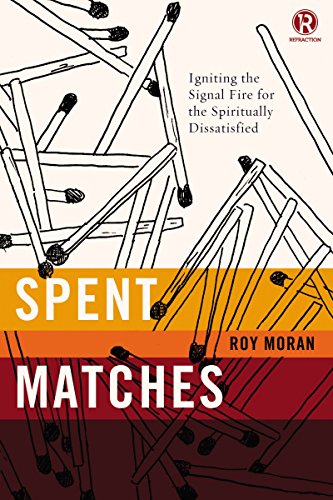
A summary of Spent Matches by Roy Moran

The Christian church has used a range of participatory metrics to evaluate her success in the modern era. Conversions, baptisms, the number of people present in worship: we fastidiously record these numbers throughout the year and then pore over them at year-end leadership summits. We define success as an increase in these totals; failure, plateau or decline. The analysis of these numbers governs the design and direction of the programmatic functions of the church. Leaders will tweak the edification programs to push for a more active evangelism, believing that transferring more information will make more effective evangelists. But how often are these same leaders referring to the commission given to the Church by her Lord to check the validity of their choices?

As Roy Moran states in his invaluable book Spent Matches, not often enough. The flaw in these metrics of success is that we no longer live in an era where information transfer to our neighbors and friends is effective in igniting their interest in God and His grace. To state this is a more colloquial fashion: the lives that surround the typical evangelical church are not the least bit interested in knowing what goes on inside. What people respond to is running into a radical life, one that is radically committed to Jesus and His teaching. Telling people what we believe puts their hypocrisy radar on full alert (as they have become conditioned to do in all areas of life). Living what we say we believe makes us stand out from the rest of the world clamoring for attention in the lives of our family, friends and neighbors.

It can be tempting to read the book as the outline for implementing a program, particularly because it includes ‘suggested’ outlines for meetings in the closing chapters. Mortify this temptation by slowly considering the imagery of the dire condition of the Church Moran paints at the beginning of the book. He suggests that our metrics should show the declining influence of modern Christian practice, likening the condition to a burning oil drilling platform surrounded by miles of churning sea. In the modern day we have two choices, jump or fry. To stay on our current platform is to die slowly on a long slope of decline. To jump is the join a movement back to the first principles of the Lord’s commission for His community of followers: make disciples who make disciples.

Moran is not the only author to put this idea into print. The Trellis and the Vine by Colin Marshall and Tony Payne leads to a similar conclusion, and has been influential in many churches by offering a ladder down from the burning platform. Moran is more forceful. We must jump and return with fresh eyes to the text of Matthew 28:18-20 and stop the bifurcation of the Gospel movement. Following a declaration of the expansive authority given to Him as the basis for the commission, Jesus commands His Church to “Go therefore and make disciples of all nations” (ESV). The command to baptize these new disciples into the family and to teach “them to observe [obey] all that I have commanded you.” The Church has been obedient to this commission, but the methods have resulted in a bifurcated gospel practice where we separate life from faith. We have defined discipleship as an education process (information transfer) and then convinced ourselves that discipleship precedes evangelism (“sharing our faith”). The outcome of this process? Disciples never feel ready to evangelize others, so we double down on teaching them, hoping that someday their ship will launch. All the while, the platform burns.

The myth of preparation-perfection that plagues the information-transfer Church is refuted by reading the verses in the passage that are not a part of the memorized commission. The audience for the Lord’s command is His remaining eleven disciples, some of whom worshipped, but some of whom doubted! Perfection was not to be the enemy of progress, as Jesus commanded them to jump from the platform into the unknown. As Moran says,

“Jesus didn’t exhibit any sense of alarm indicating this was out of the ordinary or unusual. He was quite comfortable with a team that didn’t have it all together. In fact, He was comfortable commissioning people who not only lacked complete faith but were confirmed doubters.”

This is a catalyzing moment in the book, setting in relief the encouragement to jump and ignite a new movement within the Church, disciples who make disciples as they go along, each edifying and encouraging the other rather than relying on subject-matter experts that students feel they have to imitate before moving on the Mission. The Lord does not expect to create a class of mission-minded within the Church, specialists who carry on the Commission while others sit and watch. To be a Christian is to be a disciple, one involved in daily learning what it means to be a follower of Jesus and then putting that into practice. Moran’s take on John 15:8 (“By this my Father is glorified, that you bear much fruit and so prove to be my disciples.”) is accurate and puts our current process is stark relief:

“Jesus’ hope was that it would be normal for His followers to make disciples as they lived out a dangerous message that would divide families ad heal the brokenhearted, challenge the well-off and encourage the impoverished, transform the oppressors and bring freedom to the oppressed. To fail to make disciples would indicate followers weren’t connected to Jesus and the heart of His mission.”

Owning this concept is the spark of a movement that puts away information transfer and replaces it with community life. Jesus did not commission us to be taught principles about Himself, he said we were to be taught and then apply what he commanded. This obedience is the missing part in most programs in the modern Church; we are never challenged to show what we’ve done with what we’ve learned and so we never do. This is the source of the apathy we see in the pews. We have more information than we can possibly process at our fingertips, but scarce few opportunities to put it into practice and fewer still partners in the discipleship life holding us accountable. The discipleship patterns that Moran suggests through the book aim to fill this vacuum.

A fair number of churches today claim Acts chapter 2 as their model, seeing a return to the ancient church as a solution to moribund Christianity. The component missing in many is the discipleship pattern given by the Lord’s example and command: disciples, however imperfect, who make other disciples (who repeat the process) in community. This is what will capture the imagination of a world that has long ago become inured to the invitations of the Church. I invite you to read the book a few times and see if you are tempted to jump from the platform into the raging sea of the culture, trusting the Lord’s promise for our weakness, “I am with you always, to the end of the age.”

Calvinists and the Political Left

Make every effort to keep the unity of the Spirit through the bond of peace. (Eph 4:3)

It’s taken me awhile to understand the uneasy feeling I get when I get the urge to post a comment to a Calvinist blog. Will my words be considered as a Brother in Christ or will I be vilified and subjected to ad hominem attacks that avoid the content of the post? Anymore these days, I am finding more and more that some of those theobloggers who claim the name Calvinist or Reformed default to the latter. What has brought this to a head is the current hyper-focus on politics due to the back to back conventions and specifically, the fevered attempts to defile the name and reputation of Governor Palin over the past few days. Sadly, what I have discovered is that there is a body of these Calvinist bloggers who are indiscernible from the left-wing chattering classes. This clique will brook no wavering from the TULIP line, refusing to engage any idea that challenges it and, because the challenger is considered to be somehow heretical, he or she must must be burned in the electronic town center.

Contrary to the repeated calls to unity within the body that can be found in the Scriptures, there is an increasing body within the Body that have chosen to attack rather than respond. I’ll give you a recent example (and yes I know, I should have known better) which occurred when I foolishly chose to leave a comment on the Pyromaniacs blog. In an attempt to stir further dissension within the body, a question was posted inviting response from Arminian readers. The trouble with the question was that it was a false dilemma; Arminian theology offered no different view on the topic than that of the Calvinist framework and I wrote just that in my response. Expecting a biblical challenge or theological counterpoint, imagine how disheartening it was to check back later to find that the entire response was an attempt to make a mockery of my screen name.

It’s a bit troubling to find this in any context but to get this response by the Pyros main man Phil Johnson certainly diminishes any positive reputation that he might have gained outside of his close knit little community. Attempting to misstate the intention of my Greek to English transliteration meant (ironically in their eyes) Slave Christ, a perfect definition of Arminian theology. Mistakenly responding back that this obviously not the intent, referring to Rom 1:1 in the Greek, and restating the original answer to the provocative question, my gift was a further lambasting that remained off topic.

I don’t share this to gain sympathy. I’m a big boy and mature enough to handle people like this. The reason that I post this is because the level of conversation about God should not be descending into the the same kind of rancor, vitriol, and immature attack mentality that we see from the left wing of the political establishment and their media sycophants aimed toward those of the opposing party. Personal attacks and hyperbolic caricatures replace substantive discussion of an issue. The assumption is that if you do not agree with the liberal mindset, well you simply are too stupid to even engage and you must be the recipient of character destruction and mockery.

Christ didn’t die for a Church divided by this kind of worldly dissension. There are topics to which forceful comment and righteous anger are appropriate (Todd Bentley for example) in a Christian context but theological differences on non-essentials are not among them. To mirror the world’s approach to discussing differences runs counter to being in the world but not of it. Shall we all just go to our corners and talk only amongst ourselves?

Update: Check out the comments at the end of this posting. While not as mocking, you can witness how the discussion that disintegrates in not on how the post writer constructed his argument or the content of his statements. The Calvinist cries martyrdom (no doubt scrawling Ichabod on the doorframe) as he leaves the conversation. Talk scripture in context, don’t send me to Pink or Piper. We’ve got learn to think for ourselves rather than relying on other theologians all the time.