
Boy, I miss this car on warm sunny days like this. My once prized Chevelle…cowl induction, performance tuned, and modified suspension. Fun, fun, fun…


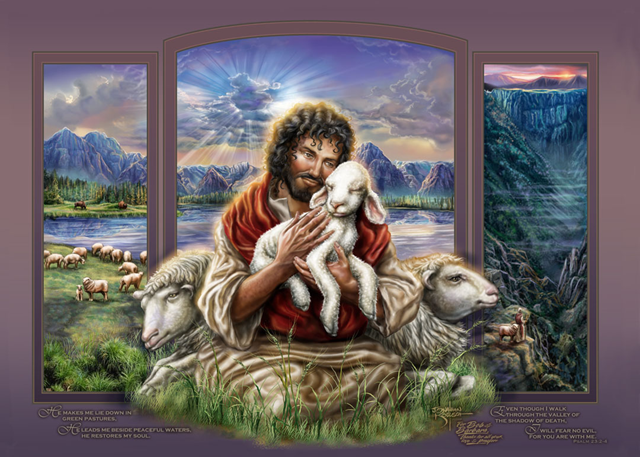 The Lord is my shepherd, I shall not be in want.
He makes me lie down in green pastures, he leads me beside quiet waters, he restores my soul.
He guides me in paths of righteousness for his name’s sake.
Even though I walk through the valley of the shadow of death, I will fear no evil, for you are with me, your rod and your staff, they comfort me.
You prepare a table before me in the presence of my enemies. You anoint my head with oil; my cup overflows.
Surely goodness and love will follow me all the days of my life, and I will dwell in the house of the Lord forever.
The 23rd psalm is one of the most beloved and well known entries in the Psalter. Though many individual verses have become a part of our praise music vocabulary, many people know this psalm by heart in its entirety. There is an appealing promise in these verses that is painted with vibrant and pleasing verbiage that brings an image of the Good Shepherd (John 10:11) cradling and protecting his lambs. He alone will look out for our every need (though not necessarily our every desire.)
 In an age of image we have stored in our minds a catalog of green pastures and quiet waters so these words immediately paint with swathes of verdant, lush tropical greens or the deep emerald of a grassy countryside. Quiet waters soothe with their deep blues turning to black as the depth increases and pops and gurgles silence us as we strain to catch the song of the water as it moves by. We miss out on the depth of this verse unless we meditate on unforgiving landscape in which the psalmist sees the work of the shepherd.
 The desert of the Middle East is far from the viridescence that our mind shows us as the words are processed in our minds. A dry, khaki, hardened land required extraordinary efforts from the shepherd. Food for the sheep might require movement, the search for water a knowledge of the terrain and the ability to bargain with those who guarded its source. The ewe and ram on their own may stand little chance of survival; dependence on the shepherd is not optional.
 Suddenly, the imagery changes to one who walks in the shadow of death. The deep and arid Wadi Qelt might be bright at midday but every other hour of the day fills it with ponderous shadows that might hide evil around each bend or rock. Walking alone in this valley, the walls rising high above, the only escape route would be forward or backward and yet the psalmist voices no fear as the Lord walks alongside him.
 Verses 4 and 5 form the core for us in our modern day as they did for Yahweh’s people. Our valley of shadows might be more urban but it holds the same dangers and fears. We will not fear these things though as our Shepherd walks beside us and comforts us. In verse five are presented with the image of the table and the cup, overflowing with good and yet, look carefully at the placement of this table. It is in the midst of our enemies. It is not removed from, guarded from, above, below, or in any way away from our enemies. We will sit with the Shepherd in the presence of our enemies.
You see the Psalmist does not envision an escape from the travails of this world to an eventual dwelling with the Lord in his temple. It is not a psalm of escape. Instead, it is an expression of supreme confidence in the Lord and the knowledge of His intimate presence even as we face trouble and danger in this world. All is for the greater glory of God. Though our pain might be temporary, in the economy of the Good Shepherd it is necessary in the greater picture of His-story. We are blessed in playing our role.
The promise of the 23rd psalm is simple: by following the Good Shepherd we will walk in goodness and love throughout all of our days. It does not mean we will escape the trials and troubles of this world but following the Shepherd will always lead us to better days. No wonder it remains a favorite.


Word created by letters found in Flickr. Generated by the tools at www.metaatem.com/words. Have fun.
 The countdown to spring training game is on! Pitchers and catchers first and the first game 10 days later. Holliday and his sunflower seeds have gone to O Town and their white shoes. The young guns will get an opportunity to step up and take the starting job that they deserve. I can’t wait.
Does anybody else think Todd Helton should retire?

Loving the Bible means letting the blue parakeets that we encounter to fly free. It means learning, knowing, and loving all of the Bible rather than a few select passages. If we apply this notion to our final topic, we must bring the entire bible to bear on our process of discernment and the method that we use to decide our position on women serving in church leadership. For example, we improperly apply 1 Cor 14:34-35 and 1 Tim 2:8-15 without also adding Acts 2:16-18:
No, this is what was spoken by the prophet Joel:
“ ‘In the last days, God says, I will pour out my Spirit on all people.
Your sons and daughters will prophesy, your young men will see visions, your old men will dream dreams. Even on my servants, both men and women, I will pour out my Spirit in those days, and they will prophesy.
Prophecy points to women being gifted and called, the Bible tells of women serving the Lord in leadership and teaching, and the fact that we selectively read the commands of the Bible all must lead us to question the manner in which we develop our position on this or any other tradition and command that we practice in our modern age. In this matter, our discernment is going to rest on whether or not we see the crimson thread of Oneness at creation, Otherness after the Fall, and the restoration of Oneness in the Messianic era.
So, what about Paul. Why did he write these passages that have caused so much confusion and consternation within the Church? We can apply historical research to the period in which Paul writes these letters and come to the conclusion that these commands were special and temporal to be applied to a specific situation but not intended to be applied through all of history. Paul himself gives us an insight into his personal process of discernment in 1 Cor 9:19-23 in which he explains that he will go to every end for the sake of the gospel:
Though I am free and belong to no man, I make myself a slave to everyone, to win as many as possible. To the Jews I became like a Jew, to win the Jews. To those under the law I became like one under the law (though I myself am not under the law), so as to win those under the law. To those not having the law I became like one not having the law (though I am not free from God’s law but am under Christ’s law), so as to win those not having the law. To the weak I became weak, to win the weak. I have become all things to all men so that by all possible means I might save some. I do all this for the sake of the gospel, that I may share in its blessings.
Would Paul put women in the pulpit if it had been advantageous for the gospel? I believe he would. In this same fashion, we must consider what we do today in the context of the good of gospel. It’s all in how we understand the Bible and learn to address the Blue Parakeet’s as they appear.
The psalmist turns in the final section of this psalm to the nature of steadfast faith. In the middle segment we encountered the voice of despair as the believer found himself facing travail from every direction. Despite the struggles he knew who would save and redeem him from these challenges. In the closing verses, he praises the Redeemer for the future good that the will bring.
I will declare your name to my brothers; in the congregation I will praise you.
You who fear the Lord, praise him! All you descendants of Jacob, honor him! Revere him all you descendants of Israel! (vv 22-23)
Instructive for us is the expansive view that the suffering man proclaims. It is easy to dwell on our personal issues and troubles at the expense of looking outward to others. The Christian must face the possibility that their suffering is for the good of another, either as instruction and example, or to directly benefit them at your expense. A true and deep faith looks beyond today toward the promise of tomorrow and our eternal time with the Lord.
From you comes the theme of my praise in the great assembly; before those who fear you will I fulfill my vows.
The poor will eat and be satisfied; they who seek the Lord will praise him – may your hearts live forever!
All the ends of the earth will remember and turn to the Lord, and all the families of the nations will bow down before him, for dominion belongs to the Lord and he rules over the nations. (vv 25-28)
Faith always look forward.
Enjoy the John Prine classic, Paradise…
 Five Sentence Emails
My Three Most Important Things
One Goal is My Key
‘Less’– 2009
The minimalist beauty of the Haiku poetry form is attractive because the central thought, though it may be nuanced, is simple and easy to decipher and enjoy. Imagine transferring this simplicity to your lifestyle and countering the Illiad like push to expand our lives to fit in more and more activities, more and more things, more commitments, more goals, and on and on until we come to the point where we realize that we just cannot handle anything more and break down. Leo Babauta’s new book The Power of Less is a turn in the other direction.
Many other books of this type encourage and attempt to teach skills for handling an ever-increasing set of goals, projects, and tasks. These systems are complex in design and often involve myriad lists and charts and numerous steps of analysis and planning. Some people may thrive in this environment and truly enjoy taking on more commitments but there is always a twin pair of risks. The first is that the next task we take on might be the one that breaks us down. Second, these complex planning systems can consume our attention and become the focus themselves.
Babauta suggests a different approach: shedding distractions, simplifying and narrowing your focus in order to improve your life and increase your performance. His system is built around the notion of limiting yourself to only the most important things and ruthlessly treating everything else as a distraction to be avoided. As you read, you begin to realize how many things that you now see as necessary (the little chime announcing each incoming email) are really distractions that are keeping you from accomplishing the things that you deem most important.
Consider your list of goals right now. You may have two or three or even more goals. If you’re the type who sets goals for yourself then you probably also divide your attention amongst these goals as you work toward their accomplishment. Leo suggests a different approach. Select the most important goal and devote all of your attention to attaining it. Your attention will be more focused, your stress reduced (because you won’t be trying to keep multiple plates spinning), and your motivation enhanced as you work toward the goal. When the first is finished – and only then – you start on the next. Simplifying in this fashion will not only improve your overall performance, you’ll find yourself happier as you discover that those things you once thought were crucial were really just distracting you from reaching your most important objectives.
Leo offers this approach up for consideration in many personal and professional areas in Less. Filing, email, and the Internet all threaten to overwhelm us if we let them. What if you only checked you email twice a day? What is the worse thing that would happen? How about unplugging from the Internet? How many times have projects become sidetracked by a quick troll through your favorites bookmarks that turns into an hour or two? In so many areas, Leo points out how many times we have become dissatisfied with ourselves because we have allowed the multitude of things demanding our attention to distract us from what we want to accomplish. Removing clutter from our life, home, and work allows us to focus on what is truly important and to find greater personal joy and satisfaction.
The Power of Less is the exact opposite of The Seven Habits… though both seek the same end, greater personal performance and achievement. If you’ve spent hours developing your mission and moving big rocks around and still find yourself unsatisfied, give Babauta’s ideas a try. Simplify, reduce, and de-clutter and you may just discover the one or two things that are most important to you buried beneath.
Leo’s blog – zenhabits.net
Sitting around the dinner table playing dominoes, everyone starts to sing this song which has wound its way back into the national consciousness. Though my wife and I were certainly alive in the 70s, the Kid ™ says what a great song this is… will I wake up soon?
More memorable for me was this one… Pablo Cruise (on Don Kirshner’s Rock Concert no less!) You see Kids, before MTV we had to stay up until the middle of the night to see music on television (cf: Midnight Special).
Rawk On!
 Let’s use our discernment skills and examine a passage, shall we? Perhaps a good one would be 1 Timothy 2:8-15:
I want men everywhere to lift up holy hands in prayer, without anger or disputing.
I also want women to dress modestly, with decency and propriety, not with braided hair or gold or pearls or expensive clothes, but with good deeds, appropriate for women who profess to worship God.
A woman should learn in quietness and full submission. I do not permit a woman to teach or to have authority over a man; she must be silent. For Adam was formed first, then Eve. And Adam was not the one deceived; it was the woman who was deceived and became a sinner. But women will be saved through childbearing—if they continue in faith, love and holiness with propriety.
Read the passage and break it down into its basic commands. As you tick off each one, make a note of whether or not this command should be practiced today.
1) Males should pray with their hands lifted up.
2) Males should pray without anger or disputing.
3) Women should dress modestly.
4) Women should not have elaborate hairstyles or wear gold or pearls or expensive clothing.
5) Women should have good deeds.
6) Women should be silent and quiet.
7) Women should not teach or have authority.
So, what were your answers? Unless you answered in the affirmative to every single one and live out that commitment you have put some framework of discernment in place with regard to the biblical commands. Can you identify the source of your decision matrix. For example, Paul commands that men should pray with their hands lifted up. I looked about during worship this Sunday morning and noted some hands clasped and most heads bowed but none of the men had their hands raised during moments of prayer. The Apostle also commands that women are to dress modestly but I suspect that what passes for modestly in Southern California or Florida might not be the same as the requirements in North Dakota or Alabama. Is it proper to make cultural adjustments to a biblical understanding or must the first century dress of women be the bar against which all current and future dress is measured? The point here is that there can be reasonable disagreement on the application of these commands and yet, the restrictions on women have become fossilized and made their way as the hard and fast tradition of the Church. Why flexibility on some and not on others? Is our discernment colored by other factors that we are unwilling to give name to?
It’s important to answer these questions for ourselves because many in church are simultaneously willing to ignore the first command of the passage and maintain the last as a hard and fast rule. This, in spite of the fullness of the Bible’s story in which women were active in ministries and leadership throughout the story. Is it appropriate to allow the WKSPs to control the greater body of WDWDs? Genesis 3:16 has become indurate and tradition bound up in its words, proscribing women forever to inferior status. Reading this in context however can lead us to see it as the result of the transition from Oneness to Otherness and the struggles that obtain from this relational status.
How do we respond then to Christ’s restoration of Oneness:
Therefore, if anyone is in Christ, he is a new creation; the old has gone, the new has come! (2 Co 5:17)
There is neither Jew nor Greek, slave nor free, male nor female, for you are all one in Christ Jesus. (Ga 3:27-28)
Do we see the power here that Christ brings? At the very least, the new creation might be seen as a restoration of Oneness between men and women but, even more powerfully, it unleashes the Spirit within to undo the the Fall in our world. Thoughts?
 LOVE | ACCEPT | FORGIVE