The Multi-Faceted View of Atonement

We have looked at three of the major views that Christians have adopted to understand atonement, Christus Victor, Healing, and Penal Substitution. At one time or another during the history of the Church, each of these theories has held the majority position among theologians. The Penal Substitution view is the dominant view now, among the American churches at least.image It’s important to recognize the historical shifts in acceptance of the various theories and to question why one would lose favor to another in the minds of Christian thinkers and teachers. Does the Bible change over time? Has the Holy Ghost made contradictory revelations at different moments in time that initiated the shift? What about all of the other atonement views that are subsumed within the larger categories?

Is it possible that the atonement brought about by the sacrificial death of Jesus Christ is much too expansive to be understood under the banner of a single, narrow category?

Atonement is Too Large for a Single Theory

Theologians who stand apart from the dominant views of atonement will answer this question by saying yes, there is no model or metaphor that is sufficient to explain the significance of of His sacrifice. The crucifixion and its result are tightly woven into God’s eternal purpose and as spirit-opened eyes continue to pore over the scriptures in the hours remaining until the end of this time, we may never run out of the countless ways of understanding its meaning for our salvation. It should not be alarming to find a number of images that lend themselves to understanding this momentous act. As centuries of eyes search out the truths of God’s word, each with a slightly different perspective on the greatest human need, it is inevitable that a number of categories would arise.

Single Views and the Bible

The New Testament authors generated a number of images in the Gospels and Epistles in order to help readers comprehend the monumental shift in God-Human relationship brought about by crucifixion of Jesus. If the primary rule of hermeneutics is applied—context,context, context—the modern reader places the writing in first century and recognizes the societal influences that are inherent in the texts. Five areas of public life dominate: the court of law (justification), the world of commerce (redemption), personal relationships (reconciliation), worship (sacrifice), and the battleground (triumph over evil).

This plethora of imagery could be differentiated by the loci of the individual authors, their use of language and metaphor and missiological interest. A more effective tool for seeing the wide span of atonement images is to survey the corpus of a single author to see if there is variety or consistency. With his dominant contributions, Paul and his works provides such a platform. The Apostle employs two main themes in discussing the significance of the atonement, the ‘giving up’ of Jesus for human salvation (cf. Rom 8:32, Gal 1:4) and ‘Christ died for our sins’ (cf. 1 Cor 15:3, 1 Thes 5:10). These themes emphasize the saving nature of Jesus’ death but they do so without linking it explicitly to a single methodological theory. With this point established, Paul then utilizes a variety of imagery applicable to particular concerns of his epistle audiences. Reading Paul exposes us to language about substitution, representation, sacrifice, justification, forgiveness, reconciliation, victory over the powers, and redemption.

Conclusion

Rather than being confined within a single theory, the atonement is better viewed as encompassing the fullness of God’s design for the world. The image which finds favor with a theologian will more often than not be a product of his definition of the greatest human need. If people are seen as in bondage to sin, they need liberation. If humanity is spiritually blind, the desperate need is for illumination. If lost, they need to be found. Taking a kaleidoscopic view of atonement provides the freedom necessary to locate all of these needs within a view of the crucifixion.
3 Reasons Christian Blogs Fail

Fail Christian blogs fail, not in attracting readers, but rather, to affect the world for the better. There is a vast difference between a theological blog and a blog whose author is incidentally a Christian. Nothing wrong with either position until one attempts to present themselves as the other. Here are three reasons that Christian blogs fail to connect with the uncountable readership of the interwebs.


1. Don’t Hold on to One Sided Arguments

There are many things that mainline Christians accept as settled fact. Google a handful of statements of faith, line them up next to one another and you will see what I mean. Outside of those things however, theology within the centuries old Christian faith ranges far and wide. Writers who fail to avail themselves of the depth and breadth of this theological history usually end up camping on one position without understanding why they are against the other positions that challenge their belief. Take Modalism for example. You read somewhere that it is wrong and your fellow theo-bloggers are not hesitant to throw the heresy flag when mentioning it but, do you know why they consider it a heresy? Simply saying something is wrong is not an argument. Before you go on the offensive or even just take a stand against a particular belief, educate yourself. Understand why the belief arose and why people believe(d) it. Study the proof texts offered in the context of the whole Bible, not just your theological framework. Be able to enter a discussion with something more than “because I said so.”

Oh, and Wikipedia is not to be considered a definitive source.


2. Don’t Be the Possessor of an Uninformed Theology

Discussing Christian theology and ecclesiology are immensely complex undertakings. It is an undertaking that requires study and meditation and no small amount of time seeking the guidance of the Holy Spirit before you can be effective in your presentation. When you find yourself simply regurgitating the work of others (who have put in the blood, sweat, and tears to arrive at their conclusions) you are doing little more than diminishing the possible impact your post might have. If each of your posts contains the reference “so and so” says “this or that” as the basis for your theological position, I may as well simply go directly to the original thinker’s/author’s website and read the words directly. Any authority that you hope to embed in your writing comes from the reader’s trust in your knowledge. If, when a comment challenges your theological position, you cannot demonstrate an understanding of the challenger’s position you will lose the trust of not only that reader, but others who survey the whole conversation from a distance.

Oh, and John Piper, John Wesley, and James White are not always right.


3. Don’t be Self Serving

If your entire reason for blogging to promote yourself, do it in a different format. We have all seen blogs that have a thin veneer of Christianity that peels away to find every post being an exposition of how wonderful/altruistic/sacrificial the blogger himself is. Readers will soon discover that the faith is simply a jacket worn to give the blogger a reason to talk about themselves. Ask yourself how this affects the kingdom. Is it glorified or expanded or masked and diminished by the monumental ego that attempts to supersede it? This is not to say that personal entries, off topic asides, and the pride of sharing some accomplishment are out of place. Each is a part of the life we lead while still a part of this world. The ratio that the reader sees between personal and thematic posts will put on full display what is most important in the eyes of the blogger.


There are probably many more topics that could make this list but these are my top three. Then again, I could be wrong.

Psalm 54 He Has Delivered Me

image

Strangers are attacking me; ruthless men seek my life – men without regard for God. (v3)

To varying degrees, every Christian can identify with the sentiment behind that verse. We have been attacked, persecuted, teased, goaded, etc. in countless ways by people who do not know God and even by those who do. We wonder why He allows this. Have we done something to deserve it? Are we being punished in some way?

Perhaps we forget the words of the Lord in John 16:33: “In this world you will have have trouble.” It doesn’t console us much but we are better off when we memorize the entire verse which reads;

“I have told you these things, so that in me you may have peace. In this world you will have trouble. But take heart! I have overcome the world.”

One thought we should always consider with regard to our current troubles is the way in which they fit into the larger plan of the kingdom. We may never see or know (in this life) this effect that our troubles have within God’s larger plan. It may be that our struggles and the way in which we face them will move another to seek the Lord or, even longer term, may set up bigger things that we will never see. Contrary to the worldly demand to know everything, we must simply trust in God and His Kingdom plan.

Image pochacco_o

Day Six in the School of Prayer

WithChristInPrayer


“Which of you, if his son asks for bread, will give him a stone. Or if he asks for a fish, will give him a snake? If you, then, though you are evil, know how to give good gifts to your children, how much more will your Father in heaven give good gifts to those who ask Him!” (Matthew 7:9-11)

How much more indeed! Often we are willing to settle for simple material gifts when the Father wants to give us so much more. The cursory handling of the verses from the Sermon on the Mount leads to the idea that our material needs—food, clothing, shelter—are to be the core of our prayers as we see the human father gives sustenance rather than danger and damage. The Saints are further led astray by reading into this passage a ‘blank check’ from Heaven in the implicit promise of good gifts. The best gift, Murray points out, is nothing material. It is the indwelling of the Holy Spirit and His control over our life and living in this world. This is the gift we should earnestly be seeking, trusting in God to take care of all of the things He already knows we need.

Jesus teaches in our lesson today to lift our eyes and hearts above our immediate circumstances to see how much more life the Father has for us when we open our connection to the Vine. The Spirit is our connection and the gift we receive upon belief that enables the life-giving nectar of the Vine to flow into our empty souls.

Extraordinary is Within Your Reach

No eye has seen, no ear has heard, no mind has conceived what God has prepared for those who love him. (1 Cor 2:9)

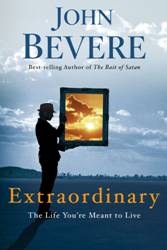
The latest by John Bevere, Extraordinary, takes off in a flash from that fundamental truth and winds through 200+ pages of confrontation and encouragement demanding that the Christian see the gift of grace as more than just fire insurance. Believers empowered by the Holy Spirit were not meant just to be saved in order to hang on by their fingertips until the end. Bevere exhorts the reader on every page to realize that they were redeemed for extraordinary purposes and that all of the power needed for this new life has been vested in them by their Redeemer. The question that is unspoken but living on every page is, why? Why are we willing to settle for the ordinary when the remarkable is within our grasp?

John Bevere Extraordinary

Extraordinary is a collection of short chapters, each touching on a specific area of Christian living. Bevere has an urgency to his writing as though he can’t wait to get the next thought down on the page and you sense this as you read. You can’t wait to see how a thought plays out and then you stop, confronted by the truth of the Scriptures that you have either passed over or conveniently set aside. More than once in each chapter I found myself opening my Bible to the verse or passage referenced and finding a new truth revealed.

Island Man and Christ’s continued question “Where is your faith?” are just two of the illustrations that will cause you to stop reading and consider your own life. So many of us have taken the promises of Jesus into our heads but they have not made their way into our hearts. He promised life-altering, world-changing, universe-shaking power through the Spirit and yet, we more often than not live as thought these promises were only for the Disciples or for a class of super-Christians alone in their monastic retreats. Bevere’s voice jumps from the page to grab you and shake your complacency away, cajoling and coaching you to take this power seriously and to live a life worthy of the sacrifice made on your behalf. Unlike the Island Man, we need to grasp the potential of what we’ve been given.

Don’t miss Extraordinary. You will be able to read it quickly but you will soon find yourself going back with your pencil to mark certain pages and sentences. Your bible will get a workout as well as you find new truths and see familiar ones in a new light. All of this will be wasted though if you just read the book. As St. James said of the truths in the Scriptures, “it is a message to obey, not just to listen to. If you don’t obey, you are only fooling yourself.” Read and then act.


For more information about this book, Extraordinary.

Psalm 53 There is No God

image The refrain that entitles this post rings out on a daily basis in print, song, and behavior. “There is no God!” “You are the god of your life…” Surrounded by the same cultural meme, the Psalmist wrote

God looks down from heaven on the sons of men to see if there are any who understand, any who seek God.

Everyone has turned away, they have together become corrupt; there is no one who does good, not even one. (vv 2-3)

The Christian who is enmeshed in the modern Evangelical lifestyle can quickly lose sight of this truth. Going to church, youth group, and maybe small group meetings can lead us to the false impression that everyone is just like us. Well, maybe not the really bad people, but surely most everybody else. What seems so obvious to us must be equally plain to everyone else.

The reality is that most people do not admit to the truth of God.

The fool says in his heart, “There is no God.”

They are corrupt, and their ways are vile; there is no one who does good. (v1)

How much responsibility do you and I bear for this condition? We are certainly not responsible for the events in the Garden but we are culpable for its continuation. Where salvation and grace were meant to empower us in our Christ emulating lives, we have treated them as fire insurance and a covering for our personal failings. Ask yourself with me, does my life mirror Christ’s in such a way that my neighbors can’t help but notice? Is the Holy Ghost such an influence in my life that only a fool would question His existence and work? Don’t raise your hands…hit your knees.


Image fotdmike

The Atonement as Divine Healing

image The Suffering and Glory of the Servant

See, my servant will act wisely; he will be raised and lifted up and highly exalted.

Just as there were many who were appalled at him— his appearance was so disfigured beyond that of any man and his form marred beyond human likeness— so will he sprinkle many nations, and kings will shut their mouths because of him.

For what they were not told, they will see, and what they have not heard, they will understand.

Who has believed our message and to whom has the arm of the Lord been revealed?

He grew up before him like a tender shoot, and like a root out of dry ground.

He had no beauty or majesty to attract us to him, nothing in his appearance that we should desire him.

He was despised and rejected by men, a man of sorrows, and familiar with suffering. Like one from whom men hide their faces he was despised, and we esteemed him not.

Surely he took up our infirmities and carried our sorrows, yet we considered him stricken by God, smitten by him, and afflicted. But he was pierced for our transgressions, he was crushed for our iniquities; the punishment that brought us peace was upon him, and by his wounds we are healed.

We all, like sheep, have gone astray, each of us has turned to his own way; and the Lord has laid on him the iniquity of us all.

He was oppressed and afflicted, yet he did not open his mouth; he was led like a lamb to the slaughter, and as a sheep before her shearers is silent, so he did not open his mouth. By oppression and judgment he was taken away. And who can speak of his descendants? For he was cut off from the land of the living; for the transgression of my people he was stricken.

He was assigned a grave with the wicked, and with the rich in his death, though he had done no violence, nor was any deceit in his mouth. Yet it was the Lord’s will to crush him and cause him to suffer, and though the Lord makes his life a guilt offering, he will see his offspring and prolong his days, and the will of the Lord will prosper in his hand.

After the suffering of his soul, he will see the light of life and be satisfied; by his knowledge my righteous servant will justify many, and he will bear their iniquities.

Therefore I will give him a portion among the great, and he will divide the spoils with the strong, because he poured out his life unto death, and was numbered with the transgressors. For he bore the sin of many, and made intercession for the transgressors. (Isaiah 52:13 – 53:12)

The Healing view of Atonement roots itself in this passage from Isaiah and the scriptures that orbit around it that see the atoning work of Christ in terms of the restoration of Shalom to the whole of God’s people. God the Healer is not satisfied to only redeem humankind from their sinful separation from His holiness, He also intended the atonement to restore the physical ailments that result from our corruption of the world. Shalom, the well being, wholeness, and peace that were characteristic of the newborn world is what God envisions for His redeemed. Jesus models the Physician through His healing and teaching ministry and initiates our restoration to Shalom through His sacrifice.

The Healing paradigm is a minority view that is often subsumed under other more dominant theological positions. Many are able to accept atonement for sin but demur at the idea of including physical ailments. Proponents say that the other views are too narrow in their scope; God had a much more comprehensive restoration in mind in reconciling humanity to Himself. They embrace a holistic view of the predicament of mankind that describes us as sin-sick and the sickness is comprised of both a spiritual and a physical component and this dual-corruption infects our economic, political, social and environment systems. Restoration is needed: Have you rejected Judah completely? Do you despise Zion? Why have you afflicted us so that we cannot be healed? W hoped for peace but no good has come, for a time of healing but there is only terror. O Lord we acknowledge our wickedness and the guilt of our fathers, we have indeed sinned against you. (Jer 14:19-20). Holistic healing of body and soul is in view in light of the biblical affirmation of the connection between sin, sickness, and well-being.

The theology of this view can be examined by a systematic approach to the Scriptures but the outline of this school of thought is most easily understood by outlining the Suffering Servant passage. I won’t approach this line by line but rather, thought by thought.

  • 52:13 The Savior/Healer will be lifted up and exalted. Jesus as the Physician was lifted up on the Cross and exalted in His resurrection.
  • 52:15 He will cleanse the nation and His mission and atoning actions will be seen by all.
  • 53:3 The Savior will be despised of men and will be a man of sorrows. Note that the Hebrew word used for sorrows includes physical and mental pain.
  • 53:4 The Savior took up our infirmities and carried our sorrows. In view is the recognition that disease is often a result of sinful living as a consequence of Original Sin.
  • 53:5 The Savior was pierced for our transgressions (sin) and crushed for our iniquities (evil). The punishment visited upon Him resulted in our Shalom and healed our infirmities. Note the impression of holistic redemption inferred from this verse.
  • 53:10 The guilt offering was the Lord himself; substitution is in view here.
  • 53:11 This singular sacrifice of the the Savior brought the satisfaction that so many animal, etc. sacrifices had not in the past.
  • 53:12 The Savior bore the sin on behalf of many and now He stands as the intercessor for transgressors.

We can refer to Malachi for a summary:

But for you who revere my name, the sun of righteousness will rise with healing in its wings. (Mal 4:2)

Conclusion

The healing view of the atonement attracts adherents on two fronts. First, the believer can be assured of the forgiveness of their sin and that they can reconciled in their relationship with God. Second, with holistic healing in view, humankind can be certain that God desires good for us; He desires Shalom. Though the believer’s life will be fraught with travail and struggle, the notion that ultimately there will be Shalom provides the necessary encouragement to persevere. Though the outline in this article was developed around an outline in Isaiah, the healing ministry of Jesus is found throughout the Gospels (note that fully one third of Mark is devoted to healing). The atonement brought by Christ solves our most fundamental plight as the corrupted children of the Garden. We are reconciled (Rom 5:10-11), our sins are forgiven never to be held against us (2 Cor 5:18-19) and we have an intercessor (Rom 8:34). The additional benefit that must not be overlooked is the satisfaction of our holistic need for physical and mental healing by this same act. Much like the paralytic man in Matthew 9, humanity is forgiven and given a hand up from our ailments. 


Image wolfsoul