Baptizo–The Word Study

I’m going to initiate the series of posts regarding the Church’s baptismal beliefs and application with a word study. As many of you already know, we engage in a word study to discover the meaning ( or range of meanings ) of a specific word in its native language, and then to compare it to our understanding of its equivalent in our modern tongue. Our objective in study is to gain a deeper understanding of the Scriptures in order to assess our application of the Word to life. In the case of baptism, we are blessed by the fact that the meaning of the word is not in dispute and the English cognate verb carries the same meaning as the Greek verb.


Βαπτιζω  [ transliteration = baptízō ]

Baptízō  is a derivation of the word Báptō [βαπτω], both of which start from the stem bap-, meaning ‘dip’. The New Testament use of báptō is in the literal form only, that of dipping an object into another substance:

Luke 16:24 … ‘Father Abraham, have pity on me and send Lazarus to dip the tip of his finger in water and cool my tongue…’

John 13:26 Jesus answered, “It is the one to whom I will give this piece of bread when I have dipped it in the dish.”

In the same sense, the word is also used to describe the action involved in dying a piece of fabric. This usage is found in Revelation:

Rev 19:13 He is dressed in a robe dipped in blood, and his name is the Word of God.


Baptízō is used in its familiar sense in the NT. When the word is encountered it is clear in its meaning as the act of ceremonially washing for the purpose of spiritual purification. The book of Acts provides a summary example:

Acts 2:38 Peter replied, “Repent and be baptized, every one of you, in the name of Jesus Christ for the forgiveness of your sins.”

The word carries a further connotation as the cause of a religious experience:

Matthew 3:11 “I baptize you with water for repentance. But after me will come one who is more powerful than I, whose sandals I am not fit to carry. He will baptize you with the Holy Spirit and with fire.”

Mark 10:38 “Can you drink the cup I drink or be baptized with the baptism I am baptized with?”


No sources dispute the meaning of the term, so why do a word study? The doctrine of baptism raises three main questions, the meaning of the act, the proper method of baptizing and who should be baptized. We will discuss sprinkling versus immersion in later posts, but much of the discussion will surround the root meanings of the word that describes the practice. Examining these topics cause us to dig into the definitions, semantic domain and usage of the words in order to arrive at a God honoring conclusion.

Grace and peace to you.

Hope–Second Sunday of Advent 2010

imageMay the God who gives endurance and encouragement give you a spirit of unity among yourselves as you follow Christ Jesus, so that with one heart and mouth you may glorify the God and Father of our Lord Jesus Christ. (Romans 15:5-6)

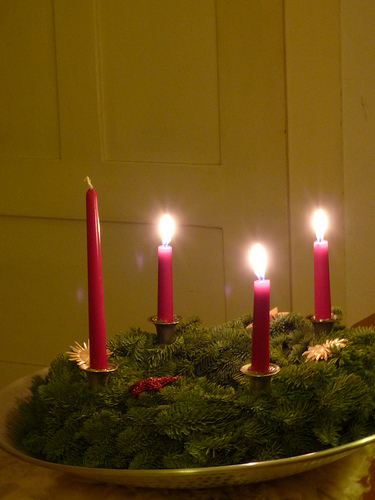
One of the great reminders that our observance of Advent brings, is that we have not been left alone to patiently endure until the Lord returns for us. As Paul wrote in the verse that precedes the passage above, every word of the Scriptures was written that we may be encouraged and have hope. Perusing those scriptures we find that we not only have hope from these words, we are surrounded with like hope in our family, community and church. We are both recipients and providers of this hope, from and to other Christians. Together, we look to the flame that edges closer to His coming with each week and together, we await his second arrival.

Paul uses the scriptures to remind the reader of a promise from years past that applied to them in that day, and which remains applicable to us in our hour:

“The Root of Jesse will spring up, one who will arise to rule over the nations; the Gentiles will hope in Him.” (15:12).

Jesus, the ‘Son of David’ is that root. He is the source and center of our hope. His life provides the model for our endurance and servanthood to others. Others within the church know the source of our hope. Our calling is to take that hope outside of the church and into the world, living lives that exude such joy and assurance that it sparks the spirit in others to seek out the fount of promise.

May the God of hope fill you with all joy and peace as you trust in him, so that you may overflow with hope by the power of the Holy Spirit. (v13)

Grace, peace and hope to you.

image Per Ola Wilberg

Advent Benediction of Five and Two

image“How many loaves do you have?” he asked. “Go and see".”

When they found out, they said, “Five—and two fish.” (Mark 6:38)


Provision to Bless Others

God Bless you brothers and sister of the Lord Jesus Christ.


May you look into you hands and know the fullness of His provision.

Where others see five tiny loaves, barely enough for one’s meal,

may you opened eyes see baskets overflowing with your daily bread,

as well as bread for others.


May you raise the two tiny fish from your basket up to Heaven

and give thanks to the Father who supplies just what you need today.


Be blessed by the God of provision,

who gives to you this day

so that you need not worry for tomorrow.


Amen


The Lord bless you and keep you.

image the Justified Sinner

Discovering “A Praying Life” by Paul Miller

imageA Praying Life arrived in my mailbox unbidden, but divinely well timed. In a box of books sent from NavPress in satisfaction of an old subscription to their discipleship journal that had ceased publication, Miller’s book was on the bottom of the stack and unremarkable in its cover art. The gifts were distributed among friends and family, but I placed this book on the shelf to be read at some undetermined date. It wasn’t to be a long wait however, as something moved me to insert this into my reading rotation immediately. I’m very glad I did.

Paul Miller’s A Praying Life is simply a prayer guide for the majority of the modern church, most of whom do not have a regular time of communion with God. It is not a program, a method or a theological dissertation. Instead, Miller’s approach is to aimed square at the heart of the Christ follower who has shied away from prayer because he believes that it is too hard or time consuming. He speaks from the heart of a harried, burdened Christian who also stumbles and teaches the reader that prayer is not simply an appointment to be kept. It is a way of life that can become as natural as breathing.

Many in the Christian community keep themselves from prayer because they see the challenges as insurmountable. The literature on prayer is wide and deep, and depending on the books that you select, it is easy to become discouraged and turn away from the practice. Picking up Bounds, you look at your life and wonder how you would find hours per day to pray. Hybels sets out a formula (ACTS) that is perfect for some but constraining for others who attempt to steer the thoughts of their heart into the framework instead of pouring them out to God. Foster gives us 21 types of prayers, all biblical and wonderful but a challenge for the Christian to remember and apply on a daily basis. Each of the authors has enriched my life, but I find it difficult to recommend them to the majority of Christians I come in contact with.

Miller takes a different approach to the privilege of prayer. He begins our discipleship in the art of prayer by turning us back to our childhood and encouraging us to speak to our heavenly Father in the same, open, unguarded fashion we once spoke to our earthly fathers. We didn’t worry about form and just told him what was on our minds. Why would God be any different? Beginning in this way we learn to crave the time with Him, worrying less about content and simply develop a comfort in the moments spent together. Without this foundation, Christians find it difficult to develop a more mature approach to prayer.

Prayer is hard, as is life as a child of God. Our Father says no, He has periods of silence that stretch for months on end and He can call us to obedience in ways that we wrestle against in resentment. It is easy for us to remember the chapters of the Bible in which prayer is immediately answered in a positive way, yet we are quick to forget the dark night in Gethsemane where the Lord cried out for His Father to take the cup from in but received a no in response. By intertwining experiences from his own life, Miller helps us to get over this hurdle that stops many Christians in their attempts to build a life of prayer. He shows that answers may not come, they may be no or that the answer may be several years separated from the supplication. The foundation that he built in the initial pages supports the broken heart of those disappointments and long winters of wait.

Whether you posses shelves of books on prayer or are seeking a new start, A Praying Life is an outstanding book to include in your library. You will read it once and be immediately moved to read it again at a slower pace, seeing and considering the parallels between your own life and that of Mr. Miller’s. This is prayer guide that should become a part of many church discipleship programs.

Watching the Skies–First Sunday of Advent 2010

imageWhen these things begin to take place, stand up and lift up your heads, because your redemption is drawing near. (Lk 21:28)

Without the calendar, and especially the Church calendar, we would be hard pressed to know the beginning of Advent. As the commercialization of Christmas has increased, the start of the season has become an artificial demarcation. The start of the ‘holiday season’ creeps further back on the pages of the calendar, with some outlets beginning to display the colors and icons of Christmas around the end of October. Thanksgiving becomes a speed-bump in the path of the gift-rush steamroller.

These false signs have an effect on us. Few are moved to shop anymore simply by the appearance of red and green replacing the oranges, auburns and browns of autumn. Fewer still see these signs as a welcome reminder of the joy of Christmas. Our senses are dulled by the barrage, hardened because of the attempted to deceit,  temporarily blinded by the fast-cut commercials and blinking LED reindeer noses.

Advent is the Church’s reminder of the Kingdom that came and makes it dwelling amongst us. Our reading for this year comes first from Saint Luke. The doctor records the Lord’s insistence that we be ever watchful for signs of the kingdom. He gave the analogy of the trees, say “Look at the fig tree and all the trees. When they sprout leaves, you can see for yourselves and know that summer is near.” (vv 29b-30) Likewise, He explained, if we are watchful and knowledgeable about the signs of an impending change in the season of our relationship with Him, we will not be caught unaware.

The world threatens to dull our sensitivity to the signs of the Kingdom. Whether it be God speaking to us through another person, a book or the movement of the leaves in the trees, the noise and busyness of our lives can drown out that quiet voice. Other signs are hidden from us as our vision tires from the constant stream of images we take in, good and bad. Without seeing the signs, our ability to raise our hands in celebration is limited.

Let us quiet our celebration this year. Spend some time looking into the flickering Advent flame rather than the Christmas lights. Reread favorite Scriptures and listen for the voice of God. When we see and hear clearly, our chances of noticing the signs of the Kingdom around us increase tenfold. Seek out and praise the Lord for the intimacy of His presence in your life.


Grace and peace to you.

image Per Ola Wilberg

All That Needs To Be Said

image

Psalm 100

A psalm. For giving thanks.


Shout for joy to the Lord, all the earth.

Worship the Lord with gladness; come before Him with joyful songs.

Know that the Lord is God.

It is He who made us, and we are his; we are His people, the sheep of his pasture.


Enter his gates with thanksgiving and his courts with praise;

give thanks to Him and praise His name.

For the Lord is good and his love endures forever;

His faithfulness continues through all generations.


Bless and be blessed.

Psalm 90–Establish the Work of Our Hands

imageMake us glad for as many days as you have afflicted us. (Ps 90:15)

People with unrealistic expectations or an outlook that is unfettered by the reality of scriptures portray a life that is without difficulty. In their view, the seventy, eighty or ninety years of life we are given is to be one great, long carnival of corn dogs and tilt-a-whirls. Adventure and sensual pleasures day after day without any hint of trouble shadowing the fun. Your best life now is not being lived right if adversity shows its face.

On the other hand, those of us with a more grounded view of life know that trouble and satisfaction go hand in hand in this life. We live in a fallen world in which sin has woven its way into the very fabric of life, leaving nothing untouched. The psalmist expresses this reality in Psalm 90, contrasting the brevity of life with the ongoing struggle that seems to mark it. Why God, he exclaims, why can’t you provide a little more balance of pleasure to pain to lessen the agony?

This psalm must be read in tandem with its brother, Psalm 91. They are two sides of the same coin. One vents a frustration with ongoing anxiety, the other expresses the knowledge that security is found only in the Lord. The balance between the good and bad of life is centered in the trust that the God of the universe has everything well in hand. Any momentary pleasures or travail are simply a part of His unfolding plan. Difficult to accept in the midst of one and seemingly too brief in the other, when we center our being in Him, we trust that each has its purpose in the plan.

Grace and peace to you.


image squarewithin

Spiritual Rhythm by Mark Buchanan

imageIn the opening pages of Spiritual Rhythm, Pastor Mark Buchanan rehearses with us of the closing verses of Psalm 88. The closing verse especially–“the darkness is my closest friend.”—speaks to a spiritual darkness nearly as black as the afternoon at Golgotha. All that the psalmist had, or thought he had, is gone, and he cries to the darkness to explain why God has abandoned him here. Most Christians can identify with the bleakness evoked in that scripture, of knowing that moment when life has crashed down and crushed our souls. As our fingers weakly reach from the rubble for the hand of the Father, none is found. We find ourselves in a season of winter.

Buchanan echoes a well known theme similar to the conclusion drawn by the author of Ecclesiastes, that our lives can be viewed as a cycle of seasons. Just as our moods and behaviors differ from season to season as the weather changes, so also should our spiritual lives mirror the life-season we find ourselves in. An important distinction that the Pastor draws in the analogy is a difference in the length of the seasons. According to the calendar winter will last precisely 90 days; a spiritual winter may last an achingly long time or pass in a few weeks. This variability demands that we prepare for the eventuality of a sudden transition into a new season before it arrives.

Spiritual Rhythm combines a pastoral sensitivity aimed at helping the believer identify the spiritual cycles and a teacher’s heart for training the disciple. In the same way that we anticipate the season to follow our present experience and prepare for it, Buchanan suggests that our spiritual disciplines should prepare for us the coming seasonal transition. Without this preparation, he says, we may find ourselves cursing the darkness rather than being able to thank God for it.

Pastor Buchanan engages the reader in the book as he has in his previous volumes. With a pastoral sensitivity and an ear for the proper personal interlude, Mark speaks to the reader as closely as your own pastor would and in a way that only a trusted associate can. He does not speak from the lofty pulpit of theological precept. Rather, he leads us to search the scriptures to find the nuggets that may not preach well but become the pearls that we jot in our journals or remember long after the book is returned to the shelf. Men will be particularly touched by the volume as Buchanan willingly visits and revisits the heart-rending pain of the lost of his friend and co-pastor Carol, expressing his pain and sorrow with complete abandon that many men strive to hide beneath layers of false machismo. A man who is especially observant will also never forget the name Abishai again.

Spiritual Rhythm is a volume that reads fast, but is one that you will want to linger on and savor. The temptation will be strong to turn this into a small group curriculum, but this material and the spiritual exercises lend themselves more to personal practice. Unless all of the members of a cell found themselves in the same spiritual season at the same time, the needs of all of the individuals would more often than not find themselves in conflict. Spend time with this book on your own and align your actions to your current season. Never again will you be anxious at an approaching transition.

I’m grateful to Zondervan who graciously provided this copy for review.

Psalm 89–Love and Faithfulness Go Before You

image

O Lord, where is your former great love, which in your faithfulness you swore to David? (Ps 89:50)

Like so many of psalms we have read before this entry, we could easily substitute our own name in place of the king’s. When we enter a season of spiritual winter, or even encounter travail in the otherwise sunny seasons, our tendency is look upward and outward rather than inward, in order to comprehend the perceived lack of love from the Father. Cries of “why are You doing this to me?” fill our prayers and thoughts. We labor to align the ‘promises’ of our faith with dark chasms that we suddenly have to cross. We Christians are prone to disillusionment in far greater percentage than the unbelieving souls around us. 

Perhaps, this is because we have not developed a mature understanding of the promises of God.

Psalm 89 turns on verse 38. After rehearsing the greatness of God and reciting the promises of the covenant made with David, the psalmist points a finger at the sky and speaks aloud his accusations.

But you have reject, you have spurned, you have been very angry with your anointed one.

You have renounced the covenant with your servant and have defiled his crown in the dust. (vv 38-39)

The temerity of the final accusation is fascinating and telling. The crown that God has ‘defiled’ was formed, shaped, adorned, fitted and assigned by Him! It is His crown, only temporarily assigned to a mortal creature and conditionally, at that. The poet fails to include the countless failures and apostasies that God has endured within the kingdom he promised his love to. His expectation is wholly out of line with the covenant agreement and yet, he does not hesitate to ponder out loud why God has ‘failed’ to uphold his end of the bargain.

We will rarely know what greater good our seasons of struggle are intended to for. Our first thoughts should turn inward toward our own sin and breaches of love with God. Is this a time of discipline that is meant for correction? Be a good student and allow the Tutor to reform your heart. If the spirit does not bring sin to mind, search the Scriptures and find all those who struggled through similar circumstances. Their roles, however minor, in the greater span of the Kingdom give us hope that our pain is not wasted. God does and will turn all things for good. Count on that before raising your next accusation to the sky.


Grace and peace to you.

image Krystn Palmer

Psalm 88–The Darkness is My Closest Friend

image

Your wrath has swept over me; your terrors have destroyed me.

All day long they surround me like a flood; they have completely engulfed me.

You have taken my companions and loved one from me;

the darkness is my closest friend. (Ps 88: 16-18)

The psalter contains numerous pleas for restoration, salvation and redemption but none as bleak as this. The psalmist lives a life, as it were, knowing only the dark side of God’s presence. Unlike Job who once knew a life of blessing, the psalmist here describes a life of pain and affliction from birth to the day he pens this scroll. The tragedy of his life is of such a degree that it is finally responsible for driving away even his loved ones and companions as he lives with one foot constantly at the edge of the grave.

The casual bible reader will quickly sift through these verses, reading forward to find more uplifting passages, but this would be a mistake.

Individual purpose is never easy to discern with our limited mindset. Why God would burden one of his beloved with such difficulty without respite is beyond our ability understand. And yet, we are called by the scriptures to endure, and even find joy in our travail, trusting that our pain and the darkness we inhabit has a larger purpose in His plan. Our response often echoes the despair that rings in these verses.

But I cry to you for help, O Lord; in the morning my prayer comes before you. 

Why, O Lord, do you reject me and hide your face from me? (vv 13-14)

This is a familiar frustration, that of the prayer that does not reach its audience. We plead and cry out but silence and pain are the only responses we receive. The Tempter whispers in our ear to surrender, to give up the belief that relief is at hand and to curse the One who visits it upon us. We come close, but we cannot do it. God will redeem this pain and bring light to this darkness. It may not be until we have left this plane, but it will occur. So we continue, like the psalmist, to raise our voice…

I call to you, O Lord, every day; I spread out my hands to you. (v9b)


Grace and peace to you.

image Ozan Ozan