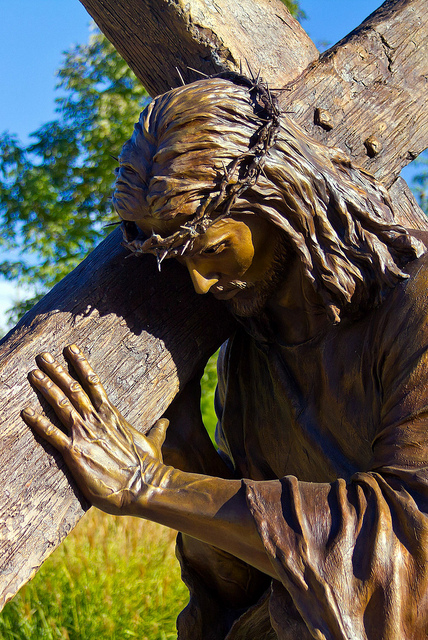
Facing Calvary Five : Satisfaction

Lenten Reflections Anno Domini Nostri Iesu Christi 2012

imageEmil Brunner suggests a duality in God that is appropriate for our reflection during this Lenten season. We are fond of the oft-repeated aphorism God is love. It is a truth borne out in Scripture (1 John 4) but it is also a truth that seems foreign the closer our proximity to the Golgotha hill.

Why would a God of love demand such a price?

In challenging this simplistic assertion, Brunner states that “God is not simply Love. The nature of God cannot be exhaustively stated in one single word.” Our dilemma arises as we gaze upon the broken body of the savior hanging from the beam, all the while knowing that God’s wrath demands this unimaginable price. God is love and wrath, simultaneously.

Brunner continues, saying that the Cross of Christ “is the event in which God makes known his holiness and his love simultaneously, in one event, in an absolute manner.” Whatever our understanding of atonement, it must take this duality into consideration.

Emil Brunner, Mediator

Grace and peace to you in the Name of the One who is over all and through all and in all.

image Charles Stirton

Facing Calvary Four : Sin and the Need for Atonement

Lenten Reflections Anno Domini Nostri Iesu Christi 2012

image

Why doesn’t God just forgive everybody?

Why indeed? Why was it necessary that the Divine Lamb to die in such a horrific manner to appease the wrath of God? This question and thousands like it have been voiced by believers through the years, often with poorly formed answers and a surfeit of resulting fruit. This question and the thousands like it also reveal the inadequacy of our understanding of atonement. The direct answer to the question is jarring:

Because of your sin, its depth, severity and continued existence.

Let that sink in and your mind races with denial and justification for your personal sinfulness. Certainly, your heart tells you, your sin cannot possibly be that bad! Oh, I might do this or that every once in a while, and occasionally I slip up in this area but I’m a pretty good person. This isn’t a new attitude, though its depth sometimes appears to have historical measure. Few are the Christians who wrestle with the true nature of their fallen souls. Fewer still are the numbers who stand their sin against the absolute holiness of God.

You see, only when we fully comprehend the perfection of God’s holiness can we begin to form a theology of atonement. Only when we have heard from the Spirit how God sees any sin, large or small, as horrific can we even start to understand the answer to our initial question. Only when we understand that God Almighty cannot be in the presence of even the slightest hint of sin can we start to see why the blood sacrifice of the Son was necessary. Only then will we ask the right question,

Can God be in my presence?

Grace and peace to you in the Name of the One who is over all and through all and in all.

image pinkMoose

Burial Cloth and Neatness

The Jesus We Missed by Patrick Henry Reardon

imageThe folding of the kerchief may have been completely unconscious. I do not find this hard to believe. The universal Christ, the eternal Word in whom all things subsist, was still the same Jesus to whom an act of elementary neatness came naturally.

It was in reading these words in the closing paragraphs of The Jesus We Missed that the import of the book finally took hold. The humanity of Christ, while a matter of theological discussion through the centuries, is rarely given the biographical treatment that we read on these pages. Is it important? I believe yes, because the full picture of the God-man Jesus is incomplete unless the full measure of his humanity is realized and taken into account alongside of His words and actions.

Jesus was not God simply inhabiting a human form. He was God who willingly made himself nothing by taking the very nature of a servant, being made in human likeness (Phil 2:7). He was not an infant who simply pretended not to comprehend the voices around him, Jesus was the helpless babe in the feed trough. He was the terrible two-year-old, the rebellious teenager, the young man full of strength and possessing the craftsmen’s hands.

And He was God, knowing an intimate relationship with the heavenly Father that we are called to emulate in the days preceding His return.

Reardon’s excellent book is not a casual read. It demands consideration on every page of the human nature of the Savior. In doing so, the reader is awakened to the senses of sight, smell and hearing in the fully-man Jesus. Events that often take on an other-worldly character when we forget His humanity are viewed in a different light as you consider scriptural hints that you may have skimmed in the past. The human portrait that Reardon paints is an encouragement to the reader in addition to its edification. Jesus relied on prayer to know the Father and His will and God used that open conduit to guide the Son’s steps. Has He promised anything less to us?

The Jesus We Missed will challenge you. It is written for the non-theological reader but that doesn’t make it a breezy read. You will be stopped on page after page as you find facets of the Lord that you had not considered in your travels through the Bible. Don’t hesitate to put the book down and pick up the Scriptures. The expanded perspective is well worth the time.

I am grateful to Thomas Nelson who provided this copy for review.

Facing Cavalry Three

Lenten Reflections Anno Domini Nostri Iesu Christi 2012

image

The late John Stott points out three truths encapsulated in the Cross:

– Our sin must be extremely horrible. The weight of our sin is revealed in the horror of the Cross.

– God’s love must be wonderful beyond comparison. He could have rightly abandoned us to our fate yet he redeems us.

– Christ’s salvation must be a free gift. It was purchased by His blood. This leaves nothing for us to “do.”

Three simple truths that form the foundation of a life in Christ. Three simple truths that highlight our true condition before God. Three simple truths that cause us to reflect on the complexity that we build into our faith in order to avoid confronting the reality of our fallen condition.

Grace and peace from the One who is over all and through all and in all.

image by photo dean

Holding Treasure in Open Hands

The Treasure Principle by Randy Alcorn

image

Quite simply, you cannot argue with this book. It is simultaneously convicting and edifying as the Treasure Principle does not come from the mind of Brother Alcorn, it comes directly from the Scriptures. Ultimately, the reader cannot arrive at any conclusion other than everything we treasure belongs to God and we are but managers of this treasure during our fleeting days in this world. Once that attitude has come set in the believers mind, behavioral change is soon to follow.

Unlike other books on this topic, Alcorn uses just a handful of application illustrations of a personal nature. This is not a ‘name it and claim it’ guide nor is it a strategy for managing your wealth for greater return. It is, on the other hand, an exemplary survey of the what the Bible has to say about the handling and giving of God’s wealth that he entrusts to his people. Randy organizes a series of principles under the guiding light you can’t take it with you – but you can send it on ahead.

You will read this book in a couple of hours but you will spend many days and weeks thinking about the principles. Inarguable, you are confronted with the uncomfortable truths that the Spirit will use to prick your conscience as He realigns your priorities. Only the most callous will walk away from the book unmoved. Others will carefully and prayerfully review the true object of their heart and begin to make the necessary adjustments.

I am grateful to Multnomah Books who provided this copy for review.

Facing Calvary Two

Lenten Reflections Anno Domini Nostri Iesu Christi 2012

image

Often seen only as a season of remembrance meant to enhance the meaning of Easter, Lent is also a time of association. Many vicariously associate their voluntary deprivation with the suffering of the Lord, but it need not stop there. One of the primary areas of investigation has to do with answering the question, why did Jesus die?

Some will answer quickly that He died at the hands of murders. Pilate, the Jewish authorities, the Roman soldiers who perform the act are all culpable. The soldiers are certainly not innocent but cannot be said to be guilty, since after all, they were just following orders and to disobey would have meant their own demise. Pilate bears a bit more of the guilt, though his feeble attempts to disavow any guilt by washing his bloodied hands attempt to point the accusations elsewhere. The Jewish leaders who initiated the process through their false accusations and provacative claims? They wear a bit more of Christ’s blood on their hands as it was their threatened egos that propelled him on the way to His death.

You and I are guilty as well.

We have the same desire to “get rid” of Jesus today as he interferes with out desire to exercise Lordship over our own lives. He intrudes at the most inopportune times and demands that we give Him worship we would rather slavish on ourselves. He is as much a rival to our Ego today as He was to the insecure leaders of the first century. Stott puts it this way, “There is blood on our hands. Before we can begin to see the cross as something done for us (leading us to faith and worship), we have to see it as something done by us (leading us to repentance).”

Grace and peace from the One who is over all and through all and in all.

image 50% Chance of Rain

Psalm 113 ~ Distances

image

Who is like the Lord our God, the One who sits enthroned on high, who stoops down to look on the heavens and the earth? Psalm 113:5-6

In this brief recital of God’s great glory, the careful reader notes the psalmist’s use of contrast in the verses. As you read and meditate on the verses you are struck by the various ‘distances’ that bookend the effusive worship.

Let the name of the Lord be praised, both now and forevermore. (v2)

From the rising of the sun to the place where it sets, (v3)

the One who sits on high, who stoops down to look (v6)

He raises the poor from the dust (v7)

The God of All, seated in the Heavens surveying all in His domain is also the intimate God. He is seated next to you in trouble, He is present in His full glory no matter the distance we attempt to place between us. He is timeless; there was, is, and never will be, a time in which we are not His beloved. Bending a knee in humble adoration does not call Him screaming across the heavens to be with us, He is already present, His heart overflowing with love.

In our Lenten reflections we focus on the redemption that has transformed our lives. This same distance applies to our forgiven sins..

Let our sins be forgiven and forgotten, both now and forevermore..

Let us walk in the light of God’s glory from the rising of the sun to the time at which it sets..

Let us be mindful of the One who sits on high, who desires to look down on lives of holiness..

Let us remember always that we are the poor and lost who He raised from the dust…


Grace and peace to you..

image Horia Varlan

Facing Calvary

Lenten Reflections Anno Domini Nostri Iesu Christi 2012

image

Unlike the anticipation of the Advent season where the focus is on new birth and the manger, Lent leads our thoughts inexorably to the cross. The crucifix often becomes invisible to us when we see jewelry and other decorations fashioned in the cruciform shape. We take for granted that it is situated in a prominent place in our sanctuaries and often fail to register its significance as our eyes survey the space on Sunday mornings. A visitor to one of the grand cathedrals of historic Christianity would be confronted the cross adorning everything at every turn but left to wonder, why the cross? Why has the Savior’s death furnishing become symbolic of the faith of hope?

The answer to this question is simple..and complex. The death of Jesus Christ and His subsequent resurrection are the key elements of the gospel; without them one came preaching good news but left us wondering. Escaping the confinement of the tomb on that first Easter morning dismissed all doubt. Sin had extracted a terrible toll but hope brought a new radiance as the living Savior showed himself having overcome the greatest fear of humanity, death.

Reflecting on the empty cross reminds us of both the cost of redemption and the hope brought about by not having to face the debt ourselves. We have about six weeks in which to prepare ourselves spiritually for the celebration of the resurrected Christ. We will keep the cross in front of us and reflect on it in depth so that when the beauty of the draped cross confronts us on Easter morning we will never again be tempted to take it for granted.

Grace and peace from the One who is over all and through all and in all.

image resclassic2

How Long Will You Love Your Simple Ways?

The Richest Man Who Ever Lived by Steven K. Scott

image How much better to get wisdom than gold,
         to choose understanding rather than silver! Proverbs 16:16

Scott’s book comes to the reader presenting an attractive idea; follow and apply each of the hundreds of proverbs to your life and you will be the beneficiary of untold success and wealth. As the author intertwines his stories of financial success and vignettes of nearly every rich person on earth with the proverbs, he intimates that by simply following these wise rules you too can become unimaginably wealthy. What appears to be missing from the consideration of the proverbs is their source.

That night God appeared to Solomon and said to him, “Ask for whatever you want me to give you.” Solomon answered God, …”Give me wisdom and knowledge, that I may lead this people.” (2 Chron 1:7,10) Though Solomon is credited with writing this book of wisdom, its source is undeniably divine. Missing from this book until the very end is any mention of the need to trust in God as the foundation to any endeavor. For the multitude of believers through the centuries who have lived without wealth and success, who even gave their lives for their belief in God, this is an inexcusable omission.

Steven Scott’s enthusiasm is understandable. It would appear that he has been richly blessed with material success. In each story of triumph or failure, he attributes the outcome to the application or ignorance of a particular proverbial concept. In reading the chapters, one begins to get the sense that Solomon’s sayings are conformed to fit Scott’s concepts of business or used to explain those times of need. He utilizes a very loose interpretive scheme, utilizing multiple translations of the Bible to get just the wording that he needs to make his point. (Review his use of the oft-mistranslated and misinterpreted Proverbs 29:18.)

Solomon’s secret to wealth, happiness and success was simple: trust in God and lean not on his own understanding. Perhaps brother Scott could benefit from a review of Proverbs 11:2.

I am grateful to Waterbrook Press who provided this copy for review.

Psalm 112 ~ His Heart is Steadfast

image

Surely he will never be shaken; a righteous man will be remembered forever. Psalm 112:6

The psalter can be a challenge to understand in some cases. We must read with the eyes of those who first received the psalms while applying to our lives many centuries past, not always the easiest task. In other cases, the inspired phrasing of the Psalmist make his intent crystal clear. Such is the message of Psalm 112.

The Lord is praised by the life of a godly man. Praise without the need for words is lifted by the God-honoring life of those who fear the Lord and obey Him. Those who pay notice to their abundant lives see no other explanation except divine favor. The just and compassionate fear nothing of men, knowing that they live in the light.

Their hearts are secure, they will have no fear; in the end they will look in triumph on their foes. They have freely scattered their gifts to the poor, their righteousness endures forever; their horn will be lifted high in honor. (vv 8-9)

There is no place other than in the light of the Lord for man to be.

Grace and peace to your soul…

image sillydog