This is a print of the lonely Point Loma lighthouse near San Diego. Before the city encroached on this peninsula, the keeper would go days, maybe weeks, without any contact from the people of the mainland. I could think of worse places to meditate, here looking out over the boundless Pacific.
Contributions of the Asian Church
A theologian who I have read and respected for some time, Simon Chan, is interviewed in the June 2007 issue of Christianity Today. The theme of the piece is missional theology and one question in particular challenged some long held beliefs about ethnic churches. The interviewer, Andy Crouch, asks What does the Asian church have to contribute to our understanding of discipleship and mission?
I believe the traditional Asian family structure, with its emphasis on extended family and authority within the family, could be very helpful to the Western church and its tendency to atomize the Christian community into autonomous individuals. Western people have great difficulty understanding that a hierarchical structure is not necessarily opposed to individual freedom. They tend to think of hierarchy as an arrangement of domination. But that is not the way we see it in Asia.
There is much to be said for a restoration of the community ethic within our churches. Perhaps too much emphasis has been placed on the idea of our ‘personal’ relationship with Christ, damaging the notion that we are created for community and hindering our acquisition of the theology that derives from it.
The Secret – Hidden in Plain Sight
… is Hidden in Plain Sight according to author Mark Buchanan. The Secret is not to get more of yourself and your thoughts into your life, the secret of more is to have more God in your life. Buchanan gives us an eminently practical book about practicing virtue, but with a twist. What he discovers in this exposition based on Peter’s second letter, verses 1:1-9 is that the pursuit of virtue is not the ever constricting legalism that we often see it portrayed as but rather, a freeing, energizing journey meant to give us life in abundance beyond our wildest dreams.
Peter begins the passage by pointing out that the followers of Jesus already possess everything they could possibly need for life and godliness. There is no further education, ritual, or secret handshake – everything you need has already been given to you by the Lord and the indwelling Spirit. Everything you need to have the full, rich, abundant life that you’ve always wanted is yours, all you have to do is recognize it, take hold of it and live. On top of the life that you’ve dreamed of, God offers more as we make every effort to add the seven virtues that follow to this already charmed life.
Buchanan does his usual excellent job of talking about the seven virtues that give us more – goodness, knowledge, self-control, perseverance, godliness, brotherly kindness, and love. Each chapter is a joy to mull over rather than an instruction manual to be followed. Sometimes we see our shortcomings while other times we are pleasantly surprised to see how far we’ve come as we turn the pages. Mark shows his pastoral heart and a good deal of transparency as the words flow from page to page and suddenly, in too short a time, the book ends. It leaves you wanting more, and God is only too willing to meet you in prayer and grant your wishes.
Now that you know the Secret, you won’t have to buy that other book.
Friday is for Rawk! IV (on Saturday)
Lemmy from Motorhead at the Warfield Theater, San Francisco. This might have been around his 80th birthday, but I can’t be sure. This show was especially memorable, not just because we saw a septugenarian playing a Rickenbacker, but because of the incredible sound pressure that was generated inside the aging show house. I have been to way too many shows through the years but this was easily the loudest concert I have ever heard. Taking picutres was difficult as you got closer to the stage because the sound was vibrating the camera so much as to make focussing difficult. Rawk awn!
Pink is the New Wednesday Beauty
Defining Religion in America
Later this summer, I’m teaching a section of Religion in America in our Themes in Religion and Culture curriculum. The course examines the intersection of various religious traditions and the pluralistic culture of America to see how each contributes and affects the cultural religion of this society. In order to contribute to this discussion, students will need to be clear on the boundaries created by their personal definition of religion and cultural religion. Since many very smart people drop by here from time to time, I would like to enlist your help. Can you provide a definition for both of these terms?
Hidden Hope
I’m preaching from John chapter one this morning and there is a passage which offers much hope to those of us who have prayed and shared and done everything we could to brings friends and family to Christ without any outward signs of movement. When Jesus runs into the skeptical Nathanael (“can anything good come from Nazareth?”) he sees something that we don’t. He sees that the Spirit has already been at work in Nate and that his heart has already turned toward the Messiah. Philip who shared his witness with Nate sure didn’t see it and his outward behavior sure doesn’t show it but Jesus knows it.
You and I never know how the Spirit is working in someone but the Lord does. Trust Him and take hope that He will leave none of His own behind.
Be blessed
Failing to Share
We’ve all found ourselves in the situation described by Andrea at her blog where we don’t follow the scripted way of sharing the Truth with our friends or loved ones. Do you find yourself ashamed and disheartened, seeing your efforts at failure or do you trust God enough to work through your frailties and make His own truth known?
Seaworthy by T.R. Pearson
Adrift with William Willis in the Golden Age of Rafting
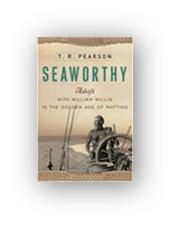
I live torn between my two landscape loves, the mountains and the oceans but when it comes to literary choices, I’m a sucker for anything that occurs out on the wide open seas, particularly in a wind-driven craft. The photograph that graces the cover of Seaworthy of an emaciated, but whip strong, William Willis guiding one of his handmade craft out on the loneliness of the ocean is all by itself enough to draw me in. The story the lies between the covers is an adventure like you’ve never read, mostly because Willis embarks upon the solo ocean journeys voluntarily and often against the advice of friends and family. The novelist T.R. Pearson takes us along onboard the various ships and into the various ports of call that Willis visits, often making us feel the salt spray, the tumult of the tides, and the discomfort of being constantly damp.
The tale of William Willis is a little known bit of sailing lore, being the story of a man who at the age of 60 decides to cross the Pacific on a raft made of lashed together balsa logs alone. Unlike the better known Kon-Tiki expedition years earlier which carried a crew and an anthropological objective, Willis made the decision to embark upon his voyage simply because he couldn’t sit still. A love for the open sea combined with an obvious inability to function normally in polite society ignited the passionate pursuit of the trip. Though his wife Teddy is vocally against the trip, she acquiesces too easily in the end, perhaps knowing the Willis has no mechanism within him to comprehend

the wisdom of his adventure.
Willis displays flashes of genius to temper his inability to complete his preparations or his need to face danger eye to eye. His days at sea are filled with mundane chores, care for his hernias, seeking peace with his shipmate animals, and questions about the wisdom of his endeavor. When we find ourselves in the chilly water with him after falling overboard, we along with Willis see the raft in the distance and wonder if this is the end, watching the raft lumber along ahead of him just out of reach. We wait cringing as he contemplates some shipboard exploratory surgery with whatever rusty implement he has at hand. We wonder why, in our own lives, we can’t summon the courage to do things just to do them and to prove our mettle only to ourselves.
Pearson takes the reader on two Pacific cruises filled with adventure; the second has Willis leaving port at the age of 70. His prose is an excellent transition from novel to non-fiction and the book is just right in its length. From his early prison break escapade to his last voyage across the Atlantic in a glorified rowboat, the reader is engaged in the life of a most interesting man. Little is said about his wife and we are left to wonder is she too was a bit of a vicarious adventurer, living through her companion and knowing the muse that drove him.
This is an excellent addition to your library. We can only hope that T.R. Pearson treats us to another real life tale somewhere down the line mixed in with his other storytelling.

Getting the Gospel Right: Restoring Community
Scot McKnight confronts our gospel of individuality and the problems that derive from it over at Out of Ur. He asks:
What then is Christian spirituality? It is the person who is restored to God, to self, to others and the world – all four directions for all time – by a gospel that emerges from a “communal God” (the Trinity) to create a community that reflects who God is. Do we preach a gospel that gives rise to holistic restoration and that can create a fully biblical spirituality?
The individuality-gospel that is found in many churches (maybe mine, maybe yours) not only has a damaging effect on our spiritual transformation, it is an incomplete representation of the God we serve. We lose the restored community facet of the good news when our gospel is personal alone. McKnight calls this gospel a parody – it’s painful to think of the label that applies to the poor pastor who presents this kind of message.
What I found intriguing in the light of some discussions I have been involved in this week is this:
Let us not suppose that any of these examples has simplistic explanations, but let us think a little more systemically: if we preach a gospel that is entirely focused on “getting right with God” but which does not include in that presentation that God’s intent is to form a community (the Church) in which restored persons live out this Christ-shaped and Spirit-directed spirituality, then we can expect to hear lots of pulpit rhetoric exhorting us that the Church matters. And, if we discover on Sunday morning that everyone in our church is the same ethnically and economically, we can be sure that we are preaching something that is attracting only those kinds of people. And if we are hesitant to admit the implication of this ethnic, economic reality, then we need to be more honest with ourselves. We get what we preach. And we perform what we preach. How we live reveals the gospel we responded to and the gospel we believe.
Read the whole post and chew on it a bit before responding. Better yet, let the Spirit guide your reading and see what comes of it.


