
Psalm 18 Pt 1 ~ The Lord is My Rock

I love you, O Lord, my strength.

The Lord is my rock, my fortress and my deliverer; my God is my rock, in whom I take refuge.He is my shield and the horn of my salvation, my stronghold.

I call to the Lord, who is worthy of praise, and I am saved from my enemies. ( vv 1 – 3 )

Such effusive praise is easily expressed in our moments of gratitude and joy as we revel in the grace that God has granted us in life. What of the more challenging times? Are we as able as David to continue to bless the Lord when it seems as though His hand has been withdrawn? The psalmist challenges our modern travails as he recounts his long running struggle with Saul.

There are three divisions to Psalm 18 and in the first David recounts the blessing of deliverance that God granted him from the hands of his enemies. He found himself as close to death as a human can be;

The cords of death entangled me; the torrents of destruction overwhelmed me.

The cords of the grave coiled around me; the snares of death confronted me. (vv 4-5)

but still his reaction, born of spiritual strength was to seek his redeemer;

In my distress I called to the Lord; I cried to my God for help.

From his temple he heard my voice; my cry came before his ears. (v 6)

Yahweh’s thunderous response is not measured and meek; he storms from heaven on the wings of the cherubim and whirling of the wind. Accompanied by lightning and the quaking of the mountains, God reaches down with his fist and scatters the enemies of His king. That same hand reaches out and pulls His beloved from the depths of his despair.

He reached down from on high and took hold of me; he drew me out of deep waters.

He rescued me from my powerful enemy, from my foes who were too strong for me.

They confronted me in the day of my disaster, but the Lord was my support.

He brought me out into a spacious place; he rescued me because he delighted in me. (vv 16 – 19)

You and I must trust that God would rush across the heavens to preserve us as well. This is one of the great challenges that we face but to continue to soak our souls in these words develops our David like confidence.

Life With God 8

imageThe life with God drives us to see what  could happen we are faithful doers of the Word rather than just hearers. As Foster begins to wind down his book Life With God, he is emphasizing the ‘why’ of spiritual transformation. He says that “ the quiet power of a life transformed by God is so explosive that it can redirect the course of human events.” When we are deeply enmeshed in a life lived in the immediate and intimate presence of God, we find ourselves with transformed inclinations. Our purposes are driven less and less by personal desire and worldly avarice and more by the subtle whispers that guide our fulfillment of God’s purposes through us.

Coming to this spiritual awareness is the purpose of the spiritual disciplines. Remember, the definition of discipline that we apply to our spiritual nature is the ability to do the right thing at the right time for the right reason. The spiritual practices are not intended for record keeping, that is, we are not rewarded by the measure of their exertion. Rather, the reward for the practice of spiritual disciplines comes in an increased sensitivity to the words of God through which He moves you to action. As Dallas Willard says, we are being prepared to enter a state of unthinking readiness in which we are able to respond despite pressures from outside to act otherwise. When the moment of action arrives, we  move in the Spirit without having to consider the possible societal implications of doing so.

There is a liberating truth that we can come to understand through study and focus on the lives of the saints that have gone before us such as John Woolman (pictured above.) The truth is that we do not become godly by trying to become godly. We become godly as our worldly habits are replaced by holy habits such as love, joy, peace, patience, and kindness. When our character is filled with these traits we will instinctively do the right thing at the right time for the right reason. Our practice of the Disciplines is not intended to change ourselves, that is God’s work. Rather, our practice is intended to open ourselves to His power so that the transformation may occur. This is the principle of indirection.

This principle works by addressing human character issues by attending purposely to the attending spiritual virtue. For example, pride is overcome by intentionally seeking out opportunities to serve others. Over time, this consistent practice puts us in a proper relationship with others, engendering humility within us. Paul mentions this intentional training in 1 Corinthians;

Do you not know that in a race the runners all compete, but only one receives the prize? Run in such a way that you may win it. Athletes exercise self-control in all things; they do it to receive a perishable wreath, but we an imperishable one. So I do not run aimlessly, nor do I box as though beating the air; but I punish my body and enslave it, so that after proclaiming to others I myself should not be disqualified. (1 Cor 9:24-27)

We do not train in the Spiritual Disciplines solely for the sake of training. We train for transformation. The key to this shift in our understanding is to remember that it is God that will provide the transformation, not our own efforts. We must become expectant of the change, sensitive to His whispers that slightly change our mechanics as a coach would do. All of our training and the resulting transformation of our character will reorient us for life in the kingdom of God and our thoughts and attitudes and our behaviors will gradually become radically different from what passes for normal in this world.

Now, that’s not such a bad thing, is it?

Psalm 17 ~ In Righteousness I Will See Your Face

The seventeenth psalm calls out to God in His role as the judge of righteousness. The psalmist cries out for judgment on himself and his enemies. Read that again. Not only does he point the Lord’s attention to his enemies so their wickedness can be noted and avenged, he calls for God to examine his own life as well.

Hear, O Lord, my righteous plea; listen to my cry. Give ear to my prayer – it does not rise from deceitful lips.

May vindication come from you; may your eyes see what is right. (vv 1 –2)

Would you and I be willing to invite the same scrutiny? The power to make this invitation comes from living the undivided life, one in which integrity is an integral component of the believer’s life. We do not live in secret a life different from the one we live in the light. We would be able to say:

Though you probe my heart and examine me at night, though you test me, you will find nothing; I have resolved that my mouth will not sin. (v 3)

Reading this psalm challenges us. Our lips might proclaim our innocence in comparison to others but our heart knows the truth. God knows the truth as well and will highlight our hypocrisy to its full extent the harder we beat our chests. We want to be in the position that the psalmist is, satisfied with the immediate presence of God and being able to express how much we cherish God. Pray that we might all be so blessed.

Psalms 9 & 10 – The Lord is Known by His Justice

This pair of psalms form a carefully constructed prayer of praise for both the glory of the Lord and David’s trust in the righteous justice by which the universe is ruled. He begins with anticipatory praise, lifting Yahweh high as he looks forward to what will be visited on his enemies:

I will praise you, O Lord, with all my heart; I will tell of all your wonders.

I will be glad and rejoice in you; I will sing praise to your name, O Most High.

My enemies turn back; they stumble and perish before you. For you have upheld my right and my cause; you have sat on your throne, judging righteously. (vv 9:1 – 4)

The combined message of nine and ten is threefold; humility, limitation, and responsibility. From a human standpoint, not three of our favorite topics. To realize our humility is to recognize how little is truly under our control. No matter how high our position, when we set our own throne before that of the King we are yet again aware of how insignificant it is. When our humility fails us, we rebel against this King thinking ourselves higher than the Host. The warning is clear:

The nations have fallen into the pit they have dug; their feet are caught in the net they have hidden. The Lord is known by his justice; the wicked are ensnared by the work of their hands. (vv 9:15- 16)

If our perspective remains on the earthly plain, we can easily convince ourselves of how powerful we are. The humility engendered by an encounter with the Almighty leads us clearly to realize our limitations. David sees clearly that the authority granted him by the Lord can be used in terribly destructive ways:

In his arrogance the wicked man hunts down the weak, who are caught in the schemes he devises. He boasts of the cravings of his heart; he blesses the greedy and reviles the Lord. (vv 10:2-3)

Does the evil man filled with hubris get away with this arrogant behavior? Perhaps, for a time, but as we soak in the words of both of the psalms we return to the glorification that filled the first few verses. We trust and know, based on the ultimate goodness of our God, that righteousness will prevail.

Finally, the rapaciousness of the ‘enemies’ that lurk in the second of the two psalms is in direct contrast to the responsibility for creation that was assigned to the men and women who are to populate it. It is provided for our use but not to be plundered without concern. To do so is as much rebellion as denying the Creator His place and authority. Circling back to humility forces us to answer; are we enemies to any degree?

Psalm 6 – Personal Travail

Be merciful to me, Lord, for I am faint; O Lord, heal me, for my bones are in agony.

My soul is in anguish. How long, O Lord, how long? (vv 2-3)

Waiting on God for relief, for an answer, for direction, for anything is difficult because we measure time in the finite scope of minutes and hours and days. With each turn of the calendar or tick of the clock we see our patience tested as our agony continues. The psalmist give us the most personal psalm we have encountered yet in the collection. He is expressing the pain of his condition personally rather than as the voice of all people. His words express the personal relationship with his Lord in which he views himself. He knows that Yahweh will hear his personal plea amidst the voices of all of the people. This confidence encourages him to pray,

Turn, O Lord, and deliver me; save me because of your unfailing love.

The psalmist expresses his assurance that his condition will be addressed based on God’s love, his unfailing, unbreakable, unceasing love. Modern theology diminishes this aspect of God’s character but without the omnibenevolence, the other parts of His character can become lifeless. Knowing and expressing confidence in His unfailing love can lead us also to a new experience, becoming a psalmist ourselves. The love of God and His love for us is not fossilized in the pages of the psalms. You too can create psalms of your own, whether it be from deep personal agony as in this example or from the heights of praise that we see elsewhere. God is interested in hearing your prayer no matter what the source.

Gideon Pursues the Enemy

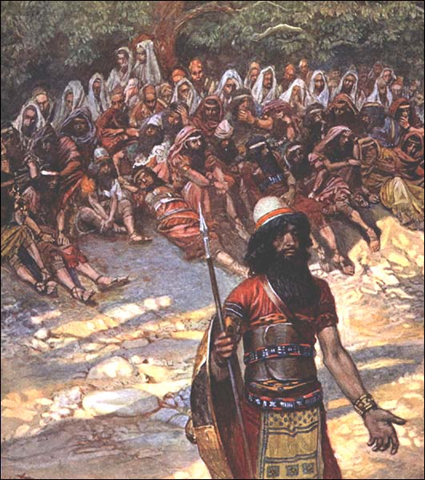
image The story of Gideon is a tale of faith, or the lack of faith. God pursued him to fulfill his purpose in restoring the relationship between Yahweh and Israel. Now, as Gideon pursues the enemy across the border territory of the Jordan. Exhausted but driven, the warriors of Israel pursue the enemy without stop. Needing sustenance to carry on the mission, Gideon asks the men of Succoth for bread to carry them further.

A lack of faith stops them cold.

A church leader faces this all the time. God will implant a vision and a call to the leader for a particular church to accomplish and yet, when the vision is presented to congregation, the naysayers raise the heads and begin to find reasons why that could not possibly be God’s call on that body. In one light, their hesitation is justified. It will cost too much money, it will damage the reputation of the church, it will never work, the carpet will get dirty. The moment of truth arrives for the leader; will they act in faith to God and his strength or give in to the church in fear for their position. Too often, we fall into the latter.

Gideon faced both the fear of the loss of reputation (Ephraim) and the concern for safety (Succoth) but kept his eyes focused on the purpose to which he was called. Did he wonder how Yahweh would ever redeem this people?

Jesus, Community Organizer – New Extra Large Size!

You shall not misuse the name of the Lord your God, for the Lord will not hold anyone guiltless who misuses his name. (Ex 20:7)

(Originally posted 11 September 2007)

The American political arena has been treated to yet one more attempt to lift one candidate to Messiah status while associating the other with an incompetent, indecisive, murderer. Donna Brazile, repeating a meme initiated by a Washington Post blogger, gave voice to the line “Jesus was a community organizer, Pontius Pilate was a governor.”

To correct the record, Jesus Christ was God. He is the atoning sacrifice for the sins of all humankind, as they will believe in Him. Jesus was in no way a community organizer in the model of Saul Alinsky, the mentor emeritus of community organizing. The Chicago stre

et agitator following Alinsky’s methods seeks to embed in the minds of the troubled that their condition is not their responsibility, it is the work of some oppressor above them. The organizer will invest as much effort as necessary to make the poor victims so angry with their perceived oppression that they rise up in direct action against those who hold them down. “Militant mass action…fueled by righteous anger.” as described by Dennis Jacobsen.

The Jesus of the Bible, on the other hand, commands a different loyalty. He speaks first of aligning oneself with the Father and His kingdom and then, in a reflection of the love of that kingdom, working to serve others in love. No mass violence; instead turning the other cheek also. Christ’s notion of social justice is to overcome by love and trust in the work of God, not radical mass action. Given the warning of the commandments above, perhaps we should be a bit more temperate in our allusions of a political figure to the Savior of humankind.

Update: It appears that Susan Sarandon received her lines a little bit late! She was parroting this decidedly unbiblical scripted dialogue yesterday AFTER Rep. Cohen delivered the line. Somebody’s head is going to roll for not delivering her script on time. Review here what biblical scholar Sarandon has to teach about Jesus.

STOP THE PRESSES!! The fourth estate senior spokespersons are just now getting their talking points about the similarity between the Savior of All Humankind and the community agitator. Tom Brokaw, the erudite theologian of record, demonstrated physical proof yesterday in the form of this recently unearthed coin of the future realm:

Aren’t there any grown ups in this group of people?

Reading the Skies

image

An odd event occurred last night as enjoyed a family meal together; out of nowhere, we heard the long building wail of the surrounding emergency warning sirens. Unlike the jarring, ever shifting emergency tones used by the police and fire department which immediately grab your attention and move you to some rapid response, the public warning doesn’t move us quite as quickly. How many people even notice the sound every Tuesday at 11:00 AM?

Why the slow reaction to the warning tones? Much of the passivity comes from two factors that creep into our lives and cultures. First, we become deaf to the sound, like a rattle in our cars that we have heard so often that we have tuned it out. Surrounded by constant noise and other distractions, the odd siren blends into the cacophony of life and doesn’t grab our immediate attention. The second reason that the siren has such little effect is that it tells us nothing without interpretation. Last night, as the siren reached its second crescendo, we followed the people on the surrounding streets out into the backyard. We looked at the thunderheads that had built through the day, scanning in all directions for anything unusual. No hail, no rain, no lightning – nothing but dark clouds and temperatures that had dipped into the pleasant 70s. We turned on the television to a local channel to see if there were any crawls and the talk radio stations continued the lead up to the baseball game. False alarm, who knows, maybe stars were going to fall from the sky.

So, why this observation? Our spiritual lives can become some cluttered by busyness or lack of attention that we can miss the warnings the Spirit springs within us. More importantly, when we do notice the sirens we need to be prepared to interpret the message rather than looking blankly about. Our time in the Bible and in prayer, and the wisdom that we attain by ingesting the teaching of others all contributes to the growth in our interpretive abilities. Our goal is to get the point where the leading edge of the wail causes us to move into action immediately, searching our thoughts and actions to determine exactly why the warning has come at this exact moment. Instead of running blindly outside only find mammoth hailstones falling from the sky, we can make life corrections without suffering the pain that comes from being soul-blind.