Life With God 3a – I AM The Bread of Life

image The ‘I Am’ passages in the book of John are good immersion points on which to meditate in seeking spiritual transformation. In these statements Jesus declares himself to us, encouraging and deepening our faith and our enhancing our ability to trust Him on a more mature basis. We become what we immerse ourselves in. The first is found in John 6:35;

“I am the bread of life. He who comes to me will never go hungry, and he who believes in me will never be thirsty.”

When we meditate on this verse in a non-theological sense, we hear the Lord speak and the Spirit move. We question the things that we pursue in life that sate only temporarily. We find nothing in our pursuit of food, sex, material things, feelings or challenges that results in anything but a momentary satisfaction that is soon followed by a desire to pursue more. Spiritual fulfillment replaces or subdues these fleeting desires with a permanent fulfillment. For sure, we will want more in the sense of going deeper but we will never hunger to fill the void in our souls that can only be filled by the Holy Spirit. 

Life With God 3

Give ear and come to me; hear me, that your soul may live. Isaiah 55:3

Richard Foster emphasizes the messy reality of the the “I am with you” Immanuel principle in chapter three of Life With God. Reading the Bible with this in mind, one of the transformative themes that we can derive is that the book does more than just tell us about the immediate presence of God. Instead it unfolds for us how embedded the Presence is in every aspect of human existence. Whether we are running toward or away from God, we cannot escape the truth of His pursuit. He calls out, “I am with you” and asks, “Will you be with me?”

Our struggle with Immanuel is often spelled out in the tension between two ideas. We comprehend our value to God in His pursuit of relationships with us and yet, when skies cloud over, we identify equally with the Psalmist’s lament “why, O Lord, do you stand far off? Why do you hide yourself in times of trouble? The space between these two poles is life guided by the choices that we make. In those choices is the ultimate act of spiritual formation, allowing God to perfect His will and His ways in our lives. In the pages of our Bible, we can see how the Living Word transforms countless other human beings and it speaks to us; surrender your will and come into relationship with me! In exercising our freedom to choose to trust in Christ, we open ourselves to transformation in the depths of life with God.

For spiritual formation, we want to read the Bible with two aims. First, we want to engage the story of God’s people who were immersed in God’s immediate presence, whether they were aware of it or not. We read of God pursuing relationship with His creations and of the blessings and consequences of choosing for or against this relationship. In fact we learn from those that have gone before us that turning back to God is not a mechanical transaction, not a rule to follow, it is a relationship.

The second aim that we want to approach the Bible with is hear God as he speaks to us through the Word. The stories that we read are replete with examples of failure and restoration. Human beings are not the most reliable partners in relationship and when we come to this realization it opens up a new horizon in how we view God. Because we are by nature fickle, the transformation that occurs in each of our spiritual lives is a unilateral commitment from our Father. He pursues and transforms. Our task to immerse ourselves in those things that can positively affect our character. It is at this level that the living Word works.

Foster refines this approach to a single statement for modern Christians in saying that the way into this life, the Immanuel life, is trusting in Jesus. The Lord’s words make it simple, “Don’t be afraid; just believe.” (Mark 5:36) Our call is to live the Kingdom life now and not just approach the faith as fire insurance. Our way into the fullness of this life is through character transformation, something that occurs when choose for life in relationships with the Lifegiver and when we immerse ourselves in the Word that changes us into what we were intended to be.

I would love to hear of your experiences of transformation. Have you found any particular scripture verses or story that were particularly meaningful in this process? Let’s share and grow together.

For Full Grown Men

Leonard Ravenhill wrote in December of 1961,

My old master, Samuel Chadwick, had some barbed phrases in his lectures, sermons, and talks. I can still hear his mellow voice saying, “Brethen [sic], the crying sin of the Church is her laziness after God.” Praying people, however, are not lazy. Prayer demands will power. Prayer recognizes unfinished business with and for God. Prayer is a battle for full-grown men, fully armed and fully awake to the possibilities of grace. I write here by constraint, for my spirit is sore, my heart sick at the slothfulness with which we tarry in prayer.

Psalm 5 – Lordship and Mercy

To reach out to God in praise is natural to most Christians. On some level, each of us is grateful for the sacrifice and salvation afforded us by the Creator of all and we find joy in proclaiming this gratitude in words of positive affirmation. We understand that praising God for His greatness, telling Him how wonderful He is is much different than the same interaction on a human level. God’s arrogance is not fed by our praise; our proper relationship to Him is. A common feature that we encounter in the psalms are words of praise, directly addressing God by crying out the magnitude of His awesome nature. Another feature that is more jarring to modern ears are the words that emphasize the fundamental nature of God, His absolute holiness.

You are not a God who takes pleasure in evil; with you the wicked cannot dwell.

The arrogant cannot stand in your presence; you hate all who do wrong. You destroy those who tell lies; bloodthirsty and deceitful men the Lord abhors. (vv 4 – 6)

How often do your prayers, personal or corporate, remind God of His holiness? The psalmist throws a wide net in these two verses that unsettles. “All who do wrong” are hated, lies bring abhorrence. To meditate on these statements brings nearly all of us to the realization that we can easily find ourselves falling into these wide, wide categories. Does the God we praise also hate us? The answer is found in next verses.

But I, by your great mercy, will come into your house; in reverence will I bow down toward your holy temple. (v7)

Only by the mercy of the One we praise can we approach the holy throne. The psalms contrast the people of mercy, God’s people, and those who choose against Him, His enemies. The contrast is less an ‘us and them’ statement as it is a recognition that we are sustained purely by the mercy that God offers. The line between the loved and unloved is very thin indeed. Praise Him.

But let all who take refuge in you be glad; let them ever sing for joy. Spread your protection over them, that those who love your name may rejoice in you.

For surely, O Lord, you bless the righteous; you surround them with your favor as with a shield. (vv 11-12)

Psalm 4 – Answer Me When I Call

How many times have our prayers started with a pleading before the throne?

Answer me when I call to you, O my righteous God. Give me relief from my distress; be merciful to me and hear my prayer. (v1)

A silence in response to our plea can be interpreted as God not hearing our prayers. Our inclination is to look to God and wonder why He ignores us. Shouldn’t we look within first? Is our relationship such that God is inclined to hear from us? Are we living in rebellion and in expectation that God hears us? Before we bank on his righteousness, that is, His promised response to those who love Him, we should be first concerned with the state of our relationship.

David speaks to his enemies in hopes that God hears the travails that he faces. They attack his reputation and disdain his God and still David tries to proclaim the truth to them.

Know that the Lord has set apart the godly for himself; the Lord will hear when I call to him. (v3)

And he beseeches them to put their trust in the right place, to understand that their anger is misplaced in the king. If they search their hearts, David’s enemies can trust that God is willing to reach out to them.

In your anger do not sin; when you are on your beds, search your hearts and be silent.

Offer right sacrifices and trust in the Lord. (vv4-5)

David closes with a cry to God to show His glory, to light the world. Seeing this glory would certainly change one’s perspective, how about yours?

Let the light of your face shine upon us, O Lord. You have filled my heart with greater joy than when their grain and new wine abound. (vv 6b-7)

David closes with a smile, knowing that he will rest peacefully. God may be momentarily silent, but He has things well in control.

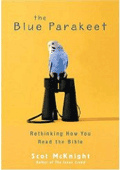
The Blue Parakeet by Scot McKnight

BlueParakeet

If you’ve read Scot McKnight’s blog Jesus Creed, you know that his work ranges far and wide but almost always centers on the meaning of Jesus in the context of living out our faith in the modern world. His books mirror this broad spectrum of application from drawing Mary back into Protestant life with The Real Mary to emphasizing the twin foci of love as the outcome of spiritual formation in The Jesus Creed.  McKnight’s latest offering is an outstanding entry in his library, moving Christians to consider the way in which they read the Bible. The Blue Parakeet is not a hermeneutics text, it is a challenge to manner in which we hear the words of the text. Is it a collection of ‘thou musts’ linked together by vignettes of human history or a lengthy and far-reaching story of God and His relationship with creation? Scot helps us to discover our initial viewpoint and then leads the reader to discover alternatives that help us to apply the Scriptures to a modern culture that is much different from the setting of the stories we read.

Central to Scot’s ideas throughout the book is the question, how does God speak to people through the Bible? We can read the text in a fossilized state, forever locking words in their first century (or earlier) context while trying to apply them to a twenty-first century culture or, as McKnight asks us, we can consider a broader reading of the Bible as themes that are universally applicable in each proceeding culture. In doing so, we can easily see that God spoke Moses’ days in Moses’ ways, in Jesus’ days in Jesus’ ways, in Paul’s days in Paul’s ways, and given that pattern it is reasonable to hear God speaking to us in our days in our ways. The themes and concepts of the Scriptures were meant to carry God’s words throughout every era of history, continually applicable to an ever-changing culture.

Blue Parakeet weaves an interesting path that leads to the development of discernment in the application of the Bible to our modern lives. Ever the professor, McKnight puts the preceding chapters to the test in applying the ideas to the contentious issue of women in ministry, devoting five full chapters to the subject. This section of the book cements the value of this work as it transfers the ideas that he presents in the early chapters from the abstract to the concrete, demonstrating how they can be applied to an issue. Will this methodology ruffle some feathers (no pun)? Certainly, but by reading the Scriptures as story rather than Torah we find each generation and culture challenges those that came before it and God remaining consistent throughout.

The Blue Parakeet was not written specifically for an academic audience but seminaries would do well to consider including this book alongside their selected hermeneutics text and How to Read the Bible for All Its Worth. As with all of Professor McKnight’s books, Parakeet is well written, organized and applicable. Like a well crafted sermon, each idea has appropriate illustrations and solid application for the reader to use in testing the viability of the proposition. Christian leaders and laypeople alike should spend time reading, discussing and applying this book. 

-oo-

I was privileged to receive an advance reader edition of this book prior to its release and I took a couple of weeks to read it slowly and savor the ideas in small sips. Scot McKnight has once again provided an invaluable contribution to the advancement of the Church and the faith and his style makes the book immediately accessible to every member of the Christian community.  I am going to begin a series of posts on the book, looking at each chapter on its own now that it has been released. It dovetails perfectly with another ongoing series I have been doing on Foster’s book Life with God. Both McKnight and Foster emphasize reading to hear; listening to the scriptures for God’s voice and his unique address to each one of us. What Scot contributes to this discussion is the emphasis on God speaking to us in our ways. Our application should then take cultural context into consideration in every move we make. I’ll look forward to interacting with other readers of the book in the weeks ahead.

Psalm 3 – I Wake Because You Wake Me

The first titled psalm in the psalter gives us an idea of the imminent threat that will influence many of the writings to come. There is danger all around and yet, the psalmist speaks from assurance and faith. His cry, O Lord, how many are my foes! How many rise up against me! Many are saying of me, “God will not deliver him” (v1-2) appears at first to be a challenge but reading quickly into the following verse shows that it was a just a set up so that he could proclaim his trust.

But you are a shield around me, O Lord; you bestow glory on me and lift up my head. To the Lord I cry aloud, and he answers me from his holy hill. (vv3-4)

Perhaps the depth of his trust is expressed in the next two verses. One who is facing death alone must be constantly vigilant lest the enemy descend in a moment of inattention. So great is his trust in the Lord that he sleeps soundly, knowing that he will be sustained through the night and awoken in the morning if his protector so deems it. In this trust, the psalmist has nothing to worry about or fear because anything that befalls him is a part of the Lord’s greater purpose.

We can know this peace despite the turmoil of our lives. It’s all rooted in trust and the one in whom we place that trust. Where’s yours?

Life With God 2

Approaching chapter two of Foster’s Life With God we may find ourselves tempted to skip past it. With its title, “Entering the world of the Bible”, our instincts as long time Bible readers is to guess that we have read all this before. We have been trained to remember context and literary genres and history and all of the other skills that we bring to a technical study of the Bible. What should prevent us from turning these pages too quickly is Foster’s core message of reading the Bible not just for knowledge, but for spiritual transformation. He poses this very question in introducing this section by asking what kind of attitude is most helpful to us in trying to apprehend the transformation that awaits in the Word.

Hint, it is not the mechanics.

The mechanics that we have learned feed our head and provide a guide for praxis but they do not necessarily engage the soul. Orthopraxy is the result of inner transformation, not just the expansion of one’s knowledge base. Jesus vehemently pointed out the bibliolatry of the Pharisees who were frozen in their mechanical devotion to the letter of the scripture:

You diligently study the Scriptures because you think that by them you possess eternal life. These are the Scriptures that testify about me, yet you refuse to come to me to have life. Jn 5:39-40

To avoid a similarly arid fate for ourselves, a different approach is called for with the aim of spiritual transformation. Foster recommends a trio of attitudes for entering the world of the Bible; we should seek to enter expectantly, attentively, and humbly. To enter the story of the Bible expectantly is enter fully anticipating an encounter with God. Reading the words is less about hearing the words replayed in our mind and more about the expectation of a dialogue between our soul and the Holy Spirit (cf. Rev 3:20). With the approach in mind, we become fully present to God in a way that transformation is now possible where in the process of memorization it is not. In the immediacy of that contact we engage more than the God that is written about and we find ourselves face to face with the living God as He is revealed through the Bible.

To come to the Bible attentively is to come in recognition that more than any other label that we apply to it, the Bible is a story. It is not neat and systematic, instead, it is an epic depiction of how works out His purposes through the messiness of human life. We see good and bad, trial and error, and success and failure and through all of it we see the triumph of God moving purposely to His ends. God certainly could have told His story in the form of a systematic theology but the temptation would be to gather the knowledge and then move back to a position of self reliance. Instead, Foster observes, God has made the story difficult so that we must rely on Him for life and to have any hope of comprehending the transformative message of the scriptures.

Though it should go without saying, we must also come to the Bible humbly. Foster uses the Damascus road story to demonstrate the depth of humility needed to engage the process of spiritual transformation. In a humbled state such as Saul found himself, he and we are open to multiple opportunities and avenues through which God can initiate and further our transformation. Humility that is less than complete tempts us to rely on our own powers to change, with the expected less than satisfactory results. Transformation occurs as we surrender to the variety of ways that God chooses to speak through the scriptures as we are drawn away from our own concerns and needs.

The difficult question that we must address is the application of these attitudes to our bible study. Do you have ideas on how we might properly approach the scripture with the purpose of reading for spiritual transformation? How about breaking from the old habits of reading for information? I’m interested to start a dialog about transformation, so please join in.

Psalm 2 Rebel In Vain

The second introductory psalm contains a note of incredulousness; why do you rebel against the true Lord in vain?

Why do the nations conspire and the peoples plot in vain? The kings of the earth take their stand and the rulers gather together against the Lord and against his Anointed One. Let us break their chains, they say, and throw off their fetters. (1 – 3)

We live in an age where the highest aspiration is individual liberty, that is we are not ruled by anyone but ourselves. Even if we give passing acknowledgement to God, we are bombarded with the message that we are little gods of our own sphere. God chuckles…and then He rebukes.

The One enthroned in heaven laughs; the Lord scoffs at them. Then he rebukes them in his anger and terrifies them in his wrath, saying, “I have installed my King on Zion, my holy hill.” I will proclaim the decree of the Lord: He said to me, “You are my Son, today I have become your father.(4-7)

The speaker shifts in this scripture but we must read the previous verses as addressing the Davidic dynasty. Are we tempted to read Jesus into this? Of course! Context rules though and we must exercise prudence in the approach we take. The anointed King will answer to God and be blessed by Him accordingly. Those considering a challenge to his kingship are warned that any attack will not be against the king alone, but his Father as well. The invitation to place their allegiances is extended,

Therefore, you kings, be wise; be warned, you rulers of the earth. Serve the Lord with fear and rejoice with trembling. Kiss the Son, lest he be angry and you be destroyed in your way, for his wrath can flare up in a moment. Blessed are all who take refuge in him. (10 – 12)

The remaining psalms rest in the final encouragement, “Blessed are all who take refuge in him.”