
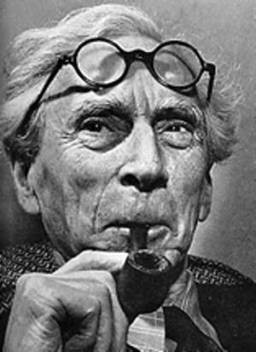
 A Critical Response to Why I Am Not a Christian by Bertrand Russell
Bertrand Russell’s essay Why I Am Not a Christian is a popular touch-point for the community of Atheist writers and thinkers. It is a source of quotations as well as offering a comforting substantiation of their shared beliefs. Some portray the writing as definitive in nature while others comment happily on the enjoyment they find in rereading it from time to time. Lord Russell’s life and philosophy are extolled for the commitment to reason that they exhibit and there is little doubt that one is expected to read this volume [of the same name] of essays in this light; that this is as well-reasoned commentary on the deceitful and harmful nature of religious belief and activity that is almost beyond the reach of contrary argument.
Having not read Russell in any form since my undergraduate days, I endeavored to read Why I Am Not from a neutral perspective. As a Christian and a theologically lettered man, this was not an easy view to take since it was obviously quite contrary to my worldview. As I read I took copious notes so that the structure of the philosopher’s arguments could take shape and I would be able to determine if, from the evidence that he would present in favor of his positions, his conclusions were true or subject to challenge. If one were to summarize the main conclusion that Russell is arguing in favor of, it is this: people believe in religion and God strictly out of emotion rather than reason. As a further subtext, the pre-eminent emotion that Lord Russell makes accountable for this belief is fear. Perhaps as closing statement meant to encourage the reader to similarly proclaim themselves to be free thinkers prepared to stare down the reality of the world around us, Russell issues this challenge in the final paragraph,
“We want to stand upon our own feet and look fair and square at the world—its good facts, its bad facts, its beauties, and its ugliness; see the world as it is and be not afraid of it. Conquer the world by intelligence and not merely by being slavishly subdued by the terror that comes from it. The whole conception of God is a conception derived from the ancient Oriental despotisms. It is a conception quite unworthy of free men.” (pg 23)
What is a Christian?
Russell begins his essay by stressing the importance of defining terms and by declaring what he means by a Christian. There are two standards which must be met in order for him to refer to a person as a follower of Christ. One, that person must have a belief in God and in immortality and on this point, he is quite adamant. I concur, Christianity without God and the notion of eternal life is something else altogether beyond even ecumenical charity and must be given some other label. Second, Russell states that a person must have some kind of belief about Jesus Christ (emphasis mine.) It is here that the careful reader begins to see that the unassailable arguments that they have been led to expect may be more couched and nuanced than originally thought. If one must have some thought about Christ, what is the spectrum of permissible thought? Can one accept some essential doctrinal point but not others? What is couched in this adjective?
Russell answers these questions with this requirement, “you must have at the very lowest the belief that Christ was, if not divine, at least the best and wisest of men.” (pg. 4) Immediately, the reader should pull up short and demand correction of this proposal for the minimum standard of membership. The divinity of Christ in all sects and doctrinal statements is non-negotiable. One cannot simply accept Jesus as just ‘the best and brightest’ minus his essential nature as God. As C.S. Lewis cleverly argued, this is not an option that has been left to you. We must conclude then that the logician has spoken his categorization to life and that he is not going to successfully argue against Christianity but rather, against his personal notion of Christianity. In other words, Russell is not basing his denial of Christianity on the God and Jesus Christ of the Christian church but rather, a Christ of his own making. He clarifies this with the following sentences,
“Therefore I take it that when I tell you why I am not a Christian I have tell you two different things: first, why I do not believe in God and in immortality; and, secondly, why I do not think that Christ was the best and wisest of men, although I grant him a very high degree of moral goodness.” (pp 4-5)
I am left to wonder at this very early stage of the essay whether or not it is fruitful to continue. Russell is not basing the fundamental arguments that support his conclusion on fact but rather, on his incorrect assertions (assumptions?) about what makes one a Christian. If I consider this false ‘christian’ that he portrays a straw man, all that follows will simply knock down that creation rather than present a valid, reasoned argument with evidence that can be evaluated independently of the essay. I suppose that I must now be prepared to read further prepared to confront additional falsehoods and unwarranted liberties with the essentials of Christian belief.









 LOVE | ACCEPT | FORGIVE