Atonement – Under Attack.

imageThis slim collection of essays is rooted in the proposition that the doctrine of atonement is under attack. While I agree that there are a number of views about the nature of atonement and what it accomplished, I dispute the idea that the doctrine itself is under attack. Given the publisher (P & R Publishing) and the group who assembled the project, the Alliance of Confessing Evangelicals, I believe the perceived challenge is to the application of the the Penal Substitution theory. It is not clear as to why this distinction isn’t made clear other than the possible notion that any other theory is so far outside of the range of discussion that it can simply be dismissed.

The essays, assembled by editor Gabriel Fluhrer, come from presentations given at the Philadelphia Conference on Reformed Theology. Bringing the best Reformed minds to bear on a topic of importance to Christ’s Church, this collection of discussions on atonement from the Conference is almost universally excellent. Heavyweight pastors and theologians J.I. Packer, James Boice, R.C. Sproul, John Gerstner, Sinclair Ferguson, John R. DeWitt, and Alistair Begg each repeat the truth and application of the atonement brought about on the cross at Calvary from a variety of perspectives.

Packer and Boice are at their usual best offering clarity in defining atonement drawing the important distinction between propitiation and expiation. Boice’s essay on the language of the marketplace and his exposition of the grace in Hosea bridges God’s wrath and His redemptive love and bear repeated reading. Gerstner’s emphasis on centering atonement only within the narrow stem of the TULIP is out of place among the winsomeness of the other authors. Perhaps I misread his intentions but it appears that atonement, in his view, can only be seen in its limited form, something the other authors avoided emphasizing.

Atonement is a fine addition to the literature on this doctrine but it remains to be seen where it fits in the library. It is an excellent introduction to the admittedly narrow definition of the doctrine of Atonement but it doesn’t offer anything new in the way of ideas.

The Voice of the Psalms

imageThe Voice is an interesting translation project unlike the others currently available. The bible market has been dominated by literal, word for word and paraphrase translations, all produced by scholars working in the ancient languages and seeking to produce a Bible that aligns closely with the original apparatus while smoothing the syntax to varying degrees. While some translations have been idiomatically freer, few translation committees have taken the input of artists, poets and authors of fiction and given them free reign to retell God’s story in the scriptures. The Ecclesia Bible Society does, and its work is to create a series of new translations for modern readers. The scriptures that result from the project are meant to appeal to a current day audience by retelling the story using modern language and imagery that brings inspiration to modern ears similar to that the Hebrew poetry brought to ancient listeners.

The Voice of the Psalms is a ‘retelling’ of the Psalter that intends to restore the beauty of the original Hebrew poetry for the modern reader. I tend to be conservative in my approach to the Bible and the translations that I will use in the pulpit or for teaching but I can appreciate a Bible in a different voice that offers benefits for my devotional life. The Voice is just such a translation. By and large, the Psalms in The Voice are faithful to the structure and pace of an ESV or NIV with re-phrasings or rewordings to bring out a depth that straight translation might not highlight.

A familiar example that readers can compare is the 23rd Psalm, which many will know by heart. The NIV verses are:

The Lord is my shepherd, I shall not be in want.

He makes me lie down in green pastures, he leads me beside quiet waters, he restores my soul.

He guides me in paths of righteousness for his name’s sake. (vv 1-3)

The Voice verses read:

The Eternal One is my shepherd, He cares for me always.

He provides me rest in rich, green fields beside streams of refreshing water.

He soothes my fears;

He makes me whole again, steering me off worn, hard paths to roads where truth and righteousness echo His name. (vv 1-3)

The Voice’s poetic presentation offers a new approach to a well known scripture. Devotional reading of familiar passages can be empty as they threaten to leave our heart by rote rather than with prayerful consideration. The Voice encourages us to pause, to consider the language and images, and perhaps to find the freedom to write the psalms to the Father in our own language.  The book won’t accompany me to preach except for illustrative purposes but I feel very comfortable in recommending this  volume for personal prayer and reading. God is blessed when the creativity embedded in His people is released.


This volume was graciously provided by Thomas Nelson for review.

Wherever Here Is, Start Here

imageBrothers Alex and Brett Harris set the young adult world on fire with their first book entitled Do Hard Things in which they pushed the readers (and their leaders) out of their comfort zones and into the world of apprehending challenges for Christ. Their encouragement sparked the energy and interest of countless young people but lacked an outline for how to proceed. Not wanting to lose the momentum that has been stirred up, the Harris brothers bring their latest book Start Here with an encouraging guide for how to get going fanning the sparks of enthusiasm into a bonfire.

Start Here is a rousing call to get moving for all of us in whom God plants a seed for action, but it is especially geared toward young adults and teenagers. The twins combine numerous first-person accounts with a theme that winds its way through all of the pages; just because you’re a teenager doesn’t mean you can’t be taken seriously. When we are confronted daily with images of the supposed lost state of our young people, it is heartening to read the stories of those who are obviously not spending all of their time texting at the mall. In fact, a twinge of guilt might fly through the older reader as we realize we haven’t even attempted anything on the scale of what some of the youngsters have accomplished for God.

The book isn’t a manual filled with step-by-step instructions for accomplishing your objectives. Instead, the authors have created a looser, Q & A format that helps the Hard Thing doer to organize their own thinking at each step of the way. The inductive approach is perfect for the intended teen audience who might rebel at being told that they need to follow a set of specific steps in order to reach their goals. Instead, they encounter a number of approaches in each area, including the struggles the people ran into by following their own path and from the varied approaches they can select the one that best fits their style and circumstances.

While I’m a bit outside of the age group of the core audience for Start Here, it was a valuable read and I found the earnestness of the authors and contributors to be refreshing. Youth leaders, Pastors, and Parents should invest a couple of days in reading this book before slipping it to their teens. The spark that comes from turning to any of the sections and reading the experiences of other young people may be just the thing to bring your teenager off of the sidelines and into the service of the Lord.

Read more about the book here.


Thanks to Multnomah books who graciously provided this copy for review.

God IS Great – The Hitchens Challenge

image

The trouble one encounters in reading God is Not Great is the Voice. After watching and listening to Christopher Hitchens speak, the words peal off of the page in his contemptuous English sneer. Your mind processes the words, sentences, and paragraphs but, all the while, your MIND hears the voice surreptitiously attempting to corner you for interrogation. Certainly, you agree with me about all of this god silliness, don’t you? You’re not one of those believers are you? – leering pompously over his glasses for assent from the sycophantic atheists in the distance who lap these prickly rants up. Hitchens is far more erudite than Sam Harris and even a bit less irritable but their two recent works are similar in theme and tenor. Both plow the same ground, germinating from the casual assumption that there is no God of any stripe and that the religious people of the world range from simply ignorant to downright evil and dangerous.

I agree with Mr. Hitchens as he observes that much evil is promulgated in the name of religion. Religious practice is a human endeavor and unlike the hopes of the progressivist dream, humans cannot be perfected. To indict broad swaths of people through the actions of a few adherents should cause us to examine Hitchens’ general arguments more closely. To argue that evil practitioners of a faith are representative of the whole requires that we move our examination to a lower strata and ask, are the theological foundations of the religion inherently wicked? Once established, the follow up question is whether or not a person roots their evil in this theology. Does the pederast priest locate his acts in the Bible? If not, intellectual honesty in making ones argument requires a separation of the man from the belief. Hitchens consistently fails to kick over this stone since it threatens to trim the broad brush with which he paints.

This broad swath extends to Mr. Hitchens’ presentation of God in general. He would have the reader accept his expansive definition of ‘god’ as being the same deity represented by all of the faith groups he excoriates. The enlightened reader will see through this facade immediately. Without a careful evaluation of the apologetic for faith traditions one might be tempted to step into this trap but the thoughtful reader will not. Simple logic (which Hitchens demands we practice on nearly every page) leads one to conclude that all views of God cannot be true. If one is correct, the others then must be false according to the apologetics of each.

The final pages of God is Not Great provide a reading group guide composed of 19 questions meant to gauge your assent to Hitchens’ arguments. I propose that we examine these one by one and see how they hold up. It might be that we discover that God is great while people, in their fallen state, are not. The two should not be confused.

The White Horse King

Few people know how often history turns on a single event or rested in the will of a single man. Moderns take for granted the liberties they enjoy or bear the chains that burden them without recognizing the fragility of these states. Humanity is frequently unaware that we are but one battle, uprising, or vote from tyranny or freedom. The historian searches the annals of our existences and can warn us against repeating previous folly or, give us hope that even overwhelming odds can be defeated.

image Such is the case with Benjamin Merkle’s fine new book The White Horse King. The story of Alfred the Great (the only Anglo Saxon king to earn that sobriquet) stands separated from the dusty, dry accounts that litter the history library. The pages turn themselves as Alfred’s life is detailed with equal accounts of his courage in battle, the sharp tactical mind he brought the arrangement of his kingdom, and the piety that drove it all. The intensity of standing side by side within the shield wall  as Ashen spears probe for exposed targets comes off of Merkle’s pages and increases your pulse while you read quickly to see if the threat of defeat becomes a reality. The brief, quiet interludes between skirmishes are spent by Alfred healing but also, seeking the will of God.

The king’s impact on English history may not be well known in our modern age, as more recent Britains such as Churchill come to mind quicker. To understand the import of Alfred’s stand and repulsion of the pagan invaders who were within a breath of conquering and settling England is to recognize the monumental change that this defeat would have had on all of history. Cultural and military history would have tacked much differently had the Vikings been allowed to conquer the Saxons, perhaps delaying even the Christian establishment and its effects for centuries.

The White Horse King reads like a Robert Louis Stevenson adventure mixed with the Nordic sagas of Poul Anderson. The thread of faith winds its way throughout the book but it never reads as proselytizing. Alfred was a man whose faith defined him, his decisions for himself and his people were driven by the Christian values that he held dear. Because the faith was internalized, Alfred does not appear as a man who lines up the Bible against the decision that he wants to make, looking for approval. Instead, the way of Christ has so influenced his heart that we marvel over the distance of time how naturally he applies the paradigm of the Kingdom to the challenges that were forced upon him.

This book was graciously provided by Thomas Nelson for review.

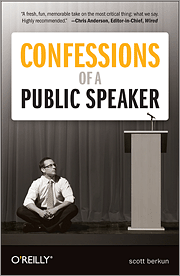
Confessions of a Public Speaker

imageI scrambled for excuses—I’m too busy (lie), I’m tired (lie), my feet hurt from the road test (bad lie)—but before anything good came to mind, he said these invaluable words: “The clutch is your friend.”

How could the clutch be my friend?

How indeed? For Scott Berkun this datum came out of the dark at just the right moment. It distilled a lot of information into a single memorable idea that was needed to be successful at a crucial task (learning to drive his brother’s beloved ‘84 Honda Prelude.) These memorable points, important as they are, are often buried or missing from the lectures, sermons, and talks that we hear (endure?). Should this come as a revelation? As people who communicate for a living it becomes all too easy for preachers, teachers, and speakers to forget the foundation of public speaking: conveying information of value to an audience whose lives will be enriched by receiving it. Everything we think about in terms of speechifying should swirl around this single ideal. To the rescue comes a new reminder in Berkun’s Confessions of a Public Speaker. 

Confessions is not a how-to book as in make three points and start with a humorous story. Instead, the reader gets the benefit of Berkun’s hard earned knowledge of what it’s like to stand up in front 5 or 5000 people and convey something in a meaningful fashion. He talks about the highs and lows with plenty of reality based examples that can aid any speaker willing to invest the time in improving their public speaking skills. There is much about the business of speaking in these pages but the most valuable paragraphs are those in which Berkun is willing to share the failures and their causes. Here is where we learn to improve.

If you are involved in any type of speaking, whether it is in front a church or classroom or simply presenting the TPS reports at a staff meeting, you need to ask yourself how much you have invested in improving yourself in this critical area. We tend to invest our time in learning the information we want to present but simply let the end product, the communication, just happen. The pages of Scott’s invaluable book remind us of the reality; unless we can effectively communicate that information to an audience all of our other efforts are for naught. Make the commitment to improve. Read Confessions and then spend the time necessary to think about the process of speaking. Practice, practice, practice. Then go out and make some noise of your own.

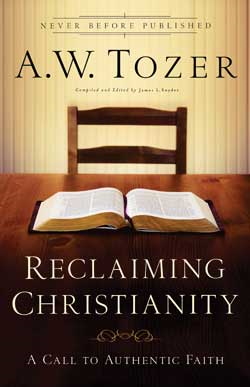
Reclaiming Christianity

image

Like Ravenhill, Bridges, Stedman and other contemporary prophets, A.W. Tozer never in his lifetime stopped calling the Church back to her first love, holiness and purity in Jesus Christ. Tozer was never one to tiptoe around the need for the Church and her individual members to stand apart from the world, to walk and talk as those called out to be God’s people. His criticism could be brash but it was always rooted in a no-nonsense biblical faith that he drew directly from the scriptures. To read Tozer is face the man as he points out the many areas in which you have compromised with the world and in which you risk becoming lukewarm, or worse.

Reclaiming Christianity is a collection of essays that are just this year seeing the light of publication day. In each, Tozer issues the same call for restoration from what he saw as a weak and ineffective Church. He saw her drifting toward entertainment rather than solemnity, modeling her activities on big business rather than community, and drawing her members toward a lukewarm faith rather than holiness.

Remember, brother Tozer went home in 1963. Can you imagine what he would see in today’s church?

This is an excellent collection of short reads that will confront you on every page. Even if you have convinced yourself that you have no areas of compromise, the author’s words will penetrate the thick blanket of justification and ignite the Spirit of conviction within. Let the words sink in, open your Bible and fall to your knees before the Lord. He will quicken your passion and you can do the same favor for your brother.

A Primal Faith Restored

A Quest for the Lost Soul of Christianity

clip_image001A subtitle like that should cause you to stop and ask a very important question before proceeding; has Christianity lost its soul? Has it become so complicated by manmade adornments and requirements that we who adhere to the faith have lost sight of the core of our faith? I struggled with responding to this challenge until I began to draw the distinction between religion and faith. Religious complexities are legion with our innumerable denominations, the theological structures that gather and divide us, and even the wide variety of Bible ‘flavors’. These things divide us and draw our attention away until the core of our faith is lost. The Shema of Jesus, the Great Commandment, gets clouded by the machinations forced by the scaffoldings we erect meant to protect it. We become great practitioners of religion while losing the glow of our faith. Pastor Mark Batterson calls us back to the simplicity of belief and practice that Jesus taught; love God with all of your heart, mind, and soul and then that love out in the world.

In Primal, Batterson attempts to push aside all of the complexity and help us return to the four corners of our faith. He organizes the book around four primal elements that he identifies in the Great Commandment:

  • The heart of Christianity is primal compassion,
  • The soul of Christianity is primal wonder,
  • The mind of Christianity is primal curiosity,
  • And the strength of Christianity is primal energy.

Each of these elements is explored in a series of chapters that further devolve the idea, hoping to drill down to the pure essence of each facet.

I was disappointed when this expectation wasn’t met. I’ll tell you up front, I wanted to love this book. Batterson’s first book In a Pit with a Lion on a Sunny Day is one of my favorite books bringing Benaiah to life as he did. I wanted to love this book, but ended up only liking it. The size of the collage of stories, biographical accounts, and inspiring words does just what Mark had set out to erase as his points get lost in the avalanche. The majority of the vignettes are inspiring and will give you pause to reflect but as far as leading us to a primal core, we could use a better map.

For more information about this book, click for the Waterbrook web site


This was book was provided for review by WaterBrook Multnomah.

Bonus Christmas Giveaway!

imageWaterBrook Press has graciously provided an additional, never-before-read, untouched by human eyes, paper fresh copy of the book 40 Loaves : Breaking Bread with Our Father Each Day and I want you to have it! This would make a great Christmas gift or something you tuck away for yourself. I’ve never had a giveaway here before so here’s how we’re going to do this:

clip_image001

Anyone who reads one the Advent posts (see the Advent Resources up there on the menu?) and leaves a comment there will be entered in the drawing on Monday, December 21. If you’re not into Advent then just leave a comment here with some link that let’s me get in touch with you.

Merry Christmas

40 Loaves: Breaking Bread with Our Father

clip_image001The devotional section of most Christian bookstores is filled with volume after volume of promises for a better tomorrow, the sweetest words of the Lord, and readings that plant nothing but positive seeds of faith in the reader. Many Christians find these an enjoyable way to begin or end the day but for some, they fall short. Some Christians are plagued with questions that seem out of place when arranged against the flowery words or sun-shiny phrases they read; why am I so angry, why do I only pray in emergencies, why don’t I feel safe at church? The overwhelmingly positive daily entries of many volumes seem out of place against the reality of disappointment that we see in our lives and they cause the seeds of doubt that we harbor to germinate. As they grow, the doubts do more than nag at us, they form a core of weakness in our lives that we fear addressing because everyone around us gives the appearance of having it so together. For those of us who struggle, C.D. Baker’s new book, 40 Loaves, arranges all the things we wonder about into daily readings and invitations to meditation and prayer.

When you first begin turning the pages you come upon a truth that is key to absorbing the encouragement contained on these pages. “Wisdom is found when troubled hearts ask honest questions.” Despite a church culture that encourages the formation of a false front, Baker steps up and addresses the questions that we are afraid to ask, the questions that make our faith appear weak and doubtful. Initially, we don’t want to admit that we hold these doubts or suffer from these wayward thoughts because we fear the impression they leave with others, especially in the modern Church where everyone works to appear without issue. Baker knows however, that there are more struggling wanderers than we would like to admit within our midst. Perhaps you and I are among them.

The vignettes that lead each entry draw your eyes and you can’t help but find your reflection in at least one of them. When you notice your picture you also notice the question that has bounced around your heart for days or months or years in bold, black letters. Why is my life such a mess? Why am I bored with church, the Bible, and Jesus? Why am I so angry? The great favor that Baker has done for us is not to give pat answers and then just throw in a couple of proof texts. He has allowed that we can have moments like this in our life and then nudges us to return back to the foundational truths that we know, but have trouble accepting. Like any good guide, He leads us to the spot where we see the sunrise but then lets us notice it for ourselves. God works when we are most honest and put down the facade. Doubts are not magically erased but truth begins the process of reducing their hold on our hearts. When the rays of truth begin to strike us and brighten our countenance, our guide doesn’t turn and leave us. Each entry closes with more questions to ponder and a prayer. Our doubts may not be erased but we will certainly not frame them in the same way. These are pages you can return to again and again and find something new to bring to the Father in your time with Him.

40 Loaves is not for every reader. There are no treacly-sweet pat answers to doubt in this small volume nor does it conclude with an assurance that you will be changed by the simple act of turning the pages. Bread will have to be broken with Him repeatedly. You will see yourself on at least one page and if you have the courage to be honest with self and God, your doubts will be eased and pushed aside by a newly growing robustness in your faith.


For more information about this book, have a look here at the Random House web site.


This book was provided for review by the WaterBrook Multnomah Publishing Group.