Day 17 in the School of Prayer : Harmony!

WithChristInPrayer

“Father, I thank you that have heard me. I knew that you always hear me, but I said this for the benefit of the people standing here., that they may believe that you sent me.” ( John 11:41b-42 )

I will proclaim the decree of the Lord:

He said to me, “You are my Son, today I have become your Father.”

Ask of me, and I will make the nations your inheritance, the ends of the earth your possession. ( Psalm 2:7-8 )

Many Christians struggle with the seeming dichotomy between the eternal decrees of God and their effect upon our individuals lives and the notion of liberty in prayer. In other words, if God has determined the course of history corporate and individual of what effect are our prayers? Many will prefer to allow this question to linger unanswered. Some will allow themselves the conclusion that prayer is fruitless yet continue in a sort of stoic legalism. Still others will see this as an impassable roadblock and give up the discipline altogether.

Were God one person, closed up within himself the latter conclusion would be appropriate. We could never hope to be close to him nor hope to influence him. God is not one, however. He is Three-In-One, and in the Son and Holy Spirit we have the bond of unity and fellowship with the whole of the Trinity. Through this brotherhood we have an opened door to ear of the Father. We have assurance that our prayers are heard and in the Trinity, eternal as it is, we see that Jesus’ commands to pray form an active part of the eternal design.

We pray because we were commanded to.

We pray because we are heard.

We pray because our petitions are a crucial part of the great plan of history.

Go and Do Likewise…

Mother Mary

Blessed is she who has believed that what the Lord has said to her will be accomplished!” 

And Mary said:
“My soul glorifies the Lord  and my spirit rejoices in God my Savior, 
for he has been mindful of the humble state of his servant.

From now on all generations will call me blessed, 
for the Mighty One has done great things for me— holy is his name. 

His mercy extends to those who fear him,
from generation to generation. 

He has performed mighty deeds with his arm;
he has scattered those who are proud in their inmost thoughts. 
He has brought down rulers from their thrones but has lifted up the humble. 

He has filled the hungry with good things but has sent the rich away empty. 
He has helped his servant Israel, remembering to be merciful 
to Abraham and his descendants forever,
even as he said to our fathers.”

Luke 1:45 – 55

Fourth Sunday in Advent ~ Change Comes

image First he said, “Sacrifices and offerings, burnt offerings and sin offerings you did not desire, nor were you pleased with them” (although the law required them to be made). Then he said, “Here I am, I have come to do your will.” He sets aside the first to establish the second. And by that will, we have been made holy through the sacrifice of the body of Jesus Christ once for all. (Hebrews 10:5-10)

The end of Advent brings the beginning of everything else…everything changes because of the single moment in history when Jesus sets aside his crown and comes to walk among us. A single moment…a holy birth…a changed world. God set aside the futility of the old sacrificial system, a set of laws that man could not satisfy in his own power and provided the perfect lamb.

One single moment changed everything…God elected to place the perfect lamb in our midst…He elected to become the perfect sacrifice for those who would believe and obey…the single Christmas moment changes everything.

Has it changed you?

image readerwalker

Advent Benediction – Little Town of Bethlehem

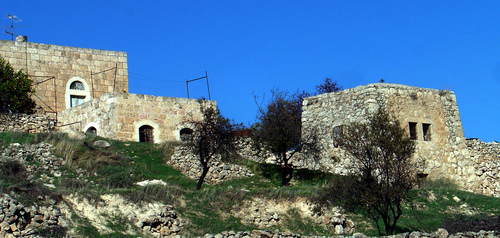
For the final Sunday of this year’s Advent season, my benediction looks toward the tiny town of Bethlehem for the momentous event that changed everything for history and for you and me…

imageimage tbass effendi

Bethlehem Benediction [Micah 5:2-5]

Out of tiny Bethlehem came the Brightest Morning Star,

the Glory of God,

The Son, our Savior.

Out of tiny Bethlehem came the Shepherd of our flock,

He stands in the strength of the Lord,

He stands in the majesty of the name of God.

He is our salvation and security.

Be blessed in the majestic name of Jesus,

Son of God,

Holy Shepherd,

Holy One of Israel,

Your Salvation and Strength.

Be a blessing to others though you may feel as tiny as Bethlehem.

Show the Love of Jesus.

Live as the Son lived.

Help others find the Shepherd, The Holy One, Their Salvation and Strength.

May the blessing be birthed in you.

Amen

O little town of Bethlehem, How still we see thee lie;

Above thy deep and dreamless sleep, The silent stars go by.

Yet in thy dark streets shineth The everlasting light;

The hopes and fears of all the years, Are in thee tonight.

Phillips Brooks/Lewis Redner

Advent Benediction of Rejoicing

image

As Mary knew, may you also be blessed to know,

the joy of anticipation, the joy the change to come.


The prophets shouted God’s promise,

‘Be glad and rejoice with all your heart;

The Lord has taken away your punishment, he has turned back your enemy.’


You are blessed in knowing that the Bright Morning Star,

would come,

did come,

and will come.


Be blessed, community of faith,

rejoice and share the news and the light of the Star!

God’s greatest blessings on you.

Amen


Image Coach O

First Sunday in Advent 2009 ~ Watching

image

“‘The days are coming,’ declares the Lord, ‘when I will fulfill the gracious promised I made to the house of Israel and to the house of Judah.

‘In those days and at that time I will make a righteous Branch sprout from David’s line;

he will do what is just and right the land.

In those days Judah will be saved and Jerusalem will live in safety.

This is the name by which it will be called: The Lord Our Righteousness.’  (Jer 33:14-16)

On our first Sunday of Advent, we watch and wait in anticipation of the fulfillment of the promise. Our perspective however, is much different than that of the exiles. Imagine being far, far from home with only this promise to hang on to. When the Lord says that the ‘days are coming’, you don’t know if it will be tomorrow, four weeks, or forty years. You only know that He has been completely faithful to you and your people since you fell under His protective gaze.

Our modern perspective is much different. We know how the promise has been kept and we live in the danger of taking that for granted. Our anticipation is muddied, our vision of eternity filtered through a thick San Fernando haze. The Advent season can become just another tradition in which we ‘remember’ historical acts but fail to apply it to our lives. We can restore the joy and the quickening that comes with anticipation. We can restore the memory and the life of faith that comes with a Kingdom that has come, but not yet.

Let us lift ourselves out of the busyness and the stresses that the culture has inflicted on this season and aim our sight into eternity. We can rediscover our purpose and anticipate its completion. We can separate ourselves from the worry and strife of daily life and look forward into a new heavens and new earth. The Messiah promise has been kept. The promise of new life is yet to come. Celebrate both.

Image egorick

Day Seven in the School of Prayer

WithChristInPrayer

“If you then, though you are evil, know how to give good gifts to your children, how much more will your Father in heaven give the Holy Spirit to those who ask him!” (Luke 11:13)

The Lord asks us to consider how small our prayers are. Are we limited in our thinking concerning what God will provide for us? Our prayers may be filled with the mundane and a focus on our day to day needs when our Father wants us to have so much more. To be filled with the Spirit satisfies so many of our needs and yet we fail to seek Him out. Not only will the presence of the Spirit change us as people, but He will also mature and expand our prayer life. It is through the guidance of the indwelling Spirit that we truly learn to pray the prayers of Heaven instead of dwelling in the smallness of the earth.

The Multi-Faceted View of Atonement

We have looked at three of the major views that Christians have adopted to understand atonement, Christus Victor, Healing, and Penal Substitution. At one time or another during the history of the Church, each of these theories has held the majority position among theologians. The Penal Substitution view is the dominant view now, among the American churches at least.image It’s important to recognize the historical shifts in acceptance of the various theories and to question why one would lose favor to another in the minds of Christian thinkers and teachers. Does the Bible change over time? Has the Holy Ghost made contradictory revelations at different moments in time that initiated the shift? What about all of the other atonement views that are subsumed within the larger categories?

Is it possible that the atonement brought about by the sacrificial death of Jesus Christ is much too expansive to be understood under the banner of a single, narrow category?

Atonement is Too Large for a Single Theory

Theologians who stand apart from the dominant views of atonement will answer this question by saying yes, there is no model or metaphor that is sufficient to explain the significance of of His sacrifice. The crucifixion and its result are tightly woven into God’s eternal purpose and as spirit-opened eyes continue to pore over the scriptures in the hours remaining until the end of this time, we may never run out of the countless ways of understanding its meaning for our salvation. It should not be alarming to find a number of images that lend themselves to understanding this momentous act. As centuries of eyes search out the truths of God’s word, each with a slightly different perspective on the greatest human need, it is inevitable that a number of categories would arise.

Single Views and the Bible

The New Testament authors generated a number of images in the Gospels and Epistles in order to help readers comprehend the monumental shift in God-Human relationship brought about by crucifixion of Jesus. If the primary rule of hermeneutics is applied—context,context, context—the modern reader places the writing in first century and recognizes the societal influences that are inherent in the texts. Five areas of public life dominate: the court of law (justification), the world of commerce (redemption), personal relationships (reconciliation), worship (sacrifice), and the battleground (triumph over evil).

This plethora of imagery could be differentiated by the loci of the individual authors, their use of language and metaphor and missiological interest. A more effective tool for seeing the wide span of atonement images is to survey the corpus of a single author to see if there is variety or consistency. With his dominant contributions, Paul and his works provides such a platform. The Apostle employs two main themes in discussing the significance of the atonement, the ‘giving up’ of Jesus for human salvation (cf. Rom 8:32, Gal 1:4) and ‘Christ died for our sins’ (cf. 1 Cor 15:3, 1 Thes 5:10). These themes emphasize the saving nature of Jesus’ death but they do so without linking it explicitly to a single methodological theory. With this point established, Paul then utilizes a variety of imagery applicable to particular concerns of his epistle audiences. Reading Paul exposes us to language about substitution, representation, sacrifice, justification, forgiveness, reconciliation, victory over the powers, and redemption.

Conclusion

Rather than being confined within a single theory, the atonement is better viewed as encompassing the fullness of God’s design for the world. The image which finds favor with a theologian will more often than not be a product of his definition of the greatest human need. If people are seen as in bondage to sin, they need liberation. If humanity is spiritually blind, the desperate need is for illumination. If lost, they need to be found. Taking a kaleidoscopic view of atonement provides the freedom necessary to locate all of these needs within a view of the crucifixion.