The Foundation of Prayer

“Audacious prayer, which perseveres unflinchingly and ceases not through fear, is well pleasing unto God,” wrote Luther. “As a shoe maker makes a shoe, or a tailor makes a coat, so ought a Christian to pray. Prayer is the daily business of a Christian.”  Martin Luther

“God does nothing but in answer to prayer.” John Wesley

imagePrayer is central to our identity as Christians. It is a distinctive that speaks volumes about the singular nature of our faith. We have personal communion with the God of the universe. Our prayers are not issued into the void in hope that some anonymous deity will take pity upon or show favor toward us. We speak directly to God and he will speak to us.

No spiritual discipline has meaning without prayer. Training ourselves to pray effectively is a primary step that is to be mastered before the other disciplines are attempted. When we live a Christian life without prayer we deprive ourselves of the strength, power and transformation that any other discipline might bring about.

To pray is to change.

A foundational truth regarding prayer is that it is simultaneously natural and unnatural. We do not naturally come to prayer and we must be intentional about pursuing it. Prayer requires effort and a long period of apprenticeship. Unlike the apprenticeship of a silversmith however, our initial prayer has power and effect. God knows our abilities and His grace extends his patience with our first, faltering words.

We must sit at the feet of the Master and learn to pray just as His first disciples did. One day Jesus was praying in a certain place. When he finished, one of his disciples said to him, “Lord, teach us to pray, just as John taught his disciples.” (Luke 11:1) These will be our words as well, Lord teach us to pray.

Grace and peace to you.

image khrawlings

Faithfulness Despite Appearances–Fourth Sunday in Advent 2010

imageOur Advent meditations have to do with an event that none of us were present for. The life and death of our Lord passed before our era and, despite numerous predictions, His return has yet to come. Our entire system of faith is rooted in the apologia that supplements our intellect and the discernment provided by the indwelling Spirit who tells us that we can trust in the words recorded long ago. Every Christian since that day at Golgotha has had to trust the beliefs passed from one to another through the centuries. We trust in the work of Christ by faith alone.

Every Christian since that Friday afternoon has lived in a world of chaos. The dimensions of this chaotic environment have varied from era to era and person to person. Many have looked upon the severity of their trials or the universality of evil and pointed to these as proof that God does not exist. Many of us might be tempted to believe them when we see the horrors that man visits upon man or in the death and loss caused by natural events. Disease surrounds us, getting stronger in some cases. Limited resources threaten the existence of many. Pregnant women are run down and left for dead in the intersections of our cities. Evil abounds.

Joseph looked upon his pregnant fiancée tempted to act on appearances. His scriptures provided a way out for him and he loved Mary enough that he planned to divorce her quietly. By all appearances, her story was incredible–almost unbelievable–and yet, at the prompting of an angel, he remains faithful.  He trusts the word of God provided for him, despite outward appearances.

There is subtle encouragement in the angels words to Joseph, “Joseph son of David, do not be afraid to take Mary home as your wife” (Mt 1:20). God does not command him to stay with Mary. Instead, the angel tells him not to be afraid, that despite what things may seem to be all will turn out well. These words echo for us as well.

This Christmas may not be the best time in your life. You and your family may be facing difficulties. It may be the first holiday without a family member at home. Your faith may be being tested to the very limits of your endurance. Despite appearances, there is reason to celebrate. Christians, you know the end of the story. You know that God has proven faithful to his promises time after time through history and He will continue to be faithful until the end of this history. Trust Him, do not be afraid. Celebrate your Savior.


Grace and peace to you.

image by VickyV

Hope–Second Sunday of Advent 2010

imageMay the God who gives endurance and encouragement give you a spirit of unity among yourselves as you follow Christ Jesus, so that with one heart and mouth you may glorify the God and Father of our Lord Jesus Christ. (Romans 15:5-6)

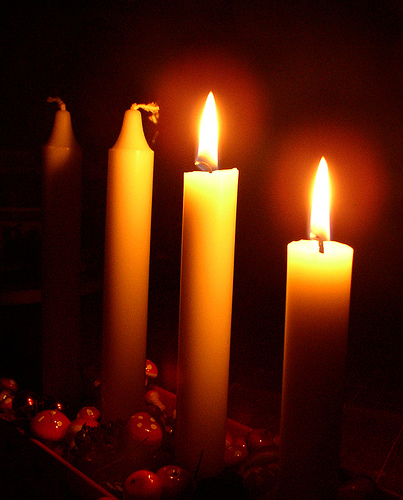
One of the great reminders that our observance of Advent brings, is that we have not been left alone to patiently endure until the Lord returns for us. As Paul wrote in the verse that precedes the passage above, every word of the Scriptures was written that we may be encouraged and have hope. Perusing those scriptures we find that we not only have hope from these words, we are surrounded with like hope in our family, community and church. We are both recipients and providers of this hope, from and to other Christians. Together, we look to the flame that edges closer to His coming with each week and together, we await his second arrival.

Paul uses the scriptures to remind the reader of a promise from years past that applied to them in that day, and which remains applicable to us in our hour:

“The Root of Jesse will spring up, one who will arise to rule over the nations; the Gentiles will hope in Him.” (15:12).

Jesus, the ‘Son of David’ is that root. He is the source and center of our hope. His life provides the model for our endurance and servanthood to others. Others within the church know the source of our hope. Our calling is to take that hope outside of the church and into the world, living lives that exude such joy and assurance that it sparks the spirit in others to seek out the fount of promise.

May the God of hope fill you with all joy and peace as you trust in him, so that you may overflow with hope by the power of the Holy Spirit. (v13)

Grace, peace and hope to you.

image Per Ola Wilberg

Psalm 69 : May Your Salvation Protect Me

imageOn the cross at Calvary the perfect innocent was crucified. Though charges were leveled and accusations screamed about Him, there was no guilt in the verdict of the ultimate Judge. The Savior knew and trusted in the ultimate outcome of The Plan.

Though our voices ring with affirmation of our trust in God and His Plan, the immediacy of the struggles we face excite the doubting voice in our hearts. Why God? Why do you allow your saints to be falsely accused while the mockers go free? No answer has ever been given except, “trust me.”

Save me O God, for the waters have come up to my neck.

I sink in the miry depths, where there is no foothold.

I have come into the deep waters; the floods engulf me.

I am worn out calling for help; my throat is parched. My eyes fail looking for God. (Psalm 69:1-3)

Along with Psalm 22, this scripture is found most often in the New Testament. The authors (as well as modern Christians) found the parallels with the innocent suffering of Christ to be the perfect descriptive words. John speaks of Jesus’ rejection by His own people (Jn 15:25) and his motive in driving out the traders from the Temple (Jn 3:17). The other gospel authors heard the words of innocence being put to death ( Mt 27:34; Mk 15:23; Lk 23:36; Jn 19:19-30) and Paul related the meaning of His suffering (Rom 15:3) to this psalm.

for zeal for your house consumes me, and the insults of those who insult you fall on me. (Ps 69:9)

For even Christ did not please himself but, as it is written: “The insults of those who insult you have fallen on me.” (Rom 15:3)

Trusting that our struggle is for the greater good is one of the greatest challenges that we face. Our innate sense of what is fair doesn’t have a category into which we can organize our pain in the face of the guilty walking free of injury. We must simply trust.

I will praise God’s name in song and glorify him with thanksgiving.

This will please the Lord more than an ox, more than a bull with its horns and hoofs. (vv 30-31)

Grace and peace to you.

image by prilfish

Day 28 in the School of Prayer : I Want but I Will

image

“Abba, Father,” he said, “everything is possible for you. Take this cup from me. Yet not what I will, but what you will.”
Mark 14:36

As in any course of study, the lessons come to finer and more distinct points as the class turns to its final days. The Lord has taught the discipline of prayer to us in this fashion, starting with a very broad brush but now switching to a fine point tool dipped in blood red to emphasize the finest points of petition. In this Gethsemane moment, the (we) disciples are schooled through an especially intimate communication between Son and Father as Jesus implores ‘ not my will but yours!’

Our initial prayer will always be self-serving. We know little of God’s will as beginning pray-ers and the scope of our world is limited to our own selfish wants. As our prayer bond grows through maturity and diligent practice, the Lord leads us to understand that all ultimately leads to His will. Our prayers are still honest expressions of our desire but we learn to fashion them in the context of the Father’s will. We say, Lord please for this or that but follow with, if it is your will. We find our place.

Grace and peace to you.

image Daniel Y. Go

Day 24 in the School of Prayer : In My Name

WithChristInPrayer

And I will do whatever you ask in my name, so that the Son may bring glory to the Father. You may ask me for anything in my name, and I will do it. (John 14:13-14)

Then the Father will give you whatever you ask in my name. (John 15:16)

In that day you will no longer ask me anything. I tell you the truth, my Father will give you whatever you ask in my name. Until now you have not asked for anything in my name. Ask and you will receive, and you joy will be complete. (John 16:23-24)

Evangelicals have made a habit of concluding all prayers with some form of the phrase “in Jesus name” with only a vague notion of why they do so. In many cases, it has taken on the veneer of a magical incantation, as if by including these words the prayer is guaranteed to be fulfilled. Kind of an abracadabra for Christians.

And wrong.

A person’s name is how we know them. Our family and friends are not disembodied beings that we know by their features; the big one, the red haired one. We know them by their names and associate all that they are to us in that name. Say the name of your wife or husband. Not only do you see his or her face in your mind but you get the full sense of your love for that person. You feel exactly what they mean to you.

So it is with the name of Jesus. He’s not just a man. He is Lord. His name represents all that that means to us. Praying in His name says two things. One, we are His representatives, serving Him and what we do carries the full force of His Lordship. Second, when asking for what we need to accomplish His will, we ask in the full force and credit of our Lord. What we ask to fulfill His will is not denied. The empowerment we desire to fulfill His will is not denied.

Lent Spent with the Psalms Day Twenty Four

image

Do you really walk alone? It can feel like that sometimes. Those we thought were friends have moved on to other pursuits. Loved ones have issues with us, real or imagined. We echo the thought of the psalmist..

You have taken my companions and loved ones from me;

the darkness is my closest friend. (Psalm 88:18)

The modern church would prefer that this psalm disappear from the Psalter. It doesn’t fit the current paradigm of happy, happy, everything is going to be great all the time forever when I’m a Christian. Believers cannot understand how God would leave His people in the midst of incredibly difficult struggles, perhaps even for the entire span of their lives.

Look to the Cross. Jesus hangs alone. The skies darken like night. No one rises to His defense. The Father alone is in control of a History that we sometimes cannot understand. We must walk toward the Cross despite the darkness, despite the fact that we might walk along. We walk in trust that the Father’s ultimate will is for the good.

Grace and peace to you.

image BostonBill

Lent Spent with the Psalms Day Twenty Three

imageWho journeys with you toward the cross? Jesus surrounded himself with a close-knit band of traveling companions, knowing that one of them would eventually be his betrayer. Despite that, he invested Himself fully in them. King David shared our more human perspective on a similar situation;

But is you, a man like myself, my companion, my close friend, with who I once enjoyed sweet fellowship as we walked with the throng at the house of God. (Psalm 55:13-14)

It would be easy to consider the painful betrayals we’ve suffered and decide to walk alone. To walk by oneself means we don’t have to risk betrayal any longer, we’re safe.

Except we weren’t designed to do that.

We were meant to be in community. The travelling companions we surround ourselves with complete us in bringing along those things that we lack. But, we say, I’m not alone, I have the Father as my companion. True, but look to see if He is alone or in communion with the Son and the Spirit.

Grace and peace to you…

image sergeant killjoy

Day 23 in the School of Prayer: Be Righteous!

imageThe prayer of a righteous man is powerful and effective. (James 5:16)

Ask and it will given to you; seek and you will find; knock and the door will be opened to you. For everyone who asks receives; he who seeks finds; and to him who knocks, the door will be opened. (Matthew 7:7-8)

Therefore, strengthen your feeble arms and weak knees. “Make level paths for your feet,” so that the lame may not be disabled, but rather healed. (Hebrews 12:12-13)

Saved is saved but saved is not always righteous. When salvation is graced upon us, we are recipients of the righteousness of Christ. This transfers places us in right standing before the Father, cleansed and released from our bondage to sin. A newborn in the world, weak and needing to mature. Many Christians never leave the cradle and then ponder aloud why their prayer seems to be weak and ineffectual.

The fact that their lives bear no fruit may have something to do with it.

Our Savior repeatedly teaches us that we are to be growing into a life of increased righteousness and piety. We are to be diligent about becoming better at keeping His commands and obeying all that He has taught us. Only with this obedience will come the power in prayer that we so earnestly desire. We cannot have one without the other. Christ must be first and foremost in our life before our prayer will have the depth and response that it was meant for. Anything else would cheapen the unfathomable price of the grace we receive.

image jf sebastian

Lent Spent with the Psalms Day Sixteen

image We conclude this week of Lent with with a question. Do we take the grace borne of the Cross for granted? To varying degrees, Christians have been guilty of this for centuries. A promise like that found in Psalm 30 can make us complacent,

When I felt secure, I said, “I will never be shaken.”

O Lord, when you favored me, you made my mountain stand firm; (vv 6-7a)

Easter becomes just a marker in the year pointing out that Spring is imminent. What if Spring didn’t arrive? Would we take notice or simply accept it, soon taking the new weather pattern for granted. Likewise, if God were to hide His face from us, would we soon accept that as the way things are?

… but when you hid your face, I was dismayed. (v 7b)

Don’t allow the soporific world around you to lull you into inattention. The Cross was an eternally history changing event on your behalf. Never allow that grace slip from view. Never take it for granted. The price was too high.

Grace and peace to you.


image Himalayan Trails