The Real Mary: Revelation

McKnight offers a chapter today entitled Woman of Ambivalence that encourages us to offer Mary a more charitable reading as she struggles to correlate the Jesus that is gradually being revealed to her with the Messiah of long term Jewish expectation. We often helicopter in to the scriptures in which Mary plays a role and, with our advantage of knowing how the story will play out, wonder why she is not more astute in choosing the Jesus that is present before her.

The mother Mary watches her baby grow into a child and then a man knowing that he is the child of God, the promised Messiah. What troubles her is that, as far as we can tell from the Scriptures, he is a normal child in every way. How does the mother see God in a sick child felled by the flu? How will this be the Messiah destined to restore her people when He is but a rebellious teenager struggling through adolescence? Do our own children correspond exactly to what they will be in their adult years? My own parents might give witness to the unexpected changes that come over time. Why then do we expect Mary to be able to theologically process the young man she is watching grow up.

As we process who Jesus is, do we face the same struggles that Mary does? Our devotional life is sometimes littered with expectations that He will conform to the script that we have Him following for our benefit. We do well to struggle along with Mary.


Bearing Your Cross for Lent

For many, Ash Wednesday is the most public display of their faith that is seen by the world at large. The sign of cross is drawn in palm ash on the forehead, ostensibly to indicate the penitent status of the bearer. Other will observe Lent without the observance of this tradition but will focus on the sacrificial nature of the Easter event.

In the forty days that follow, how will your faith be affected? Will your sacrifice become works? Will you examine your faith in light of the public and private personae that we tend to develop? Will any injustice in the world be addressed? There are so many avenues for reflection as we approach Easter that it is an excellent avenue for personalization of your relationship to the Christ.

I’m going to meditate deeply on the Sermon on the Mount and its call to action rather than passivity this year.  Perhaps you can join me.  


Fat Tuesday

An interesting meditation for the day known as Mardi Gras, Shrove Tuesday, Pancake Day, or Fat Tuesday is to note how it relates to our often up and down Christian lives. Though its roots are religious, when Mardi Gras is mentioned the majority of Americans are going to flash to the drunken bacchanal occurring this week in New Orleans and to a lesser degree in other cities around the country. The revelry will end abruptly at midnight tonight and the celebrants will shuffle back to their lives with a bit a hangover and perhaps, a twinge of remorse. The clock striking midnight signals the beginning of Lent, traditionally a period of penance and sacrifice.

Do our personal dealings with God reflect this night and day behavior? Do we find ourselves involved in behaviors that the Spirit reminds us are wrong that culminate in deal making with the Judge? We plead that after this one last time we are going to stop abruptly and enter a period of repentance which will lead to our not repeating the behavior? Maturity comes when these spikes, the need to engage in one more personal Carnivale, begin to level out. The transformation takes root when our desire for debauchery is overcome by our hope for holiness.

Just something to think about.


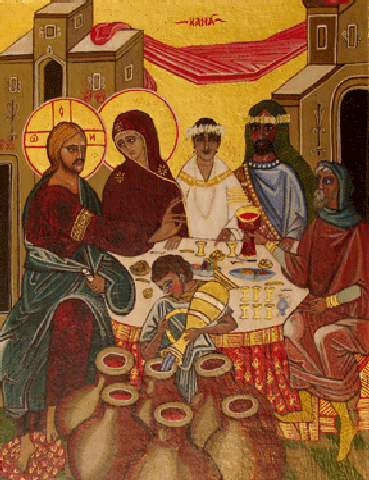
The Real Mary Surrenders

After Jesus has called His first disciples, we catch another important glimpse of the growing relationship between Mary and her Son. The wedding at Cana is recorded, not to memorialize the bride and groom but, so that we might be witness to a turning point in both Mary’s life and the ministry of the Lord. The memory most often associated with this event is the miraculous transformation of water into wine but we must reread this passage again to see all that going on.

We can initially be put off by the brusqueness of the interchange between Jesus and His mother as her innocent observation that there was no more wine causes His not so gentle reminder that the time had not come for Him to act. Mary is brought to a precipice of realization at this moment. Jesus’ allegiance was simply and profoundly placed in His Father and in His comments and Mary would need to recognize her place in this new economy. She must now surrender any influence she desired in directing his life or ministry as Jesus honors God with His obedience to the eternal plan. She must fully commit herself to becoming a follower of Jesus.

Just as Jesus indicates that He is prepared only to act in obedience to God’s timing, we too must find in ourselves the same obedience. It begins with the surrender that Mary displays. Life for the follower of Christ is no longer ordered around our human desires and timing. Instead, obedience calls us to recognize, as Jesus did, the perfection of God’s plan and his timing. Surrender.


New Adventurers

Read Sarah’s proposition Could Church Not Suck?  Well Sarah, I hope you are discovering that the answer is Yes! Actually, Church can not suck! God’s heart is for people and He is with them in many, many places outside of the four walls of the sanctuary. The missional ideas that Hirsch is talking about takes us all out of the church and into the world. It’s dangerous out there where God is but you can’t beat it. Come on and join the adventure…

Worshipping as Artists

Rebecca Groothuis, who contributed greatly to the egalitarian components of my pastoral theology, has a wonderfully provocative question in her article Let’s Put Worship Back in the Worship Service. Though the article is a decade old, her proposal that we focus on ministry to God in worship before ministering to those in need challenges our current missional order of priorities.

I think that we often get swept into combining the worship impulse with our outreach impulse into a single activity. By ministering to his people we are worshipping God and in this mashup, He will be singularly pleased. Our separation of these activities and the subsequent recognition of the quality of our worship will result, Groothuis suggests, in a reordering of our ministry. It is not without benefit. The greater focus on worship as vocation contributes to our discipleship which in turn contributes to a greater missional impulse. What do you think?


The Forgotten Ways: Unattractive

Scot McKnight at Jesus Creed continues with the conversation regarding Hirsch’s book and this week he discusses chapter four, Disciple Making. The question that he poses are “(Questions for the day:) Is consumerism the biggest threat to discipleship today? What is the best way to make disciples?” Hirsch treats this section with a bit more emphasis, seeing the making of disciples as “the single, most crucial factor” in contributing to mDNA that lies at the heart of a missional church or movement. His contrast throughout the chapter lies in the contrast between a “white hot” movement rooted in a mission and the passive, consumerist Church of modernity.

I think that the question regarding the threat posed by consumerism to discipleship can be better framed by reversing the focus; why isn’t discipleship a threat to consumerism. The American context in which I’m reading the book is very much defined by its consumer tendency. We are free to pick and choose from countless choices and, in many cases we need not expend much effort at all to receive goods and services. We can be passive consumers and participants in the culture. This culture has obviously affected the Church where we often find the vast majority of Sunday morning consumers passively receiving programs and services with little demanded in return.

The consumer mentality threatens discipleship because, by its very nature, it is not a passive activity. Discipleship in the way of Jesus requires accountability, dedication, and personal investment, all things that are anathema to the consumerist mindset. The pastor that models and expects it from a congregation will often experience consumerist reaction as the passively committed members seek an easier to consume experience.

In returning to my restatement of Scot’s question: why aren’t we more of a threat to consumerism? Do we who are pastors allow the passivity to take root in our congregations? Are we engaged in discipleship ourselves sufficient to stoke a white hot faith within us? Why not? Is it easier to read (consume) someone else’s work instead of creating our own?