The Secret … Again

The Blessed Church

The Blessed Church by Robert Morris

The simple secret to growing the Church you love; the subtitle sings that sweet siren song that lures so many pastors and church leaders to delve into the pages of books like this. In the era of often relentless pressure to grow the attendance of their church, leaders are always looking for an edge, one method or program that will bring more souls into the seats. Morris’ contribution to the literature is enticing, but the secret is absent.

That there is nothing new here is not Morris’ fault. The biblical path to a sound Christian church is well-trod ground. There are no secrets to be gleaned, only an obedient heart to be followed. Sound, God-given vision, check. Godly, devoted leaders at all levels of the church, check. A healthy pastor, check. Each of the elements that Morris highlights is rooted in Scripture and is supported by engaging writing. But new secrets? No.

Pastor Morris is relentlessly upbeat about the Church and the pastorate, and given the blessed success of Gateway Church, he has every reason to be. Reading the book is uplifting and encouraging and can provide some touch points for the pastor to hold their own ministry against. The one thing that should not happen (though it often does as a result of books/programs like this) is that a minister or leader should attempt to clone God’s work at Gateway. God creates every work for his specific purposes in specific locales to specific populations. Looking at the success or failure of other churches simply draws your eyes away the One leading you.

I am grateful to Waterbrook Press who provided this book for review.

Clearing the Clutter

One Big Thing by Phil Cooke

Millions of people spend their lives in the pursuit of nothing, but you have chosen the great adventure.

Will that be true of you? Will you come to your final breath confident that you lived in full, that you discovered, nurtured and unleashed on the world the benefits of the one big thing that you were uniquely created to do or be? If history be our guide then the vast majority of humanity will answer no. We will endure lives, as Thoreau wrote, of quiet desperation. Our lives in this world will pass leaving little wake to even remind others that we were here.

That is not who you and I were created to be says author, filmmaker and media guru Phil Cooke. In his latest book, Cooke cheerleads, guides and pokes the reader in the side at every opportunity to get off the couch, put down the cookies and find out the one great thing that the Creator has endowed Brand You to be or do. The OBT is within us, peaking out every so often but generally muted or crushed by the day-to-day process of making our way through life.

It doesn’t need to be this way and Cooke dismisses every excuse that tends to arise during a discussion of this sort. The book has example after example of others who faced down the twin dragons of justification and remorse and put aside the excuses of age, opportunity, finances and on and on to put in the hard of work of bringing that OBT to life. You cannot close the book and not be motivated –even in the smallest way- to make passion a reality.

Cooke outlines a process by which you can discover what your OBT might be but the book is not a how-to guide. It is a volume that you will return to, thumbing through the pages and snatching one of the pull quotes for encouragement or trying to find your doppelganger in the dozens of lives that he highlights proving that it can be done. This is a book you will keep close at hand.

A rock pile ceases to be a rock pile the moment a single man contemplates it, bearing within him the image of a cathedral. – Antoine de Saint-Exupery

I’m grateful to Thomas Nelson who provided this book for review.

Hard Rock Mining

Father Hunger by Douglas Wilson

Coming to the final pages of Father Hunger, I find myself exhausted. Having taken pick and shovel into the pages of Wilson’s book, I find myself looking at my still empty hands. Here there I encountered color in the paragraphs but assembling a coherent whole out of a sentence here or a paragraph here was simply beyond my abilities. Mining this book for its treasures takes dedication, time and a notepad.

And it shouldn’t be this way.

Taking on an issue that is critical to the reversal of cultural trends, Douglas Wilson could have done much better. When I finished the book I would have liked to easily identify the next action step that I should take to address the problems discussed. Instead, I’m left scratching my head wondering what I just read and just what prescription will turn the issue around. Jesus seems to be the answer but the application is absent.

The author’s style may lie at the heart of the readability issue. He veers unexpectedly from and academic voice to colloquialism to one-off humorous aside in the span of a few sentence. I didn’t know whether to snicker or go to the notes to verify a fact. This is not to say that there are not strong chapters, there are, but their effectiveness is blunted by those that go nowhere. Perhaps an editor that enforces a single voice could have saved the book.

If the reader takes each chapter on its own merit and reads the scriptures referenced in context they will gain more from Wilson’s work. The question is, will the casual reader be willing to commit to the extra work in order to find the nuggets?

I am grateful to Thomas Nelson who supplied this volume for review.

Ruled by Reality

Relentless by John Bevere

Relentless - John Bevere

While it can be said that author John Bevere is relentlessly upbeat and nearly breathless in building a case for his premise, ultimately the book falls short of his objective. He says in the first chapter, “how we ‘finish’ is more important than how we ‘begin’” and the proceeds to propose a life in which we are to be in control of all of life’s events such that we arrive at the end of a life “well lived.” The trouble is that throughout the book, the sovereignty of God is abrogated to the will of man.

Bevere is relentless is promoting the idea that if we just have more faith, we won’t sin, we won’t suffer and we won’t do without the riches of this world. Yet we do sin, we do suffer, we do live in poverty, despite our faith. Are we not relentless enough? Or, do we live in the shadow of the Fall, in a corrupted world and corrupted bodies and continue to endure the consequences of the fateful decision in the Garden? Despite our relentless prayer, unending faith and our close abiding in the Lord, loved ones still dies, we continue to get life-changing diagnosis, people still walk into movie theaters and commit unspeakable atrocities.

If the author’s promises were rooted in the sound handling of the Scriptures, my troubles with the book would be muted. When he relates experiences of miraculous healing by claiming a particular verse and having sufficient faith, I think that he does the kingdom a disservice. Claiming Isaiah 53:4-5 as having to do with physical healing reflects an improper handling of the scriptures. This passage has to do with redemption through Christ; to claim it guarantees physical repair is inappropriate and leads believers down a false path driven by their own desires, not those of the Lord.

Casual readers of Relentless will be encouraged. Their faith will be challenged and, when the desired healing, riches, etc. don’t appear, the book will tell them that the faith they have is not strong enough. In the same way, Bevere states that a sinless perfection is possible in this life is one is just relentless in their faith. Worse off is the one who continues to have sin in their life. To them Bevere suggests that their very salvation is in question. At that point, I would have to say that I can’t recommend this book.

I’m grateful to WaterBrook Press who provided this volume for review.

Psalm 118 ~ Rejected Stone

The stone the builders rejected has become the cornerstone; the Lord has done this, and it is marvelous in our eyes. The Lord has done it this very day; let us rejoice today and be glad. Psalm 118:22-24

These stanzas carry a familiarity for the Christian as they are heard in both the New Testament and modern worship. Christ uses the words of himself in all three of the Synoptic accounts, not only making it memorable but also, markedly important across the three diverse audiences for each book. In its NIV84 form, not a week goes by that the day the Lord has made doesn’t ring out in music from the stages of His church. We hear these words and envision the imagery through Christ’s voice, but what does He intend to convey?

Psalm 118 is a hymn of thanksgiving for deliverance. In the case of the Psalmist, deliverance from military enemies who threatened to encroach upon the sovereignty of God’s people. The author leaves no historical context from which to apply the celebration to a particular victory, leaving it open to wide range of interpretations. Regardless, the hymn begins and ends with a vibrant call to praise that cements the goodness of God in the minds of the celebrants:

Give thanks to the Lord, for He is good;

His love endures forever. (v1)

Is your maturity such that you can say the same thing? Can you look over the record of your life, its struggles, troughs and troubles and say with confidence that God is good every minute of every day and this His love is on full display in your life? Should He elect not to deliver you from trouble, will you sing the same words?

When Jesus speaks these words of the monumental change in the kingdom, He has just told the parable of the Tenants to a dumbstruck audience, most of whom would fail to see themselves as actors in the story. If the parable applied to them, their thoughts would run to a world turned upside-down, something they were wholly unprepared to face.

Salvation for followers of Christ is inextricably bound up in this monumentally changed kingdom. While travail may still be a part of our lives, we can take a celebratory attitude in the hope and promise that this change engenders. For a short time we may suffer, but at an appointed time the Lord’s goodness will be more than a promise. It will be the reality of His enduring love.

Grace and peace to you…

If You Would Just…

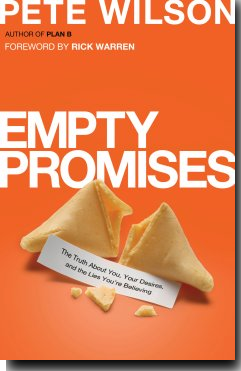
Empty Promises by Pete Wilson

imageIf you would just [give,show, serve, pray…] more, then and only then, will you be safe.

Christians habitually segregate the sacred and profane, thus explaining the blind spot that prevents us from seeing how even religion can become one of the idols that weave their way into our lives. They masquerade as good things: ambition, love, food, etc., only to draw and demand all of our attention in an effort to be the source of our satisfaction. Too late we discover that the promise is empty.

Pastor Pete Wilson comes up beside us and holds the mirror that brings these blind spots to our attention. Empty Promises addresses the pantheon of mute idols that commonly appear in the lives of Christ followers and derail our journey. Each chapter effectively points out our snare in the context of the scriptures, letting us see what it has done in the lives of others. Though we are separated by centuries and context, the solution remains the same. Find satisfaction in God; don’t be led astray by the empty promises of sensual or religious experiences.

Empty Promises is well written and engaging and will find a welcoming audience. The challenge that Wilson encounters in our modern day is that this has all been said before. Voracious readers will have already trod this territory many times over, finding the referenced scriptures already underlined in their bibles. This shouldn’t stop you from picking up the book but it may be one that you pass on to a younger reader so they can engage it for the first time.

I’m grateful to Thomas Nelson who provided this volume for review.

All The Cool Kids Are Doing It

“Pastor, everyone thinks that…”

“Hey, everyone is going to …”

“Mom, everyone will be at …”

Everyone is an interesting pronoun. It is an indefinite form that doesn’t refer to a specific person or thing. While plural in its scope, it is treated grammatically as a singular. Everyone is the faceless mob.

Pastor, everyone dislikes the color of the carpet in the sanctuary!

Wow, you wonder, how could I have been so wrong? How can I be the only person who likes the [color of the carpet, the new sound of worship, the Children’s church, the youth pastor, (insert your current issue)]? This reflection should only last a second though as you recall your grammar. It represents the whole as a single entity, and since you don’t dislike (whatever) you recognize that the scope of its usage is necessarily limited.

Everyone is not leaving the church. Everyone does not disagree with the decision to name so and so as a ministry leader. Everyone is no one until you are included. Until then, the scope of the commenter is subject to challenge. When you do however, an interesting thing happens.

They almost never include themselves in ‘everyone’.

‘Everyone’ is a challenge or a test. The person using the term is poking and prodding to see what kind of a reaction they can provoke in you. If you take the bait and respond by asking what can be done about the issue at hand, don’t be surprised if the solution is deeply enmeshed in that person’s agenda. This isn’t necessarily malicious but it may threaten to derail the plans that God has laid before you for His church.

When I am confronted by ‘everyone’, I use a number of probing questions and statements to get to the heart of the issue:

  1. “Do you dislike …”: Often, this simply question helps to uncover the true nature of the speaker’s concern. Perhaps there was safety in posing the question as crowd-sourced and now they feel safe in speaking for the group even as they give their personal take on the issue.
  2. “Who exactly is unhappy with …”: This question can put a stop to agenda promoters as you indicate that you will speak to the other people directly, freeing her from the enormous responsibility of being the spokesman for the crowd.
  3. “You and I agree that … should be done, so it really isn’t everyone is it.” This is another statement that uncovers what really wants/needs to be said.

Grace and peace to everyone…

Psalm 117 ~ Extol Him All You People

Praise the Lord, all you nations; extol him, all you peoples.

For great is his love toward us, and the faithfulness of the Lord endures forever.

Praise the Lord. Psalm 117

Extol: glorify, magnify, exalt, bless, make much of, celebrate, emblazon, sound or resound the praise of, ring one’s praises, sing the praises of, trumpet, praise to the skies, porter aux nues, doxologize, praise God from whom all blesing flow…does your list end here?

Grace and peace to you …

image Eric Slatkin

Ethos, Pathos, Logos

Saying It Well by Charles Swindoll

Near the very end of Saying It Well, Chuck Swindoll shares a piece of wise advice that summarizes the preceding pages…deliver it broken. In a moment of personal crisis for the Swindoll family, pastor Chuck considers how to put on his game face and step into the pulpit to deliver his message. Mrs. Swindoll leans in suggests that he not be anything but who he is at that moment and trust that God will use it to hone the edges of His Word to a razor point.

Pray that we should all deliver the Word from our brokenness.

Swindoll’s latest book is for those of us who speak to the public, whether in church or in a secular setting. Rather than a primer on how to craft a three-point message or rousing speech, Saying It Well emphasizes that who we are as people lies behind the most powerful messages. Without the use of the terms, Aristotle’s three conditions for persuasion (Ethos, Pathos, and Logos) are infused on every page.

The structure of the book mystifies the reader at first as it it largely biographical. What might this have to do with public speaking, one wonders, and then it dawns on you. Who you are so colors the delivery of a message that we are drawn to consider our own biography. The credibility (ethos) of your words is measured by the life that you lead. Your words will ring hollow if the listeners know you to be a man lacking integrity in your personal life while you talk about the importance of honest dealings. If you have no bond (pathos) with the people you are addressing, many will wonder why they should listen to you. You will be left with only the logic (logos) of your arguments to make your point. Many speakers bank on this aspect of their message but are disappointed to find little change in the listener afterword.

Swindoll does include a good deal of practical material in the book but none of it hits like a text book. In his homey way, Pastor Chuck suggests that this is his method for building a message, but that the reader should adapt rather than copy the process to their own workflow. We may be tempted to copy given the enormous success of Swindoll’s ministry but then remember that this success comes from who he is and not just the words themselves. Excellent advice for all of us to apply.

Grace and peace to you…

I am grateful to Hachette Book Group and Faith Words who provided this book for review.