Volume != Passion

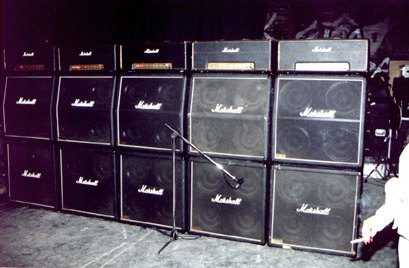
image In the February 2009 issue of Christianity Today, John Stackhouse has a penetrating piece on the trend toward louder worship bands in the church. (You can read the text on his blog by going here.) The core premise of his essay is that we have lost the intent of the musicians in the church. They are to accompany the praise of the congregation, supporting our voices with rhythm, melody, and key as we lift our hearts in song to our Father who we came to worship. The trend has gone in the other direction however. The praise band have become performers in many cases who feel that they must then project their music onto us as though we were attending a concert.

Though no worship band has yet to reach Motorhead-at-the-Warfield sound pressures, the volume in some cases has become annoyingly loud. Besides the physical discomfort of poorly mixed loudness, the volume has an effect that many worship leaders have failed to note. When you cannot hear your voice or those near you, the tendency is to not sing or to sing quietly. Look around you this week if your church uses a high volume praise band and make note of the number of people not singing but instead, simply watching the ‘performers.’ An important part of singing in worship is not often discussed; you are often singing for the benefit of others around you. When a person is unable to raise their own voice in praise due to their pain, suffering, depression, etc. many times it is the sound of your voice that lifts them up and gives them hope. When drowned out by the sound of crash cymbals, an opportunity for love can be lost.

Has your praise group become performers? Has the worship service become so choreographed and scheduled to the second that there is no room for the Spirit to work? When I think back to churches I have visited in which there was a lone pianist who played the melody and God was serenaded by the majority of people in the room and contrast it with some of the production oriented services I have been too, I come to conclusion that the pendulum has swung too far to one side and perhaps it is time for the arc to begin to come back in the other direction. Worship leaders, can you hear us?

Digg This

Friction Free Worship

As I’ve thought more about the impediments introduced by the church coffee shop and bookstore, I see a great deal of value in moving in the opposite direction of the “mall church” trend and instead designing a friction-free worship environment. This would be one which leads a worshipper directly from the narthex to the chancel (or in modern language, from the doorway to the altar) with as few obstacles as possible. Consider this passage from Isaiah as we reflect on the intentional design of our celebration event;

A voice of one calling: In the desert prepare the way for the Lord; make straight in the wilderness a highway for our God. (Isa 40:3)

and this one

And it will be said: “Build up, build up, prepare the road! Remove the obstacles out of the way of my people. (Isa 57:14)

image Each of these verses serves the larger context of the passage in describing the movement of the Lord to the holy place in which He meets with His people. Because He is the King, his people’s desire is to smooth the way for their meeting by removing obstacles and straightening the path so that there is as little friction as possible in His movement toward the destination.

I’m getting the feeling that the ‘all-in-one’ church design is beginning to deter from the core reason for the Sunday celebration. We may not all agree but from the perspective of a pastor, my understanding of the Sunday (or Saturday or Tuesday as it applies) gathering is the corporate worship of God. With this objective placed properly in the hierarchy we can then clearly examine the effect that other activities might have on accomplishing this goal. For example, an issue I raised in an earlier post has to do with the distraction caused by the church coffee shop. It has a certain stickiness, an attractiveness that introduces friction on the path to worship. I am tempted to stop and enjoy a cup of coffee on my way to sanctuary, perhaps justifying it as fellowship, rather than moving deliberately toward the altar, physically and mentally.

When we introduce friction in this manner, we are placing obstacles in our people’s preparation and attendance to worship. Their minds can become distracted from the purpose of the gathering and thus, they become not fully present to God. Our task as the called leaders of the Church is reduce rather than increase any friction between God and His people. Must we do away with the coffee shop or the bookstore? No, they serve a purpose in the community of the church and the lives of the congregation. Perhaps we might consider closing them before and during the worship gathering and opening them afterwards to contribute to the fellowship and growth of the family of God. In doing so we accomplish two things. One, we establish the priority of the corporate worship event and practice in the life of the Christian and two, we make straight the path for the worshipper’s heart so that there is a frictionless path from the door to the altar. What do you think?

Digg This

The Church Cafe and Shallow Worship

imageThe incongruity of the scene doesn’t affect you as you sweep past on the way to the sanctuary so that you might find a seat a least a few moments before the praise team takes their places. The rich, bittersweet smell of the daily roast caught you as you entered the lobby of the church and you wind through the clusters and knots of people surrounding the cafe. The brisk pace that you set for the family belies the fact that the Nine O’clock hour is moments away, but you can’t help but notice the number of people sitting at the little tables sipping coffee and the number of people still waiting in line to purchase a steaming cup of their own. Taking your seat with a minute or two to spare you glance around at the sanctuary which is barely one quarter full. Your eyes close and your head bows and you focus on the process of quieting your heart and bringing yourself fully present to the community worship of God.

As people trickle into the room for the next twenty or thirty minutes, you can’t help but wonder how many of them were sitting outside enjoying their latte as the praise leader skillfully attempted to lead the congregation into the immediate presence of God. Sure, many of the latecomers have no sense of urgency in being present while prayers are lifted up and voices raised in praise; to some it is simply a prelude to the sermon and it serves no purpose other than ritual. Do those same notions fill the hearts of the coffee drinkers? Have we gone too far in attempting to create an inviting environment, so much so that we have abandoned our primary mission as the Church – the worship of God?

I believe we have. I believe that in some instances the Church has leaned so far into the venues of the world in an attempt to be relevant or attractive that we have done so to the detriment of the Church itself. We would do well to contemplate again and again our purpose in convening on Sunday mornings. Is it to meet our needs for fellowship and only incidentally about worship? Or, do we gather at an appointed hour and place specifically to give corporate expression of our love and worship to God? With our answer in hand, we should then strive to ‘cleanse the temple’ of everything that distracts from that purpose, stripping away things that do not direct the people of God in the appropriate direction.

What do you think? Do you think that the cafe/bookstore/etc. contributes to preparing the hearts of the people of God for worship? Or, should these venues be closed and the hospitality ministry be directed to remove any friction between the front door and the chapel wherein people can quiet themselves, put the world aside, and prayerfully seek to know the presence of the Father?

Digg This

Psalm 15 ~ I Will Never Be Shaken

The psalmist asks,

Lord, who may dwell in your sanctuary? Who may live on your holy hill? (v1)

It is a reflection on one’s approach to the Temple and the appropriate condition of one’s holiness before nearing the throne. The ‘response’ cites a variety of ways by which a person can judge the condition of their heart and how closely they adhered to the Law. He or she are blameless, they speak the truth, loves their neighbor, etc. As we read the psalm in modern times we are driven to question our own approach to meeting with God in worship. Are we as worthy?

Some corners of the kingdom have substituted tolerance in place of holiness in the sanctuary. We often fail to consider the condition of our hearts before approaching the throne. In some ways, we approach the altar with the same casualness that we approach the Starbucks counter. Our personal holiness is of little concern during the week and yet we fully expect God to receive our praise and hear our prayers on Sunday. We don’t take holiness seriously and this attitude cannot be masked from God when we enter His house.

Each of us would do well to rewrite this psalm in our journal as a personalized prayer reminder to be used for reflection all through the week. It can aid the Spirit in cooperating with the transformative work in which He engages in our lives. He does so purely that we might be presented at the throne, today and into eternity as righteous and blameless.

Gideon’s Call from Weakness II

Even the most devout among Christian believers will have moments of struggle and doubt. While our minds may fully grasp the promise that God does indeed hear our prayers, we are challenged by the silences that we encounter from time to time. There may be longer periods – ‘seasons’ is the popular way to refer to them – where we perceive God to be silent on all things. We feel overwhelmed by life and its inherent  challenges and wonder why God doesn’t step in and alleviate some or all of them. In extreme moments of despair, we may look around and consider the possibility that God has abandoned us. Such was the fuel for Gideon’s doubt and his question to the Lord, “…why has all this happened to us?”

Israel had devolved into an apostasy of previously unheard of depths explaining God’s distance from His people. The cycles in Judges of apostasy and repentance are demonstrated by the repeated chastening that God allows to be visited upon the land. True to human nature, the Israelites fail to consider their personal contributions to the times of silence and simply point out that maybe, perhaps, God has just given up on them despite the Covenant. Being able to consider the scriptures from our distance of time, the source of their troubles is obvious but to the Israelites living in the middle of it, not so much.

The problem with apostasy is one of degree, as we see with the Gideon cycle. Where brief periods of separation bring us to repentance, longer periods bring on bigger problems. Israel’s apostasy in the Gideon cycle is so deep and prolonged that even the proper method of worship has been forgotten. Gideon demands a sign as proof of the legitimacy of his calling and he will prepare an offering to see if it is accepted in a divine fashion. Gideon’s struggle with proportion makes its first appearance as he goes about preparing his test offering.

Forgetting the proper forms of worship offering spelled out in the Law, Gideon’s preparations are based solely on his own evaluation of what is appropriate. He prepares bread, for example, from nearly a bushel of wheat. He brings this and a goat to the Lord as his offering to which God shows patience. This could have gone two ways as we look at it now. God could have refused the flawed, human oriented offering or He could do as He did and sanctify the offering but creating an altar for it’s proper presentation. The consuming fire convinces Gideon of exactly who stands before him.

We talk much about proper worship today, perhaps banking on the fact that God will accept just about anything as a form of worship. I wonder if our own apostasy leads us to believe this and stretch the boundaries of worship further and further from God and closer to ourselves. We trust in God to know what’s in our hearts and ignore the outer trappings that we bring Him as worship. Gideon certainly did and God demonstrated patience with him. Is there a point where we take it too far?

Wesley on the catholic Spirit

Wesley does not speak here about theological compromise. Instead, he demonstrates a rare ability to segregate the essential from nonessential elements in the Christian faith.

Every man necessarily believes that every particular opinion which he holds is true; (for to believe any opinion is not true, is the same thing as not to hold it;) yet can no man be assured that  all his own opinions, taken together, are true. Nay, every thinking man is assured they are not… “To be ignorant of many things  and to mistake in some, is the necessary condition of humanity.” This, therefore, he is sensible is his own case. He knows in the  general, that he himself is mistaken; although in what particular he mistakes, he does not, perhaps he cannot, know…

Every wise man, therefore, will allow others the same liberty of thinking which he desires they should allow him; and will no more insist on their embracing his. He bears with those who differ from him, and only asks him whom he desires to unite in love that single question, “Is thy heart right, as my heart is with thy heart?”…

But what is properly implied in the question? … The first thing implied is this: Is they heart right with God?…Does the love of God constrain thee to serve Him with fear? … Is they heart right toward thy neighbor?… Do you show your love by your works?… Then, “thy heart is right, as my heart is with they heart.”

“If it be, give me thy hand.” I do not mean, “Be of my opinion.” You need not: I do not expect or desire it. Neither do I mean, “I will be of your opinion.” I cannot; It does no depend on my choice; I can no more think, than I can see or hear, as I will. Keep you your opinion, I mine; and that as steadily as ever. You need not even endeavour to come over to me, or bring me over to you. I do not desire you to dispute these points, or to hear or speak one word concerning them. Let all opinions alone on one side and the other: Only “give me thine hand.”

I do not mean, “Embrace my modes of worship;” or, “I will embrace yours.” This also is a thing which does no depend either on your choice or mine. We must both act as each is fully persuaded in his own mind. Hold you fast that which you believe is most acceptable government to be Scriptural and Apostolic. If you thing the Presbyterians or Independents are better, think so still, and act accordingly. I believe infants ought to be baptized; and that this may be done either by dipping or sprinkling. If you are otherwise persuaded, be so still, and follow you own persuasion. It appears to me, that the forms of prayer are of excellent use, particularly in the great congregation. If you judge extemporary prayer to be of more use, act suitably to your own judgment. My sentiment, is that I ought not to forbid water, wherein persons may be baptized; and that I ought to eat bread and drink wine, as a memorial of my dying Master; however, if you are not convinced of this, act according to the light you have. I have not desire to dispute with you one moment upon any of the preceding heads. Let all these smaller points stand aside. Let them never come into light. If thin heart is as my heart, if thou lovest God and all mankind, I ask no more: “Give me thine hand” (Works, V, 494-499)

Perhaps we too can exercise some discernment and divide the essential from the non-essential, loving one another as the result.

The Legacy We All Hope to Leave

This tale of a life lived rightly was just the reminder I needed to carry on toward the prize. The theological debates, the bigotry on parade, the sacrificial struggles; they all mean nothing if we are not letting the glory of Jesus shine through our lives. In the end, Jesus will ask, “Did you give me a drink, did you visit me in prison, did you patch my wounds when I was ill,” and so on.

Jubilee in the Age of Racism

[The following was written by one of my spiritual mentors, H. Malcolm Newton. I was unable to find an online link to the old document so it is transcribed word for word here. It was originally published in the Faculty Column of a journal called Focal Point.]

The Mark Fuhrman developments in the O.J. Simpson case as well as the Million Man March in Washington D.C. tend to confirm the view that those failing to learn from history are condemned to repeat it. It was simply a matter of time before circumstances exposed the deep-seated racial hatred running rampant in American society. Both incidents reveal that America is descending into “a state of psychological apartheid.” They reveal what “the future is going to be, unless the church grabs hold of its prime directive: to be God’s reconciling agent in the world” (Dr. Bill Pannell, The Coming Race Wars)

The Bible records the response of faithful people to events and issues. It is action arising from the foundation of biblical witness, church tradition and a a community of faith. Jesus’ call to repent and turn away from the destructive forces that permeated his society was followed by an invitation to be part of a new community of faith. The church cannot be just another social institution; it must be a new social reality presenting an alternative way of life.

The challenge is for Christian leaders to resurrect a new vision of hope and faith in the face of the spiritual nihilism and material decay in our inner cities. How does the church do theology (ministry) in light of such challenges? Strict doctrine, speculative theology and political ideology cannot be the basis for action. The church must root itself again in the values of the kingdom and live a theology of response.

Foundation to reconciliation is a theology of creation. Scripture records that God created the earth and the whole of creation is his. God gave Israel the use of the land, but it was not their possession: “No land shall be sold outright, because the land is mine, and you are coming into it as aliens and settlers” (Leviticus 25:23). Stewardship of God’s creation became a crucial aspect of Hebrew theology. The Torah taught that the right of property was subordinate to the obligation to care for the weaker members of society, such as the poor, the homeless and the stranger (Leviticus 25:35).

The year of release established a universal release of debts and freedom every seven years to all enslaved for debt (Deuteronomy 15). In the 50th year, the year of jubilee was celebrated (Leviticus 25) in which all land sold returned to its original owner or his heirs. The jubilee year met three basic demands for justice: remission of debt, liberation of slaves and redistribution of land.

God designed jubilee to protect the poor and weak. The Hebrew nation, however, strayed from this system of justice. God stood strongly with the poor through the prophets who frequently pronounced judgment on the nations because the poor had been oppressed, exploited and denied justice (Amos 5:7-13). God judged the nations because they had reneged on their promise to observe the jubilee and Sabbath years (Jeremiah 34-35).

Jesus’ message proclaimed the ethic of jubilee: release of the captives, recovery of sight to the blind and good news to the poor. At the beginning of his ministry, Jesus read the words of the prophet Isaiah, saying that these words had come true:

    The Spirit of the Lord…has anointed me; he has sent me to announce good news to the poor, to proclaim release for the prisoners and recovery of sight for the blind; to let the broken victims go free, to proclaim the year of the Lord’s favor (Luke 4:18-19).

In Jesus the reality of jubilee was present.

The church must raise the question, what is the level of pain and hurt that minorities, and in particular black males, are experiencing in this country that they are attracted to Louis Farrakhan, a non-Christian? The evangelical church missed the opportunity to proclaim the good news to the poor because it has failed to understand the justice issues related to the poor. Farrakhan is trying to fill that void.

Evangelical leaders need to be empowered for a ministry of reconciliation. It is time that evangelical ministries become deeply involved in addressing the consequences of systemic violence, child abuse, battered women and gang violence as well as rivalry and conflict between and among ethnic groups. The culture of confrontation and violence taking hold in our cities is making new demands on the Christian community who can no longer ignore the pain and suffering of their brethren. Christians must validate the integrity of that pain and hurt in order to speak to the crisis in people’s lives. At the same time, Christina must talk seriously about agape strategies (love-informed strategies) and how to allow the grace of God to transform those lives and the society in which they live.

Christian leaders must proclaim to the drug user and drug dealer, the homeless, the prostitute and the gangs that Jesus is the Christ and that is the good news! The sin-bound, blind, brokenhearted and despairing need healing. The captive and oppressed need transformation. The devastated and ruined cities need repair.

As the presence of Christ in the world, the church is to become the embodiment of jubilee. Based on Scripture, I call upon churches, church agencies and the academic, theological communities throughout the country to consider, discuss, debate and take action. Establish “Adopt a Gang” programs that evangelize youth in gangs; commission missionaries to serve as court advocates for black and Latino juveniles; train street-corner evangelist to work with youth involved in drug trafficking; establish rape crisis centers and services for battered women; provide counseling for abusive men.

The crises generated by the capitalist urbanization process present an opportunity for the emergence of new moral and intellectual leadership. “The ascension of Farrakhan as a pivotal figure in the black community is a result of the failure of black church leadership to develop a coordinated program of evangelism and rehabilitation for black males” (Eugene Rivers as quoted in Christianity Today). If we, the community of faith,–black and white—rise to the occasion, we may be able to retrieve a generation cut adrift. If not, we will have brought down the judgment of God on ourselves for reneging on Jesus’ promise of jubilee.

Prof. H. Malcolm Newton is [was] assistant professor of World Christianity and director of Globalization at Denver Seminary.

Here is a PDF of the original article newtonessay.pdf