The Real Mary Surrenders

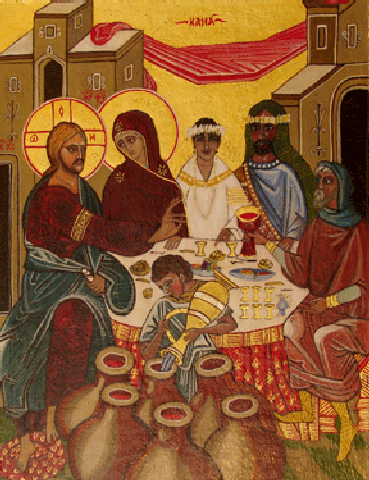
After Jesus has called His first disciples, we catch another important glimpse of the growing relationship between Mary and her Son. The wedding at Cana is recorded, not to memorialize the bride and groom but, so that we might be witness to a turning point in both Mary’s life and the ministry of the Lord. The memory most often associated with this event is the miraculous transformation of water into wine but we must reread this passage again to see all that going on.

We can initially be put off by the brusqueness of the interchange between Jesus and His mother as her innocent observation that there was no more wine causes His not so gentle reminder that the time had not come for Him to act. Mary is brought to a precipice of realization at this moment. Jesus’ allegiance was simply and profoundly placed in His Father and in His comments and Mary would need to recognize her place in this new economy. She must now surrender any influence she desired in directing his life or ministry as Jesus honors God with His obedience to the eternal plan. She must fully commit herself to becoming a follower of Jesus.

Just as Jesus indicates that He is prepared only to act in obedience to God’s timing, we too must find in ourselves the same obedience. It begins with the surrender that Mary displays. Life for the follower of Christ is no longer ordered around our human desires and timing. Instead, obedience calls us to recognize, as Jesus did, the perfection of God’s plan and his timing. Surrender.


New Adventurers

Read Sarah’s proposition Could Church Not Suck?  Well Sarah, I hope you are discovering that the answer is Yes! Actually, Church can not suck! God’s heart is for people and He is with them in many, many places outside of the four walls of the sanctuary. The missional ideas that Hirsch is talking about takes us all out of the church and into the world. It’s dangerous out there where God is but you can’t beat it. Come on and join the adventure…

Worshipping as Artists

Rebecca Groothuis, who contributed greatly to the egalitarian components of my pastoral theology, has a wonderfully provocative question in her article Let’s Put Worship Back in the Worship Service. Though the article is a decade old, her proposal that we focus on ministry to God in worship before ministering to those in need challenges our current missional order of priorities.

I think that we often get swept into combining the worship impulse with our outreach impulse into a single activity. By ministering to his people we are worshipping God and in this mashup, He will be singularly pleased. Our separation of these activities and the subsequent recognition of the quality of our worship will result, Groothuis suggests, in a reordering of our ministry. It is not without benefit. The greater focus on worship as vocation contributes to our discipleship which in turn contributes to a greater missional impulse. What do you think?


The Forgotten Ways: Unattractive

Scot McKnight at Jesus Creed continues with the conversation regarding Hirsch’s book and this week he discusses chapter four, Disciple Making. The question that he poses are “(Questions for the day:) Is consumerism the biggest threat to discipleship today? What is the best way to make disciples?” Hirsch treats this section with a bit more emphasis, seeing the making of disciples as “the single, most crucial factor” in contributing to mDNA that lies at the heart of a missional church or movement. His contrast throughout the chapter lies in the contrast between a “white hot” movement rooted in a mission and the passive, consumerist Church of modernity.

I think that the question regarding the threat posed by consumerism to discipleship can be better framed by reversing the focus; why isn’t discipleship a threat to consumerism. The American context in which I’m reading the book is very much defined by its consumer tendency. We are free to pick and choose from countless choices and, in many cases we need not expend much effort at all to receive goods and services. We can be passive consumers and participants in the culture. This culture has obviously affected the Church where we often find the vast majority of Sunday morning consumers passively receiving programs and services with little demanded in return.

The consumer mentality threatens discipleship because, by its very nature, it is not a passive activity. Discipleship in the way of Jesus requires accountability, dedication, and personal investment, all things that are anathema to the consumerist mindset. The pastor that models and expects it from a congregation will often experience consumerist reaction as the passively committed members seek an easier to consume experience.

In returning to my restatement of Scot’s question: why aren’t we more of a threat to consumerism? Do we who are pastors allow the passivity to take root in our congregations? Are we engaged in discipleship ourselves sufficient to stoke a white hot faith within us? Why not? Is it easier to read (consume) someone else’s work instead of creating our own?


The Real Mary Wonders

In the compressed narrative of Mary’s relationship with her son Jesus, twelve years have passed since the birth and consecration of the boy. In the four gospels we are not invited to peer into this era but his mother, at his side during this formative period has had plenty of time to consider who the man Jesus is going to be. Since Simeon dashed her original impressions of the Messiah, she has watched the development of her son for clues about his future. Does Mary wonder why God has delivered the Christ as a child? Does she ever consider, as the boy goes through all of the struggles and triumphs of childhood and early adolescence, that perhaps there may have been a mistake in her understanding of the what has been revealed to her?

During the Passover celebration of his twelfth year, Jesus acknowledges his vocation. When Mary notices him missing from the caravan and she and Joseph hurry back to Jerusalem we can sense her alarm. Is she frightened because her child has gone astray, or more worried that she has failed to protect the Christ? To her astonishment, her frenzied search through the city finds Jesus at the center of a theological discussion in the Temple. Not listening and learning, but leading and clarifying.

Mary’s admonishment of Jesus momentarily puts aside the divine history for the love of a mother. Her frustrated, maternal relief is evident in the anger of her question. Jesus, not disrespecting her but clarifying a shift in their relationship, asks why she is alarmed at his being in His Father’s house. As we picture this scene in our minds, we see yet another change Mary’s understanding of the child she has brought into the world. Though tacitly He will be known as her son, Mary must confront the stark realization that His greater allegiance is to their Father. Was she broken, humbled, or proud of this moment? Given the history of revelation to her, can she have come to any other conclusion? We are left to wonder.


Michael and the Briarcrest Saints: a Parable

The word translated Goodness as we read the list of the fruit of the Spirit (Gal 5:22-23) has both a descriptive element that combines with an active component. It means both to have the goodness of character brought about by the transforming Holy Spirit and to actively demonstrate this good, wholesome character trait to others. The parable of the Good Samaritan is often pointed to as an illustration of good, as the Samaritan goes out of his way to care for the injured man who had been bypassed by others who should have been marked by this same spirit of compassion and generosity. He alone exercises both trait and action.

It strikes me that the story of Michael Oher and the Tuohy’s is a modern parable of this goodness. Michael’s destiny was pointing in the wrong direction from the moment of his birth. Being born into poverty and a broken family situation placed him alongside the highway of American culture while others who could intervene whizzed past him without attempting to help, justifying their lack of charity for any one of a million reasons. When Big Tony put Michael and Steven in his ancient Taurus and drove them over the imaginary line dividing Memphis, he set in motion the act of goodness that would come to pass.

When Michael was granted admission to the Briarcrest Christian School, Sean and then Leigh Anne had their moments of intervention into his life. Unaware that his future trajectory would skyrocket with the recognition of his football skills, the Tuohy’s simply saw a person in need of help. And help they did, as the Samaritan did, by taking greater and greater responsibility for their charge ignoring the racial line that had divided their community for years and treating him as though he were one of their own. In other words, their good went beyond a sense that something should be done – it came to life nosing the course of Michael’s life into a steeper and steeper upward angle.

The best parables are simple so many details are absent this observation. The rest of the story is told in The Blind Side which I’ve written about previously.  There is much fruit to be harvested in this tale; love, patience, kindness and self-control among them.

The Real Mary: Triumphalism Reversed

Scot McKnight has produced a volume that is academic and devotional, and irenic and polemic, sometimes in the same chapter. The Virgin Mary is not the one-sided character of the creche (a new word for me) but she is a woman of numerous facets upon which we might meditate. One side of her life that is too easily hidden by the oft-pictured passivity is the Mary of sorrow, the topic of today’s chapter in The Real Mary today.

Joseph and Mary take their baby to the temple in Jerusalem for a two-fold ritual in obedience to the Law. (Luke 2:21-39) Mary is to be purified and restored to normal community relations after her delivery and the boy is to be consecrated to the Lord. Mary cannot be approaching this ceremony without considering its place in the triumphal theology that has been developing in mind since the moment of conception. The baby she carries up to the temple is the newborn King and the consecration may be the end of one cycle as He is given over to the service of God. She must have wondered if this become his coronation, the beginning of the public recognition for all that she has kept relatively secret in her heart.

That is, until the moment that the man named Simeon swoops over to take the child in his arms, lifting his voice in praise to the God who had promised him that he would not die before seeing the long awaited Messiah. Was Mary alarmed at this stranger? He had not only taken her child from the safety of her grasp but he was also receiving revelation similar to hers. Perhaps though, she had come to recognize that the little King would not remains hers alone for very long. Perhaps it was the praise with which Simeon buoyed Jesus above all other temple activity at that moment saying that God could call him heavenward as the promised Christ had come. Perhaps she was relieved that the important announcement of the coming of the King had been made by Simeon in the holiest locale rather than by her. Perhaps her simple joy at the immediacy of God’s presence overwhelmed all other streams of thought. We do well to consider all of these possibilities.

We do well also to consider the immediate reshaping that Mary’s triumphal soteriology takes upon Simeon’s following words. The Christ will divide rather than unite; he will become a person to be opposed by many rather than followed. As Mary certainly struggles to assimilate this new revelation, she is struck personally by Simeon. Her son will be a sword that pierces her own soul. How does she gaze upon the baby now? She knows now that Jesus will break her heart and she knows that she can do nothing to stop it. Mary is now a woman of sorrow.


The N Word

I suppose that legislating the use of the n-word has some symbolic value but its use will continue until those who retain it as a part of their vocabulary can look upon another human being and see the inate worth of that person. Continuing to hang on to the use of a derogatory word, whether it is a cultural affectation or a pejorative, degrades us as people from the inside out. Laws will not hinder the term’s use; souls connected to the Image Creator will.

Hope Iz

Iz once wrote “For without hope I cannot live.” He told a story in the song Hawai’i ’78 Introduction about his father who died of a broken heart. The pressures of life exerted so much force upon the man that what hope he had was unable to push back. Every morning we’re confronted with word of a new slaughter, another on the job shotgun rampage, stories of the best and brightest cheating, and the never ending rancor of political debate that continues to rise in its shrillness. Is it even possible to have hope?

Iz had hope. Paul had hope. I have hope. When the lyrics point you to a hope found somewhere at the end of the rainbow, remember that the rainbow is an arc, not a line up past the clouds. That arch begins and ends right where you are after having touched the heavens. You are made in the image of the one who wants to give you hope, not only in the future, but right now.

Technorati tags: , , ,