You, Theologian : Where We Begin

image

As we accept our call to be theologians, the next logical question is to ask what that means. Many in the Christian community will default to the image of the sequestered scholar, surrounded by mountains of books and poring over the scattered papers piled before him. Theology, in this narrow view, is a field with high barriers to entry, only to be approached by a select few while the rest of us wait to receive their wisdom. Nonsense. This stereotype is not only damaging to the faith, it is flat out wrong. Go look in a mirror Christian. There is a theologian. Regardless of background, social group, education, or denomination even, you and I are called to be theologians and our theology is formed in two ways. One is by our experience of being a Christian. This is known as our embedded theology.

Our first order theology comes from the Christian environment that surrounds us. This environment, usually our church and this immediate community, usually drives what we believe about our faith. Since every church believes itself to be living by Christian principles, the initial framework of how we think about faith is organized on a similar framework to that which guides our church. The practices, stated doctrine, and general atmosphere give us some idea of what it means to be a Christian. We trust that those who developed the doctrines and traditions knew what they were doing and this confidence tells us we can accept these things without too much worry.

This is as far as many believers will ever go. If our church teaches it, regardless of the initial reasons, it’s good enough for us. Embedded theology works well for a while but some cracks in the firmness of the foundation begin to show when it is challenged. The first challenge often arrives in the form of a comparison between our church and our neighbor’s church. We may worship within a tradition that has a dry tradition toward alcohol and so we live as teetotalers. One fine summer day our neighbor Ed invites us over for a barbecue. Ed and his family are Christians who go to a different church but we still look forward to some fine fellowship. Knocking on the door brings Ed quickly to answer it, swinging the door wide with the hand that isn’t gripping his beer. Beer! Your embedded theology sends a message to your brain: smile, but watch this guy carefully since you know that no Christians use alcohol.

The barbecue is fine and later, as you nurse your third cola, you get a chance to talk to Ed alone. “Say Ed,” you say. “I noticed you drink beer.”

“Yep, I have a couple now and then. Why?”

You don’t want to lecture (but secretly you do) so you put a big smile on your face and say “Well, my pastor speaks against alcohol at least once every couple of months. I was just wondering how often yours does.”

“I’ve only heard him talk about it once.” Ed replies and takes the last sip of his beverage. “He taught us that the Bible talks about drunkenness but doesn’t say we must not drink alcohol. Didn’t Jesus drink wine?”

So it seems that some Christians do drink alcohol. How can the Bible teach both things? We trust our embedded ideas but often find them quickly challenged.

Second order challenges are much more difficult for this type of theological thinking. Imagine the family of the child who wandered away at the beach and got too close to the surf. She was swept out of reach of her searching parents and they lost her. How will the shallow theology of our community answer this tragedy. Why did God take the child? Were the parents secret sinners who were being punished? Was the child herself punished? Embedded theology is usually to fragile to deal with something like effectively. To come to grips with a loss like this requires a depth in the answers. It requires an intentional approach to theological questions. It requires that we practice deliberative theology.

Deliberative theology begins work right where we are by setting forth to reflect upon our embedded convictions. We question the beliefs that we have taken for granted and seek to place them among the spectrum of Christian belief on a subject. The deliberative approach looks into the various positions and seeks to understand that which is most satisfactory. Sometimes this is easier said than done since seeking answers outside of our narrow understanding can lead to challenges that we would rather not face. Beloved traditions and beliefs can be toppled in an instant and many will retreat to the shallow end of the pool when this threat becomes too real.

Sadly, we discover our need for a more intentional approach to theological thinking when the deeper tragedies of life occur. Our embedded beliefs prove unsatisfactory to answer the questions we have and we embark on a quest to understand. When we are prepared to set aside simply believing what we are told to believe and to make the effort to understand why we believe what we believe, we finally grow and mature as Christians. We see God as more than just Daddy. We seek out a deeper knowledge of His revealed nature and character. The result is a more satisfying faith and a more complete worship. We are living out our calling.

image by rogilde

Day Eight in the School of Prayer : Be Persistent

WithChristInPrayer

Then he said to them, “Suppose one of you has a friend, and he goes to him at midnight and says, ‘Friend, lend me three loaves of bread, because a friend of mine on a journey has come to me, and I have nothing to set before him.’

Then the one inside answers, ‘Don’t bother me. The door is already locked, and my children are with me in bed. I can’t get up and give you anything.’ I tell you, though he will not get up and give him the bread because he is his friend, yet because of the man’s boldness he will get up and give him as much as he needs. (Luke 11:5-8)

We have often read this parable or heard it preached with an emphasis on the persistence of the asker. The friend who responds to our knock would turn us away because the conditions are not right, yet if we are bold (persistent depending upon your translation) he will arise and provide the requested loaves. There is another emphasis in the Lord’s words that is not often heard and that is speaking to a friend on behalf of another.

Christ teaches us of the importance of intercession in this brief interchange. Our temptation is most often to pray for ourselves and our own needs or comforts. God is certainly not offended when we voice our needs but He is examining our trust of His provision if this activity becomes our sole focus. Jesus speaks here of shifting our focus from ourselves to the needs of others in prayer. We do not seek the three loaves for ourselves because we were too lazy to bake them. We seek the three loaves from a friend at midnight when he is in bed because we want to provide for a visitor who has unexpectedly appeared at our door and is in need of sustenance. We can be assured of answer to our intercessory prayer.

Perhaps the easiest word to read over is ‘friend.’ Jesus does not say we go our neighbor or a stranger to request to loaves, we go to a friend. Are you approaching God as a friend? Jesus proposed the simplest test for us to evaluate our friendship; “You are my friends if you do what I command.” (John 15:14) The prayer as a friend of God is the one in which confidence can be vested.

Psalm 27 ~ Wait for the Lord, Be Strong and Take Heart

imageIn the 27th Psalm we have one of the most eloquent expressions of the central ideal of biblical faith – trust in the Lord. David exhorts us to come to the same conclusion that he has; despite current challenges and threats, the Lord can be trusted in full. Two stanzas of his expression of trust open the psalm.

The Lord is my light and my salvation – whom shall I fear?

The lord is the stronghold of my life – of whom shall I be afraid?

When evil men advance against me to devour my flesh, when my enemies and my foes attack me, they will stumble and fall.

Though an army besiege me, my heart will not fear; though war break out against me, even then I will be confident. (vv 1-3)

Danger is all about and the psalmist has every reason to fear but he will not allow himself to do so. Fear will not overwhelm his confidence in the protective wing of the Lord nor will it challenge his confidence. Do we practice the same steadfast confidence in our current world? We are bombarded constantly with bad news and dire predictions of calamity. Without faith in the preservation of the Lord that he has exhibited throughout history, men and women succumb easily to the short view, seeing their imminent destruction and possibly their final breath. Knowing that life in this plane is not all that there is, the Christian looks forward.

With such confidence, why does the psalmist pray for deliverance in the second half of the psalm? Confidence does not preclude our petition of God. The Bible teaches us the propriety of being in prayerful communion with God and to take all things to him. Asking for a deliverance and His preservation should not indicate a lack of confidence but rather, a knowledge that the Lord craves our presence with him in prayer. The concluding verses of the psalm summarize for us.

I am still confident of this: I will see the goodness of the Lord in the land of the living.

Wait for the Lord; be strong and take heart and wait for the Lord. (vv 13-14)

Digg This

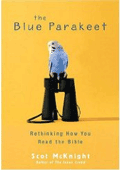
The Blue Parakeet by Scot McKnight

BlueParakeet

If you’ve read Scot McKnight’s blog Jesus Creed, you know that his work ranges far and wide but almost always centers on the meaning of Jesus in the context of living out our faith in the modern world. His books mirror this broad spectrum of application from drawing Mary back into Protestant life with The Real Mary to emphasizing the twin foci of love as the outcome of spiritual formation in The Jesus Creed.  McKnight’s latest offering is an outstanding entry in his library, moving Christians to consider the way in which they read the Bible. The Blue Parakeet is not a hermeneutics text, it is a challenge to manner in which we hear the words of the text. Is it a collection of ‘thou musts’ linked together by vignettes of human history or a lengthy and far-reaching story of God and His relationship with creation? Scot helps us to discover our initial viewpoint and then leads the reader to discover alternatives that help us to apply the Scriptures to a modern culture that is much different from the setting of the stories we read.

Central to Scot’s ideas throughout the book is the question, how does God speak to people through the Bible? We can read the text in a fossilized state, forever locking words in their first century (or earlier) context while trying to apply them to a twenty-first century culture or, as McKnight asks us, we can consider a broader reading of the Bible as themes that are universally applicable in each proceeding culture. In doing so, we can easily see that God spoke Moses’ days in Moses’ ways, in Jesus’ days in Jesus’ ways, in Paul’s days in Paul’s ways, and given that pattern it is reasonable to hear God speaking to us in our days in our ways. The themes and concepts of the Scriptures were meant to carry God’s words throughout every era of history, continually applicable to an ever-changing culture.

Blue Parakeet weaves an interesting path that leads to the development of discernment in the application of the Bible to our modern lives. Ever the professor, McKnight puts the preceding chapters to the test in applying the ideas to the contentious issue of women in ministry, devoting five full chapters to the subject. This section of the book cements the value of this work as it transfers the ideas that he presents in the early chapters from the abstract to the concrete, demonstrating how they can be applied to an issue. Will this methodology ruffle some feathers (no pun)? Certainly, but by reading the Scriptures as story rather than Torah we find each generation and culture challenges those that came before it and God remaining consistent throughout.

The Blue Parakeet was not written specifically for an academic audience but seminaries would do well to consider including this book alongside their selected hermeneutics text and How to Read the Bible for All Its Worth. As with all of Professor McKnight’s books, Parakeet is well written, organized and applicable. Like a well crafted sermon, each idea has appropriate illustrations and solid application for the reader to use in testing the viability of the proposition. Christian leaders and laypeople alike should spend time reading, discussing and applying this book. 

-oo-

I was privileged to receive an advance reader edition of this book prior to its release and I took a couple of weeks to read it slowly and savor the ideas in small sips. Scot McKnight has once again provided an invaluable contribution to the advancement of the Church and the faith and his style makes the book immediately accessible to every member of the Christian community.  I am going to begin a series of posts on the book, looking at each chapter on its own now that it has been released. It dovetails perfectly with another ongoing series I have been doing on Foster’s book Life with God. Both McKnight and Foster emphasize reading to hear; listening to the scriptures for God’s voice and his unique address to each one of us. What Scot contributes to this discussion is the emphasis on God speaking to us in our ways. Our application should then take cultural context into consideration in every move we make. I’ll look forward to interacting with other readers of the book in the weeks ahead.

The Psalms

image The one hundred and fifty psalms collected in the scriptures are very nearly a bible unto themselves. These praises, prayers, and laments have spoken to the spectrum of human emotion and experience century after century as God’s people try to comprehend what it means to be just that, God’s people. The psalms have been a part of devotional bible reading and cried out as individual prayer because of the depth of the psalmists soul that the Spirit revealed for inclusion in the Word. The Psalter has a revered place in worship beyond the pulpit as well. The psalms often find their way into the call to worship and the musical selections. The Psalms provide us with God’s word for all seasons of life.

My next series of bible study posts will be on the psalms, one at a time. I invite you to contribute to a dialog on the meaning and theology of each of these important portions of scripture. Have they affected your life or your relationship with God? How does your church utilize this book? Will we be different when we finish this time together.

The Two Sides of Gideon I

In a Judges cycle that has definitely taken an unexpected turn for the worse, we catch a glimmer of hope.

The Israelites said to Gideon, “Rule over us—you, your son and your grandson—because you have saved us out of the hand of Midian.”

But Gideon told them, “I will not rule over you, nor will my son rule over you. The Lord will rule over you.”

At the inappropriate request, Gideon flashes his devotion to the Covenant. “The Lord will rule over you!” The tribes had pledged their absolute allegiance to Yahweh as their king at the base of Mt. Sinai and this near history should not have been lost on the people raising this cry. Certainly, it must have at least crossed someone’s mind that to take Gideon and his sons as a dynasty would have broken their covenant agreement?

Gideon does, and emphatically demonstrates his loyalty to the agreement. This catches our eye so quickly after he has acted impetuously out of his own anger in Succoth and Pineil. For a man with such respect for the covenant and Yahweh’s lordship, he did not hesitate to act in vengeance of his own volition. Maybe the reason this catches our interest is that it all sounds so familiar. We’ve been there. We recognize the struggle to make our actions match our theology. It’s harder than it looks.

The Shock of Gideon’s Turn

image

Reading the Gideon cycle in Judges we find ourselves at an unexpected turn after his victory in war. Rather than the hero we are led to expect who transcends his fearfulness and forges forward in trust, we find instead a normal person.

Maybe, a person more like ourselves than we are willing to admit.

What catches us off guard is how quickly Gideon forgets his Yahweh ordained purpose. God did not call on him to destroy parts of Pineil or administer the whipping that the men of Succoth endured; he performed both of these actions out of his own desire for revenge. The Israelites will respond in much the same way as we turn the page. Rather than turning to the Lord in their desire for leadership, they cry out for Gideon to lead them as their ruler. Is there hope for Gideon?

We can benefit today by meditating on the words of a later leader.

Psalm 3

O Lord, how many are my foes!

How many rise up against me!

Many are saying of me,

“God will not deliver him.” Selah

But you are a shield around me, O Lord;

you bestow glory on me and lift up my head.

To the Lord I cry aloud,

and he answers me from his holy hill. Selah

I lie down and sleep;

I wake again, because the Lord sustains me.

I will not fear the tens of thousands

drawn up against me on every side.

Arise, O Lord!

Deliver me, O my God!

Strike all my enemies on the jaw;

break the teeth of the wicked.

From the Lord comes deliverance.

May your blessing be on your people.

Gideon Pursues the Enemy III

image After Gideon and his army had routed the entire army of the Midianites and began marching their kings Zebah and Zalmunna back toward the Jordan, he must have been wondering why his Israelite brothers had refused to support him. Angrily he must have decided that they remained turned against Yahweh, unwilling to trust the mission that he had been given. Given the distance of time, do we see the irony in Gideon’s rage against them. They were bypassed by the Midian army but would suffer humiliation and destruction at the hands of God’s judge.

Perhaps the irony is masked by the change we see in Gideon himself. Starting out as hesitant and fearful, he slowly obeys God’s commands and embarks on the restorative mission. Obedience marks this Judges’ cycle until ego and the need for revenge transforms the man. Does he feel that God’s mission gives him permission to act independently to punish Piniel and Succoth? He crosses ‘over the line’ in crossing over the Jordan. Are we at similar risk?

Christian leaders are all tempted by ego and the human desire to get ‘even.’ It’s easy to even momentarily forget that we serve at the pleasure of God and it is His glory alone that should be the result of our service. Obstacles may come, we may have to face struggles that prick our every nerve ending and exhaust the limits of our patience, we may even find ourselves sidelined for a season when we feel as though we should be in the middle of the action but we must maintain our trust in God and the purpose he calls us to.