Teach Me Some Melodious Sonnet

Then Sings My Soul Book 3 by Robert J. Morgan

imageUnlike other books of this genre that provide insight into the background of our favorite hymns, Then Sings My Soul inspires. Christians raised on the worship music of today will discover the passion and depth of songs that they had never considered including in a set as they encounter the stories outside of John Newton or Horatio Spafford’s lives. Reading the accounts of tragedy and triumph that have led those who came before to pen the words that have endured as tools of worship for centuries in the ever-transitive life of the Church.

Morgan expands the individual accounts in this volume with material that expands the perspective of the reader in a number of directions. Brief sketches of musical movements throughout different eras broaden our understanding of why, for example, the German hymns follow the developmental course that they did and that the English hymnal is more than a collection of drinking songs. At the other end of this volume, Morgan includes a series of extended stories that will open the reader’s eyes, in many cases bringing new color and texture to some long-treasured life stories shared over and over in worship.

Of special interest is a brief plea to worship leaders to reconsider the concept of blended worship. Having spoken these same words to the Church many times, to read Robert’s eloquent support of intertwining ancient-historic-modern music was heartening. All inspired music has a story to tell, and the worship leader facing an intergenerational congregation honors God and His people by blending all of the eras to lead each to learn from another.

I am grateful to Thomas Nelson who provided this copy for review.

Spiritual Gifts: Cautious Openness

image

For now we see only a reflection as in a mirror; then we shall see face to face. 1 Cor 13:12

Where the Cessationist takes the view that certain of the spiritual gifts-specifically those of a miraculous nature-have ceased to be given to modern believers, a mediating position grants that they may be seen again. This position is often labeled open but cautious, indicating a recognition of God’s sovereign ability to once again visit believers with spiritual gifts of a miraculous nature. If He were to do so however, their receipt and use would align with the experiences recorded in Scripture in both purpose and practice.

Arriving at this theological position follows many of the threads that establish the cessationist position. Though the Holy Spirit distributes gifts to believers as He sees fit to edify and build the church of Christ, certain of the gifts —tongues, prophesy and healing-– were given for an earlier time in church history. Their purpose was to establish the authenticity of the Apostles and to aid in establishing the Church in the world. In the broader scope of all Scripture, the bible records miraculous events and happenings being clustered around three eras in history: Moses-Exodus, Elija-Elisha and the Christ-Apostolic era. (This does not diminish or dismiss other singular manifestations; it simply recognizes a concentration of activity around these points in history.) This review also establishes that nowhere does scripture indicate that the miraculous gifts are to be considered a normal condition of the Church era experience.

Complicating all theological discussion of the spiritual gifts is the lack of any explicit biblical statement with regard to the cessation of specific gifts. The cessationist position hinges upon the statement made in 1 Corinthians 13:8-13 as evidence for the discontinuation of the miraculous gifts. Contained within this pericope is the reference to that time “when completeness (cf: perfection) comes (1 Cor 13:10)” which is read as pointing to the time of the Lord’s return. This schedule thus leaves open the possibility of continuation for these gifts.

Limited openness to the continuation of the miraculous is encouraged by further examination of the New Testament record. First, the silence of the scriptures on the matter of cessation must cause us to expand the scope of our consideration. Second, the scriptures do not testify to the state of the Church in a post-Apostolic era. For this reason, we must rely upon recorded history since that century in evaluating what is to be normative, and this history includes limited manifestations of the miraculous. Finally, as God elected to utilize the signs of the miraculous for specific purposes in His unfolding of history, we must always be cognizant of His sovereign ability to do so again.

Though an openness is encouraged in this theological position, it is intertwined with the belief that nowhere does scripture support  the apprehension of the miraculous gifts as a normal part of the Christian’s experience. Since every manifestation in the scriptures is given by God for a ‘sign’ purpose or an exercise of His grace, this precludes the use of these gifts as a test of salvation. Nor does scripture support the giving of the spiritual gifts at the request of an individual for their personal use.

Any purported manifestations of the miraculous gifts must be joined with the Apostle’s exhortation to “test everything” (1 Thes 5:21). Any instance of these gifts should align with the historical purposes of their past application (purpose, use, etc.) and their manifestation in the Bible. Prophecy will be for the edification of the church, rather than individuals. The expression of tongues will be languages which express thought, not gibberish that cannot be interpreted by others present. Healings that are a part of a campaign are foreign to the scriptures and will likely remain so. In all things God is sovereign but He is also a God of order and verification.

Marana Tha …

image mustafa khayat

In Him All Things Hold Together

Jesus + Nothing = Everything by Tullian Tchividjian

imageThomas Paine described the crisis of revolution as the “times that try men’s souls”, a season of life in which one would have to be undeniably sure of the foundation on which his feet rested. Without that assurance there would be no resistance against which to create forward motion. Though not as momentous as the birth of a nation, author Tullian Tchividjian was confronted with a leadership challenge in the melding of two ministries that brought an unexpected resistance. The crisis forced him back to the irreducible minimum that formed his foundation, faith in Christ alone.

Driven to reflection, Tullian renewed his understanding of the rock on which he stood as character attacks and questions of ministerial competency swirled around, making him doubt the efficacy of what had brought him to that point. A performance ethic in particular threatened to derail his belief in the completed work of Christ as the touchstone against which he pushed for momentum. His exposition of key passages in Paul’s Letter to the Colossians restored his understanding of the sufficiency of Christ and the atonement and it is these reflections that form the core of the book.

Tchividjian’s writing and structure are dense, limiting the appeal of the tome to those willing to reflect alongside him. It will be read in small sections that turn your attention back to the Scriptures to see things that may have been masked to your eyes on previous reading. It is this density that gives the book its timeless appeal. Unlike the myriad volumes that will be published giving advice that quickly goes out of date, Pastor Tullian has written a book that can be pulled from the shelf over and over in the years to come as a guide to returning to the key, Christ alone.

Snipping the Tail of Rupert’s Drops

image

As readers have come to expect from Dr. Sweet, an upending of long-held paradigms is to be found in the pages of I Am a Follower. Less about mimicking the the ego eimi statements of the Savior and more about challenging modern perceptions of the Mission, Sweet’s book orients around the idea that leadership was not in Jesus’ mind when He set about discipling His followers and the generations that follow through the Bible. Sweet may be right, but a mature and finely-honed sense of discernment are needed to apply this notion, something that those new to the author’s works may not be prepared for.

Many Evangelical’s are immediately critical of Leonard Sweet and his body of work labeling it emergent and him as being on the fringes of orthodoxy. This misses his role as a provocateur working to prod the Christian masses to a deeper meditation of what Christ and His Church are to be about. In Follower, Sweet challenges the infatuation we have leadership in all of its permutations. He critiques the corpus of leadership material, training and practice, saying that it has led Christians away from the true command of Jesus to “follow me.” Creating an environment in which leaders are celebrated threatens to diminish Jesus when those leaders are not intentional about pointing others back to Him. The cure, he says, is for leaders to return to the original position as disciples at the feet of the Rabbi. As their wonder and humility are restored, a new attitude will be reflected in their discipleship of others.

I agree with Dr. Sweet in his premise that good leaders must be first and foremost good followers of Christ. I don’t believe that he intends to say that there should be no focus on leadership in the Church though it is difficult to see in his blanket indictment. Clearly, the Spirit calls some to be leaders. The illustrations that Sweet elects to provide of leaders who ‘get it’ show his bias. Standing up Shane Clairborne as a model of humility is difficult to accept as everything about the carefully cultivated image of Clairborne screams ‘look at me.’ Effective leaders such as John Piper, Bill Hybels and Jim Shaddix can both impress us with the leadership gifts and the calloused knees of true disciples.

Reading Sweet is never easy and Follower is no different. He will cause you to stop and think, considering his use of scripture and illustration. Dr. Sweet’s work is not for the casual Christian who lacks the ability to process the often challenging ideas that he types. The reader must be able to not only say that he or she doesn’t believe what is written, they must also be able to state why.

I am grateful to Thomas Nelson who provided this book for review.

That’s Not Like Me!

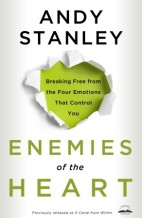
imageEnemies of the Heart by Andy Stanley

How many times have we heard,

I can’t believe I just said that or I don’t know where that came from?

Dr. Luke records the words of Jesus that put these exclamations to rest: “A good man brings good things out of the good things stored up in his heart, and an evil man brings evil things out of the evil stored up in his heart. For the mouth speaks what the heart is full of.” (Luke 6:45) As Pastor Stanley points out, regardless of our attempts to control, hide or otherwise diminish its impact, the heart is the source and control of our speech, action and thoughts. Troubles in the heart will soon become troubles in life.

Four enemies of the heart capture Stanley’s attention in this excellent book: guilt, anger, greed and jealousy. Four poisons that we allow to take root in the soul and then act surprised when their green tentacles reach out at the most inopportune time and damage the relationships that we value so much. Though Oprah would suggest a different path, Stanley correctly identifies these monsters as having spiritual components. Ever the excellent pastor, Andy devotes the largest portion of the book to armor and weaponry needed to combat them.

Pastor Stanley has penned a long string of must-have books for any Christian’s library and this volume belongs on the top shelf. Better yet, buy two copies so you can keep one and pass the other one around to everyone you know. (You should be aware that the book was previously published as It Came From Within, and you may already posses the material.) A useful discussion guide is included with the book enabling you to develop a dialog around the material, whether in a one-on-one relationship or in a group setting.

I am grateful to Multnomah who provided this copy for review.