Building on Bedrock

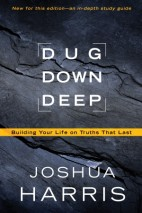
Dug Down Deep by Joshua Harris
image

Contrary to the oft-heard sentiment among Christians that they “just want to love Jesus” and dispense with the wrestling with the challenges of theology, Pastor Joshua Harris says that “we can’t know him and relate to him in the right way without doctrine.” We know the redeemer, but through the study of doctrine we come to fully understand the contours of how God is working in His world. The study of doctrine enables us to understand “what he’s done and why he’s done it”.

Dug Down Deep is an unexpected joy. Having read and studied many of the lengthy, challenging theological treatises that he references throughout the book, Harris has produced a systematic theology that doesn’t read like the typical volume of this type. Dug Down Deep approaches the key doctrines of Christianity in the pastoral voice of your friend Josh. He swaddles the theological truth with personal accounts, showing over and over how different points of doctrine have a direct application to day to day life.

While Harris has gone to great lengths to make the book approachable for Christians who locate themselves nearly anywhere along the continuum of spiritual maturity, it has a depth that will make it a useful book to return to again and again throughout life. The reader can take away as much as their maturity enables them to understand within each chapter without getting overwhelmed. Repeated reads through the chapters will give new insights and scriptures to meditate upon enough for many years of fruitful study. This book belongs an many shelves where no doctrinal guides exist now.

Pastor Harris’ conversational approach would make this book especially useful for youth and young Christian study groups. He has a pastoral heart for people to know their Lord better and each topic is designed to invite you in and to understand Him on a deeper level. More mature Christians will find the quotes by Packer, Sproul, Stott and others and will gain the confidence to approach some their more challenging theologies.

I’m grateful to Multnomah Books who provided this book for review.
P.R.O.O.F. of Life

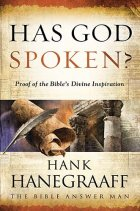
Has God Spoken by Hank Hanegraaff

imageThe Bible Answer Man brings us yet another good addition to our apologetics library to sit aside The Apocalypse Code. Battling against the torrent  of semi-gnostic “secret” exposes published by authors such as Bart Ehrman purporting to reveal the falsehoods behind the Scriptures, Hanegraaff offers a flood of his own, laying out the various proofs that undergird the truth of the Bible that we read today.

Structured to provide the reader with an easily accessible tool for developing their apologetic chops, the book is organized logically around the succession of topics that support the truth of the Bible. This is important reading for any Christian who takes Peter’s command seriously to “give an answer to everyone who asks you to give the reason for the hope that you have”. Questions about the accuracy of the texts of the Bible, the places and objects of the Bible and progressive revelation of the Bible are organized into the three initial chapters concerning the provenance of the manuscript, archeology and the linkage of prophecy.

As he does on his radio program, Hank makes these intimidating  topics understandable to Christians not steeped in biblical research. Fact after fact ( with nearly seventy pages of references and bibliography to verify ) pour forth from his pen to counter the challenges presented to factual basis for the Bible. He counters popular theories such as the error-ridden transcriptions (by verifying the numerically superior autographs against which the modern Bible is tested) and holds the archeological findings that affirm the people and places of the Bible against the non-existent findings that contradictory holy books point to.

While Hanegraaff has contributed an immediately useful volume, there are a couple of areas that might be improved. His love for his “hankronyms” went a touch overboard here, seeming to artificially organize the information in order to match the spelling. Mnemonic devices are excellent for memorization but they usually work best in limited use. Organizing the entire book around the acronyms (and sub-acronyms) gave the reading a somewhat challenging flow. Organizing the materials similar to the format that he uses on his radio program might make it easier for readers to locate the facts that they want but don’t know in which direction to turn.

Minor issues aside, I found this to be an excellent book. Hanegraaff has a unique gift set that makes his books great additions to the Christian’s library as they battle against the onslaught of anti-Christian sentiment that pervades our culture today. It is not enough to answer “in faith” when asked why you receive the Scriptures as true when the facts are so quickly accessible to you.

I’m grateful to Thomas Nelson who provided this book for review.

Grace and peace to you.

Spiritual Gifts: Cessation of the Miraculous

The wind blows wherever it pleases. You hear its sound, but you cannot tell where it comes from or where it is going. (John 3:8)

The Cessationist Position

Doctrine regarding the spiritual gifts is a generally accepted component in the life of the Church. It is recognized that the Holy Spirit empowers redeemed individuals with abilities useful to building up the Body. Individual Christians may be the recipients of one or more of these gifts, evidence of the work of the Spirit in their lives. The precise count of the gifts is variable, dependent upon the system of classification used to enumerate them (Rom 12:6-8; 1 Cor 12:4-11; Eph 4:11; 1 Pet 4:10-11). Certain gifts-often called the miraculous, prophetic or word gifts-raise a question within the Church as to their continued distribution. These include the gift of tongues, prophecy and healing.

The cessationist position argues that the distribution of the miraculous gifts has ceased in the modern era of the Church. The gifts of tongues, healing and prophecy were limited in their assignment to the first century, useful for building up the early churches in the Apostolic era prior to the completion of the canon.

The arguments for cessation are complex and require a broad understanding of eschatology and the “Church Age”. The miraculous gifts are seen to have been products of necessity for the foundation of the early Church. They functioned as a part of the “canonical” principle for the Church during the time in which it was being founded but prior to the completion of the canonical writings. When the canon was closed, the need for the miraculous gifts was over and they subsequently ceased being given by the Holy Spirit.

This idea may be further divided. The prophetic gifts were no longer needed by the Church in light of the necessary Word of God having been canonized. To have further prophetic words from God would necessitate the reopening of the Scriptures so as to include them, thus giving a “never for sure” status to the Bible. The insufficiency of the revelation of the Scriptures must then be addressed as it challenges their closed nature. In other words, if one is to consider the Bible the final word of God for our days then it is required that we not be constantly wondering if a new word is going to modify the old. The maintenance of the prophetic gifts blurs the difference between being led by the Spirit (Rom 8:14) and being carried along by the Spirit (2 Peter 1:21).

In the same way, the sign gifts (tongues, miracles) were given only during the Apostolic age as necessary support for the foundation of the Church (cf Eph 2:20). With the last of the Apostles came the last distribution of these gifts as it is not necessary to lay and re-lay the foundation of the Church throughout history.

The cessationist refers to 1 Corinthians 13:8-13 as a key text on which their position rests. As the application of the spiritual gifts is only efficacious in love, the first verse in this passage sets the bar; “Love never fails.” (vv 8a). Love, as a strengthener and edifier within the Church, will never pass away but prophecy, tongues and knowledge will (vv 8b). They pass as perfection replaces imperfection (vv 10; cf Heb 2:4).

This passage is read by the cessationist as expressing the less than eschatological significance of prophetic gifts of the Spirit. In the Church era until the moment when Jesus returns, faith, hope and love have eschatological meaning, unlike knowledge and other expressions of personal miracles. Fruits of the Spirit express the reality of the Holy Spirit today, serving the twin purposes of evangelism and edification of the Church.

Grace and peace to you.

Sauntering into the Sanctuary

image

After expressing his displeasure at improperly brought worship ( see Nadab and Abihu – Lev 10 ), God commanded that the following steps be followed in meeting Him on the Day of Atonement.

  1. Locate a young bull
  2. Locate a ram
  3. Bathe thoroughly
  4. Put on the linen tunic
  5. Put on the linen undergarments
  6. Tie the linen sash around waist
  7. Put on the linen turban
  8. Locate two goats without blemish
  9. Locate another ram
  10. Sacrifice the bull for the atonement of the priest and his household
  11. Light a censer get two handfuls of incense
  12. Take these implements behind the curtain
  13. Put the incense in the censer to create fragrant smoke, protecting the priest from direct sight of the Ark and the presence of the Lord
  14. Sprinkle the bull’s blood seven times
  15. Bring the goats to the entrance of the Tent of Meeting
  16. Cast lots to determine which goat will be the scapegoat
  17. Sacrifice the goat whose lot fell to the Lord
  18. Repeat steps 11 to 14 with the goat’s blood
  19. The priest will go to the Altar
  20. Sprinkle blood of both the bull and goat on the Horns of the altar seven times
  21. Bring the scapegoat out
  22. Lay both hands on the goat’s head, assigning all of the sin of the nation to the goat
  23. Another man will take the goat and shoo it away into the desert
  24. The priest will return to the Tent of Meeting
  25. Remove the linen garments
  26. The priest will bathe and dress in his regular clothes
  27. Sacrifice the burnt offering for himself
  28. Sacrifice the burnt offering for the people
  29. Burn the fat of the sin offering on the altar
  30. The man who released the goat will bathe and wash his close before returning to camp
  31. The remains of the bull and goat must be taken outside of the camp and burned
  32. The man who burns the remains must bathe and wash his clothes before returning to camp

The meticulous and precise nature of these worship instructions should cause us to pause and consider the way in which we will enter God’s presence this Sunday. Do we toddle in with no more thought than if we were buying a gallon of milk?

There is great privilege in being the children of God, but also great responsibility.

Grace and peace to you.

image jacsonquerubin

Psalm 108 ~ Awaken the Dawn

imageMy heart, O God, is steadfast; I will sing and make music with all my soul.

Awake, harp and lyre! I will awaken the dawn. I will praise you, Lord, among the nations; I will sing of you among the peoples.

For great is your love, higher than the heavens; your faithfulness reaches to the skies. (Psalm 108:1-4)

In a short cry for physical aid, the psalmist calls us centuries later to consider the urgency of our spiritual motivation. Are we driven to rise in the darkness, to awaken the dawn in fervent worship? Do we linger in the comfort of our bed, seeking additional moments of slumber, delaying our appointment with God until a more convenient moment? Many are the nights in which the Lord beckons us awake, seeking our company and wanting to share a moment of communion with us. How will we respond?

Grace and peace in the Spirit of the Lord to you.

image kotcha

Church is Not a Spectator Sport

Why Church Matters by Joshua Harris

image“…When your heart begins to beat for God’s glory and God’s people and you begin to glimpse His longing to visit you, Sunday changes. Actually, it becomes something extraordinary. Something sacred. Something essential.”

Let’s get this out of the way right up front; this is a delightful gem of a book that belongs in the hands of every person sitting in the pews on Sunday. Distracted by something that happened at home. Bored by the preacher. Perturbed at the fact that the praise team went astray from the hymnal again. All of these feelings and more are brought into the church for the most important hours of the week, and we wonder why our body doesn’t seem to be more dynamic, activist or interesting.

Could it be us?

It is far too easy for modern Christians to view church from the perspective of a shopper or spectator says Joshua Harris. Our attitude is what can the church do for me or does this church serve my needs. With a little review of the Bible and our hearts, he says, we can ask different questions: what can I contribute to this church or for what purpose did God place me and my family in this church? In seven brief chapters, Harris provokes Christians to view the bride of Christ in a different light, understanding how important the privilege of worshipping and serving together is.

There are a number of volumes that delve into this same topic in much greater depth but that is not the purpose of this volume. Harris has written a conversational book, quick to read and digest that will get the reader thinking. If you don’t see yourself on one page, read a few more paragraphs and you will see something that reminds you of an attitude that may have flirted with. Pastor Harris is looking you in the eye and asking you to think differently. Think about what it means to be a part of a family where you are important, missed when you are absent and cared for when infirm.

I am grateful to Waterbrook Multnomah who provided this book for review.